Shneider I / II

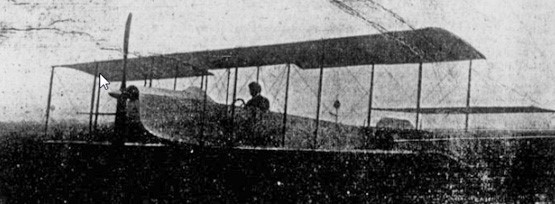
The 1909 Shneider I and II were direct copies of Wright A for exhibition work. The were two-place, open biplanes powered by a 30hp 3-cyl Eldbridge with two chain-driven pusher propellers.

The Model I was destroyed in a crash on 12 July 1909. Following the subsequent crash of Model II, Shneider concentrated on building Curtiss pushers.

Shirlen Big Cootie

The Big Cootie is a modernized version of the Powell PH Racer biplane for homebuilt construction. The aircraft is a single seat biplane with conventional landing gear, designed for mild aerobatics. The fuselage is welded steel tube construction with aircraft fabric covering. The cowling is fiberglass. The ailerons are controlled with push-pull tubes. The wings use wooden spars with plywood leading edges.

The prototype, N84Z, survived an in-flight impact with powerlines during its initial testing. It was rebuilt at the Piedmont Aerospace Institute at Smith Reynolds Airport in Winston-Salem, North Carolina. A Continental A-80 80 hp (60 kW) engine replaced the Lycoming O-145 65 hp (48 kW) engine installed in the prototype.

The kits included all premolded composite parts. All metal parts and fuselage are welded. The wings and tail are attached like a glider and a removed in 5 minutes.

Shirlen Big Cootie
Engine: 1 × Lycoming O-145, 65 hp (48 kW)
Propeller: 2-bladed
Length: 15 ft 9 in (4.80 m)
Wingspan: 15 ft (4.6 m)
Airfoil: RAF 15
Empty weight: 467 lb (212 kg)
Gross weight: 750 lb (340 kg)
Fuel capacity: 12 U.S. gallons (45 L; 10.0 imp gal)
Maximum speed: 122 kn; 225 km/h (140 mph)
Cruise speed: 104 kn; 193 km/h (120 mph)
Stall speed: 55 kn; 101 km/h (63 mph)
G limits: -4g
Crew: 1

Gross Wt. 750 lb
Empty Wt. 467 lb
Fuel capacity 12 USG
Wingspan 18’9”
Length 14’
Top speed 140 mph
Cruise 120 mph
Stall 63 mph
Takeoff run 500 ft
Landing roll 500 ft
Range 300 sm

Engine: Rotax 912, 80 hp
HP range: 80-120
Height: 6.4 ft
Length: 20.4 ft
Wing span: 29.4 ft
Wing area: 113.8 sq.ft
Empty weight: 550 lb
Gross weight: 1200 lb
Fuel capacity: 18 USG
Top speed: 190 mph
Cruise: 160 mph
Stall: 40 mph
Range: 690 sm
Rate of climb: 1600 fpm
Takeoff dist: 230 ft
Landing dist: 230 ft
Seats: 2
Landing gear: nose or tailwheel

Shirl Dickey Enterprises E-Racer / King Racer

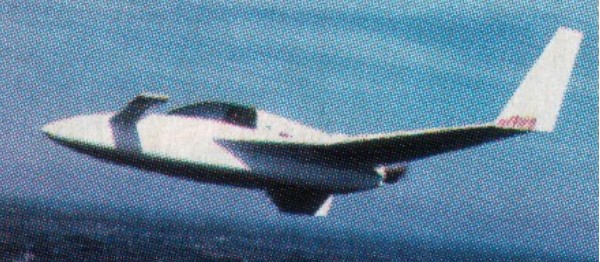
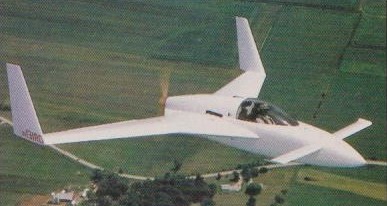
A derivative of the Rutan Long EZ, the E-Racer has retractable undercarriage. There were various options including the Mk.1 (auto engine), Mk.2 (aero engine), and the King Racer (enlarged cockpit).

Five were flying by 1998.

Mk.1
Engine: Buick V8, 240 hp
HP range: 160-250
Height: 7.8 ft
Length: 17 ft
Wing span: 26.2 ft
Wing area: 94 sq.ft
Weight empty: 1000 lb
Gross: 1800 lb
Fuel cap: 46 USG
Speed max: 240 mph
Cruise: 220 mph
Range: 1000 sm
ROC: 2500 fpm
Take-off dist: 1200 ft
Landing dist: 1500 ft
Service ceiling: 25,000 ft
Seats: 2
Landing gear: retractable nose wheel

Engine: Lycoming/Buick, 240 hp
Wing span: 7.99 m
Wing area: 8.65 sq.m
MAUW: 816 kg
Empty weight: 454 kg
Fuel capacity: 174 lt
Max speed: 386 kph
Cruise speed: 354 kph
Climb rate: 12.5 m/s
Seats: 2
Plan price (1998): $250

Shinn Meiwa PS-1 / US-1

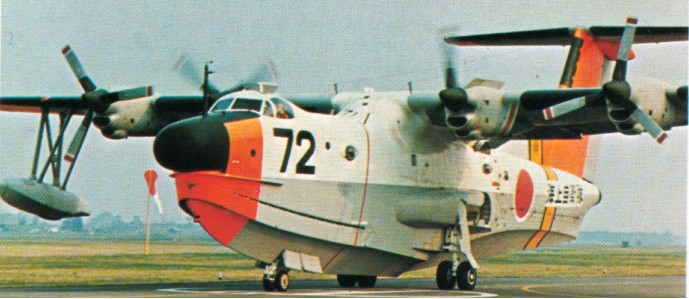
After January 1966, directed attention was put into a new marine aircraft. A Grumman Albatross was rebuilt as a dynamically similar flying model for a projected very large STOL ASW flying-boat for the Japanese Maritime Self Defense Force. The type was developed as the four-turboprop PS-1, but later as the US-1 amphibious search-and-rescue aircraft.

The Shinn Meiwa PS 1, a four turboprop STOL amphibian with an auxiliary engine driving a boundary -layer control pump, has a speed range from 295 knots maximum to a 40 knot stall. PS 1s carry search radar, sonobuoys, MAD and ECM equipment to aid in the search for submarines, and against which they can deploy anti submarine bombs, homing torpedoes, and rockets for surface attack.

Shinn Meiwa PS-1 / US-1 Article

Designed for long-range ASW, the four-turboprop PS-1 flying boat first flew in October 1967, entered service in 1973, and was followed by the US-1 amphibious variant in October 1974.

The first prototype PS-1 was converted later as waterbombing test vehicle.

Production of the PS-¬1 was completed with the 23rd aircraft in 1979. The seventh and subsequent US-1s are fitted with uprated T-64 IHI-10J turboprops and are designated US-lAs. Earlier aircraft are being progressively retrofitted with these engines.

The JMSDF intended to purchase one US-1A SAR amphibian every two years, the next funding was being sought in FY1988.

PS-1
Engines: 4 x T64-IHI-10 turboprop, 3060 shp
Wing span: 108 ft 8.75 in (33.14 m)
Max speed 340 mph (547 km/h)
Crew: 10