Siebel Si 202 Hummel

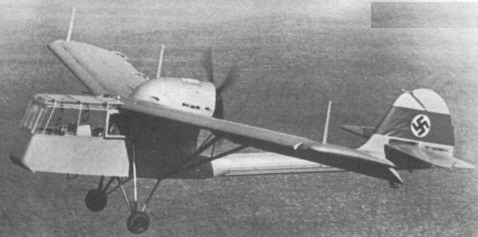
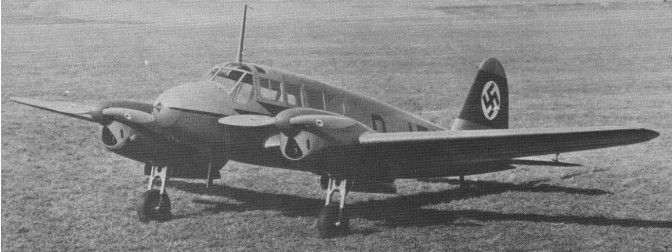
The Si 202 Hummel of 1938 was a side by side 2-seater of simple all-wooden construction.

The Fh 104 and a liaison machine, the Si 202 Hummel (which had lost out to Fiesler’s Fi 156 STORCH) shared production line space with license built Do 17s, all examples of the Siebels going to the Luftwaffe.

Siebel Si 202 P 4 Hummel
Engine: Zündapp 29-92, 49 hp
Length: 20.997 ft / 6.4 m
Height: 6.234 ft / 1.9 m
Wing span: 34.449 ft / 10.5 m
Max take off weight: 1212.8 lb / 550.0 kg
Max. speed: 86 kts / 160 kph
Service ceiling: 14108 ft / 4300 m
Range: 270 nm / 500 km
Crew: 1+1

Siebel Si 201

The Siebel Si-201 was designed and built by Siebel in response to the German Air Ministry specification issued in February 1937 for an air observation / army co-op aircraft that had superlative Short Take-off/Landing (STOL) capabilities, excellent slow-flight performance and all-round visibility. Three aircraft were designed and built to meet this particular specification – the Fiesler Fi-156 (already being tested before the specifications were released), the Bayerische Flugzeugwerke designed and built Bf-163 and the Siebel Si-201, these latter two flying in 1938.

The Si-201 was an unorthodox design with its Argus As10 V-8 air-cooled engine mounted above the wing as a pusher, driving a four-bladed fixed-pitch airscrew which rotated above a slim, circular-section tailboom. It had a boxy, fully glazed forward fuselage with room for a pilot and observer in tandem and was a high-wing braced monoplane with a tail-wheel landing gear.

This design allowed superlative vision from the forward cockpit and so the pilot was seated towards the rear of the cockpit. The aircraft had high lift devices such as full span automatic leading edge slots and four section Fowler-type flaps with the outermost flaps also acting as ailerons and which occupied almost the entire trailing edges, the outboard sections serving as ailerons. The fuselage was of welded steel-tube construction with metal skinning and the plywood-covered wing was of wood. The pilot and observer were seated in tandem in the extensively-glazed forward fuselage, the observer being positioned ahead of the pilot with his seat offset to starboard.

The first of two prototypes of the Si-201 flew during the early summer of 1938, revealed excellent short take-off and landing characteristics, and was found to possess acceptable slow-flying characteristics closely comparable with those of the Storch, but at the upper end of the speed scale tail flutter proved troublesome. Considerable effort was expended in damping out oscillation in the tailboom which developed under certain flight conditions, and the second prototype, which featured some simplification of the high-lift devices, was flown with a somewhat sturdier tailboom. The most serious shortcoming of the Si-201 proved to be the extremely limited cg travel permitted by its configuration, and when Siebel was ordered to abandon further development of the aircraft the problem of tail flutter remained largely unsolved.

The Si-201 was evaluated against the Fieseler Fi 156 and Messerschmitt Bf 163 but did not compare well to these aircraft. The Si-201 was also flown by General Ernst Udet, then head of the Reich Air Ministry’s technical department. He was unimpressed with its ground handling and landing characteristics, essential elements in the success of the Storch. The Si 201 would also have been more costly to construct than the Fi 156 Storch. The Si-201 had a higher top speed than the Storch, but speed wasn’t an important consideration for its expected roles, and work on the Si 201 stopped after two prototypes had been built.

The Ilmavoimat evaluation team test-flew the aircraft and experienced the same issues at the upper end of the speed scale with tail flutter. While this was a concern, the aircraft remained under consideration until the decision by the Reich’s Air Ministry not to order the aircraft into production put a halt to further consideration.

Siebel Si 201
Crew: two (Pilot and Observer)
Engine: 1 x Argus As 10C, 179 kW (240 hp)
Maximum speed: 115mph
Range: 280 miles
Service ceiling: 18,000 ft
Siebel / Flugzeugwerke Halle GmbH

Siebelwerke-ATG GmbH

Siebelwerke-ATG GmbH name was that of F. W. Siebel (1891-1954), associated with early sport-flying in Germany and who helped form the Klemm company, for which he took charge of new works at Halle (Saale). In 1937 Siebel established own company as Flugzeugwerke Halle GmbH, later renamed Siebelwerke-ATG GmbH. First aircraft was Fh 104 5-passenger monoplane of 1937. Si 201 was experimental military reconnaissance aircraft; Si 202 Hummel of 1938 a sideby- side 2-seater. In Second World War Siebel contributed to production of standard German military types; also built own Si 204 communications aircraft, though this was mainly built by SNCAC in France.

Klemm joined Siebel in 1940.

ATG joined Siebel in 1945 to become Siebel ATG (SIAT).

After war produced Si 222 Super-Hummel and 3-seat Si 308. As member of Nordflug group helped with Noratlas.

Siebel ATG (SIAT) joined MBB in 1973.

Sidou Joao Grande

Designed by Eng Antonio Menezes Sidou of Porto Alegre in the state of Rio Grande do Sul, this Brazilian tandem two-seater is intended for primary and advanced training and Open Class contest flying, and Eng Sidou hoped to begin construction of the Joao Grande (or Stork) at Paso Funde in Rio Grande do Sul early in 1978. It is a cantilever midwing monoplane similar to the IPD Urupema in appearance but with a T-tail and cambered wing tips, of all-wooden construction with plywood covering and abrasion-resistant plastics finish; it is designed for aerobatics and cloud flying. There are Schempp-Hirth air brakes on the upper and lower surfaces of the wing, which has long span ailerons and a dihedral of 3° 36′. The ailerons, elevators and rudder are both statically and dynamically balanced, a narrow-chord tailptene being mounted on top of the swept back fin. There is a retractable rubber-sprung monowheel with rubber shock absorbers and a brake, and a tail bumper. The two pilots sit in tandem under a long flush-fitting one-piece jettisonable Plexiglas cockpit canopy.

Span: 59 ft 0.75 in
Length: 29 ft 6.25 in
Height: 8 ft 3.25 in
Wing area: 139.5 sqft
Aspect ratio: 25.0
Empty weight: 595 lb
Max weight: 992 lb
Max speed: 112 mph (in rough air)
Min sinking speed: 1.87 ft/sec at 50.5 mph
Best glide ratio: 43.9:1 at 59 mph

Siddeley Tiger

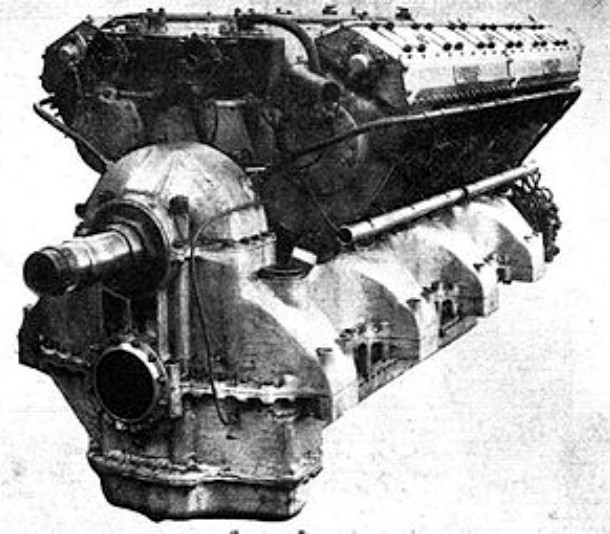
The Siddeley Tiger was an unsuccessful British aero engine developed shortly after the end of World War I by. Problems encountered during flight testing caused the project to be cancelled.

Developed using two modified cylinder banks from the Siddeley Puma, the Tiger was a liquid-cooled 60 degree V12 engine with the advanced feature of an electric starter motor protected by a friction clutch. A reduction gear arrangement was provided for the propeller drive with a ratio of 0.559:1. The company claimed a power output of 600 hp (447 kW) but this was regarded as optimistic. First run in 1920, flight testing by a Royal Aircraft Establishment test pilot, Frank Courtenay, revealed problems and his opinion of the engine was low as the following quote shows:
‘The engines could never be persuaded to run simultaneously for any length of time’
—Frank T.Courtenay, Lumsden – British Aero-Engines and Their Aircraft

The Tarrant Tabor, a giant triplane bomber was designed to use the Tiger but redesigned to use other engines when it became clear the Tiger would not be available soon enough. The only aircraft in which the Siddeley Tiger flew was the ill-fated prototype of the twin-engined Siddeley-Deasy Siniai of which three were planned to be produced. Major problems with both the engines and this experimental bomber aircraft led to cancellation of the projects.

The Siddeley Tiger marked the end of the aero engine line started by Beardmore and Siddeley-Deasy. The name was later re-used for an Armstrong Siddeley radial engine.

Specifications: Tiger
Type: 12-cylinder liquid-cooled inline piston engine
Bore: 6.3 in (160 mm)
Stroke: 7.1 in (180 mm)
Displacement: 2,657 in³ (43.5 L)
Length: 81.34 in (2,066 mm)
Width: 33.46 in (850 mm)
Height: 39.57 in (1,005 mm)
Dry weight: 1,400 lb (635 kg)
Valvetrain: Overhead camshaft, 4 valves per cylinder
Fuel system: Twin carburettors
Fuel type: Petrol
Cooling system: Liquid-cooled
Power output: 600 hp (447 kW)
Power-to-weight ratio: 0.42 hp/lb (0.7 kW/kg)

Armstrong Siddeley Puma

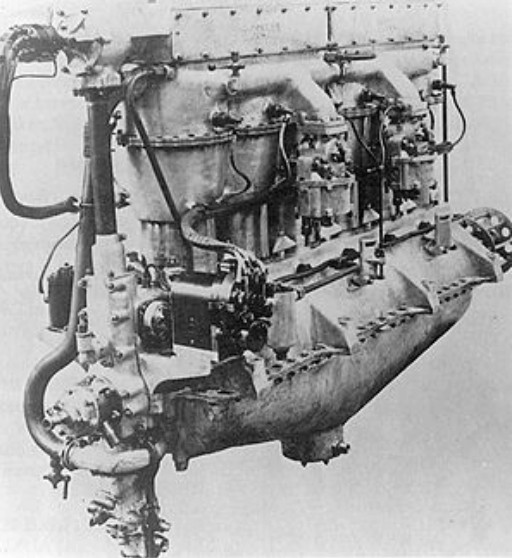
The Siddeley Puma was a British aero engine developed towards the end of World War I and produced by Siddeley-Deasy. The first engines left the production lines of Siddeley-Deasy in Coventry in August 1917, production continued until December 1918. At least 4,288 of the 11,500 ordered engines were delivered, orders were cancelled following the Armistice. Production was continued under the name Armstrong Siddeley Puma when the manufacturer was bought by Armstrong Whitworth and became Armstrong Siddeley.

The engine was based on a previous B.H.P engine.

Applications:
The Puma engine was used in the British World War I bomber aircraft, the Airco D.H.9. In use it proved to be highly troublesome, making the aircraft significantly inferior to the type it replaced. The engine was also installed untidily, with the cylinder heads protruding. The D.H.9, as a type, was improved by replacing the Puma engine with the Liberty 12 to make the D.H.9A.

The unit was used in the first prototype of the Airco DH.10 in a twin-engined pusher configuration but as performance was unsatisfactory, alternative engines were used in a subsequent prototype of the type and production models.

Short Silver Streak (1920)

Puma
Type: 6-cylinder water-cooled inline aircraft piston engine
Bore: 5.71 in (145 mm)
Stroke: 7.48 in (190 mm)
Displacement: 1,149 in³ (18.832 L)
Length: 69.9 in (1,175 mm)
Width: 24 in (610 mm)
Height: 43.6 in (1,107 mm)
Dry weight: 645 lb (293 kg)
Fuel system: Carburettor
Cooling system: Water-cooled
Power output:
250 hp (186 kW) at 1,400 rpm for takeoff
265 hp (198 kW) at 1,500 rpm for short-term maximum power
Specific power: 0.23 hp/in³ (10.5 kW/L)
Fuel consumption:
14 US gal/h (54 L/h) at cruise
67 US gal/h (258 L/h) at short-term maximum power
Power-to-weight ratio: 0.41 hp/lb (0.67 kW/kg)

Siddeley S.R.2 Siskin

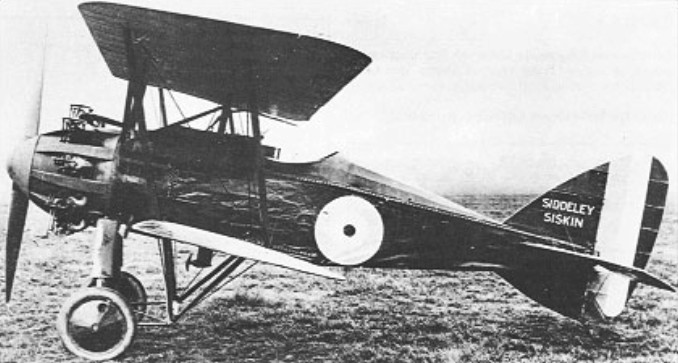
When, in January 1917, Capt F M Green became chief aeronautical engineer of the Siddeley-Deasy Motor Car Company, he began the design of a single-seat fighter, the S.R.2. A compact single-bay sesquiplane predominantly of wooden construction with fabric skinning, the S.R.2 was powered by a 320hp A.B.C. Dragonfly nine-cylinder radial engine. Armament comprised two synchronised 7.7mm machine guns.

A contract for six prototypes was reduced to three in mid 1918, the first of these flying in April 1919, by which time the fighter had been officially named Siskin. The first prototype Siskin was subsequently re-engined with an Armstrong Siddeley Jaguar, development in this form continuing after Siddeley Deasy acquired in 1921 the name and goodwill of Sir W G Armstrong Whitworth & Co Ltd, and the Armstrong Whitworth Siskin II emerging in 1922.

Max take-off weight: 989 kg / 2180 lb
Empty weight: 664 kg / 1464 lb
Wingspan: 8.38 m / 27 ft 6 in
Length: 6.48 m / 21 ft 3 in
Height: 2.97 m / 9 ft 9 in
Wing area: 22.95 sq.m / 247.03 sq ft
Max. speed: 233 km/h / 145 mph
Ceiling: 7255 m / 23800 ft

Siddeley Deasy Motor Car Co. Ltd

In 1909, J. D. Siddeley resigned from Wolseley and took over the Deasy Motor Co and the company became known as Siddeley-Deasy. During World War I the company produced trucks, ambulances, and staff cars. In 1915 airframes and aero-engines started to be produced as well.

Major F.M. Green served as chief engineer at the Royal Aircraft Factory and then become a part of the Siddeley-Deasy Motor Car Company. Not limited to the production of motor vehicles, the Siddeley-Deasy brand also delved into manufacture of engines and aircraft. The company was based out of Coventry and was founded by Henry Hugh Peter Deasy. While Deasy left in 1908, J D Siddeley came aboard and changed the company name to Siddeley-Deasy. From there, the company would gradually morph into the Armstrong Whitworth Aircraft firm (known formally as the Sir W.G. Armstrong Whitworth Aircraft Co. Ltd after their 1920 merger with Armstrong Whitworth) and became responsible for a large portion of Siskin production thereafter.

In April 1919 Siddeley-Deasy was bought out by Armstrong Whitworth Development Company of Newcastle upon Tyne and in May 1919 became Armstrong Siddeley Motors Ltd a subsidiary with J. D. Siddeley as Managing Director.

Based at Coventry, Warwickshire; was concerned in production of RAF R.E.7 and R.E.8 and Airco D.H.10 during First World War. Own experimental types included R.T.1 of 1917-1918, a redesigned R.E.8; S.R.2 Siskin, developed from ideas of Major F. M. Green and precursor of famous Armstrong Whitworth line of fighters; and Sinaia twin-engined bomber, completed 1921, also associated with Armstrong Whitworth. In 1919 Armstrong Whitworth and Siddeley-Deasy combined to form in 1920 Sir W. G. Armstrong Whitworth Aircraft Ltd.