The Siemens-Halske Sh 11 was a seven-cylinder, air-cooled, radial engine for aircraft built in Germany in the 1920s. First run in 1925, it was rated at 75 kW (100 hp).
Applications:
Albatros L 68
BFW M.26
Messerschmitt M 21
LFG V 40
Udet U 12
The Siemens-Halske Sh 11 was a seven-cylinder, air-cooled, radial engine for aircraft built in Germany in the 1920s. First run in 1925, it was rated at 75 kW (100 hp).
Applications:
Albatros L 68
BFW M.26
Messerschmitt M 21
LFG V 40
Udet U 12
The 1971 Siegrist RS1 Ilse was a four-place cabin high-wing monoplane, built by Rudolf Siegrist. Registered N3087, it first flew in June 1971.
Engine: 180hp Lycoming O-360
Wingspan: 28’0″
Length: 21’6″
Useful load: 907 lb
Max speed: 170 mph
Cruise: 150 mph
Stall: 73 mp h
Seats: 4
Parma OH.
USA
Built the Siegrist RS1 Ilse in 1971.

Mieczysław Siegel, a village schoolteacher from Skrzynice near Lublin, had already some experience with designing and building fairly amateur gliders when he decided to turn to somewhat more ambitious endeavour of building an aircraft. In 1927 he built a small MS-5 plane with parasol configuration, which was then deliberately destroyed during static tests. A year later Siegel built an improved MS-6 airplane but failed to acquire an engine, which made the designer decide to stick to gliders.
Mieczysław Siegel, a village schoolteacher from Skrzynice near Lublin, had some experience with designing and building fairly amateur gliders when he decided to build an aircraft and in 1927 he built a small MS-5. A year later Siegel built an improved MS-6 airplane but failed to acquire an engine, which made the designer decide to stick to gliders.

The Siedek KS 3 was built by Diplom-Ingenieur Richard Siedek in Vienna, Austria. The powerplant was an 80 hp two-stroke aircraft engine, developed by Ingenieur Kraus and Siedek.”
Span: 22 ft 11.6 in (7.00 m)
Length: 16 ft 8.8 in (5.10 m)
Height: 6 ft 6.7 in (2.00 m)
Wing area: 172 sq.ft (16.00 sq.m)
Takeoff weight: 882 lb (400 kg)
Cruise speed: 75 mph (120 kmh)
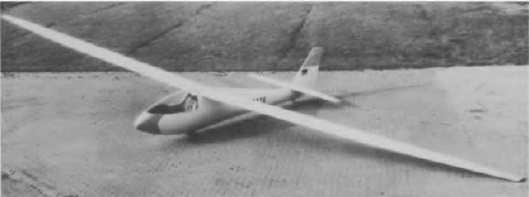
This wooden Standard Class single-seater was designed by Paul Siebert and first flew in prototype form in 1971; by January 1975 a total of 27 had been built by the Paul Siebert Sportund Segelflugzeugbau and sold to Belgium, Holland, Denmark and Portugal as well as to customers in Germany. Permission was being sought from the Luftfahrtbundesamt, the Federal German civil aviation authority, to offer the Sie 3 in a form suitable for amateur construction. Of conventional wooden construction, the Sie 3 is a cantilever high wing monoplane with a constant chord centre section and tapered outer panels; Schempp-Hirth aluminium air brakes are featured. The fin and rudder are swept back and the low-set tailplane is an all-moving surface. Landing gear consists of a monowheel with brake and a tailskid, and the pilot sits under a one-piece flush-fitting cockpit canopy.
Span: 49 ft 2.5 in
Length: 22 ft 0 in
Height: 3 ft 11 in
Wing area: 127.44 sqft
Empty weight: 467 lb
Max weight: 750 lb
Max speed: 124 mph (in smooth air)
Min sinking speed: 2.23 ft/sec at 48.5 mph
Best glide ratio: 34.3:1 at 56 mph
After war Siebel produced the Si 222 Super-Hummel and 3-seat Si 308.
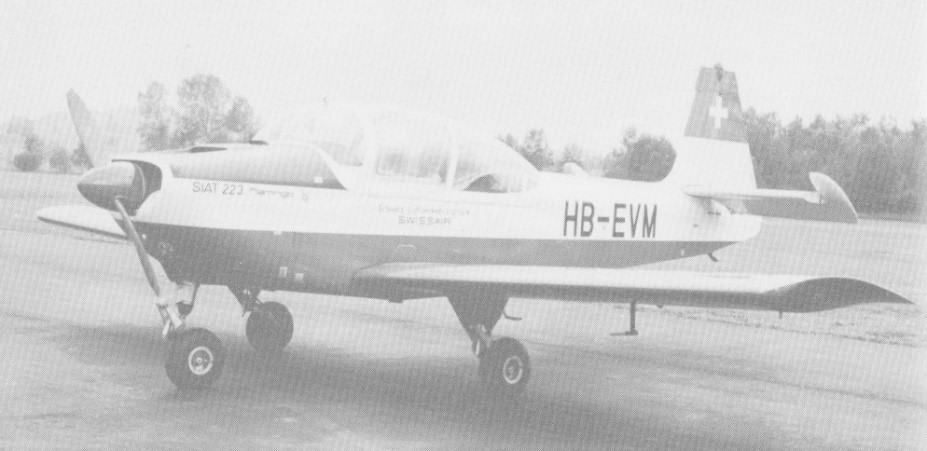
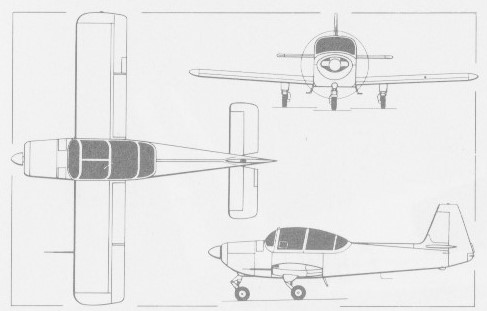
Designed by the Siebelwerke and first flying in 1967 the Flamingo was turned into an aerobatics trainer.
There are two seats side-by-side at the front of the cabin with provision for fitting a folding seat for one adult or two children in the baggage area. Removable dual controls are fitted.
Originally produced in Germany by SIAT, CASA produced the 223A1 basic version in the Normal Category as a there/four-seater or agricultural aircraft, or in Utility Category as a two-seater intended primarily for training airline pilots.
The 223K1 single-seat fully-aerobatic version with a specially modified IO-360-C1B engine and stressed to +6 / -4g was also originally produced in Germany by SIAT, then CASA in Spain.
Later, in 1986 the Flamingo was used as a testbed for the new developed Porsche aviation engine.
CASA 223A1
Engine: Lycoming IO-360-C1B, 200 hp
Wingspan: 27 ft 2 in / 8.28 m
Length: 24 ft 4.5 in / 7.43 m
Empty weight equipped: 1610 lb / 685 kg
MTOW Norm: 2315 lb / 1050 kg
Max cruise 76%: 116 kt / 134 mph / 216 kph
ROC SL: 846 fpm / 258 m/min
Service ceiling: 12,300 ft / 3750 m
Range 30min res: 620 nm / 715 mi / 1150 km
Seats: 3-4
Baggage capacity: 200 lb / 90 kg
Cabin length: 7 ft 2.5 in / 2.20 m
Cabin width: 3 ft 8 in / 1.12 m
Cabin height: 3 ft 11 in / 1.20 m
MBB 223 PFM Flamingo
Engine: Porsche PFM 3200, 207 hp
Wingspan: 27.231 ft / 8.3 m
Max take off weight: 2425.5 lb / 1100.0 kg
Max. speed: 124 kts / 230 km/h
Range: 756 nm / 1400 km
Crew: 3
After war Siebel produced the Si 222 Super-Hummel and 3-seat Si 308.

