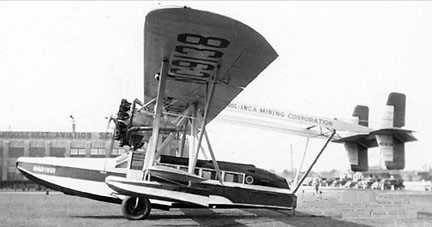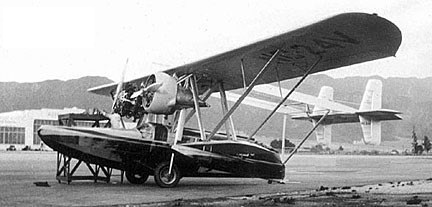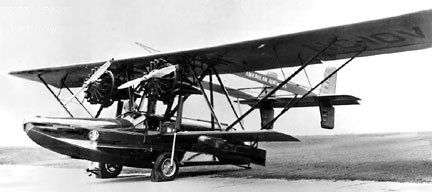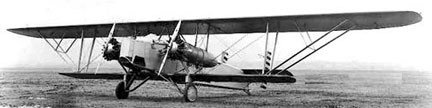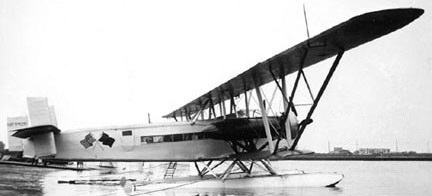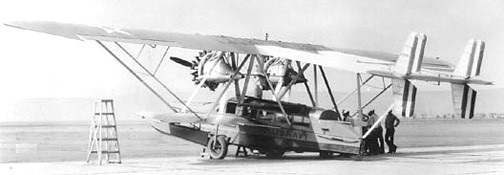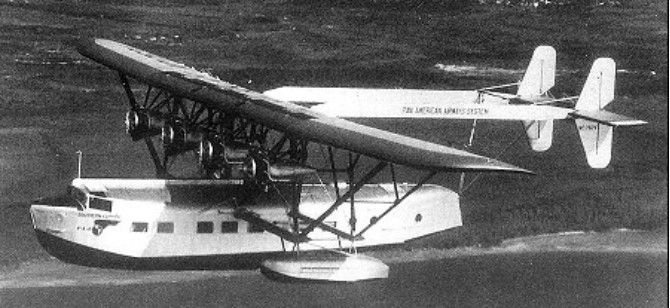
Sikorsky S-40

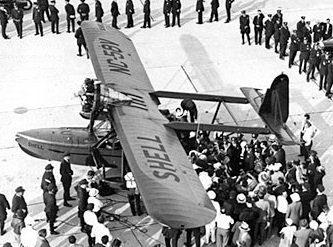
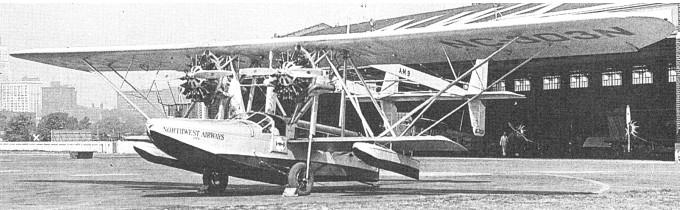
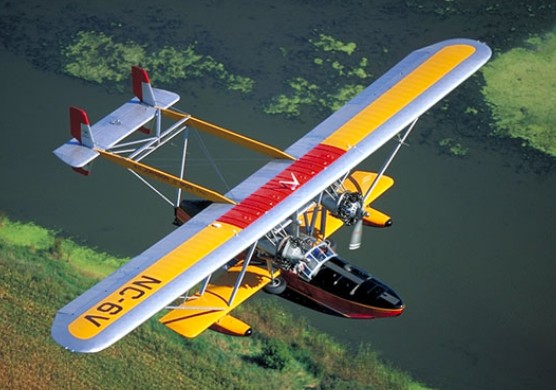
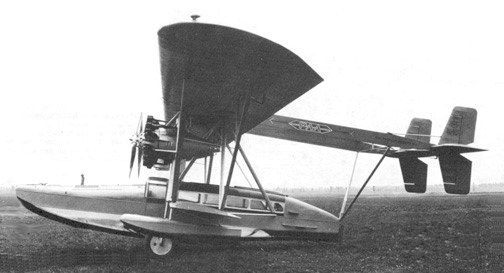
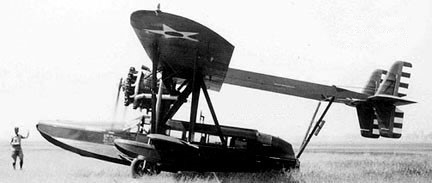
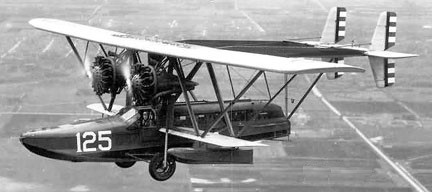
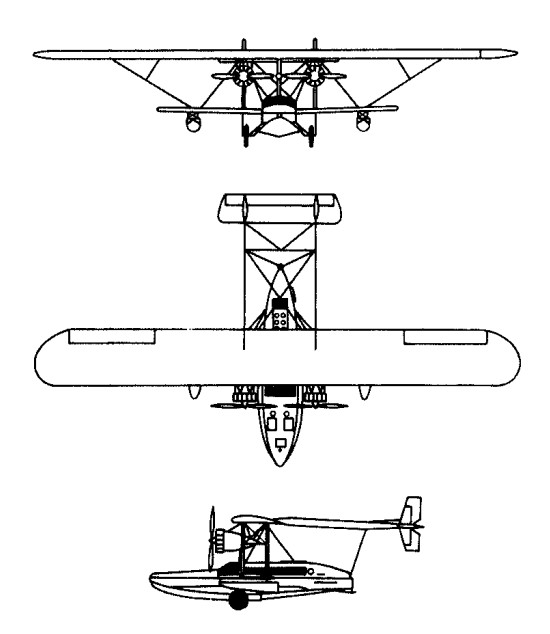
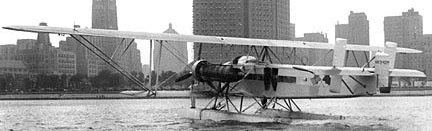
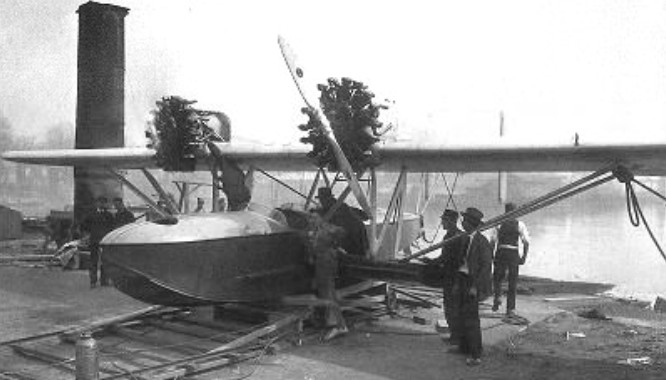
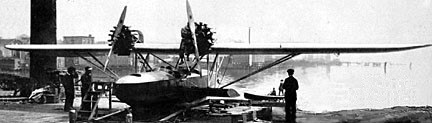
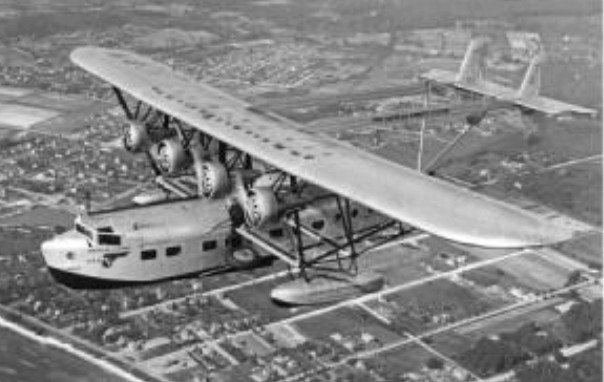
On December 20, 1929, Pan American awarded a contract to build three aircraft as the S-40, with deliveries starting mid-1931. The S-40 featured four engines and a two-step all metal hull, divided into seven watertight compartments, twin-boom, twin-tail and parasol wing. Almost sixty feet in length, accommodation was provided for up to thirty-two passengers and the added luxury of a smoking room with three chairs. Sikorsky selected a monoplane wing with stabalising floats mounted on outrigger booms. When built the Sikorsky S-40 was the largest amphibian in the world.

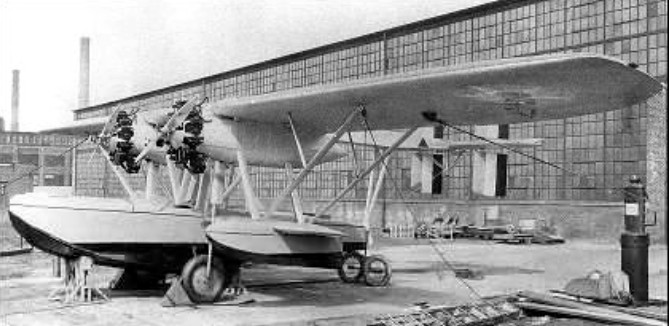
Sikorsky S-40 under construction

First flying on 31 August 1931, piloted by Boris Sergievsky and S Gluhareff, flight testing of the S-40 began in early 1931, and it was delivered to Pan American the following October, as soon as the ATC certificate was granted (ATC 454).

The seaplane version had an 11,000 lb load and slightly higher speed.

Selling for $139,000, named “American Clipper” and piloted by Charles A. Lindbergh, the first S-40 inaugurated the Miami-Canal Zone route on 19 November 1931. “American Clipper” pioneered Pan American World Airways mail and passenger routes around the Caribbean and to South America. It was joined by the second, ‘Caribbean Clipper’, later the same year, then by the the third, ‘Southern Clipper’, in early 1932.
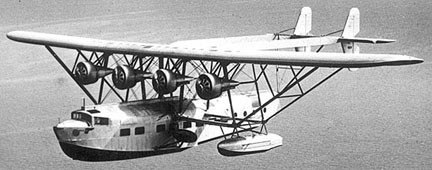
The three S-40s (NC80V, NC81V, and NC752V c/ns 2000 to 2002) established regular airline service between the US east coast and South American destinations such as Rio de Janerio and Buenos Aires, operated without their amphibious gear to improve range as needed. The S-40 carried 40 passengers over distances of 500 mi. at speeds up to 115 mph.
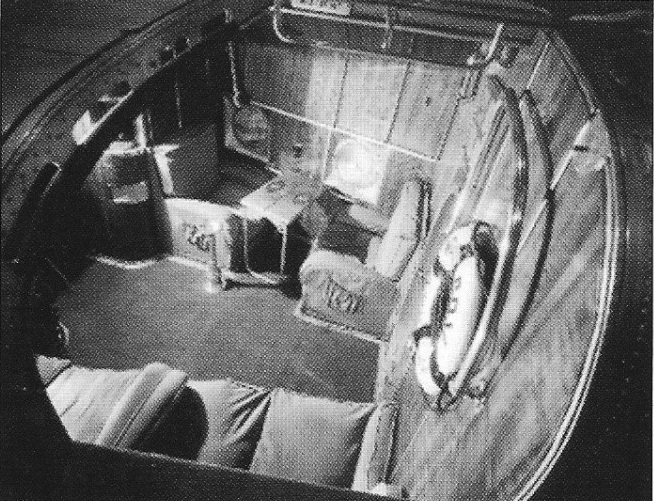
PAA S-40 lounge cabin

During 1935, after all three had their engines upgraded to super-charged 660hp P&W Hornets, their designation was changed to S-40-A (ATC 562). By the end of 1939 the S-40As had been withdrawn from Pan American service. Caribbean Clipper later served with the Navy as a navigational trainer and is said to have amassed a total of 13,000 flying hours before being scrapped in 1944.

S-40
Engines: 4 x Pratt & Whitney R-1690 Hornet B, 575hp / 425kW
Wingspan: 34.8 m / 114 ft 2 in
Wing area: 174.0 sq.m / 1872.92 sq ft
Length: 23.4 m / 77 ft 9 in
Height: 7.3 m / 24 ft 11 in
Hull length: 48’0″
Max take-off weight: 15400 kg / 33951 lb
Useful load: 9252 lb
Max. speed: 210 km/h / 130 mph
Cruise speed: 185 km/h / 115 mph
Stall: 65 mph
Ceiling: 5550 m / 18200 ft
Range w/max.fuel: 925 km / 575 miles
Crew: 4
Passengers: 40

S-40-A
Engines: 4 x Pratt & Whitney R-1690-44 Hornet, 600 hp
Prop: 2 blade, ground adjustable, metal
Wingspan: 154 ft 0 in
Wing area: 1740 sq.ft
Length: 76 ft 8 in
Max speed: 140 mph
Cruise: 120 mph
Stall: 65 mph
Ceiling: 13,000 ft
Range: 900 miles
Empty weight: 21,000 lb
MTOW: 34,000 lb
Useful load: 10,813 lb

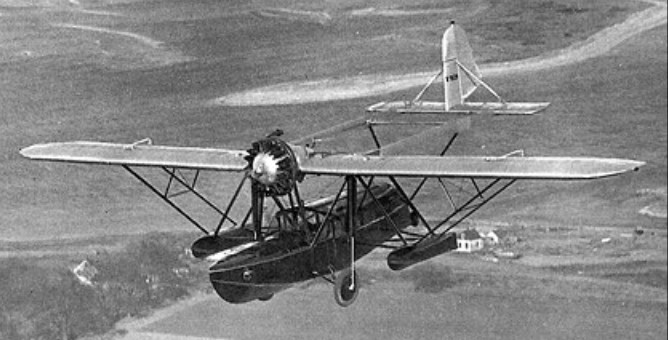
Sikorsky S-40

Sikorsky S-39

Sikorsky downsized the basic S-38 design to create the S-39. The original prototype, NX813M / NX963M, was experimentally converted to two tractor-mounted 115hp Cirrus Hermes Mk I engines, was test flown in mid-1929 but crashed later that year after an engine failure.

Sikorsky followed with the S-39-A, flown in early 1930, with a single R-985 Wasp Junior engine mounted directly to the wing. The S-39-A was the first US aircraft to be certified with the R-985.

Sikorsky S-39-A NC804W

Twelve S-39-As (NC42V, NC802Y, NC803W/809W, NC887W), marketed at an average price of US$17,500 with ATC 340, were sold to civil owners by the end of 1930.

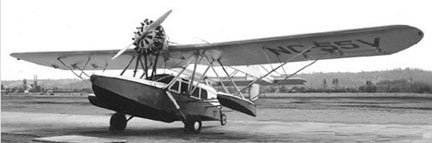
The S-39-B (ATC 375), introduced in 1931 with a larger fin and rudder, sold eight examples (NC50V and 51V, NC53V to 55V, NC58V, NC888W, and NC896W) to private owners at $20,000, plus one to the US Army Air Corps as the YIC-28 32-411, plus 9 conversions from S-39-A.

Sikorsky S-39-B NC55V
Sikorsky S-39-B NC58V

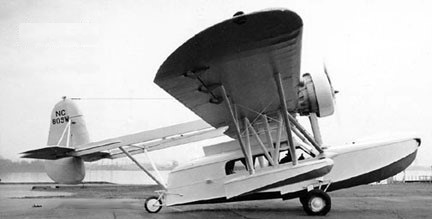
Two S-39-B, refitted with 400 hp R-1340 Wasp engines, were re-certified as S-39-C.

Sikorsky S-39-C NC809W

The final example, an S-39-CS Special named “Spirit of Africa”, was built in 1932 to an order from explorers and photographers Martin and Osa Johnson. In a giraffe paint scheme, the Spirit of Africa covered more than 60,000 miles across Africa and East Indies.

Several civilian S-39s were operated by the Civil Air Patrol during World War II on search and rescue missions.

A total of 21 were built.

S-39-A

S-39 / S-39-A
Engine: Pratt & Whitney R-985 Wasp Junior, 300 hp
Prop: 2 blade, ground adjustable, metal
Wingspan: 52 ft 0 in
Length: 38 ft 11 in
Wing area: 320 sq.ft
Empty weight: 2678 lb
MTOW: 4000 lb
Max speed: 115 mph
Cruise: 97 mph
Ceiling: 18,000 ft
Range: 375 miles
Seats: 4

S-39B
Engine: Pratt & Whitney R-985 Wasp Junior, 300 hp
Prop: 2 blade, ground adjustable, metal
Wingspan: 52 ft 0 in
Length: 38 ft 11 in
Wing area: 320 sq.ft
Seats: 5

Sikorsky S-38 / C-6 / RS-4

The S-38 was a nine-seat commercial amphibian powered by two 313kW Pratt & Whitney Wasp radial engines. A sesquiplane wing arrangement was employed and the tail unit was carried on two outriggers running aft from the main wing and braced to the heel of the hull by two struts. It was a successful design and many were built for airline use (including Pan American Airways, entering service in October 1938), private use and for the US Navy/USAAC. The type also set several world records for speed and altitude with specific loads. Over 100 were built from 1928 on.

By 1929 the company, having become a division of United Aircraft Corporation, occupied a large modern plant at Bridgeport, Connecticut, and was producing S-38 twin-engined amphibians. A ten-place prototype was built, NC5933, and eleven S-38A were built; NC8000, NC8005, NC8019 to NC8022, and NC8043 to NC8044, with ATC60.

Sikorsky S-38-A NC5933

One special luxury model was built as a personal transport for John H Whitney; NC8005.

The S-38-AH of 1928 (ATC 2-36) was powered by 525hp P&W Hornet A.

A single 12-place S-38A was procured by the USAAC in 1929 for evaluation as XC-6 29-406, also as Wright Field s/n XP-588. Eventually the aircraft, which had a length of 41’0″, was used as a VIP aircraft.

Sikorsky C-6

The XC-6 was followed by 10 C-6A production aircraft (30-397 – 30-406), used mainly for transport duties and target towing.

Sikorsky C-6A 30-400

Two S-38A were impressed from Pan American (37854 and 37855) as RS-4.

Two went to the USN as XPS-2.

First flying on 13 March 1928, the 2-10 place S-38-B (ATC 126, 2-74) was priced from $50,000+. Seventy-sic were built; NC1V to NC3V, NC5V, NC7V, NC11V, NC15V, NC18V to NC21V, NC23V, NC25V, NC40V, NC73K to NC75K, NC113M, NC141M to NC146M, NC158H to NC160H, NC196H to NC199H, NC300N to NC304N, NC306N to NC309N, NC943M to NC946M, NC9105 to NC9107, NC9137 to NC9140, NC9143 to NC9144, NC9151, NC9753, NC9775 to NC9776, of which NC9140 was another -38-B Special with two 450hp P&W Wasp C under (2-74), but crashed before its delivery to Colombia.

Sikorsky S-38-B NC9138

1929 S-38-B Special NC9143 and NC9144 (ATC 2-68, 2-69) were S-38-A approved for eleven-place with 450hp P&W Wasp C engines and four-place with Wasp SC, NC9137.

Two S-38-B, NC25V and NC40V (DoC records show as NC16V c/n 314-20 and NC17V c/n 414-8), were converted to S-38-BH in 1929 with ATC2-190 (superseded by ATC356). They sold for $53,000.

The 1932 S-38-BL NC24V c/n 414-15 was a modified S-38-B.

Sikorsky S-38-BL NC24V

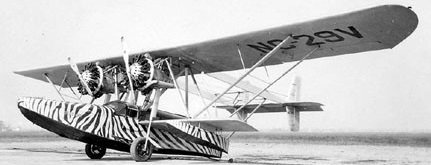
The 1932 S-38-BS NC29V c/n 414-20 (ATC2-434) was a seven-place with two 450hp Wasp SC engines. It was built for a 1933 African wildlife survey, flown by pilot Osa and photographer Martin Johnson, with a “Zebra” paint job.

Sikorsky S-38-BS NC29V

The 1933 S-38-BT NC22V c/n 414-23 (ATC 2-446) was an 8-10 place with two 525hp P&W supercharged Wasp T engines.

Selling for around $50,000, ten 1929 S-38-C (ATC 158) were built; NC4V, NC6V, NC10V, NC26V, NC28V, NC111M and NC112M, NC160H, NC199H, and NC305N. By now, 111 S-38 had been built.

Sikorsky S-38-C NC10V

Two S-39-B (NC809W and NC1933/NC14326) were refitted with 400hp P&W Wasp S1 engines in 1931 as S-39-C in 1931. They received ATC 2-391 and 2-436,

The 1932 S-39-CS Special (ATC 2-436) was a four-place with 375hp P&W Wasp S2 engines. The one built, NC52V c/n 914, was for Osa and Martin Johnson.

Gallery

S-38-A, -B, -C (ATC 60)
Engines: 2 x Pratt & Whitney Wasp, 313kW / 400hp
Wingspan upper: 21.8 m / 72 ft 6 in
Wingspan lower: 11.0 m / 36 ft 1 in
Length: 12.3 m / 40 ft 4 in
Height: 4.4 m / 14 ft 5 in
Wing area: 66.9 sq.m / 720.10 sq ft
Max take-off weight: 4753 kg / 10479 lb
Empty weight: 2970 kg / 6548 lb
Max. speed: 200 km/h / 124 mph
Cruise speed: 175 km/h / 109 mph
Stall: 57 mph
Ceiling: 5480 m / 18000 ft
ROC: 1000 fpm
Range w/max.fuel: 965 km / 600 miles
Crew: 2
Passengers: 10

S-38-AH
Engines: 2 x 525hp P&W Hornet A.

S-38-B
Engines: 2 x P&W Wasp, 410hp
Wingspan: 71’8″
Length: 40’5″
Useful load: 3930 lb
Max speed: 125 mph
Cruise: 110 mph
Stall: 55 mph
Range: 750 mph
Ceiling: 18,000′
Seats: 2-10

S-38-B Special
Engines: 2 x P&W Wasp C, 450hp or Wasp SC
Seats: 11 or 4

S-38-BH
Engines: 2 x P&W Hornet B, 575hp
Useful load: 3580 lb
Max speed: 143 mph
Cruise: 120 mph
Stall: 55 mph
Range: 600 mi
Seats: 10

S-38-BS
Engines: 2 x P&W Wasp SC, 450hp
Seats: 7

S-38-BT
Engines: 2 x P&W supercharged Wasp T, 525hp
Seats: 8-10

S-38-C
Engines: 2 x P&W Wasp, 420hp
Wingspan: (upper) 71’8″
Wingspan: (lower) 36’0″
Length: 40’3″
Useful load: 3630 lb
Max speed: 125 mph
Cruise: 110 mph
Stall: 55 mph
Range: 600 mi
Ceiling: 18,200′
Seats: 8-12

S-39-B convert. S-39-C
Engines: 2 x 400hp P&W Wasp S1

C-6 / C-6A
Engines: 2 x P&W R-1340-7
Wingspan: 71’6″
Length: 40’3″
Max speed: 112 mph
Seats: 12

Sikorsky S-38

Sikorsky S-37

Despite the S-35 tragedy, Capt. Rene Fonck decided to try again, in a new Sikorsky aircraft, the S-37 NX1283 Ville de Paris. Powered by two 500hp Jupiters, it cruised at 190km/h and had a designed range of over 6400km, which would have taken it to Paris with fuel to spare.

Tests at progressively increased loads included the overload weight needed for the transatlantic flight, but the planned attempt was abandoned after the Orteig prize had been won by Charles Lindbergh.

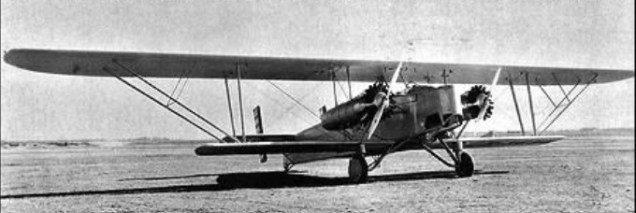
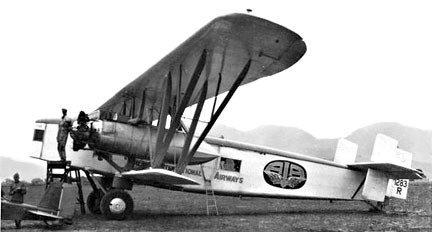
The S-37 was sold by Fonck’s sponsors to American International Airways of Argentina as the Southern Star airliner for twenty passengers. During its delivery flight, begun on 30 June 1929, it became the first commercial transport to cross the 5700m Andes mountains, carrying eight people and a total useful load of 2300kg. Further flights over the Andes, between Buenos Aires and Santiago, became routine for several years.

Sikorsky S-37-1 AIA in Lima Perú R1283

First selling for $15,955, R1283 was modified as a sixteen passenger with 525hp P&W Hornet engines (the Jupiters went to S-37-B) for service in South America. It was scrapped by PAA in 1930.

The 1927 S-37-2 NX3698 (ATC 2-170) was built under a contract from Consolidated Co as their Model 12, for Army evaluation as five-place XP-496 bomber with two 525hp P&W R-1690 engines.

Sikorsky amended the suffix to “-B,” but while in the service it never did get an official Army designation.

Sikorsky S-37-2 NR942M

It did not meet Consolidated’s requirements, either, and was rebuilt in 1929 by Sikorsky from eight passenger to 21 passenger transport with two 675hp P&W Hornets, which were replaced by the Jupiters from the S-37-1.

Sikorsky S-37-B

Rebuilt again and re-registered in 1934 as NR942M, it crashed at sea in 1934.

Sikorsky S-37-2 NR942M

Gallery

S-37-1 Guardian
Engines: 2 x Gnôme-Rhône Jupiter, 520hp
Wingspan upper: 100’0″
Wingspan lower: 58’0″
Length: 44’0″
Useful load: 7000 lb
Max speed: 135 mph
Cruise: 115 mph
Stall: 57 mph
Capacity: 20 pax

S-37-2 / S-37-B / Model 12
Engines: 2 x P&W Wasp, 500hp
Wingspan upper: 100’0″
Wingspan lower: 58’0″
Length: 45’6″
Useful load: 7000 lb
Max speed: 140 mph
Cruise: 120 mph
Stall: 53 mph
Ceiling: 15,000′
Capacity: 8 pax

S-37-2 / S-37-B / XP-496
Engines: 2 x P&W R-1690 Wasp, 525hp
Useful load: 6315 lb
Max speed: 108 mph
Stall: 57 mph
Range: 575 mi

S-37-B
Engines: 2 x P&W Hornets, 675hp
Capacity: 21 pax

Sikorsky S-36 / XPS-1 / RS-3

Sikorsky developed the S-36, a larger version of the S-34, and six S-36 amphibians were built, usually with two 200hp Wright J-4 Whirlwind engines. Certified ATC 2-275, the 1927 S-36 had various seating arrangements and various wingspans, from 56’0″ to 72’0″. The latter span for the long-range version. Length was 34’0″.

Five built were NX1282, N3001 (temporary, cancelled), NX3699, and N4567, plus XPS-1 A8005 in 1928.

The US Navy used the PS-1, PS-2, PS-3, based on S-36 and -38, on patrol, transport and utility duties as the XPS-1. One was built as XPS-1 A8005 in 1928.

Sikorsky XPS-1 A-8005

Also in 1928, two PS-2 were built; A8089 and A8090.

Sikorsky PS-2

Four PS-3 were built in 1929 (A8284 to 8287), later being designated RS-3. One was produced for the USN (A9055) and two for the USMC (A8922 and 8923).

Other S-36s, carrying two crew and up to six passengers on two facing bench seats with a table between, were delivered to Andean National Corporation and, on 7 December 1927, to the newly formed Pan American Airways for survey flights in the Caribbean.

An S-36, named Dawn, was bought by Mrs Frances Grayson, a niece of President Wilson, who wanted to be the first woman to fly the Atlantic. After take-off on 23 December 1927, with Mrs Grayson and two pilots on board, it vanished over the ocean.

XPS-1
Engines: Two 220hp Wright R-790
Wingspan: 71’0″
Length: 36’8″
Ceiling: 9,000′
Seats: 3-4

PS-2
Engines: Two 450hp P&W R-1340B
Wingspan: 71’8″
Length: 40’3″
Ceiling: 19,400′
Seats: 3-4

PS-3
Engines: Two 450hp P&W R-1340C
Wingspan: 71’8″
Length: 40’3″
Ceiling: 14,800′
Seats: 3-4

Sikorsky S-35

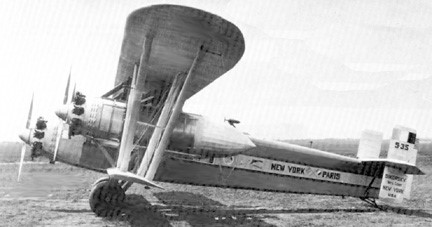
The S-35 was designed as a twin-engined transport with a range of about 1600km.

In the spring of 1926 Capt. Rene Fonck, a French First World War fighter ace, persuaded Sikorsky to redesign it in an attempt to win the $25,000 Orteig prize for the first non-stop New York-Paris flight. It became a very different aircraft, with three 400hp Gnome-Rhone Jupiter engines and vastly increased fuel load. The first test flight, by Fonck and Igor Sikorsky, was made on 23 August 1926. Later, pilot Frank LaVista of the Department of Commerce reported that the aircraft handled very well, could climb on two engines, and lost only 15m of height while flying at 132km/h for 35 seconds on one engine.

Jettisonable auxiliary landing gear was fitted to the S-35 for take-off on its transatlantic attempt, at an overload weight of 8400kg, on 20 September 1926. Fonck insisted on having a radio operator, Charles Clavier, and veteran Sikorsky mechanic Jacob Islamoff, in addition to his co-pilot Lt Lawrence Curtin of the US Navy. Watched by a huge crowd, part of the auxiliary landing gear broke away as the aircraft gathered speed. It plunged down a steep slope beyond the runway and burst into flames. Only the two pilots escaped. The S-35, which had cost $100,000 to build, was destroyed.

The original wingspan, before extra bays were added, was 76’0″. This was increased to 101’0″.

Gallery

Sikorsky S-35
Engines: three 420hp Gnôme-Rhône Jupiter
Wingspan (upper): 101’0″
Wingspan (lower): 76’0″
Original load: 6600 lb
Load: 15,710 lb
Ceiling: 16,800 ft
Seats: 4

Sikorsky S-34

Sikorsky’s first attempt to build an amphibian, the six-seat S-34 NX883, flew in 1926. During a test flight in November 1927, piloted by Capt. Collier and with Igor Sikorsky as observer, it developed engine trouble while flying low over water and sank after forced landing. The two men were rescued and taken ashore by motor boat.

Sikorsky S-34 NX883

Engines: two 200hp Wright J-4
Wingspan: 50’5″
Sponsons width: 12’0″
Length: 34’0″
Useful load: 1600 lb
Max speed: 111 mph
Cruise: 90 mph
Stall: 52 mph
Range: 360 mi
Ceiling: 15,000′
Seats: 7

Sikorsky S-33

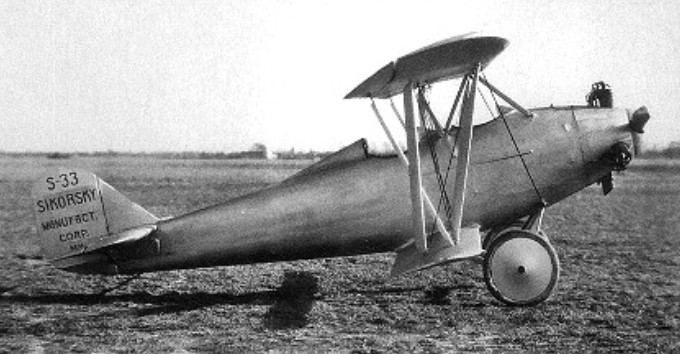
Two S-33 Messengers were built, the first in 1926 as a racing aircraft with a 60hp Wright Gale aircooled engine, the second in 1927 as a two-seat utility aircraft with a 60hp Lawrence. The racer was flown by Al Krapish, one of the company’s earliest employees and a passenger on the first unhappy flight of the S-29A. It spanned 9.75m and had a speed of 165km/h.

S-33 Messenger
Engine: 60hp Anzani
Wingspan (upper): 32’0″
Wingspan (lower): 20’0″
Useful load: 500 lb
Max speed: 115 mph
Stall: 35 mph
Ceiling: 15,000′
Seats: 1

Sikorsky S-32

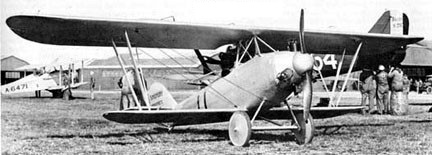
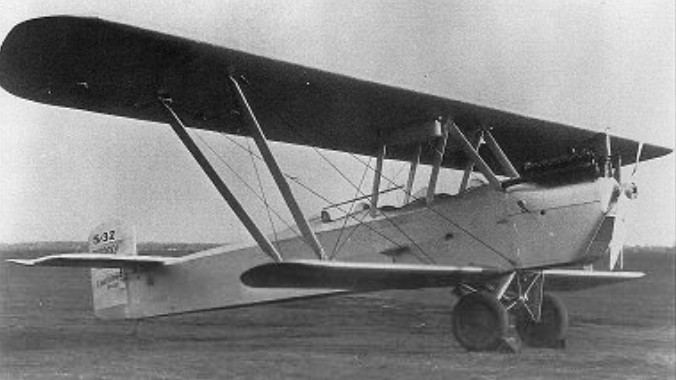
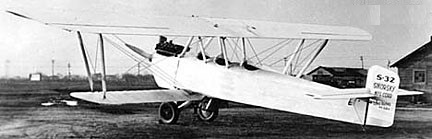
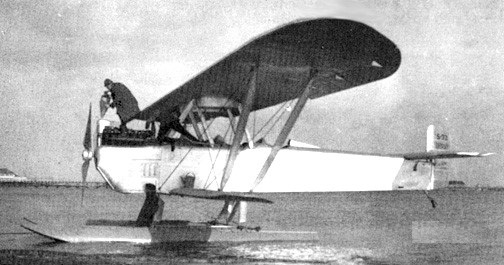
The 1925 one-off S-32 was a large fabric-covered metal biplane, with a 400hp Liberty engine, built for the Andean National Corporation, a subsidiary of Standard Oil Company, for extra-heavy duties in Colombia.

It carried the pilot in the rear cockpit and two pairs of passengers in the forward cockpits. In landplane form it had a top speed of 215km/h and endurance of more than four hours, but was flown mainly on floats.

Sikorsky S-32 on floats

Engine: 400hp Liberty 12
Wingspan: (upper) 58’4″ / 17.78m
Wingspan (lower): 38’0″
Length: 36’0″
Maximum weight: 2450 kg
Useful load: 2100 lb
Max speed: 133 mph
Stall: 40 mph
Ceiling: 16,000′
Seats: 5

Sikorsky S-31

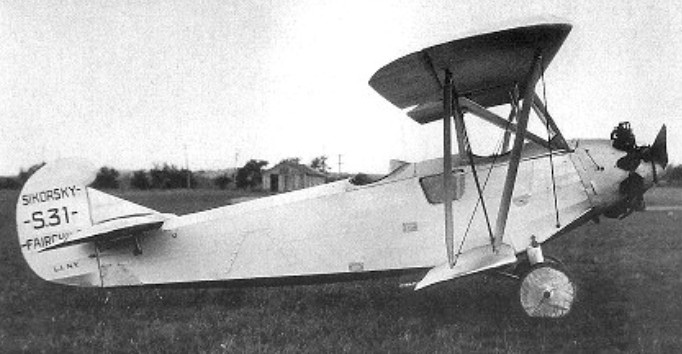
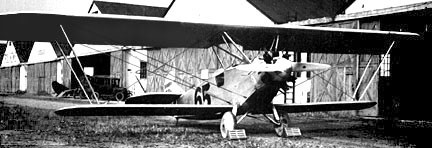
The 1925 five-seat S-31, with a 200hp Wright J-4 Whirlwind engine, was used by the Fairchild Company for aerial photo-mapping work in South America.

Up to four passengers, or photographic equipment, could be carried in the semi-closed centre cabin.

During flight testing, the S-31 climbed to 4680m in 47 minutes with a pilot, two passengers and fuel for four hours of flying.

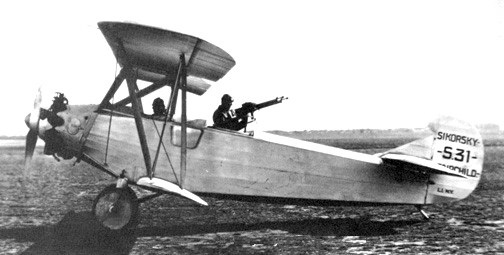
The sole example built was shown in a publicity photo shows it with a machine-gunner in the rear cockpit, suggesting plans for a military export version.

S-31
Engine: 200hp Wright J-4
Wingspan (upper): 45’0″
Wingspan (lower): 32’0″
Length: 26’0″
Useful load: 1200 lb
Max speed: 124 mph
Cruise: 110 mph
Stall: 35 mph
Range: 500 mi
Ceiling: 15,000′
Seats: 3