The Austrian aeronautical engineer Otto Kauba approached the Reichsluftministerium (RLM) with a proposal for a flying-bomb early in 1942. The ministry was sufficiently interested in his ideas to assist in establishing the Skoda-Kauba design bureau in Prague, Czechoslovakia. The proposed flying-bomb layout was tested in a light monoplane, the SK V1, which was written off in a crash. Two modified aircraft, the SK V1A and SK V2, were tested before the project was abandoned in 1943.
Era
Skoda-Kauba
Czechoslovakia
Founded spring 1942 at Cakowitz, near Prague. Worked for Germans. Experimental types included Sk-V4 light fighter-trainer with German Argus engine. SK257 development received German production order; five completed before Russians captured factory.
Sklenar Tatra T-101.2
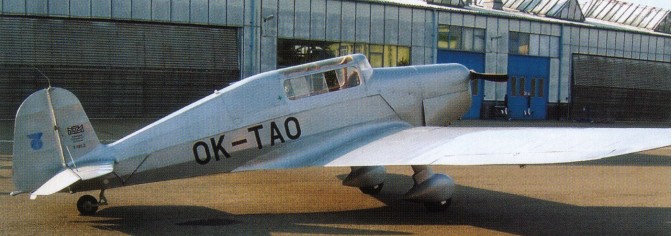
Over a 10 year period Jiri and Ivo Sklenar created a replica Tatra T-101 (designated T.101.2). An original 1938 Tarta T-100 engine was overhauled by the original Tatra Company, and apart from some safety and cost effective material compromises, the replica deviates little from the sole produced original aircraft.
The aircraft features a 13 metre span, one piece wooden wing with 11 fuel tanks. This allows for approximately 30 hours flying time.
The replica was first flown from Kunovice airport, Czechoslovakia, by Stanislav Sklenar on 29 September 2007.
Skandinavisk Aero Industri As / SAI / Kramme & Zeuthen
Skandinavisk Aero Industri A/S (abbreviated SAI) was a Danish manufacturer of aeroplanes that existed between 1937 and 1954. The company was founded by technician Viggo Kramme (1905–1984) and engineer Karl Gustav Zeuthen (1909–1989) and based in Copenhagen.
The company’s aeroplanes were labelled “KZ” for Kramme and Zeuthen, the first being the KZ I from 1937. The KZ IV was built as an ambulance plane for Zone-Redningskorpset and introduced in 1944. Post-war sales never reached the company’s expectations, and production turned unprofitable in the early 1950s, driving the company to shutdown. In mid-1950s turned increasingly to repair and maintenance of military aircraft, and aircraft production had ended by late 1950s. In total, about 200 planes were built by the company.
A number of the KZ planes have been preserved. As of 2005, Dansk Veteranflysamling (The Danish Collection of Vintage Aircraft) exhibits a specimen of each of the 11 aircraft models manufactured by the company.
Skandinaviska Aero BHT-1 Beauty

On 7 May 1943 three young engineers sat in the Bacchi Wapen restaurant in Stockholm together with Åke Forsmark, manager of Skandinaviska Aero, and chatted about aircraft. The three were Erik Bratt, Karl-Erik Hilfing and Björn Törnblom, all students at Kungliga Tekniska Högskolan, the Royal Technical University in Stockholm. Their ideas gradually evolved into this sketch, on the back of a menu. It was originally meant to be a glider towing aircraft, and by May 1944 the design work was complete, with 4,000 drawings and 2,500 load calculations, performed by Törnblom, the only one of the three who had previous experience in aircraft design. He also designed the wings, fin and rudder. Hilfig was responsible for the fuselage and Bratt worked on the engine installation, propeller and landing gear.
The BHT-1 is a wooden low-wing cantilever monoplane with a retractable tailwheel landing gear. Powered by a 60 hp (45 kW) Walter Mikron 4 piston engine it has an enclosed single-seat cockpit. The wings include slotted flaps.

The BHT-1 Beauty was built by Skandinaviska Aero of Stockholm and first flew on 4 December 1944. Only one, SE-ANX, wa built.
The BHT-2 was a proposed two-seat development. A prototype constant speed propeller was developed for the aircraft using differential between engine oil, and ram air pressure to control pitch.
Engine: 1 × Walter Mikron 4, 45 kW (75 hp)
Length: 5.80 m (19 ft 0 in)
Wingspan: 6.82 m (22 ft 4½ in)
Height: 1.90 m (6 ft 3 in)
Wing area: 7 m2 (75.3 ft2)
Empty weight: 240 kg (538 lb)
Gross weight: 420 kg (924 lb)
Maximum speed: 250 km/h (155 mph)
Cruising speed: 210 km/h (130 mph)
Range: 1700 km (1056 miles)
Service ceiling: 7500 m (24600 ft)
Crew: 1
Six-Chuter SR-5
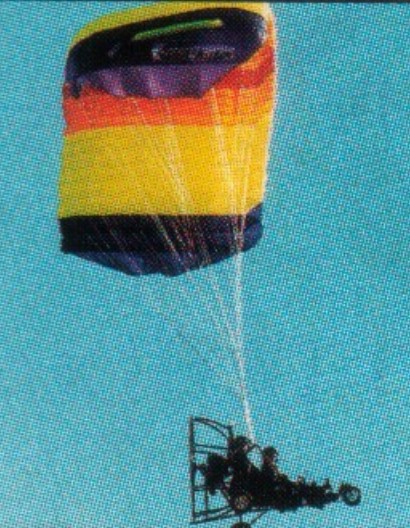
The two seat kit is complete with airframe, engine, prop, tacho and custom cowling. Powder coating is optional.
Also available in the XP version powered by a Rotax 582.
SR-5
Cruise: 26 mph
Range: 50 sm
Rate of climb: 650 fpm
Takeoff dist: 100 ft
Landing dist: 50 ft
Service ceiling: 10,000 ft
Engine: Rotax 503
hp range: 40-46
Fuel capacity: 9 USG
Empty weight: 252 lb
Gross weight: 700 lb
Height: 7 ft
Length: 5.5 ft
Wing span: 39.5 ft
Wing area: 500 sq.ft
Seats: 2
Six-Chuter SR-3
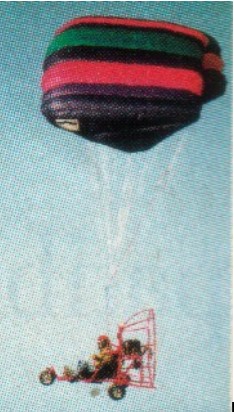
The single seat kit is complete with airframe, engine, prop, tacho and custom cowling. Powder coating is optional.
Cruise: 26 mph
Range: 52 sm
Rate of climb: 700 fpm
Takeoff dist: 100 ft
Landing dist: 50 ft
Service ceiling: 10,000 ft
Engine: Rotax 503, 46 hp
hp range: 40-46
Fuel capacity: 5 USG
Empty weight: 230 lb
Gross weight: 550 lb
Height: 7 ft
Length: 5 ft
Wing span: 36.5 ft
Wing area: 450 sq.ft
Seats: 1
Six-Chuter Inc
In 1991 there were six friends who decided they could build the best powered parachute: The name Six Chuter, Inc. was born. During the first summer, three of the original six left the company to find full time “paying” jobs. It was tough and there were many times we considered closing shop. But somehow the remaining three of us survived the winter and made it into 1992. New sales were sporadic at best, but between those and parts sales, the business survived. Then in July 1992 they received an order for three units from a gentleman in Ohio. Those three sales turned things around and they’ve never looked back.
1995-8: 2925 So. Wiley, Yakima, WA 98903, USA.
2009: 7700 Olmstead Ct. Yakima, WA 98903, USA.
The standard kits are sub-assembled at the Six Chuter factory for economical shipping anywhere in the world. The average builder can assemble these units in 40-60 hours. A sub-assembled kit can purchased and certified as an Experimental Light Sport Aircraft. The SLSA is assembled, tested and certified at the factory before it is sold. Six Chuter will offer the XT ssdc and other models as either SLSA or ELSA kits.
Sivel SD-28 Trittico
A more-powerful two-seat aerobatic and sporting aircraft was to fly in 1999.
Sivel SD-27 Corriedale
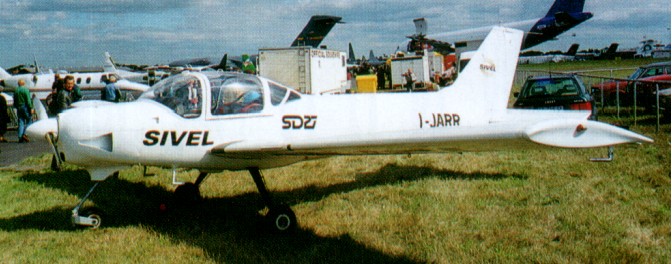
The SD-27 Corriedale two-seat touring and training lightplane was offered for sale since 1998 (first flown 1992).
Engine: Rotax 912, 80 hp
Seats: 2

