Societe Anonyme Pour La Realisation D’avions Prototypes / S.R.A.P.

Established at Billancourt in 1926 to build aircraft to the design of Louis Becherau, formerly with Deperdussin and SPAD. First production design was the C.2, a two-seat monoplane powered by a 500hp Salmson engine.

The Paris-based S.R.A.P. is often listed as the ‘Société pour la Réalisation d’Appareils’. Flight truncated the name as ‘Société pour la Réalisation d’Avions’. However, ‘Prototypes’ seems important as it suggests that S.R.A.P. did not intend to manufacture aircraft designs in series.

Societa Idrovolanti Alta Italia / SIAI

Italy

Forerunner of the Siai-Marchetti organization (see Siai-Marchetti Societa Per Azioni). Founded 1915 by Luigi Cape at Sesto Calende, with a seaplane base on Lake Maggiore. As Idrovolanti Savoia built FBA flying-boats under license. Name “Savoia”had a geographical and historical connotation (House of Savoy), and after the war new flying-boats were known by the name Idrovolanti Savoia, or Savoia. These achieved early distinction, notably in the 1920 Schneider Trophy contest. Names Savoia and Marchetti were linked in 1922, when Alessandro Marchetti became technical director of company renamed Societa Idrovolanti Alta Italia—Savoia-Marchetti. In 1925 the company gained publicity when an S.16ter was flown to Australia and Tokyo and back to Italy by Francesco De Pinedo. Famous types included the twin-hulled S-55 which, though first flown in 1924, is remembered chiefly for General Balbo’s mass-formation flights of 1930 and 1933. Special long-range landplane S-64 broke world’s duration and distance records in June 1930. Initials S. M. for type numbers were not commonly applied until later, and then particularly in association with fast 3-engined civil and military types. Most famous was S.M.79 bomber and torpedo bomber of Second World War. Civil types included the record-breaking S.M.75 of 1939. Last Second World War aircraft was S.M.91 twin-boom fighter-bomber, but S.M.84 bomber served as transport until 1948.

SAN SAN-101

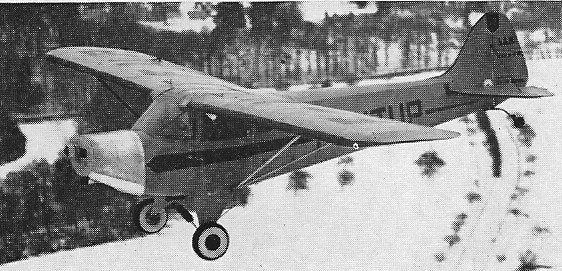
The SAN-101 was the first product of Societe Aeronautique Normande. A tandem two-seat high-wing monoplane powered by a 65 hp Continental C65 engine.

One prototype was built, first flying at the end of 1949.

Engine: 65 hp Continental C65
Wingspan: 38 ft 2.5 in
Length: 24 ft
Max speed: 98 mph
Cruise: 74 mph
Range: 373 mi

Societa Italiana Aeroplani MB / Monoplano Biposto

Societa italiana aeroplani – founded in Milan in 1912 by attorney Enrico Luzzatto after the close of the Helios firm – made use of the work of engineer Flaminio Piana Canova, who left the workshops of Somma Lombardo’s Battaglione Aviatori, and briefly assumed the role of technical director for all of Asteria where soon he built an almost identical monoplane to the Sia Italia, called Asteria MB, and also presented at the 3rd International Exhibition of Aerial Locomotion of Turin (May 17-24, 1913).

Sochen ES-1 / Phoenix

The Sochen Phoenix was a single engine, three axis control microlight designed by Edwin Sochen and produced in South Africa in the early 1980s.

The original single seat ES-1 Phoenix began as a rebuild by Edwin Sochen of a storm-destroyed Quicksilver MX but emerged a much refined aircraft, with two-surface wings, ailerons rather than spoilers and a fully steerable undercarriage. One of these was built and flown, then Sochen developed it into the CII two-seater.

Seating apart, the two variants were generally similar. The two surface wing, tapered in plan with a straight leading edge and a forward swept trailing edge, was braced from below on each side by a single strut, assisted by jury struts. The ailerons filled the whole span. The fuselage of the Phoenix was a completely open aluminium frame structure which carried the exposed pilot’s seat, placing his head just below the leading edge of the wing and supporting the engine in pusher configuration immediately behind. The fuselage frame extended rearwards to carry a conventional tail with horizontal surfaces at the same height as the wing and an all-moving rudder with a swept leading edge, extending below the tailplane aft of the rudder post. The rudder of the CII was swept on both edges, unlike that of the single seat version, and extended downwards further. The tricycle undercarriage had three similarly sized wheels mounted on short legs interconnected by a triangular frame. The front wheel was steerable from the rudder bar and the rear pair were differentially braked.

After two prototypes the CCII was put into production by Court Helicopters. Only eleven were completed before production was stopped.

CII
Engine: 1 × Rotax 503, 52 hp (39 kW)
Propeller: 2-bladed, 4 ft 10 in (1.47 m) diameter
Wingspan: 32 ft 0 in (9.75 m)
Empty weight: 315 lb (143 kg)
Maximum speed: 65 mph (105 km/h; 56 kn)
Cruise speed: 50 mph (80 km/h; 43 kn)
Stall speed: 28 mph (45 km/h; 24 kn)
Range: 100 mi (87 nmi; 161 km) at average cruising speed
Rate of climb: 350 ft/min (1.8 m/s) from sea level
Take-off distance: 230 ft (70 m)
Landing distance: 100 ft (30 m)
Crew: Two