1998:
Wald Str. 21
A-6020 Innsbruck
Austria
Paramotor builder
1998:
Wald Str. 21
A-6020 Innsbruck
Austria
Paramotor builder
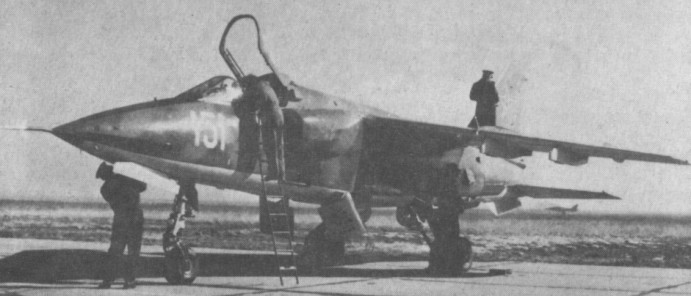
Built in Yugoslavia as the Soko Orao (eagle) and in Romania as the CNIAR (Centrul National al industriei Aeronautica Române) IAR-93, the aircraft was designed by a joint team and developed under a programme known as YuRom, the name indicating the partner countries. Prototypes assembled by Soko and CNIAR made their first flights within minutes of each other on 31 October 1974, and these were followed by a pair of two-seat variants, both of which flew on 29 January 1977. During 1978, deliveries began of a pre-production batch of 15 to each country, after which the initial series model, known in Romania as the IAR-93A, entered service. This was fitted with a pair of non-afterburning Viper Mk 632 engines, but after a short run of single and two-seat aircraft to this standard (20 of them for Romania) manufacture began of the definitive IAR-93B which features a licence-built afterburner and structural changes such as integral wing fuel tanks and a honeycomb rudder and tailplane.
Soko / CNIAR J-22 Orao / IAR-93 Article
The uprated Orao 2/IAR-93B flew in Jugoslavia in October 1983, and in Romania in 1985. The principal difference from the earlier Orao 1/IAR-93A is the introduction of a licence-built Viper 633 with reheat, giving improved performance and weapons carrying capability. The Orao 2 has a Thomson-CSF headup display, and four underwing and one underfuselage stores pylons. Optical and infrared reconnaissance pods are available for carriage on the centreline station.
Romania required 165 IAR-93Bs, including some two-seat models, with similar operational capability to the main version, for advanced training and weapons instruction. Yugoslav plans were believed to be similar. The Orao/lAR-93 is limited to the close support role by its lack of radar or inertial navigation, but low-level interception is a secondary duty.
The J-22 Orao/IAR-93 attack aircraft was out of production before all deliveries made, due to regional conflict.
Orao 2/IAR-93B
Engine: 2 x Rolls-Royce Viper Mk 633-47 afterburning turbojets
Installed thrust (dry / reheat): 37.7 / 44.8 kN, 2268-kg (5,000-1b)
Span: 9.62 m (31 ft 6.75 in)
Length excluding probe: 13.96 m (45 ft 9.5 in)
Height 4.45 m (14 ft 7.25 in)
Wing area: 26 sq.m (279.86 sq ft)
Empty equipped wt: 5900 kg (13,007 lb)
MTOW: 10,097 kg (22,260 lb)
Warload: 2800 kg
Max speed: 1160 kph (721 mph) at sea level
Initial ROC: 5.5 min to 13,000 m / 3960 m (12,990 ft) per min
Service ceiling 12500 m (41,010 ft)
T/O run: 690 m
Ldg run: 1050 m
Combat radius hi-lo-hi: 360 km
Fuel internal: 2600 lt
Air refuel: No
Armament: two 23-mm GSh-231, twin-barrel cannon (with 200 rpg) in front fuselage
four wing pylons and one centreline pylon carrying five x 250-kg (551-1b)
SOKO J 22 Orao 2
Engine: 2 x Rolls Royce Viper 633 41, 17462 N
Length: 45.932 ft / 14.0 m
Height: 14.764 ft / 4.5 m
Wingspan: 31.496 ft / 9.6 m
Wing area: 279.864 sq.ft / 26.0 sq.m
Max take off weight: 24806.3 lb / 11250.0 kg
Weight empty: 12678.8 lb / 5750.0 kg
Max. payload weight: 12127.5 lb / 5500.0 kg
Max. speed: 626 kts / 1160 km/h
Landing speed: 148 kts / 274 km/h
Cruising speed: 394 kts / 730 km/h
Initial climb rate: 13779.53 ft/min / 70.0 m/s
Service ceiling: 44291 ft / 13500 m
Wing loading: 88.77 lb/sq.ft / 433.0 kg/sq.m
Range: 572 nm / 1060 km
Crew: 1
Armament: 2800kg ext 5pods
Following 1998 restructure, Soko Air Ltd created the Soko 2 two-seat very light monoplane (first flown November 1996).

Designed to replace the T-33 and the earlier G.2A Galeb in Jugoslavian Air Force service, this two-seat basic trainer/light strike aircraft has swept wings and all-swept tail surfaces, the tailplane having pronounced anhedral, and stepped tandem seating. Its performance is improved by the introduction of a 17.8kN Rolls-Royce Viper turbojet.
The first of two prototypes was flown on 17 July 1978 and the first of six pre-production aircraft on 17 December 1980. These and the first prototype were designated G-4 PPP, and had fixed tailplanes with inset elevators and no anhedral.
Production examples (and the second prototype) were designated G-4 and featured an all-moving anhedral tailplane and comprehensive avionics improvements. Armament includes a detachable underfuselage 23mm cannon pod, and a variety of stores on four underwing hardpoints. A Ferranti D282 gyro gunsight is standard equipment.
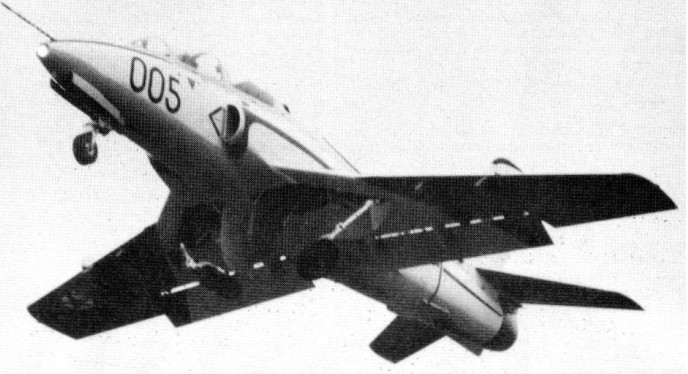
The G-4 was been ordered in large numbers for the Yugoslav air force. They were delivered to the Air Academy at Zemunik (later relocated to Udbina) and to advanced flying schools at Pula and Totograd. The academy fleet includes the ‘Letece Zvezde’ (Flying Stars) formation display team, whose aircraft are painted in a red, white and blue colour scheme.
Twelve G-4s, in two batches of six, were delivered to Myanmar in 1991 and 1992.
A ground-attack trainer, with advanced avionics, an upgraded nav/attack system, and wingtip missile launch rails was developed under the designation G-4M, but no prototype has flown. A similar single-seat derivative designated G-5 was also under development.
The UTVA factory was heavily bombarded in 1999 and certain parts of it were still off limits due to the unexploded ordnance in 2012. All five original lasta 95 prototypes were destroyed in the factory and the only existing Supergaleb G4MD prototype was lightly damaged.
G.4 Super Galeb
Engine: 1 x R-R Viper 632 Mk. 632
Installed thrust: 17.8 kN
Span: 9.88 m / 32 ft 5 in
Length: 11.86 m / 39 ft 11 in
Height: 4.28 m / 14 ft 1 in
Wing area: 19.5 sq.m / 209.90 sq ft
Empty wt: 3250 kg
MTOW: 6330 kg / 13955 lb
Loaded weight: 3250 kg / 7165 lb
Warload: 1350 kg
Max speed: 491 kt / 910 kph / 565 mph
Landing speed: 89 kt / 165 km/h
Cruising speed: 459 kt / 850 km/h
Initial ROC: 1800 m / min
Ceiling: 15,000 m / 49200 ft
T/O run: 600 m
Ldg run: 550 m
Fuel internal: 1720 lt
Combat radius lo-lo-lo: 300 km
Range w/max.payload: 600 km / 373 miles
Armament: 1 x 23 mm GSz-23L cannon
Hardpoints: 5
Crew: 2
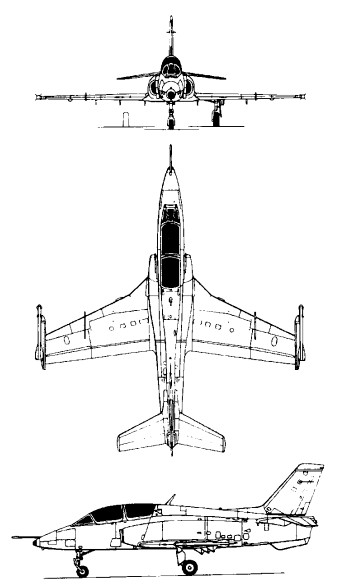
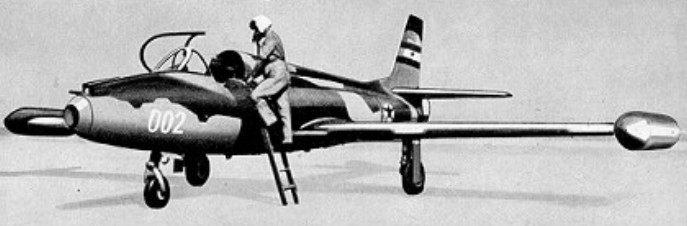
The Galeb was complemented by a generally similar but higher performance single-seat light attack/tactical reconnaissance version designated J-1 Jastreb (Hawk), which had a strengthened airframe and was powered by the improved Rolls-Royce Viper 531 turbojet. This was built as the J-1 attack and RJ-1 tactical reconnaissance aircraft for the Yugoslav air force, with corresponding J-1E and RJ-1 E versions for export. For operational conversion a two-seat TJ-1 was developed.
Production of all versions of the Jastreb ended during 1978.
J-1 Jastreb
Engine: 1 x Rolls-Royce “Viper” 531, 1361kg
Max take-off weight: 5100 kg / 11244 lb
Loaded weight: 2820 kg / 6217 lb
Wingspan: 11.68 m / 38 ft 4 in
Length: 10.88 m / 36 ft 8 in
Height: 3.64 m / 12 ft 11 in
Wing area: 19.43 sq.m / 209.14 sq ft
Max. speed: 820 km/h / 510 mph
Ceiling: 12000 m / 39350 ft
Range w/max.fuel: 1520 km / 945 miles
Armament: 3 x 12.7mm machine-guns
Hard points: 8
Crew: 1


The first of two prototype SOKO G2-A Galeb (Gull) two-seat trainer and light attack aircraft was flown during May 1961 and production was started in 1963.
Powered by a 2,500 lb / 1134kg thrust Rolls-Royce Viper 22-6 turbojet, the G2-A was the standard version for the Yugoslav air force. A G2-AE export variant became available from late 1974 and was built for Libya and Zambia. The basic G2 A version served with the Yugoslav Air Force and G 2A Es with Libya and Zambia.
Production of the G-2A Galeb ended in 1983.
G-2A Galeb
Engine: 1 x 2500 lbs.t. (1134 kgp) Bristol Siddeley Viper A.S.V.11 Mk. 22-6 turbojet
Span: 34ft 0.75 in (10.38 m)
Length: 33 ft 11.5 in (10.35 m)
Height: 3.3 m / 11 ft 10 in
Wing area: 209.14 sq.ft (19.43 sq.m)
Empty weight: 5485 lb (2488 kg)
Loaded weight: 7,438 lb. (3374 kg)
Max. speed: 505 mph (812 kph) at 20,340ft (6200 m)
Cruise: 334 mph (537 kph)
Initial climb: 4,500 fpm (22.86 m/sec)
Ceiling: 10000 m / 32800 ft
Range w/max.payload: 1250 km / 777 miles
Crew: 2


First flown in 1966, a total of thirty piston-engined P-2 Kraguj were built at Mostar, Yugoslavia, as a counterinsurgency aircraft.
Engine: Lycoming IO-540, 340 hp
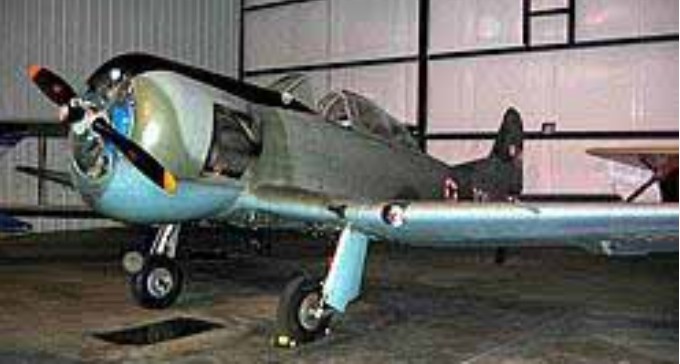
Ground attack aircraft
Dual Controls. 2 place tandem cockpit
Engine: Pratt & Whitney 600 hp
Cruise: 165 mph
Seats: 2
Preduzece SOKO
SOKO Vazduhoplovna Industrija, Ro Vazduhoplovstvo
Soko Air Ltd
Bosnia-Herzegovina
Founded as Preduzece SOKO in October 1950, and produced license-built Westland Whirlwind helicopters. Designed the G-2A Galeb two-seat armed jet basic trainer (first flown 1961), produced for the Yugoslav Air Force and for export. Designed the J-1/RJ-1 Jastreb attack and reconnaissance versions of Galeb, and the P-2 Kraguj piston-engined counterinsurgency aircraft (first flown 1966); the G-4 Super Galeb jet trainer (first flown July 1978). Built the Aerospatiale/Westland Gazelle helicopter under license in several versions, including Partizan, GAMA antiarmor model and HERA reconnaissance model; and joined lAv Craiova of Romania in development/ production of J-22 Orao/IAR-93 attack aircraft (first flown 1974 but out of production before all deliveries made, due to regional conflict).
Privatized 1991, at which time extensive subcontract work included components/ assemblies for Airbus, ATR, Dassault, de Havilland, EMBRAER, Eurocopter, McDonnell Douglas and Tupolev commercial aircraft. Did not go out of business during regional conflict that followed, but had short periods of inactivity during the worst of the troubles.
Following 1998 restructure of Soko company and its division into several smaller concerns under Soko Holding Co, Soko Air Ltd. was created at the Mostar-Rodoc factory to undertake its aviation programs. They include the Soko 2 two-seat very light monoplane (first flown November 1996) and LH1 two/three-seat light helicopter, which was at an advanced stage of design at time of writing. Other work includes civil aircraft component production for international customers, and design of four- and six-seat lightplanes.
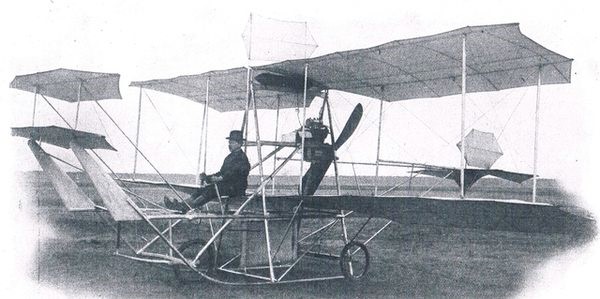
German flight-technician Emil Sohn seated on his doppeldecker during one of his trials at Johannisthal 1909. Sohn’s machine was a Wright-like biplane with a Haake motor. The engine didn’t work and Sohn was left without enough money to purchase a better one.

