1929:
States Aircraft Co,
1633 Wentworth Ave,
Chicago Heights IL.
USA
1933:
Center TX.
1937: Ended operations.
1929:
States Aircraft Co,
1633 Wentworth Ave,
Chicago Heights IL.
USA
1933:
Center TX.
1937: Ended operations.
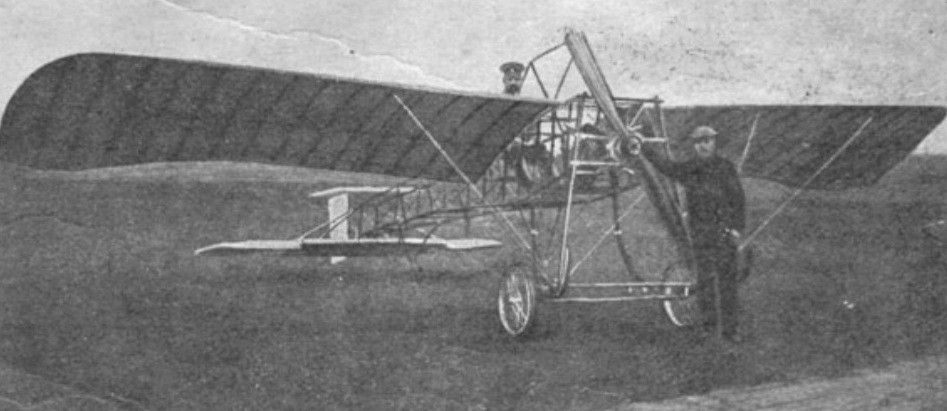
This monoplane of Captain N.P.Stasenko [Н.П.Стасенко] – a trained engineer – was built in 1910 in St. Petersburg and was financed from his own funds, it was not successful in intersting the Russian military.
Span: 24′
Length: 24’6″
Weight loaded: 750 lb
Speed: 43 mph
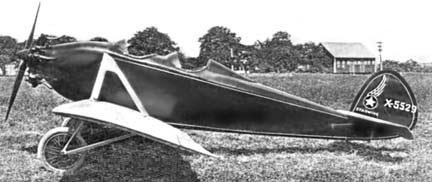
The 1928 Starwing G-4 was designed by Phil Goembel and sold for $2,885. A two-place monoplane, NX5529 and possibly one other were built.
Engine: 60hp LeBlond 5D
Wingspan: 29’0″
Length: 23’0″
Useful load: 306 lb
Max speed: 105 mph
Cruise: 95 mph
Stall: 35 mph
Seats: 2
Massillon OH.
USA
Built the 1929 Starwing G-4.
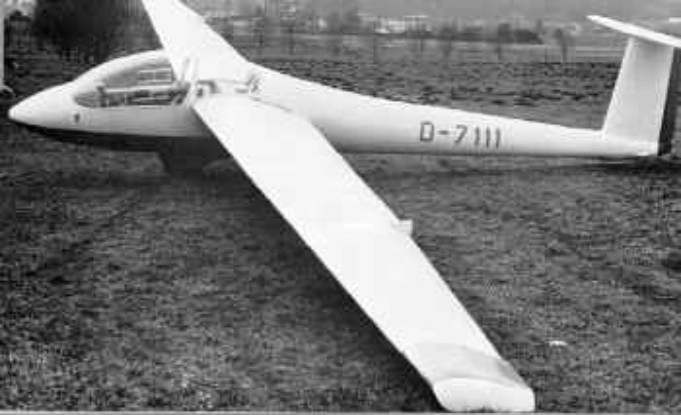
Designed by Walter Stender and Ursula Hanle and originally known as the Schulmeister, this side-by-side two-seater training sailplane first flew in prototype form on 28 July 1977, and production began in March 1978. The Globetrotter is a cantilever mid-wing monoplane of 17m span with a T-tail, and mainly of glassfibre reinforced plastic construction. The wings have an Eppler E 603 aerofoil section and are swept forward 2° 30′; air brakes are fitted in the upper surfaces, and there is provision for water ballast. Landing gear consists of a non-retractable monowheel and tailwheel, and the two pilots sit under a one-piece canopy that slides forward to open over the tip of the nose.
Only one was built.
Wing span: 17 m
Wing area: 15.8 sq.m
Aspect ratio: 18.29
Airfoil: Eppler 603
Empty Weight: 400 kg
Gross Weight: 600 kg
Wing Load: 38 kg/sq.m
L/DMax: 36 100 kph
Min Sink: 0.65 m/s 80 kph
Seats: 2
Span: 55 ft 9.25 in
Length: 25 ft 1.5 in
Height: 3ft 5.25 in
Wing area: 170.1 sqft
Aspect ratio: 18.3
Empty weight: 639 lb
Max weight: 1,102 lb
Max speed: 155 mph
Min sinking speed: 2.13 ft/sec at 50 mph
Best glide ratio: 36:1 at 62 mph
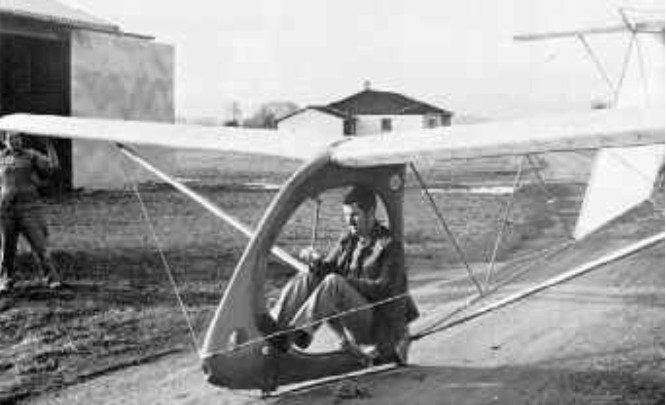
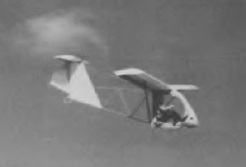
Designed by Ursula Hanle, this simple ultra-light single-seat glider weighs only 106lb without the pilot and is designed to achieve take-off by a variety of methods: by foot-launch, auto-tow, winch launching or any other suitable form of assisted launch.
It has strut-braced dihedral wings of constant chord with small endplate-type fairings and Wortmann aerofoil sections. The basic structure is of glassfibre with carbon-fibre reinforcement; the wings are plastic-covered and the tail surfaces fabric-covered, the tail being carried on an open girder-type framework, and the braced tailplane being mounted on the large fin. The landing gear is formed by the glassfibre seat fairing which has a small keel surface underneath it, and there is a metal hoop at the base of the rudder to form a tailskid. The pilot sits behind a windscreen extending from the leading edge to the front of the seat fairing.
For a foot-launch the product of the hill’s angle in degrees and the wind speed in metres per second should be a figure of 80 or above. After foot-launching, the pilot draws up his legs into the hoop-like glassfibre seat fairing at the front of the aircraft, which also serves as the landing skid.
The Hippie flew for the first time on 15 August 1974 and examples were flying in five countries outside Germany.
The airframe can be dismantled and packed into a carrying case measuring 5m (16ft 4.75in) by 1.10m (3ft 7.25in) by 0.60m (1ft 11.75in).
A new version of the Hippie was available, with wings of honeycomb construction, a longer tail structure of aluminium tubing, an enlarged rudder, quick-connect fittings and an enlarged seating area for the pilot.
35 were built.
Wing span: 10 m / 32 ft 9.75 in
Wing area: 9 sq.m / 96. 9sq ft
Length: 18 ft 8.5 in
Height: 4 ft 7 in
Empty Weight: 48 kg / 110 lb
Gross Weight: 133 kg / 298 lb
Wing Load: 14.8 kg/sq.m
Max speed: 37 mph
Aspect ratio: 11.11
Airfoil: FX S 02
L/DMax: 12 at 45 kph
Min Sink: 1.3 m/s 40 kph
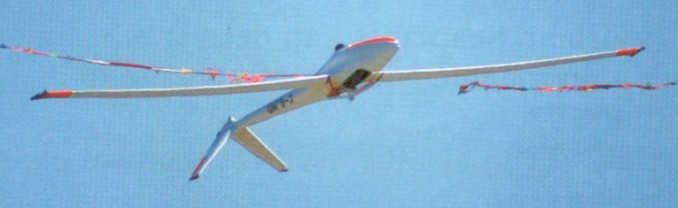
The H 101 Salto is an aerobatic version of the Standard Libelle developed by Frau Ursula Hanle, widow of Ing Eugen Hanle, the former Director of Glasflugel; the Salto (this word is German for loop) is produced by Start + Flug GmbH formed by Frau Hanle.
The design of this single-seat 13 metre sailplane draws extensively on that of their glassfibre sailplane, the H-30, designed by Hutter, and of the Standard Libelle. The Salto is manufactured so that several components are interchangeable with those of the Libelle.
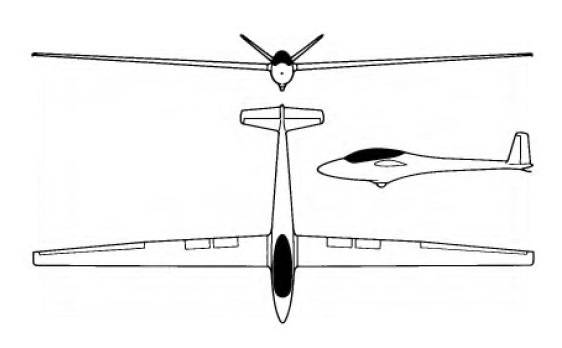
The Salto differs from the Standard Libelle largely in having a V-tail with an included angle of 99°. The Salte also owes something to the V-tailed Hiitter H-30 GFK. Four flush-fitting air brakes repositioned on the wing trailing edges replace the more conventionally-sited air brakes of the Standard Libelle; the Salto’s air brakes are hinged at their mid-points so that half the surface projects above the wing and half below. The fuselage has a fixed, faired wheel, and a tailskid, and the one-piece canopy is hinged to open sideways.
The Salto employs a Standard Libelle wing shortened at the root to produce a span of 13.6 m (44 ft 7.5 in), and fitted with trailing edge dive brakes and a tail parachute for approach control. Tip extensions have been designated extending the wingpspan up to a much as 15.8 m/ 51.8 ft. G limitations are +7 and -5.
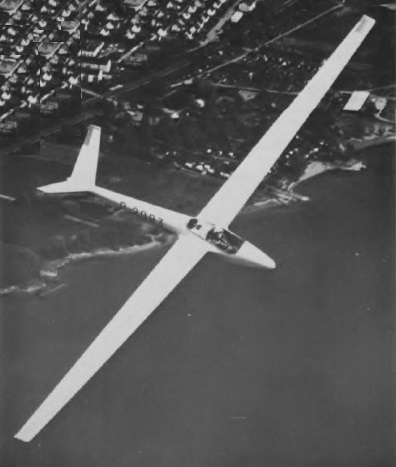
The Salto prototype first flew in March 1970 and 60 had been delivered by the spring of 1977; German type certification was granted on 28 April 1972 and the Salto has also been certificated by the FAA as well as Germany in the Normal and Aerobatic catergories.
Later production was by Dokter Fiberglas.
Bob Carlton’s Super Salto has been retrofitted with a 225 lb thrust jet from PBS in the Czech Republic. Powered by this new Jet engine, the highly modified Super Salto jet sailplane self-launches and performs both a classic sailplane aerial ballet and screamin’ low-level jet aerobatics.
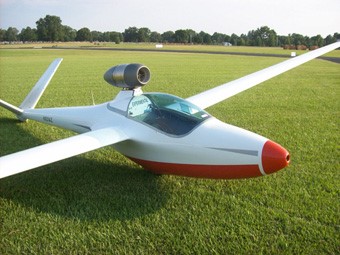
The first flight of the Super Salto Jet Sailplane took place on October 8, 2008.
Start + Flug Salto
Wing span: 13.6 m (44 ft 7.5 in)
Length: 5.95 m (19 ft 6.25 in)
Height: 0.88 m (2 ft 10.75 in)
Wing area: 8.58 sq.m (92.4 sq ft)
Wing section: Wortmann FX-66-17-Al 1-182
Aspect ratio: 21.6
Empty weight: 180 kg (397 lb)
Max weight: 310 kg (683 lb)
Water ballast: None
Max wing loading: 36.13 kg/sq.m (7.4 lb/sq ft)
Max speed: 135 kt (250 km/h)
Stalling speed: 35 kt (65 km/h)
Min sinking speed: 0.6 m/sec (2 ft/sec) at 40.5 kt (75 km/h)
Max rough air speed: 135 kt (250 km/h)
Best glide ratio: 35 at 48.5 kt (90 km/h)
H101 Salto Normal
Wing span: 13.6m /44.6ft
Wing area: 8.58sq.m / 92.4sq.ft
Empty Weight: 182kg / 401lb
Payload: 98kg / 216lb
Gross Weight: 280kg / 617lb
Wing Load: 32.6kg/sq.m / 6.68lb/sq.ft
Aspect ratio: 20.6
Airfoil: Wortmann
L/DMax: 34 94 kph / 51 kt / 58 mph
Min Sink: 0.70 m/s / 2.3 fps / 1.36 kt
Seats: 1
H 101 Salto Aerobatic
Wing span: 13.6m / 44.6ft
Wing area: 8.58sq.m / 92.4sq.ft
Empty Weight: 182kg / 401lb
Payload: 98kg / 216lb
Gross Weight: 280kg / 617lb
Wing Load: 32.6kg/sq.m / 6.68lb/sq.ft
L/DMax: 34 94 kph / 51 kt / 58 mph
MinSink: 0.70 m/s / 2.3 fps / 1.36 kt
Aspect ratio: 20.6
Airfoil: Wortmann
Seats: 1
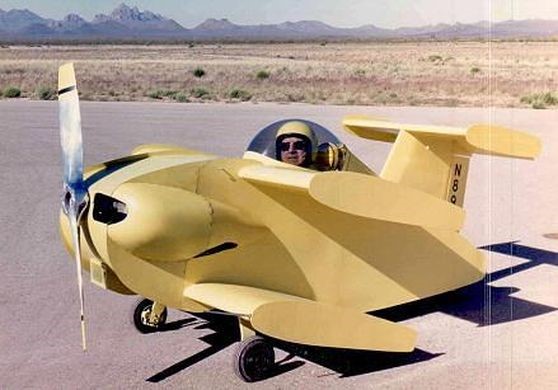
This 1988 plane had a wingspan of just 1.9-meters. and was powered by an 85hp engine. Unfortunately, the plane crashed on its maiden flight but the pilot Starr made a full recovery. The plane weighed 260kg with the pilot and could fly at a maximum speed of 190mph. This record has not yet been beaten.
Engine: 1 × Continental C85, 85 hp / 63 kW
Wingspan: 5 ft 6 in / 1.68 m
Length: 8 ft 10 in / 2.7 m
Empty weight: 396 lb / 180 kg
Max takeoff weight: 574 lb / 260 kg
Fuel capacity: 3 US gallons / 11.35 litres
Maximum speed: 165 knots / 190 mph / 305 km/h
Cruise speed: 130 knots / 150 mph/ 241 km/h
Stall speed: 75 knots / 86 mph / 139 km/h
Service ceiling: 14,000 ft / 4,270 m)
Rate of climb: 4,500 ft/min / 23 m/s
Crew: One
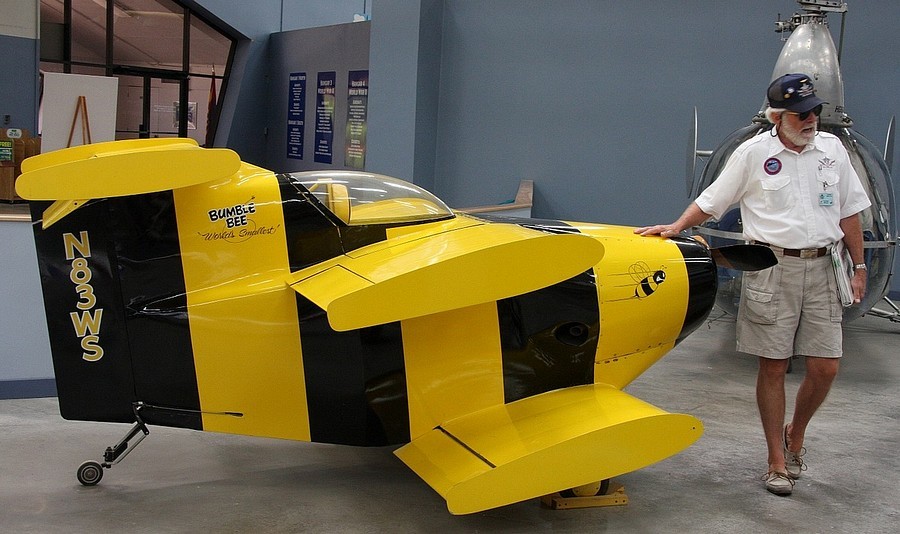
The Bumble Bee II was the world’s smallest piloted airplane. It was built by Robert H. Starr. Its first flight was on 8 May 1988. The Bumble Bee II crashed on the same day due to an engine failure. Robert Starr was seriously injured in the crash, but he fully recovered from his injuries.
Engine: 85hp Continental C-85
Wingspan: 6’6″
Length: 9’4″
Fuel capacity: 3-gal
Max speed: 180 mph
Cruise: 150 mph
Stall: 80 mph
Range: 30 mi
Ceiling: 5,000 ft
Seats: 1
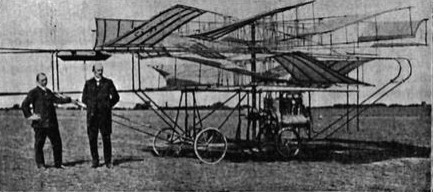
A complicated helicopter with two contrarotating fabric-covered rotors of eight and six blades, built by F. Sternemann and Dr.ing. W. Siebert of Hamburg, Germany, in 1910 and tested at the Wandsbecker Exerzierplatz.

