A 1996 hang glider for advanced pilots.
Predator 142
Wing area: 14 m²
Wing span: 10.20 m
Aspect ratio: 8
Hang glider weight: 30 kg
Minimum pilot weight: 63 kg
Maximum pilot weight: 90 kg
A 1996 hang glider for advanced pilots.
Predator 142
Wing area: 14 m²
Wing span: 10.20 m
Aspect ratio: 8
Hang glider weight: 30 kg
Minimum pilot weight: 63 kg
Maximum pilot weight: 90 kg
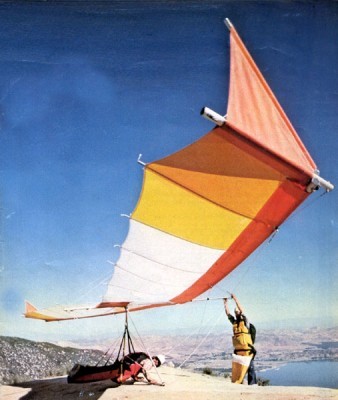
Designed by Roy Haggard, chief designer at Ultralite Product since 1974, UP released the Mosquito almost at the same time as the Comet (1980). The Mosquito is a crossbar-less bowsprit glider with thinner leading edges (in diameter) that could be bent at high speed by tensioning the sail. Therefore, it had a light handling at low speeds and good penetration when flying faster. With its ultra-flat sail and its truncated ends, the Mosquito is a direct descendant of the Spyder of UP.
Twenty pre-production prototypes were built for U.S. level racers to assess their capabilities in the world’s toughest cross-contry event, the XC “Classic” and “open” in Owens Valley. The results were: First place: Rich Pfeiffer – U.P. Mosquito. In addition, there were 4 U.P. Mosquito in the first 8 places, they won all the speed events and set 3 new world records in free flight.
Its assembly is a bit complicated the first time … there are cables everywhere. Very solid wing with oversized cables. The wing tips are connected with a cable on the nose via a pulley. When you turn it tilts the ailerons.
Mosquito
Wingspan: 11.40 m
Mosquito 146
Wing area: 13.4 m²
Wing span: 10 m
Aspect ratio: 7.4
Hang glider weight: 23 kg
Minimum pilot weight: 56 kg
Maximum pilot weight: 83 kg
Nose angle: 127°
Mosquito 166
Wing area: 15.1 m²
Wing span: 10.61 m
Aspect ratio: 7.4
Hang glider weight: 25 kg
Minimum pilot weight: 64 kg
Maximum pilot weight: 94 kg
Nose angle: 127°
Mosquito 196
Wing area: 18.02 m²
Wing span: 11.55 m
Aspect ratio: 7.4
Hang glider weight: 29 kg
Minimum pilot weight: 78 kg
Maximum pilot weight: 113 kg
Nose angle: 127°
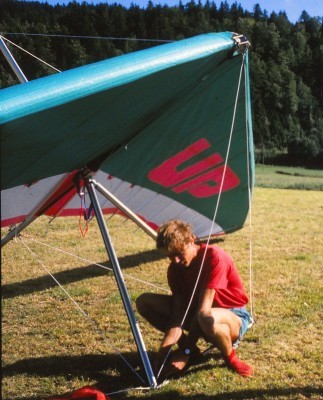
The GZ was a 1985 hang glider.
The Glidezilla appeared in 1986. Glidezilla from UP (which was manufactured in France with parts from La Mouette) was also named UP GZE.
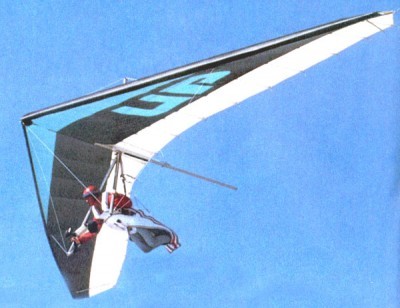
The glider has pronounced adversed yaw effect. The glider featured a LDS sail with a metal component: UV resistant and durable but rather tough for a flexwing.
GZ 155
Glidezilla
Wing area: 15 m²
Wing span: 10.6 m
Aspect ratio: 7.49
Hang glider weight: 32 kg
Nose angle: 127°
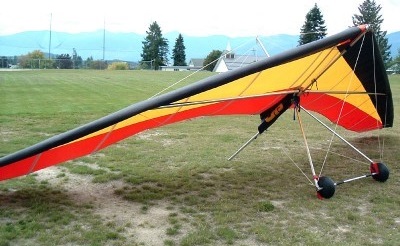
A 1981 hang glider.
Gemini 134
Gemini 164
Gemini 184

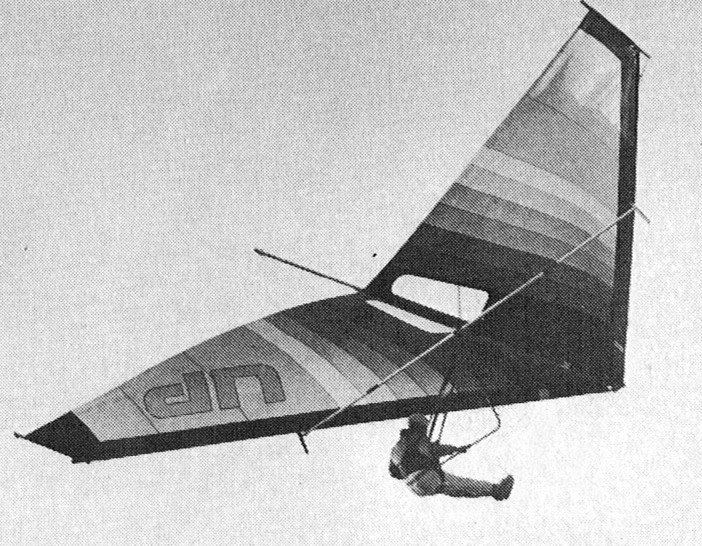
The 1974 Dragonfly Mark I was the first flex-wing, finite tip glider to be put into production. Designed for advanced and competition, it can be soared in approximately half the wind velocity needed for a standard Rogallo. It has a low sink rate, tight turning ability, broad speed range, and has no tendency to drop a wing even when banked at more than 40 degrees.
Roy Haggard’s truncated-tip Dragonfly performed well at the January 1975 Nationals at Escape Countery and he and the design went to work for Ultralite Products.
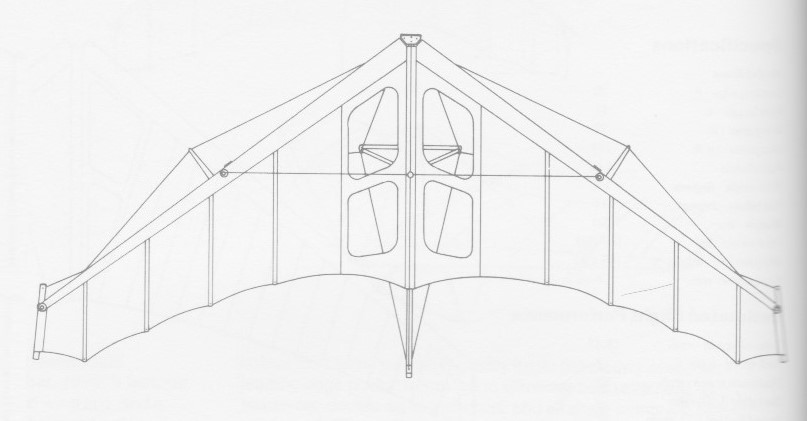
An exclusive quick set-up design uses a double pivot centre box which eliminates attaching or detaching the cross spar and leadspar assemblies. I has an adjustable centre of gravity control bar mounting bracket.
The leading edge spars are made from 6061-T6 1.75in x .049 aluminium tubing. Keel and cross-spar are 1.5in x .049. Ultralite Products saddles are used at all tubing joints. Rigging cable is 304 3/32in 7×7 stainless steel. Cables for deflexers are 1/16in 7×7 stainless steel.
All hardware is grade 8 aircraft bolts, washers and nuts. Stainless steel nose plate, tangs, control bar and kingpost bracket are fitted.
The sail is Howe and Bainbridge 3.8oz stabilised dacron and there was a choice of colours. Leading edge pockets are fitted for minimum airfoil distortion. Special soaring windows for upward visibility was optional.
The control bar was 6061-T6 1in x .083 aluminium with epoxy coating, and a swing seat was included.
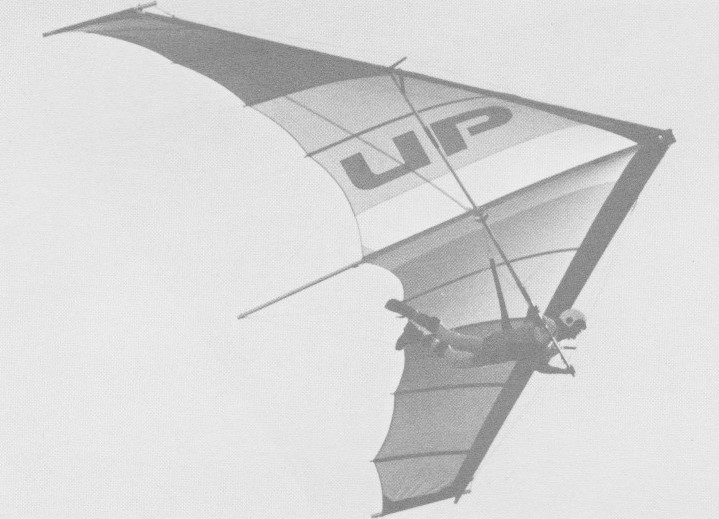
The Dragonfly II is similar to the Mark I except the sail is fully battened and has less billow. It features doube plane deflexers to tune the wing shape and prevent leading edge distortion at high speeds. The sink rate, glide ratio and speed (increased 30%) are all improved.
The leading edge spars are made from 6061-T6 1.75in x .049 aluminium tubing. Keel and crossbar are 1.5in x .049. The entire airframe is fabricated with stainless steel “telebush” units for strength. The Mark II has an adjustable centre of gravity control bar mounting bracket permitting 4in of total adjustment. An additional 5 lb could be saved by ordering the glider with 2024-T3 x .035 tubing.
Rigging cable is 304 3/32in 7×7 stainless steel. Cables for the deflexers are 3/32in 7×7 stainless steel. All hardware is grade 8 bolts, washers and nuts. Stainless steel nose plate, tangs, control bar and kingpost bracket are fitted.
The sail is Howe and Bainbridge 3.8oz stabilised dacron and there was a choice of colours. Leading edge pockets are fitted for minimum airfoil distortion. Special soaring windows for upward visibility was optional.
The 60in control bar is 6061-T6 1in x .083 aluminium with anodised finish. It could be ordered with prone or supine rigging or set up with ‘flip-flop’ wires for quick adjustment to either type of flying.
Dragonfly Mk.1
Wing span: 10 m
Hang glider weight: 21 kg
Packed length: 6.25 m
Dragonfly Mk.1
Leading edge: 20 ft
Keel length: 11 ft
Wing span: 32 ft
Wing area: 181 sq,ft
Aspect ratio: 5.47
Nose angle: 102˚
Sail billow: 3.0˚
Weight: 50 lb
Pilot weight: 150-200 lb
Takeoff speed: 15-17 mph
Stall speed: 12 mph
Max speed: 32 mph
Best L/D speed: 17 mph
Min sink: 258 fpm
Dragonfly II 140
Leading edge: 17 ft
Keel length: 10 ft
Wing span: 26.8 ft
Wing area: 140 sq,ft
Aspect ratio: 5.13
Nose angle: 104˚
Sail billow: 2.6˚
Pilot weight: 105-130 lb
Takeoff speed: 15 mph
Stall speed: 15 mph
Max speed: 42 mph
Best glide ratio (L/D): 7.25-1
Best L/D speed: 18 mph
Min sink: 226 fpm
Dragonfly II 160
Leading edge: 18.75 ft
Keel length: 10 ft
Wing span: 29.5 ft
Wing area: 160 sq,ft
Aspect ratio: 5.45
Nose angle: 104˚
Sail billow: 2.6˚
Weight: 50.5 lb
Pilot weight: 120-170 lb
Takeoff speed: 15 mph
Stall speed: 15 mph
Max speed: 42 mph
Best glide ratio (L/D): 7.25-1
Best L/D speed: 18 mph
Min sink: 226 fpm
Dragonfly II 180
Leading edge: 20 ft
Keel length: 11 ft
Wing span: 32.0 ft
Wing area: 181 sq,ft
Aspect ratio: 5.68
Nose angle: 104˚
Sail billow: 2.6˚
Weight: 54 lb
Pilot weight: 165-200 lb
Takeoff speed: 15 mph
Stall speed: 15 mph
Max speed: 42 mph
Best glide ratio (L/D): 7.25-1
Best L/D speed: 18 mph
Min sink: 226 fpm

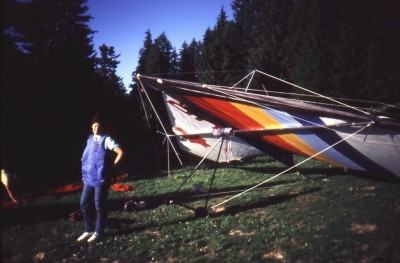
The UP Condor in the late 70s was a typical floater. It flew very slowly, and the wires were very slack before becoming airborne. Condor was a easy hang glider to fly.
Condor 151
Condor 174
Condor 192
Condor 224

The 1980 Comet was for advanved pilots. The early Airwave-built Comet 165 was very soft, predictable handling in roll and a really good sink rate. Exceptionally easy to land with a soft, progressive approach to the stall.
All these gliders were built by Dick Cheney out of Layton UT.
The Comet 2 appeared in 1983.
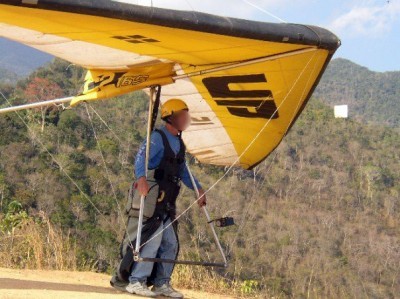
The Comet C3 appeared in 1989.
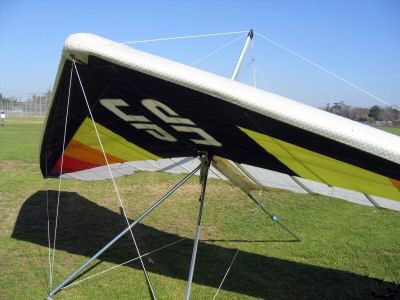
The Comet 3 glider was comperable to the large Axis, with better handling qualities. This was also a heavy glider at approx. 85+ lbs.
Comet 165
Wing area: 15 m²
Wing span: 9.80 m
Aspect ratio: 6.5
Hang glider weight: 30 kg
Minimum pilot weight: 60 kg
Maximum pilot weight: 95 kg
Minimum speed: 27 km/h
Max glide ratio (L/H): 8.5
Minimum sink rate: 0.9 m/s
Packed length: 5.70 m
Number of battens: 19
Nose angle: 120°
Comet 185
Comet OVR
Comet 2 165
Comet 2 185
Comet 3
Nose angle: 125°
Span: 34.8 ft
Wing area: 185 sq.ft
Aspect ratio: 6.5
Wt. range 170 – 290 lbs
Battens: 25
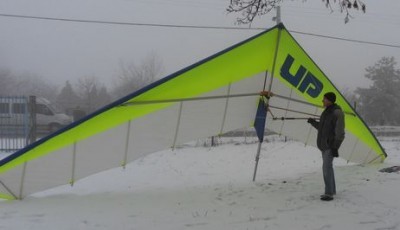
A 1989, very easy glider to fly, it gives a lot of confidence and gives the pilot the opportunity to get the feeling of how to handle a hanglider.
In mountain conditions when thermalling, it’s fun, but heavy flying.
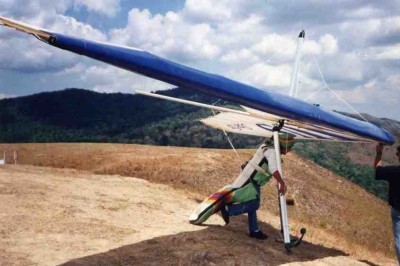
A 1988 hang glider for advanced pilots.
Axis 13
Wing area: 13 m²
Wing span: 9.75 m
Hang glider weight: 32 kg
Minimum pilot weight: 57 kg
Maximum pilot weight: 95 kg
Minimum speed: 40 km/h
Maximum speed: 74 km/h
Packed length: 5.6 m
Packed length short: 3.6 m
Number of battens: 27
Nose angle: 126°
Axis 15
Wing area: 15 m²
Wing span: 10.6 m
Hang glider weight: 33 kg
Minimum pilot weight: 75 kg
Maximum pilot weight: 113 kg
Minimum speed: 40 km/h
Maximum speed: 74 km/h
Packed length: 6.1 m
Packed length short: 4.5 m
Number of battens: 31
Nose angle: 124°
Vision Classic L
Paraglider circa 1998.
Wing area: 32.4 sq.m
Certification: DHV 1-2/Afnor
Pilot weight: 100-130 kg
No. of cells: 41
Wing span: 12.6 m
Aspect ratio: 4.9
Price (1998) £ 1999
Vision Classic M
Paraglider circa 1998.
Wing area: 29.4 sq.m
Certification: DHV 1-2/Afnor
Pilot weight: 85-110 kg
No. of cells: 41
Wing span: 11.9 m
Aspect ratio: 4.9
Price (1998) £ 1949

