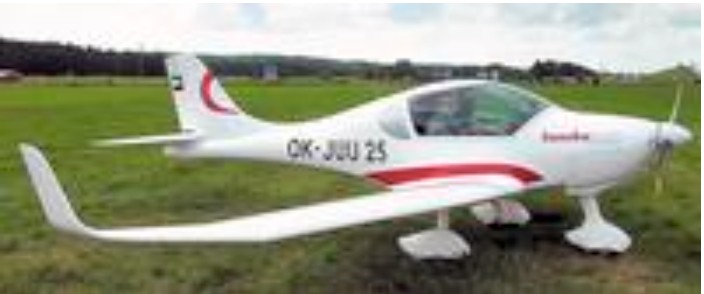
Urban Air UFM-10 Samba / Distar Air UFM-10 Samba

The Samba XXL is based on successful plane UFM-10 Samba. Excellent flight characteristics were preserved while the space for pilots was extended. That is why Samba XXL is ideal for travelling, training and towing sail planes.
SAMBA XXL – brief technical description:
The ultra-light plane Samba XXL is a double-seat, single-engine, self-carrying low-wing aeroplane with crew members sitting one next to each other. It is all-composite. The fuselage is made mainly of carbon laminate with local sandwich construction. The wing is of sandwich construction while the flanges are of carbon rowing.
The wing is equipped with a lifting flap with a slot. Positions of electrically adjustable flaps are 20° for take-off and 45° for land. The tail surfaces are of classic layout. The carriage is three-wheel with controlled front wheel and braked main wheels.
The main carriage legs consist of a laminate spring. Integrated fuel tanks (2 x 50 litres) are located in the wing leading edge.
The plane may be equipped with a towing device for sail planes towing with maximal climbing weight of 650 kg.
The Samba XXL may be equipped with removable wing extensions. 2009 Price: 50000 EURO
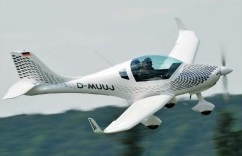
Samba XXL

Samba XXL
Stall: 35 kt / 40 mph / 65 kmh
Cruise: 119 kt / 137 mph / 220 kmh
VNE: 146 kt / 168 mph / 270 kmh
Empty Weight: 265 kg / 584 lbs
MTOW Weight: 472 kg / 1041 lbs
Climb Ratio: 1400 ft/min / 7,5 m/s
Glide Ratio: 1:18
Take-off distance (50ft obstacle): 490 ft / 150 m
Landing distance (50ft obstacle): 660 ft / 200 m
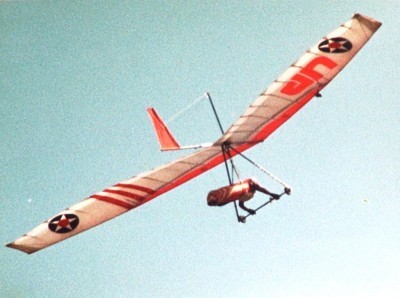
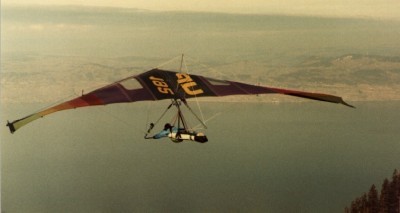
UP XTR

The 1992 XTR wing flies very slow and also flies very fast and it lands easily. The sink rate in still air is about 225 ft/min. The launch is very easy, even a 6000 ft site.

XTR 145
Wing area: 13.25 m²
Wing span: 10.4 m
Aspect ratio: 8.1
Hang glider weight: 31 kg
Minimum pilot weight: 50 kg
Maximum pilot weight: 80 kg
Packed length: 5.8 m
Packed length short: 3.7 m
Number of battens: 23
Nose angle: 127°

UP XTC

A 1993 hang glider.

DS 150
Wing area: 13.25 m²
Wing span: 10.4 m
Aspect ratio: 7.4
Minimum pilot weight: 50 kg
Maximum pilot weight: 80 kg
Nose angle: 127°

150
Wing area: 13.7 m²
Wing span: 9.1 m
Hang glider weight: 27 kg
Minimum pilot weight: 50 kg
Maximum pilot weight: 90 kg
Packed length: 5.7 m
Packed length short: 3.7 m
Number of battens: 17
Nose angle: 127°

DS 170
Wing area: 14.7 m²
Wing span: 10.9 m
Aspect ratio: 7.4
Minimum pilot weight: 75 kg
Maximum pilot weight: 100 kg
Nose angle: 127°

170
Wing area: 15.1 m²
Wing span: 9.6 m
Hang glider weight: 28 kg
Minimum pilot weight: 70 kg
Maximum pilot weight: 115 kg
Packed length: 5.8 m
Packed length short: 3.7 m
Number of battens: 21
Nose angle: 127°

BI 202
Wing area: 17.3 m²
Wing span: 11.6 m
Aspect ratio: 7.4
Minimum pilot weight: 140 kg
Maximum pilot weight: 200 kg

UP TRX

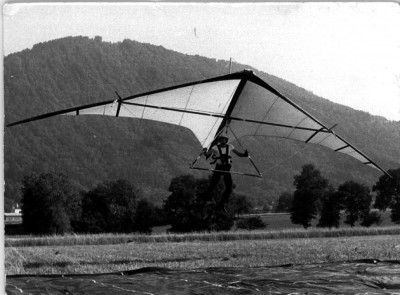
The 1991 TRX is a performance wing with a classic wing tip, finished with a plastic molding. Carbon fiber is widely used in the construction of the structure.

TRX 140
Wing area: 13.7 m²
Wing span: 10.4 m
Aspect ratio: 7.7
Hang glider weight: 30 kg
Minimum pilot weight: 50 kg
Maximum pilot weight: 80 kg
Packed length: 5.8 m
Packed length short: 3.7 m
Number of battens: 31
Nose angle: 127°

TRX 160
Wing area: 14.7 m²
Wing span: 10.9 m
Aspect ratio: 8.1
Hang glider weight: 32 kg
Minimum pilot weight: 75 kg
Maximum pilot weight: 110 kg
Packed length: 6 m
Packed length short: 3.7 m
Number of battens: 33
Nose angle: 127°

UP Speed

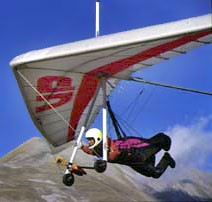
The 1997 Speed was a design developed by UP Europe, intended to be an easy to fly, high performance glider. The downside of this glider was that the crossbar met the leading edge relatively inboard as compared to other similar designs and this allowed the leading edges to flex, so while the handling was great, upper speed performance suffered from leading edge flex.

They did fly well, but it is necessary to adjust the centering to not have to climb into the spiral trapeze (high siding).

Speed S
Wing area: 12.4 m²
Wing span: 9.65 m
Aspect ratio: 7.5
Hang glider weight: 30 kg
Minimum speed: 25 km/h
Maximum speed: 80 km/h
Packed length: 5.6 m
Packed length short: 3.8 m
Nose angle: 127°

Speed
Wing area: 13.4 m²
Wing span: 10.5 m
Aspect ratio: 8.2
Hang glider weight: 32 kg
Minimum speed: 25 km/h
Maximum speed: 80 km/h
Packed length: 6 m
Packed length short: 4.1 m
Nose angle: 127°

Speed TL
Wing area: 13.4 m²
Wing span: 10.5 m
Aspect ratio: 8.2
Hang glider weight: 35 kg
Minimum pilot weight: 65 kg
Maximum pilot weight: 95 kg
Minimum speed: 25 km/h
Maximum speed: 80 km/h
Packed length: 6 m
Packed length short: 4.1 m
Nose angle: 127°

Speed XL
Wing area: 19.3 m²
Wing span: 10.5 m
Aspect ratio: 5.7
Hang glider weight: 35 kg
Minimum pilot weight: 100 kg
Maximum pilot weight: 210 kg
Minimum speed: 25 km/h
Maximum speed: 80 km/h
Packed length: 6 m
Packed length short: 4.1 m
Nose angle: 127°

UP Red Tail

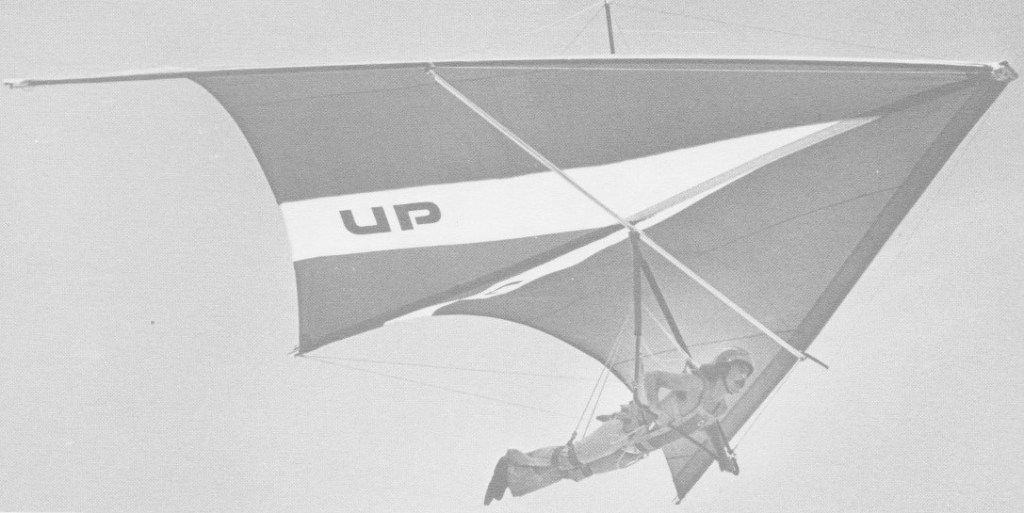
UP Redtail was an ordinary rogallo with a short keel. A 1977 hang glider for intermediate pilots.

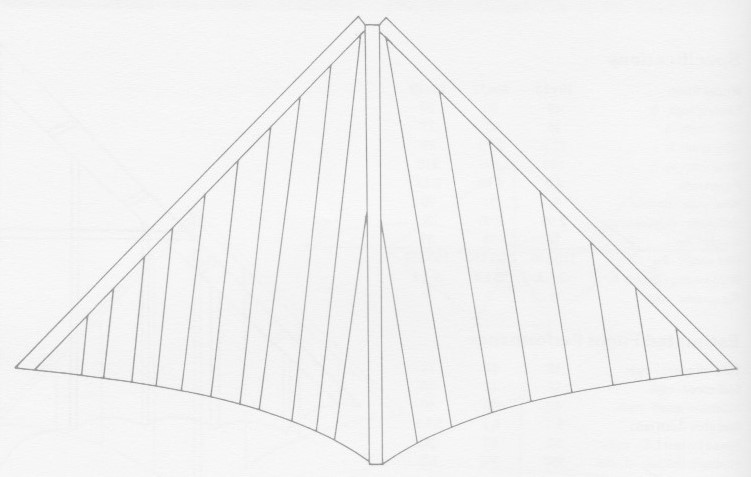
The Redtail features a J-wire nose cambering device, deflexers and sail mounted cleats. It has adjustable centre of gravity bar mounting bracket. The airframe is made from 6061 T-6 aluminium tubing with spars 1.5in x 0.049 and sleeves 1 5/8in x 0.058. Sprcial Ultralite Products “saddles” are used at all tubing joints to distribute loading over tube surfaces.

Rigging cable is 304 3/32in 7×7 stainless steel. Flying wires are not adjustable. Landing wires are turnbuckle tensioned. All bolts, washers, and nuts are grade 7 aircraft. The nose plate, tangs, control bracket, and kingpost bracket are stainless steel. The sail is Howe & Bainbridge 3.8oz stabilised dacron. All sails come with centre tail portions red. There was a choice of 11 colours for the remaining portion of the sail. The sail has applied leading edges for minimum airfoil distortion. A swing seat was included or optional prone harness.

There was another version of this glider that had a two foot shorter keel and was called Super Redtail.

17×15
Leading edge: 17 ft
Keel length: 15 ft
Wing span: 22.3 ft
Wing area: 156 sq,ft
Aspect ratio: 3.2
Nose angle: 82˚
Sail billow: 3.8˚
Weight: 32 lb
Pilot weight: 110-130 lb
Takeoff speed: 12 mph
Stall speed: 12 mph
Max speed: 40 mph
Best glide ratio (L/D): 4.8-1
Best L/D speed: 20 mph
Min sink: 392 fpm

18×16
Leading edge: 18 ft
Keel length: 16 ft
Wing span: 23.6 ft
Wing area: 177 sq,ft
Aspect ratio: 3.15
Nose angle: 82˚
Sail billow: 3.8˚
Weight: 24 lb
Pilot weight: 120-165 lb
Takeoff speed: 12 mph
Stall speed: 12 mph
Max speed: 40 mph
Best glide ratio (L/D): 4.8-1
Best L/D speed: 20 mph
Min sink: 392 fpm

19×17
Leading edge: 19 ft
Keel length: 17 ft
Wing span: 24.9 ft
Wing area: 199.5 sq,ft
Aspect ratio: 3.1
Nose angle: 82˚
Sail billow: 3.8˚
Weight: 26 lb
Pilot weight: 160-190 lb
Takeoff speed: 12 mph
Stall speed: 12 mph
Max speed: 40 mph
Best glide ratio (L/D): 4.8-1
Best L/D speed: 20 mph
Min sink: 392 fpm

Redtail 150
Wing area: 15 m²
Wing span: 9.41 m
Aspect ratio: 5.6
Hang glider weight: 24 kg
Minimum pilot weight: 50 kg
Maximum pilot weight: 75 kg
Packed length: 4 m
Number of battens: 10
Nose angle: 118°