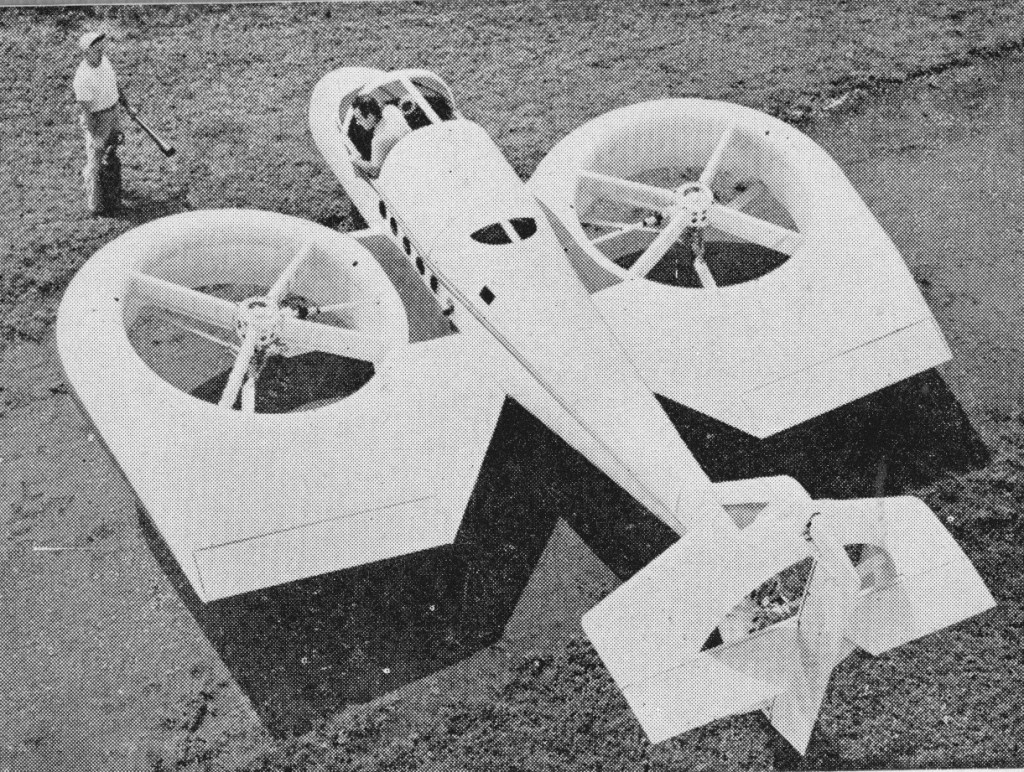
Vanguard 2 Omniplane

The Vanguard Omniplane was an American approach to vertical operation and high cruise speed. The ducts contained vertical thrust propellers that could be closed by venetian blind shutters to form small wings in forward flight. In forward flight, covers above the rotors and louvers below sealed the wing for aerodynamic lift.
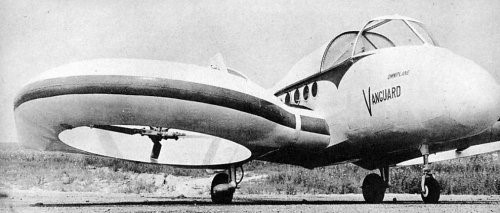
The design, apparently not registered, used a 25-ft long Ercoupe light plane fuselage and weighed 2,600 lb. The round wings each housed a 6 ft diameter three-bladed propeller that was mechanically driven for vertical flight by a 265 hp Lycoming O-540-A1A six cylinder piston engine.

Thrust was produced by a 5′ shrouded prop in the tail, elevator and rudder behind the rear fan-controlled pitch and yaw, while differential propeller blade pitch affected roll in hover.

Ground tests, starting in Aug 1959 and including tethered hover trials, were followed by NASA full-scale wind tunnel testing.

Modifications in 1961, including a 860hp Lycoming YT53-L-1 turboshaft, improved control system, and 5′ nose extension to house a third lifting prop, led to the redesignation 2D. The nose prop improved control in pitch, as well as in yaw through the use of movable exit vanes. 2D completed tethered hover tests, but was damaged by a mechanical failure and discontinued in early 1962.

Engine: Lycoming O-540-A1A, 265hp
Wingspan: 22’0″
Length: 25’6″
Useful load: 500 lb
Max speed: 190 mph
Range: 150 mi
Seats: 2
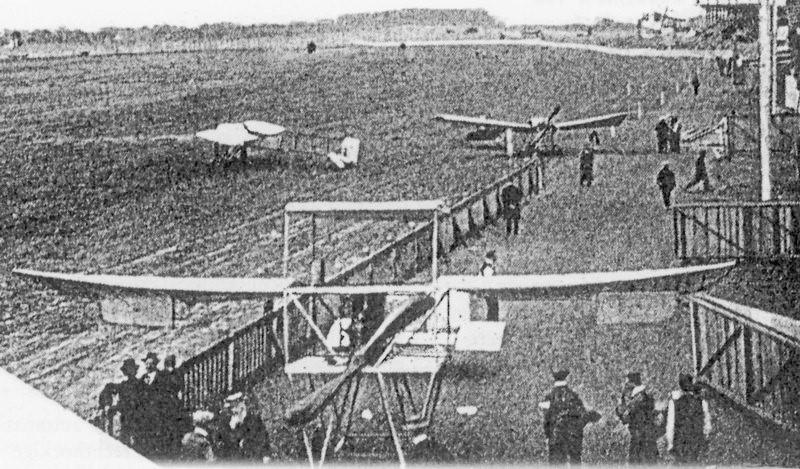
Vanderford 1923 Experimental

In 1923 William Vanderford of Gladbrook IA. Built a single place, open cockpit, high wing monoplane, powered by a 2-cyl Harley-Davidson engine, which was not the only motorcycle part used. Open frame fuselage.

On the first run of the engine the airplane spun around, ran over a small tree, and almost made it to the neighbor’s porch. Taxiing trials were made, but the airplane would not rise, so it ended up instead as a powered sled.

Vanden Plas Médiaplan

The second try at flying by Vanden Plas was the “Médiaplan”, subject of Belgian Patent 237.925 of 22 July 1911. It was built by the Laurent firm at Leuven, which built propellers and other aviation parts. It was shown at Ans on 15 June 1911, flown successfully by Westerlain, although it is reported it ran out of fuel and had to land in field. It was displayed at the XI Salon in Brussels in January 1912 and it was reported that flying would resume in Kiewit, but nothing was heard of it. It was powered by a Vivinus engine, later by a 50 hp Gnôme.

Vanden Plas

The coach building firm Vanden Plas was founded in 1870 in Belgium and employed a total workforce of 750 before the Great War. Albert Victor Vanden Plas tried his hands in designing aeroplanes, first resulting in a Belgian patent for a “Héli-Orthoptère-Planeur”, which was not proceeded with.

The second try was the “Médiaplan”, subject of Belgian Patent 237.925 of 22 July 1911.