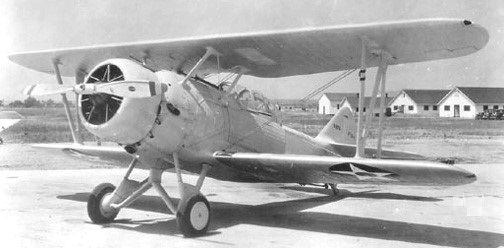
The XF3U-1 was ordered by USN for testing as a replacement for the Helldiver. One was built (9746), first flying on 22 June 1933 and later rebuilt and modified as the prototype XSBU-1.
Engine: 700hp Wright R-1535
Seats: 2
The XF3U-1 was ordered by USN for testing as a replacement for the Helldiver. One was built (9746), first flying on 22 June 1933 and later rebuilt and modified as the prototype XSBU-1.
Engine: 700hp Wright R-1535
Seats: 2
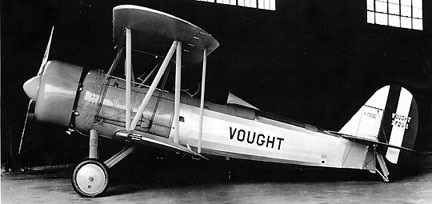
One XF2U-1 (A7692) was built in 1929.
Engine: 450hp P&W R-1340
Wingspan: 36’0″
Length: 27’0″
Useful load: 1368 lb
Max speed: 146 mph
Cruise speed: 110 mph
Stall: 58 mph
Range: 495 mi
Seats: 2
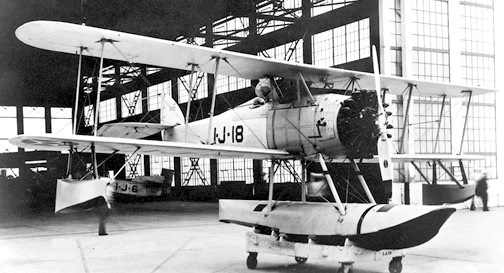
In January 1927 the Chance Vought company produced a single seat fighter version of its mass produced VO 1 shipboard observation aircraft. A two bay biplane, the VO 1 was not entirely suitable as the basis for a competitive fighter, and with only the same engine as before, the 200 hp Wright R 1790 Whirlwind, performance was inadequate. Nevertheless, 20 FU 1 fighters were converted from UO-3 for the US Navy, most of them being central float seaplanes (at least two were fitted with wheels for airfield use).
Despite being pleasant to fly, the FU was really only suitable for training. In their first year, ending in the winter 1928 29, the FU 1s equipped fighter squadron VF 2B aboard the carrier Langley. Thereafter the 18 that survived were converted into FU 2 trainers, still with a fixed Marlin machine gun. They remained in use as trainers and general-purpose aircraft into the 1930s.
Equipped for catapult launch, they were the last fighter so equipped.
FU
Engine: 220hp Wright J-5 (supercharged R-1790)
Span: 10.46 m (34 ft 4 in)
Length: 7.44 m (24 ft 5 in)
Gross weight: 1093 kg (2400 lb)
Useful load: 694 lb
Maximum speed: 236 km/h (147 mph)
Stall: 53 mph
Range: 430 mi
Seats: 1-2
In January 1927 the Chance Vought company produced a single seat fighter version of its mass produced VO 1 shipboard observation aircraft. A two bay biplane, the VO 1 was not entirely suitable as the basis for a competitive fighter, and with only the same engine as before, the 200 hp Wright R 1790 Whirlwind, performance was inadequate. Nevertheless, 20 FU 1 fighters were built for the US Navy.
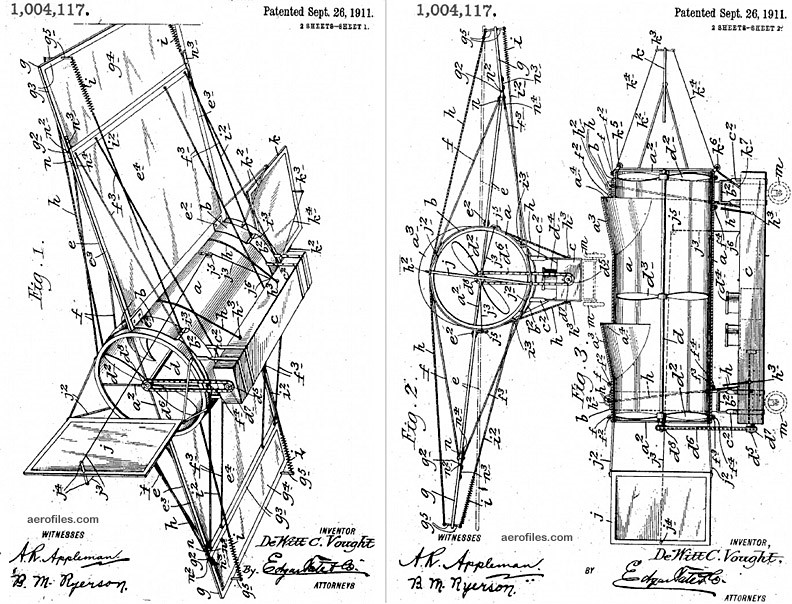
In 1911 the US patent #1,004,117 was issued 9/26/11 for an “aeroplane with car containing motor, etc, free to swing” to De Witt C Vought.
In 1948 E B Votaw built the W-2V registered N17624, A two-place open cockpit monoplane, power was a 125hp Warner Scarab.
Beaumont TX.
USA
In 1948 E B Votaw built the W-2V registered N17624.
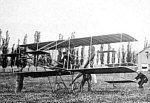
The 1909 Vosgiens biplane was designed and built by Atelier Vosgiens in France.
Atelier Vosgiens built aircraft in France circa 1909.
tandem two-seat military primary jet and electronic warfare trainer, also suited to other military tasks and for use as a civil sporting aircraft. Developed from the Bede Jet Corporation BD-10 prototype first flown July 1992, via the later Peregrine Flight International Peregrine PJ-2. Major design review undertaken, with original supersonic wing replaced by subsonic and simpler wing of greater strength and carrying more fuel.

