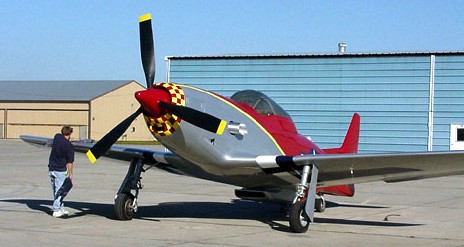
The P-51 is a full size Carbon Fiber Mustang manufactured by Cameron and Son’s Aircraft. This aircraft is available with a 1450 hp turbine, or can be fitted with a Rolls Merlin. It is capable of speeds in the mid 400mph range. There are three options on the canopy, the standard P-51D, a 9ft bubble, or a low profile racing canopy. Also available are standard P-51D wing tips. The cockpit features dual controls. The kit is built from 12 major components, making it the fewest part count aircraft of its kind.
Cruise: 420 mph Stall: 87 mph Range: 580 sm Rate of climb: 4200 fpm Takeoff dist: 1250 ft Landing dist: 1750 ft Engine: Allison, 1750 hp HP range: 1150-3500 hp Fuel capacity: 250 USG Empty weight: 4500 lb Gross weight: 6000 lb Length: 36 ft Wing span: 37 ft Wing area: 233 sq.ft Seats: 2 Landing gear: tailwheel
During the 1980s Malcolm Forbes, publisher of the Forbes magazine, built up a collection of special shape balloons. All built by Cameron Balloons in Bristol, Forbes had a special shape commissioned for each country he had visited. From the early 1980s balloonists from all around the world were invited to fly from Balleroy, his French estate, in Calvados, Northern France where he would unveil his newest creation. Nobody had ever seen hot air balloons like this before with only a very small number of shapes made before the most well-known of the fleet, the original Chateau de Balleroy.
The Chateau, registered G-BKBR and built in 1982, was just one of many other spectacular special shapes which followed, including:
the Minar-e-Pakistan (G-BKNN, 83)
Sphinx (G-BLFE, 84)
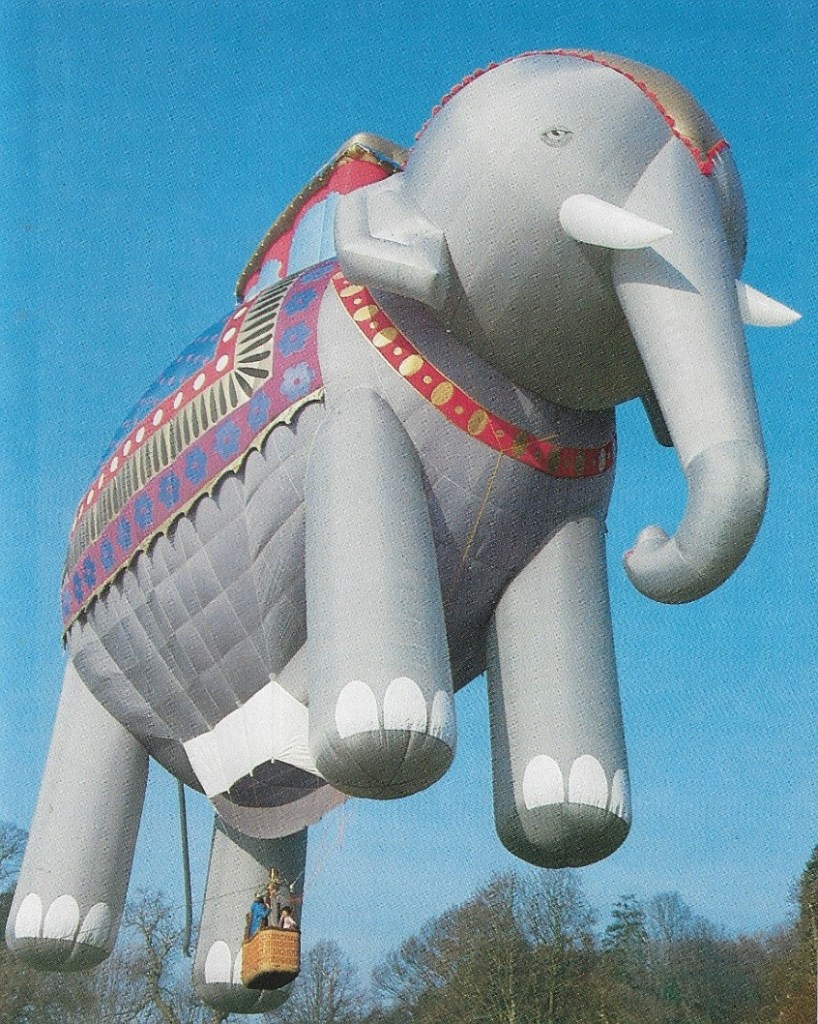
Thailand Elephant (G-BLRW, 85)
Harley Davidson (G-BMUN, 86)
Golden Temple (G-BMWN, 86)
Rosebud Egg (G-BNFK, 87)
Beethoven (G-BNJU, 87)
SulIman the Magnificent (G-TURK, 88)
Forbes Magazine (G-BPOV, 89)
Santa Maria (G-BPSP, 89)
Mcaw (G-BRWZ, 90)
Chateau de Balleroy no.2 (G-BTCZ, 91)
Cameron Balloons test inflated each of Malcolm Forbes’ balloons at Ashton Court Estate early in the morning, which is still done with new balloons to this day before they are shipped to their new home.
Breitling Orbiter was the name of three different Rozière balloons made by the Bristol based balloon manufacturer Cameron Balloons to circumnavigate the globe, named after the Swiss watchmakers Breitling. The third was successful in March 1999 of making the first nonstop flight around the world by balloon. It was piloted by Bertrand Piccard and Brian Jones.
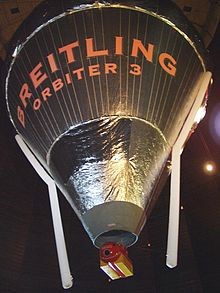
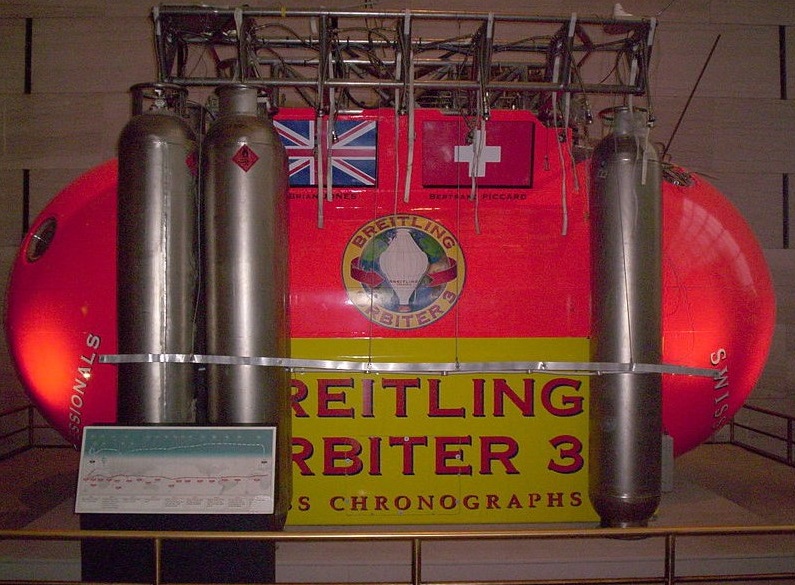
The Cameron R-650 Breitling Orbiter 3 was a Rozier balloon of Kevlar and carbon fiber composite weave built in 1998. The Breitling Orbiter 3 combines the features of a hot-air balloon and a gas balloon, with a helium cell within a hot-air envelope. Initially, the helium cell is filled to approximately 47% of its maximum capacity. During ascent, warming by the sun causes the helium to expand even more than the surrounding air, which aids the balloon in gaining altitude (unlike the expansion caused by the drop in atmospheric pressure, which can even hinder that until the air and helium temperatures equalize).
The propane gas that fueled its six burners was contained in 28 titanium cylinders mounted in two rows along the sides of the gondola. Concerned about fuel consumption, the team added four additional propane containers prior to launch; these additions proved necessary to complete the trip.
The Breitling Orbiter 3 gondola was constructed of a weave of Kevlar and carbon fiber material. After launching, the cabin was sealed at 1,800 m (6,000 ft) to trap the air within it. During the flight the cabin atmosphere was supplemented by nitrogen and oxygen; carbon dioxide was removed by lithium hydroxide filters. Cabin pressure was maintained at around 24 kPa (3.5 psi) by adding oxygen and nitrogen to the cabin air as necessary. At 10,000 m (33,000 ft), the cabin pressure equaled atmospheric pressure at 3,000 m (10,000 ft). Solar panels suspended beneath the gondola recharged the on-board lead-acid batteries that provided electrical power. Satellite-based systems enabled the crew to navigate via GPS as well as communicate.
Bertrand Piccard and Brian Jones launched from the Swiss Alpine village of Château-d’Oex at 8:05, GMT, March 1, 1999. They traveled southwest over the Mediterranean and then swung east over Mauritania on March 2 at a starting meridian of 9 degrees, 12 minutes west. They landed in the Egyptian desert after being aloft 19 days, 21 hours, and 55 minutes on March 21, 1999, having traveled a distance of 40,814 km (25,361 mi). During the course of the flight, the balloon had climbed to altitudes of up to 11,737 m (38,507 ft), and achieved speeds up to 123 knots. The official “finish line” of the circumnavigation occurred over Mauritania at 4:54 AM, EST on March 19. The goal of ending in Egypt had been to touch down near the Great Pyramids; however, high winds forced the pilots to land short of their target about 80 kilometers north of Mut. Aboard, they carried a copy of Guy de Maupassant’s A Life, which had been inscribed by Maupassant to Jules Verne, who had imagined such a flight in his novel, Five Weeks in a Balloon. The book had been loaned to the pilots to carry for good luck by a grandson of Jules Verne from the novelist’s personal library.
The daily routine was for each man to spend eight hours alone at the controls, eight hours working with his crewmate, and eight hours in the single bunk. A unique pressure-operated toilet was included in a curtained off area at the rear of the craft. Despite the use of heaters designed to maintain a cabin temperature of 59 °F (15 °C), temperatures occasionally decreased so much at night that drinking water froze and ice had to be chipped away from delicate electronic circuitry on the interior walls.
The Breitling-Orbiter III accumulated the following records: Flight duration: 19 days 21 h 47 min Maximum altitude: 11,755 meters Maximum ground speed: 240 km / h Distance traveled: 45,755 kilometers Number of countries flown over: 26 countries
When asked by reporter Howard Schneider about the fate of Breitling Orbiter 3, the project manager Alan Noble remarked that the sponsors and the team “…would probably donate the craft to a museum. Possibly the National Air and Space Museum or the Smithsonian.” And indeed the gondola was located for several years on the ground floor of the National Air and Space Museum in the Milestones of Flight Gallery, next to the Wright Brothers 1903 Flyer, Charles Lindbergh’s Spirit of St. Louis, the Mercury Friendship 7 capsule, the Gemini IV capsule, the Apollo 11 command module, and Space Ship One.
The gondola is now displayed at the Udvar-Hazy Center of the National Air and Space Museum, Dulles Airport outside Washington D.C.
A model of the Orbiter 3 constructed with a spare Orbiter 2 envelope was exhibited at Gasometer Oberhausen from 2004 to 2006.
Cameron R-650 Breitling Orbiter 3 Balloon height: 55 m (180 ft) inflated Fuel: Propane Gondola height: 3.1 m (10 ft 3 in) Gondola length: 5.4 m (17 ft 10 in) Weight: 2,000 kg (4,400 lb) empty Cabin Air: nitrogen-oxygen mixture Cabin Pressure: 24 kPa (3.5 psi) at altitude
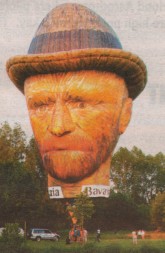
Adding an artistic flavour is a three dimensional replica of Van Gogh’s painting Self-portrait with Grey Felt Hat. Cameron Balloons of the United Kingdom used digital technology to piece the balloon together and it was launched in 2003 at Van Gogh’s birthplace in the Netherlands.
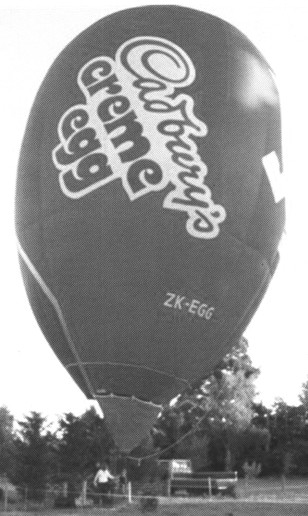
First registered to Cameron Balloons of Bristol, UK, on 11-02-2000 was the 65,000 cu.ft “EGG-65” G-OZEG. This is a two-person balloon built to order for Cadbury’s in the UK to advertise one of their products. The balloon has only three hours on it, all done in NZ before 2003. Cadbury now has no finan-cial interest in the balloon, which was cancelled from the UK register on 17-04-02. Cameron Balloons offered the unit to Andy Nicholson, the NZ dealer, and it became ZK-EGG, with Balloon Affair out of Christchurch.