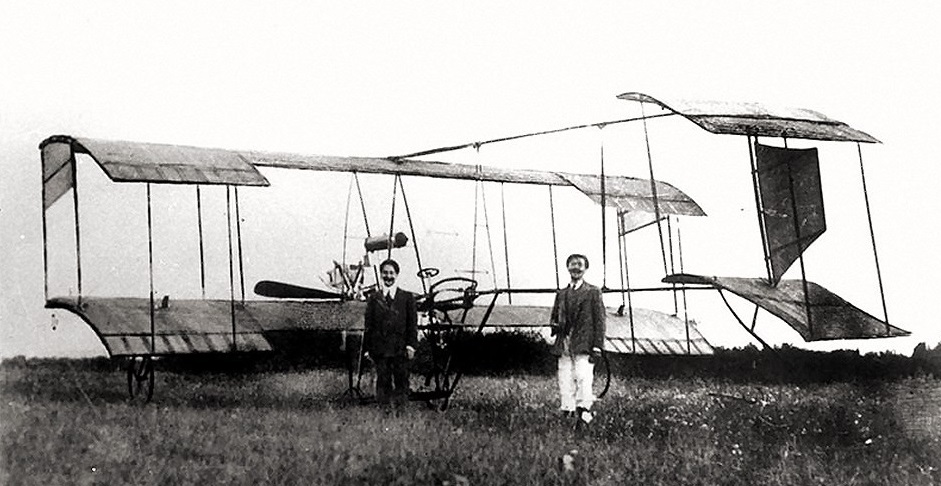
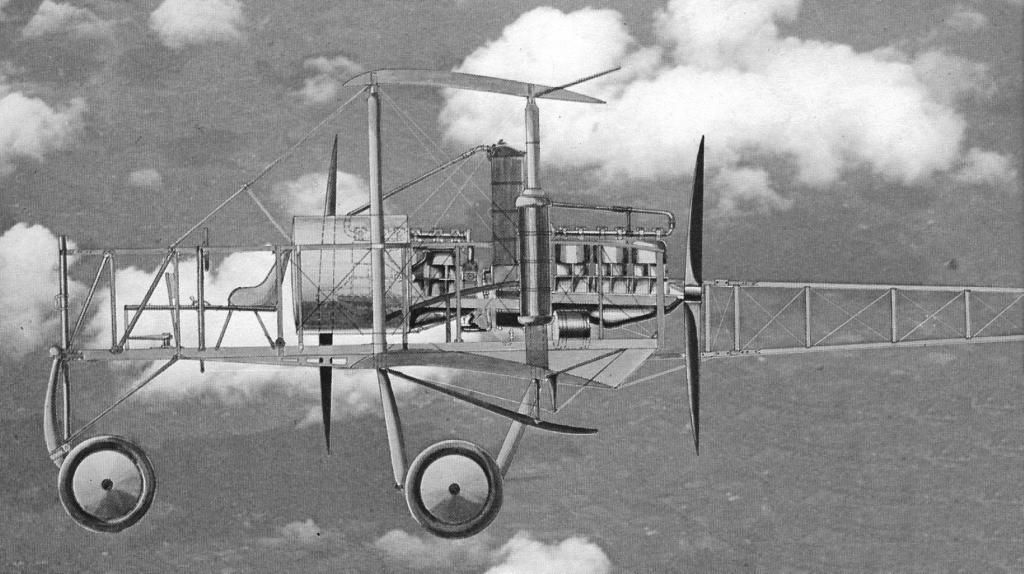
The 1911 Caproni Ca.4, designed and built by Gianni Caproni, was powered by a 25 hp engine.
Span: 44’5″
Length: 30’6″
Weight empty: 530 lb
The 1911 Caproni Ca.4, designed and built by Gianni Caproni, was powered by a 25 hp engine.
Span: 44’5″
Length: 30’6″
Weight empty: 530 lb
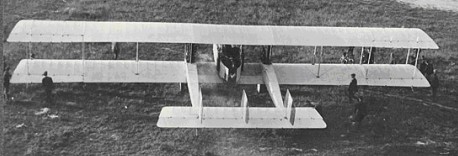
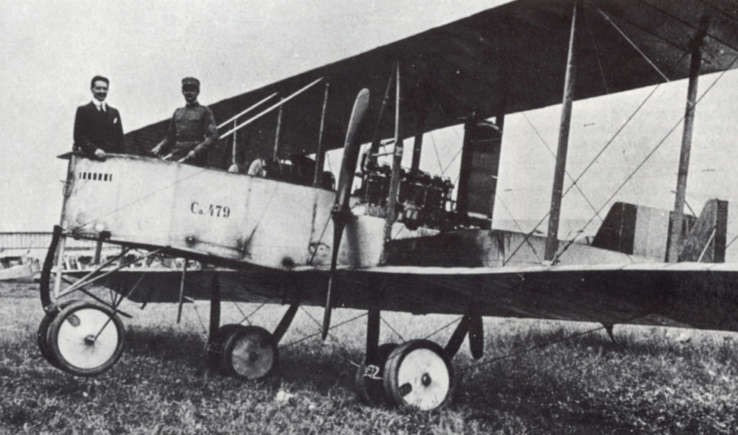
Ca.3 (or Ca.33) of 1917 was the alternative designation of the Ca.450HP, 299 of which were built between 1917 and 1919. Powered by three 112kW Isotta Fraschini V.4B engines, the normal bomb load was 200kg and defensive 7.7mm machine-guns were mounted over the nose cockpit and in a tubular metal structure just behind and slightly higher than the trailing edge of the upper wing centre section.
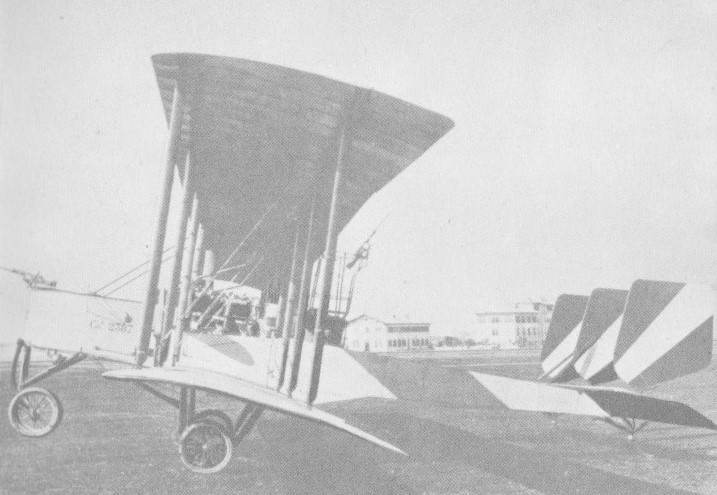
Three main versions were built, consisting 166 Ca.31’s with 80-100 hp Gnome engines, eight Ca.32’s with 100 hp Fiat engines, and the Ca.33.
A three-bay biplane of conventional wooden construction, wooden fuselage, the entire airframe was fabric covered. The tail has a fixed central tail-fin and twin outboard rudders. Ailerons are on all four wings. Each main undercarriage unit has two pairs of wheels. In addition, a pair of nose-wheels are fitted.
The Ca 3 (Ca 33) became the major production version, 270 being built. It was characterized by three bay equal span wings, and three rudders mounted above the tailplane.
In Italian service the Ca 3 was operated by the IV, IX, Xl, XIV and XVIII Gruppi Bombardamenti, and one Italian navy squadron in Albania.
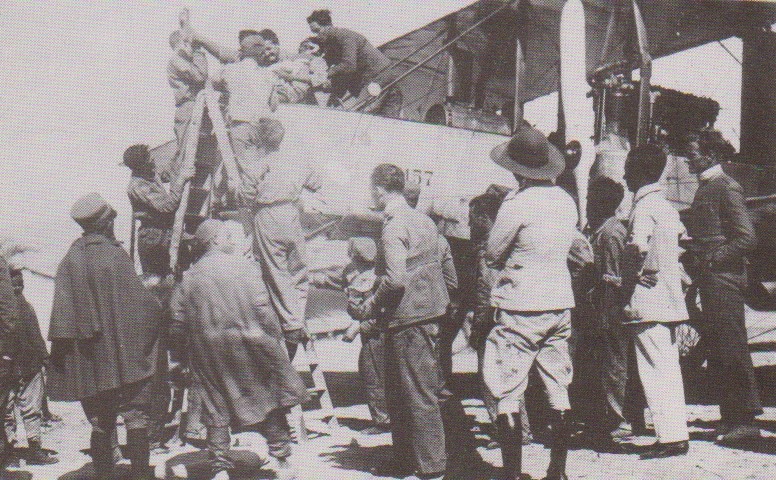
Licence production of a further 86 was undertaken in France by the Esnault Pelterie and SAIB factories, these serving with the escadrilles of the French Aviation Militaire. In addition, wartime and postwar Italian production figures reached 153 examples of the Ca 3 Mod (Ca 36), of which the CAM received 144. These had detachable outer wing panels, and some were converted as ambulance transports (Ca 36 S), carrying four stretchers and up four sitting casualties.
In 1925 eight machines were sent to Libya in support of the reconquest of that territory. By the end of 1926, however, the last examples had been withdrawn from first-line service.
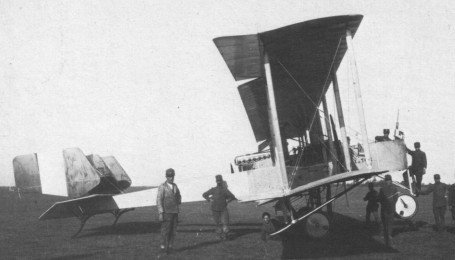
The mainstream Ca 3 bombers carried a crew of four (two pilots, an observer/front gunner and a rear gunner), with a ring-mounted Revelli machine gun in the front and rear positions. The rear gunner was installed in an exposed, cage like structure below and aft of the upper wing trailing edge, directly ahead of the rear propeller.
Most Ca 3s were used for conventional bombing attacks, but some were also employed briefly as torpedo bombers. Experimental variants included models with modified landing gear (Ca 34), tandem pilot seats (Ca 35), shorter span wings (Ca 37) and a proposed single float seaplane version (Ca 39). A number of Ca 3 Mods were adapted as mail or six passenger civil transports (Ca 56a) after the war.
Ca.3
Engines: 3 x Isotta-Fraschini V.4B, 112kW
Max Take-off weight: 3312 kg / 7302 lb
Empty weight: 2300 kg / 5071 lb
Wingspan: 22.2 m / 72 ft 10 in
Length: 10.9 m / 35 ft 9 in
Height: 3.7 m / 12 ft 2 in
Max. speed: 140 km/h / 87 mph
Ceiling: 4100 m / 13450 ft
Range: 450 km / 280 miles
Crew: 4
Armament: 2-4 x 7.7mm machine-guns, 450kg of bombs
Ca,33
Engine: 3 x Isotta-Fraschini V4B, 150 hp
Propellor: 2 x 2-blade tractor, 1 x 2-blade pusher
Wingspan: 72 ft 10 in
Length: 35 ft 9 in
Height: 12 ft 2 in
Empty weight: 5080 lb
MTOW: 8400 lb
Max speed: 85 mph at SL
Service ceiling: 13,400 ft
Endurance: 3 gr 30 min
Armament: 2-4 machine gun
Bombload: 1000 lb
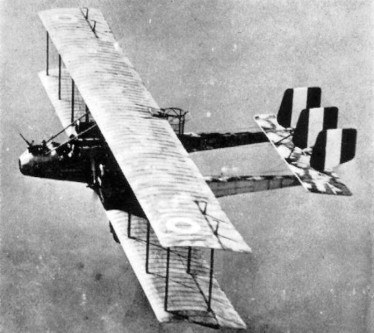
The “Societa de Aviazone Ing Caproni” bureau (better known simply as “Caproni”) proved something of a pioneer in the field, resulting in their first impressive attempt sometime in 1913 as the “Caproni 260hp”. This version sported a “pusher” engine and a pair of “pusher” engines – these 80 hp Gnome rotary engines all being mounted in-line along a central fuselage nacelle. The three man crew sat in the forward part of the nacelle, and two slender fuselage booms carried the triple rudder tail unit. The two pusher systems drove propellers mounted at the tail booms via a tractor arrangement. Prior to the first flight, in October 1914, the two forward engines were re installed with direct propeller drive.
In the post-war years, these respective systems came to be designated as the Ca.30 and Ca.31.
After a period of evaluation, it was determined that the new larger bomber platforms were wholly underpowered. Caproni set to achieve better performance from his “giant” and moved the puller engines to the tips of each tail boom, keeping the pusher system in its centralized nacelle approach from earlier. This allowed each wing-mounted engine to directly drive its propeller more efficiently. The French-based Gnome rotary engines were then replaced with Italian FIAT A.10 inline types and produced the new company designation of “Caproni 300hp”.
A contract was signed for 12 Caproni 300HP bombers powered by three 74.5kW Fiat A.10 engines. First flight occurred in late 1914. A further 150 were delivered during the next two years. These aircraft were also known as Ca.1s and were followed by nine Ca.350HP machines (with the third engine replaced by a 112kW Isotta Fraschini) designated Ca.2.
The Ca.1 featured a wide-span, four-bay, biplane wing assembly. At the center of the wings was fitted the crew nacelle containing the four crew and the third engine. The primary engines were fitted ahead of the twin booms extending aft in a “puller” function arrangement. The third engine on the central nacelle operated in a “pusher” format. The crew consisted of two pilots, a forward gunner and a rear gunner – all fielded in tandem positions. The forward gunner sat in the forward-most compartment. Distinctly, the rear gunner stood in an open air, cage-like pulpit behind the upper wing assembly and ahead of the pusher engine at rear. The twin booms extended aft into a tailplane. The tailplane held three vertical tail fins. The undercarriage was a fixed tricycle featuring two single-wheeled main landing gear legs and a single-wheeled nose landing gear, all supported by struts. The rear of the empennage was supported by a tailskid fitted to the extreme end. Construction was mainly wood covered in fabric.
Bombs were suspended under the central nacelle and there were 2 x 6.5mm FIAT-Revelli machine guns used for defense. These machine guns were fitted to the front gunner tub and the rear gunners pedestal cage.
The 3 x Fiat A.10 6-cylinder, liquid-cooled in-line engines delivered up to 100 horsepower output each. This supplied the massive aircraft with speeds of up to 75 miles per hour as well as a range equal to 344 miles. Her service ceiling was listed at approximately 13,000 feet. Her empty weight ranged in at about 7,200lbs with a gross weight tipping the scales at 8,800lbs. Wingspan was nearly 23 feet with an overall running length of 36 feet plus. She stood 12 feet high.
This revised development led to the Italian Army and the first Italian bomber force. The aircraft was designated officially as the Ca.1 by the Italian Army and production increased by the middle of August 1915. A total of 162 were delivered up to December 1916.
Their first true sortie in Italian Army service occurred on August 20th, 1915, in an attack on Austrian targets at an airfield in Aisovizza. Most Ca.1s were committed to such attacks, primarily against the Austro-Hungarian Empire and the new bomber eventually served in some fifteen total Italian air squadrons during the war effort. Three of these Italian squadrons were known to have operated out of France with another stationed for action out of Libya.
A modified version (for which no post war designation seems to have been allotted) was the Ca 2, in which the ‘pusher’ A.10 engine was replaced by a 150 hp Isotta Fraschini V-4B. Only nine of these were completed.
In the post-war years, the Ca.1 was redesignated Ca.32. The Ca.1/Ca.32s that survived were refurbished to be used as passenger airliners. These could transport up to six passengers in relative comfort and fell under the Caproni designation of Ca.56.
The Caproni Ca.2 (“Caproni 350hp”) was a minor variation (improved engines) on the strengths of the Ca.1 platform. Development ultimately led to the definitive Ca.3 bomber platform.
Caproni Ca.1 / Ca.32
Engines: 3 x FIAT A.10 6-cylinder, 100 hp
Length: 36.25ft (11.05m)
Wing span: 74.61ft (22.74m)
Height: 12.14ft (3.70m)
Maximum Speed: 75mph (120kmh; 65kts)
Maximum Range: 342miles (550km)
Service Ceiling: 13,123ft (4,000m; 2.5miles)
Armament: 2 or 4 x 6.5mm FIAT-Revelli machine guns
Up to 1,874lbs of external ordnance
Accommodation: 4
Hardpoints: 4
Empty Weight: 7,280lbs (3,302kg)
Maximum Take-Off Weight: 8,818lbs (4,000kg)
Ca.2
Span: 34’5″
Length: 32’4″
One of the companies form¬ing part of the industrial empire founded by Count Gianni Caproni in 1908 was Caproni Vizzola, originally an important pilot training school, but from 1934 a design and construc¬tion organization as well.
Company’s founder, Count Gianni Caproni di Taliedo, built and flew his first aircraft in May 1910. Count Gianni Caproni di Taliedo designed his first heavy bomber in 1913. Caproni’s big biplane bombers had a demoralizing effect on ground troops during the Austro-Italian conflict, more by virtue of their size and threatening ap¬pearance than their destructive power, and led to a series of immense triplane bombers during World War I. The first was de¬signed in mid-1915 and was designated Caproni Ca. 40. A later development, the Ca.42.
At one time, largest aircraft manufacturer, the Caproni group comprised more than 20 companies, of which the principal aircraft building members were Aeroplani Caproni Trento, Caproni Aeronautica Bergamasca, Caproni Vizzola SpA, Compagnia Nazionale Aeronautica, Aeronautica Predappio SpA, and Officine Meccaniche Reggiane SpA. The Isotta-Fraschini aero- engine company was also part of the group.
The most prolific company in the group was the Compagnia Aeronautica Bergamasca, which began aircraft design in 1927, joining the Caproni group in the ‘thirties. The chief designer was Cesare Pallavicino, formerly chief designer to Ernesto Breda, and initially the original designs produced by Bergamasca were given Caproni-Bergamaschi designations, but later “Berga- maschi” was dropped and aircraft emanating from the Bergamo works could only be identified by their type numbers, which were in the 300 series.
After formation of Regia Aeronautica in associating with various partners until First World War. 1923 Caproni achieved success with such military aircraft as the Ca 1 -Ca 5 series of large tri-motor biplane and triplane bombers
During the 1920s, a retrospective series of manu¬facturer’s designations was applied to war¬time Caproni designs, in an endeavour to clarify different variants. Under this system the prototype Ca.1 was designated Ca 31 and the Fiat engined Ca 1 was allocated Ca 32; to avoid confusion between the two systems.
Achieved an international reputation with the Ca 36, Ca 73 and Ca 74. The following decade produced the Ca 101, Ca 111, and Ca 133 range of aircraft and a series of multipurpose reconnaissance/light bomber/transport types, production of which was shared with the Bergamasca subsidiary.
Early post-war publicity gained by Ca 60, an enormous eight-engined ‘triple-triplane’ of 1921, intended to carry 100 passengers, which was shared with the Bergamasca subsidiary.
Cantieri Aeronautici Bergamaschi had been absorbed by Caproni in 1931. Initially built Ca 100 and Ca 101, then built the new aircraft to the designs of Ing Cesare Pallavicino.
In the mid ‘thirties Caproni-Vizzola activities were expanded and a fully-equipped factory built. The plant was primarily engaged on sub-contract work building the Breda Ba 65 attack aircraft, but in 1938 its first original designs, the F.4 and F.5 single-seat fighters appeared, powered respectively by the 1,025-h.p. Isotta-Fraschini Asso 121 R.C.40 and the 840-h.p. Fiat A.74 R.C.38 radial. Designed by Ing. Fabrizi, a pre-production batch of fourteen of the radial-engined F.5 fighter was built immediately prior to Italy’s entry into the war, but like most of Italy’s fighters of this period the F.5 was under-powered (maximum speed being 326 mph) and under-armed (two 12.7-mm. guns). Nevertheless, a squadron was equipped with the F.5 for a short period and employed for the night defense of the area surrounding Rome.
One of the fourteen F.5 fighters was re-engined in 1941 with a 1,050-h.p. DB 601 engine. This conversion was designated F.6, but the most interesting development was the F.6Mz powered by the 1,250-h.p. Isotta-Fraschini Zeta engine (which was also to have been installed in the Reggiane Re 2004). The F.6Mz flew for the first time late in 1942 and was to have carried an armament of four 12.7-mm. guns or two 12.7-mm. and two 20-mm. guns. Maximum speed was 404 mph, but the Zeta engine was insufficiently developed for operational service, and the F.6Mz progressed no further than the prototype stage.
Major production types during 1934-1944 were A.P.1 single-seat fighter, followed by the family of multi-purpose twin-engined aircraft: Ca 309 Ghibli; Ca310/310 bis Libeccio; Ca 311 Libeccio; Ca 312 bis Libeccio; Ca 314, and 316.
More than 2,500 examples of the Ca 100 training/touring biplane were built during the 1930s; the Ca 161 bis, a single-seat single-engined biplane, set an international altitude record of 17,083m that remains unbeaten today in its class. The Caproni-Campini CC-1 of 1940 was Italy’s first and the world’s second aircraft to fly by jet propulsion, though it was not powered by a turbine. During the Second World War the company was chiefly concerned with the production and development of the Ca 310-Ca 314 multipurpose twin-engined aircraft and with the Reggiane Re. 2000-Re 2005 series of single- seat fighters. During the lifetime of the group some 180 different types were built, in addition to licensed construction of almost as many by other designers.
The parent company went bankrupt in 1950. Aeroplani Caproni Trento survived the bankruptcy and in May 1952 flew Italy’s first postwar jet light aircraft, the F.5, designed by Dott Ing Stelio Frati.
In 1969, Caproni – Vizzola began producing in his workshops 30,000 m² located near the airport of Milan – Malpenza.
Caproni Vizzola Costruzioni Aeronautiche SpA was formerly the Scuola Aviazione Caproni, the oldest flying school in Italy, and became the last surviving part of the company until bought by Agusta in 1983, producing the Calif series of sailplanes and finally the C22J Ventura two-seat very light basic trainer with two Microturbo turbojet engines, first flown 1980. Earlier it remodeled the Ca 133 for ambulance and military transport duties and assisted in production of the Breda Ba 65. Its first original design had been the F.4 single-seat fighter designed by Ing F Fabrizi, flown in 1940. Prototype F.6 had more powerful engine.
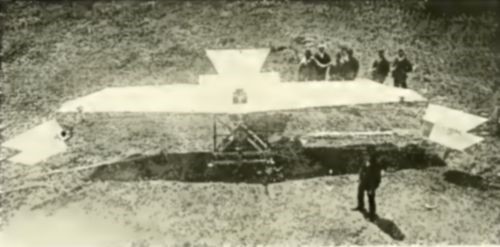
Federico Capone’s machine was called l’Aérogyroplane because of the way it was powered. A small motorcycle engine of 4.5 hp drove double pairs of swinging blades symmetrically disposed at the end of wings. The blades worked like rotors in the initial stage of flight and then their position could be changed from horizontal to vertical. The latter was to give horizontal action to the machine. Built by Ceccarelli in Naples, testing was not very successful, as the machine was partially wrecked by a gale on April 30, 1905. The repaired machine was later sent off from a high launching position and managed to fly a certain distance.
In 1911 Capon designed and built a monoplane in France.
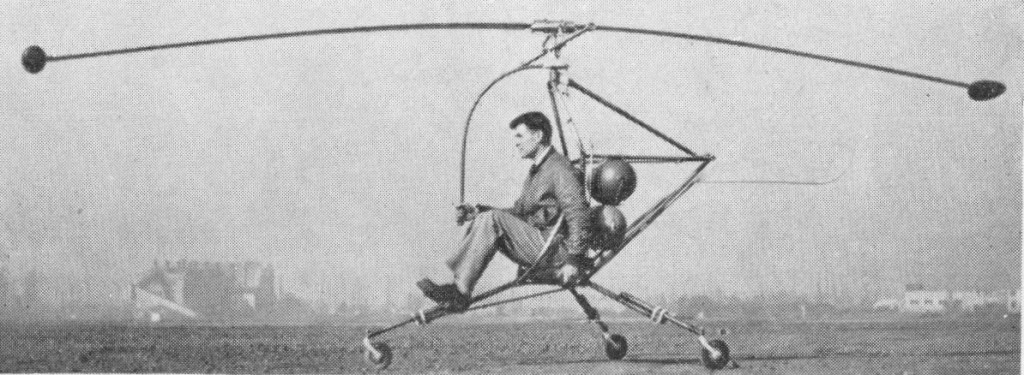
An experimental development of the series of Hoppi-copter personal runabout, designed by Horace Penticost.
Power: 2 x 23 lb. thrust N.R.L. pulse. jets.
Rotor diameter: 18 ft.
Rotors: 2-blade tip-powered main rotor
Loaded weight: 450 lb
Ceiling: 10,000 ft
Typical range: 100 miles at 60 m.p.h.
Seats: 1
USA
Established January 1954 for continued development of C-1 Hoppi-Copter, built previously by Hoppi-Copters Inc. C-1 L, first flown 1954, was a redesigned and simplified version of original 1945 prototype.
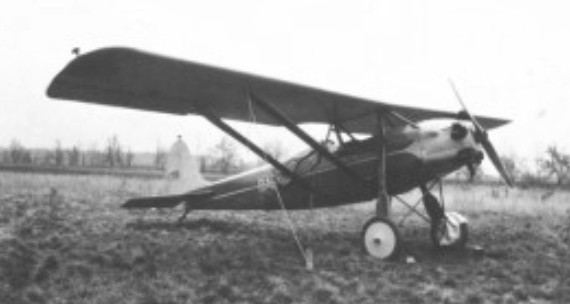
The aircraft was designed by Prof. Peter Altman of the University of Detroit. At that time it was named the Derickson Air Trainer.
John and Donalt Thomas acquired the design rights in 1928 and formed a company under the name Capital Aircraft Corporation located in Lansing, Michigan.
They built only one aircraft, registration number X795K. The airframe was initially built as a seaplane powered with a 60 hp LeBlond 5-D engine, which was exchanged with a 90 hp 7-D when later converted as a landplane. Span was 34 ft, length 25 ft, useful load 535 lbs, Vmax 105 mph, Vc 85 mph, Vso 30 mph, and range 400 miles.
In 1929 Capital Aircraft Corporation was relocated in Royal Oak, Michigan, and was renamed the Royal Aircraft Corporation.
USA
Founded at Detroit, Michigan, in 1928, this company produced a lightweight two-seat sporting and training monoplane known as the Capital Air Trainer.

