Originally developed by Cabrinha as the Free Spirit Mk I and first flown 1986. A composite design with forward swept wing and 2+1 seating. First flown in 1995. The kit price in 1998 was US$24,950.
Engine: Continental IO-360, 210 hp. Speed max: 265 mph. Cruise: 220 mph. Range: 1400 sm. Stall: 52 mph. ROC: 2000 fpm. Take-off dist: 600 ft. Landing dist: 750 ft. Service ceiling: 24,000 ft. Fuel cap: 52 USG. Weight empty: 1150 lbs. Gross: 2150 lbs. Height: 7.5 ft. Length: 20.6 ft. Wing span: 30.3 ft. Wing area: 85 sq.ft. Seats: 3. Landing gear: retractable nose wheel.
1995-7: 345 Woodside Way, Auburn, CA 95603, USA. Markets kits to construct the Free Spirit Mk II two-seat low-wing monoplane, originally developed by Cabrinha as the Free Spirit Mk I and first flown 1986.
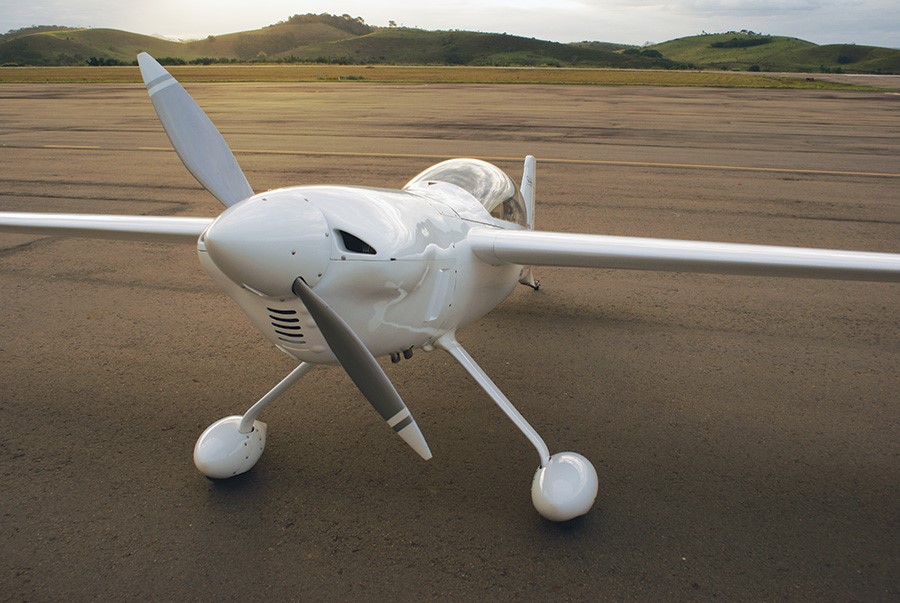
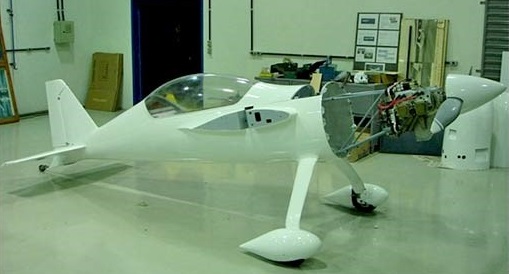
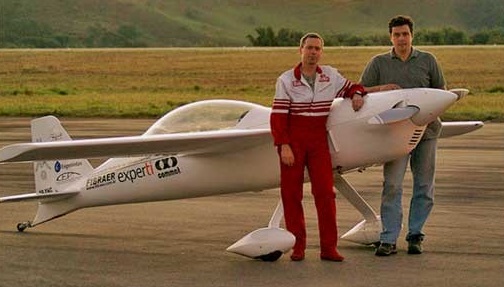
The design phase of the CEA-308 started in 1999 as Paulo Iscold’s undergraduate project. The construction of the design started in 2000 and used wood and steel for the fuselage with white foam formed in between bulkheads and stringers which was carved to shape and covered with fiberglass. The wing is built-up wood ribs and a wood spar; like the fuselage the spaces between the wood parts were filled with white foam which was carved to shape and covered with fiberglass.
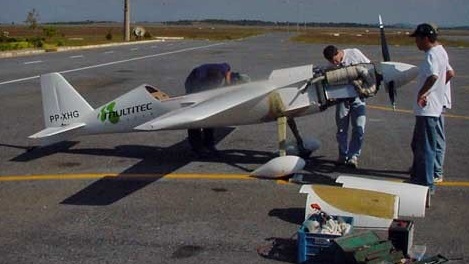
Early CEA-308 2 cycle engine installation
The first flight was flown in 2002, powered by a Rotax 532. The intention was to do initial flight test with the 532 and install a 100hp Hirth 3701 (3 cylinder, 2 cycle) for the records. Early in the flight test program the Rotax 532 failed, while the pilot was able to save the airplane, the engine was lost. As a result, the project was shelved from 2002 until 2005 when Gúnar Armin (former Brazilian Aerobatic Champion) took interest in the project. At this time, the Hirth was still the engine of choice, but an undisclosed problem procuring a suitable engine forced the team to look into other engines. The Jabiru 2200 was selected and one was bought used, and installed in the airplane.
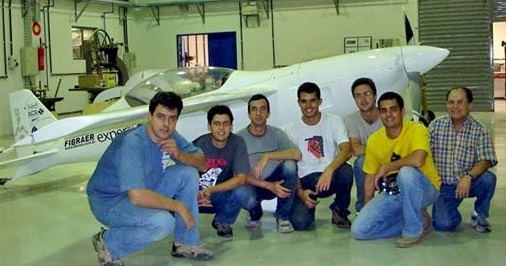
Professor Paulo Iscold and several of the students that helped build the CEA-308
Catto props are also a favorite for absolute speed and other records, where the prop can be optimized for a single flight condition. “Catto has been very supportive of our projects,” says Dr. Paulo Iscold, professor of aerodynamics at UFMG in Brazil, consultant to several Red Bull and Reno air race teams, and holder of four world records with his CEA-308. “The first prop that he sent for our 308 was almost perfect, and the second prop was better than perfect. I’m not afraid to say that Catto’s props are the best aerodynamic setup in the world today. He has been trying many different ideas through the years, and his propellers incorporate many features that are not listed in the usual literature. On the 308 I must remind you that we set the 3 km absolute speed record and the 3000 m time-to-climb record with the same prop!”
The Jabiru 2200 80 hp engine installation in the CEA-308
The Jabiru installation has been on the airplane ever since. Paulo did not say what happened to the exotic custom three bladed propeller they had designed and built for the Hirth. The records (all of which were in the C-1.a/0 weight class) were set on the 1st and 3rd of December 2010 and all attempts were flown by Gúnar on Craig Catto 58×69 propellers. The first flight of the day was the time to climb to 3000m. This was a Russian record and it stood at 13min 40 sec held by Mikhail Markov in a MAI-89 (Rotax 532 USSR 8/6/90). Mr. Armin’s attempt was successful (8 min 15sec), his record also eclipsed the American record (9 min 36 sec) held by Brian Dempsey in a Sonerai (VW 1600 Easton MD 2/19/89). The second record was the 15 km speed record which Gúnar set at 204 mph, previously 181 mph also held by Brian Dempsey in his same Sonerai on the same date and location. The final record set on the 1st of December was the 100 km speed record set at 202 mph, previously 184 mph set by Charles Andrews in the Monex (Aero Vee, Fond du Lac, WI 8/3/82).
The CEA-308, Pilot Gúnar Armin, and Professor Paulo Iscold
The most impressive record setting attempt was on the second day of flying. On the 3rd of December the team tackled the 3km speed record. The record stood at 218 mph set by a BD-5B in Zeltweg Austria (8/28/99). The American record is slower still at 213 mph set by Mike Arnold’s AR-5 (now hanging in the Hiller museum). The CEA-308 took the record at 223 mph, thereby setting four records in two days of attempts.
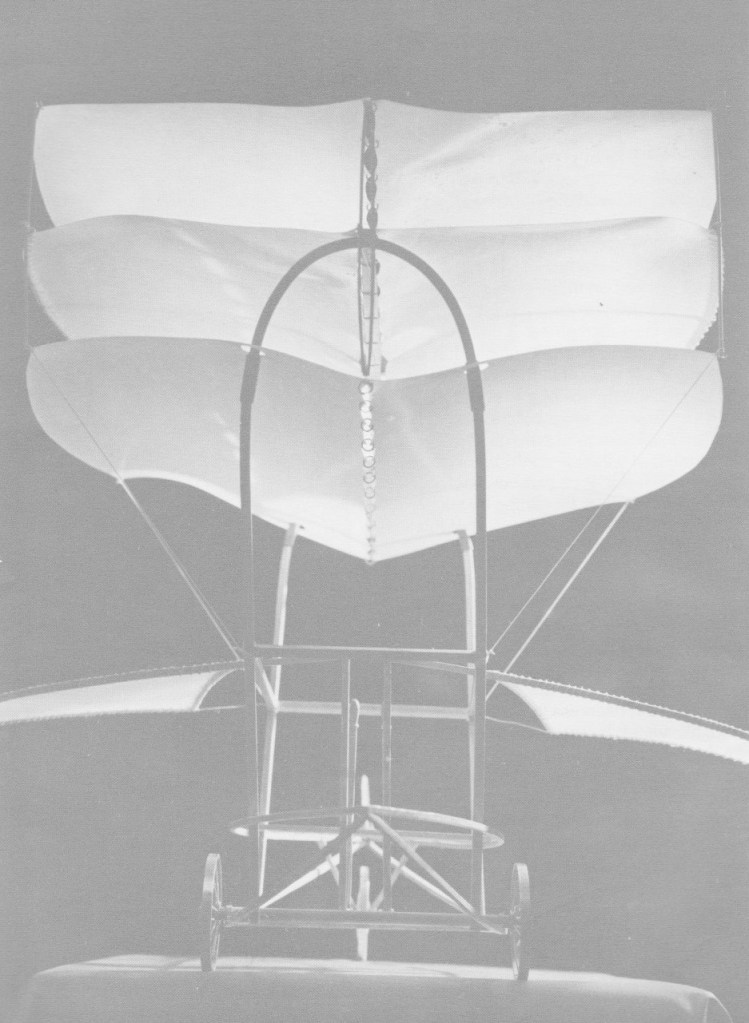
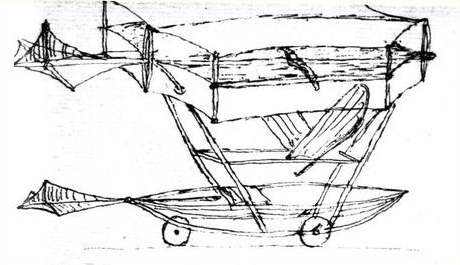
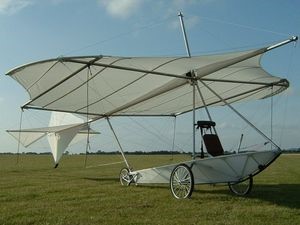
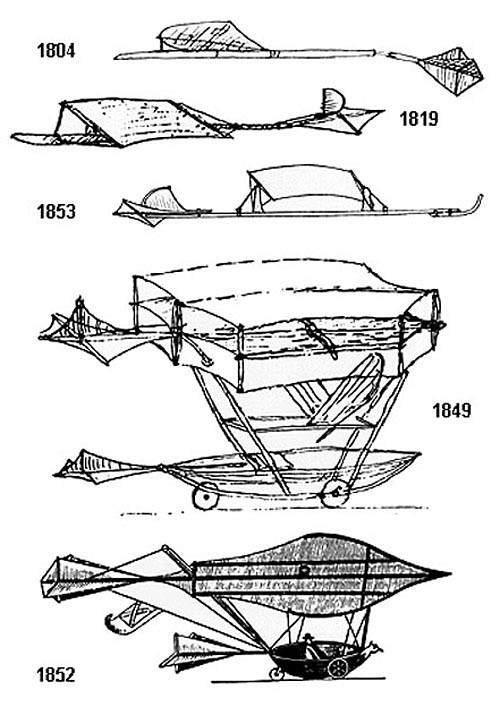
The first Cayley glider was a triplane hang glider designed with an open section in the centre for self-propelled starts. A young boy is reported to have been gently lifted and carried a few yards.
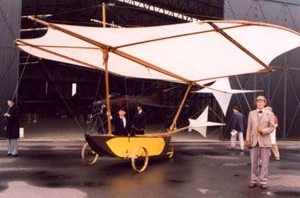
Replica
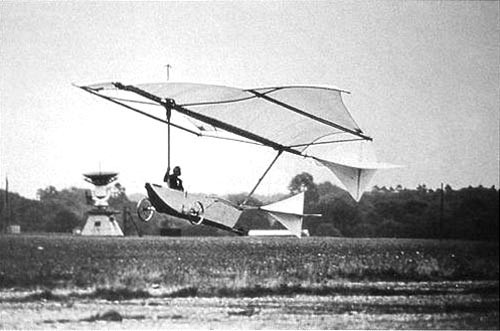
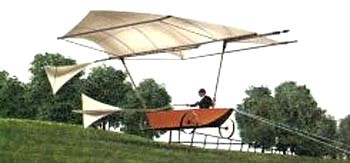
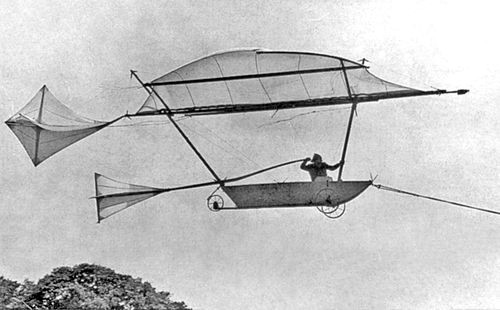
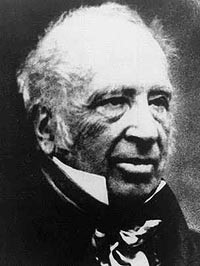
Sir George Cayley (1773-1857) was first to design an aerofoil and one of his flying machines made the world’s first manned heavier-than-air flight at Brompton Dale, near Scarborough, in 1849. This was more than 54 years before the Wright brothers made the first powered flight from Kitty Hawk Sands in the USA on 17 December 1903. Another machine, which Cayley called a ‘governable parachute’, was flown in 1853 at Brompton Dale, carrying Sir George’s coachman, who on coming back to earth said, “I wish to give notice, I was hired to drive not to fly”.
A young girl who was there wrote later: “the wings acted rather on the principle of the parachute, merely flating the experimentor, who started from a moderate elevation, by a gradual descent towards the earth”.
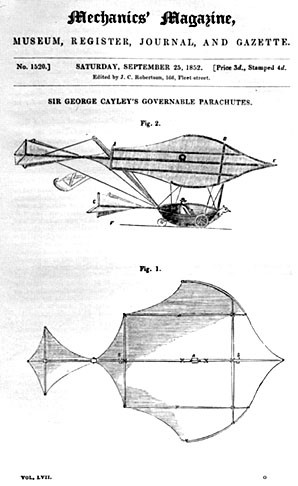
George Cayley, “Governable Parachute”, “Man Carrier” 1852, Replica
It was the world’s first aeroplane with inherent stability.
Sir George Cayley, 6th Baronet (27 December 1773 – 15 December 1857) was a prolific English engineer and one of the most important people in the history of aeronautics. Many consider him the first true scientific aerial investigator and the first person to understand the underlying principles and forces of flight. Sometimes called the “Father of Aviation”, in 1799 he set forth the concept of the modern aeroplane as a fixed-wing flying machine with separate systems for lift, propulsion, and control. Often known as “the father of Aerodynamics”, he was a pioneer of aeronautical engineering. Designer of the first successful glider to carry a human being aloft, he discovered and identified the four aerodynamic forces of flight—weight, lift, drag, and thrust—which are in effect on any flight vehicle. Modern aeroplane design is based on those discoveries including cambered wings. He is credited with the first major breakthrough in heavier-than-air flight and he worked over half a century before the development of powered flight, being acknowledged by the Wright brothers. He designed the first actual model of an aeroplane and also diagrammed the elements of vertical flight.
George Cayley, Gliders, 1804 -1852
Cayley served for the Whig party as Member of Parliament for Scarborough from 1832 to 1835, and helped found the Royal Polytechnic Institution (now University of Westminster), serving as its chairman for many years. He was a founding member of the British Association for the Advancement of Science and was a distant cousin of the mathematician Arthur Cayley.
Successor to Trans-Florida Aviation, acquired during 1960s type certificate for North American F-51 Mustang, producing tandem two-seat business/sport conversions of F-51D as Cavalier 2000 series, and building new single-seat F-51Ds for the USAF counterinsurgency Military Assistance Program. Prototype of Mustang II, two-seat COIN patrol/attack version equipped with heavier armament, flew December 1967; prototype Turbo Mustang III (with Rolls-Royce Dart) in 1969. Second prototype flew in April 1971, equipped with Lycoming TSS engine, by which time the program had been sold to the Piper Aircraft Corporation, but then the company was dissolved.