First flew DK-10 Dracula two-seat lightplane 1998.
Era
CPCA ADC-XO
First flew ADC-XO two-seat ultralight 1997
Centml de Projiectare Si Consulting Pentru SA / CPCA SA
Romania
Centml de Projiectare Si Consulting Pentru Aviatie SA or Aviation Design and Consulting Center. Established 1991. First flew ADC-XO two-seat ultralight 1997 and DK-10 Dracula two-seat lightplane 1998. ADC-H1 two-seat light piston-engined helicopter expected to fly 1999.
Celier Aviation XeWing
The Celier XeWing (contraction of Xenon Wing) is a Polish ultralight aircraft that was designed by Frenchman Raphael Celier and produced by his company Celier Aviation of Jaktorów-Kolonia, Poland.
The XeWing was developed by mating the fuselage from the Celier Xenon 2 gyroplane with a newly designed folding strut-braced parasol wing in place of the rotor system. The aircraft was intended to comply with the Fédération Aéronautique Internationale microlight rules. It features a two-seats-in-side-by-side configuration enclosed cockpit, fixed tricycle landing gear and a single engine in pusher configuration.
The aircraft wing is made from aluminum sheet, has a span of 6.6 m (21.7 ft) and an area of 10 m2 (110 sq ft). The wing can be folded for ground transportation and storage. The standard engine specified was the 100 hp (75 kW) Rotax 912ULS four-stroke powerplant.
Despite the commonality of the fuselage and engine package with the Xenon 2, the XeWing cannot swap its fixed wing for a rotor system.
It was introduced at AERO Friedrichshafen in 2009. The aircraft was intended to be supplied as a kit for amateur construction or as a complete ready-to-fly-aircraft (projected price of €60,000, assembled, in 2011).
By 2012 the company was no longer advertising the XeWing and it is unlikely that it progressed beyond the prototype stage.
XeWing
Engine: 1 × Rotax 912ULS, 75 kW (101 hp)
Wingspan: 6.6 m (21 ft 8 in)
Wing area: 10 m2 (110 sq ft)
Empty weight: 300 kg (661 lb)
Gross weight: 472.5 kg (1,042 lb)
Fuel capacity: 85 litres (19 imp gal; 22 US gal)
Cruise speed: 150 km/h (93 mph, 81 kn)
Stall speed: 70 km/h (43 mph, 38 kn)
Crew: one
Capacity: one passenger
Celier Aviation Kiss
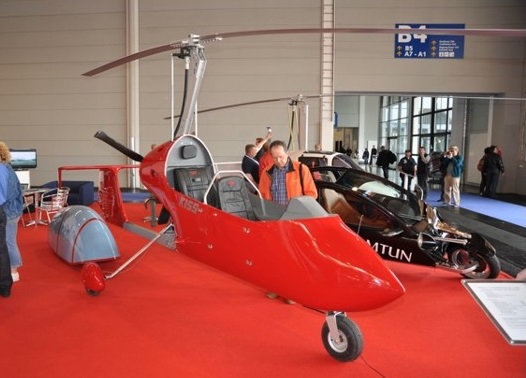
The Celier Kiss is a series of Polish autogyros that was designed by Frenchman Raphael Celier and produced by his company, Celier Aviation of Jaktorów-Kolonia, Poland. When it was available the aircraft was supplied as a kit for amateur construction or as a complete ready-to-fly-aircraft.
The tandem seat Kiss series was designed as a complement to the side-by-side configuration Celier Xenon 2 series of autogyros. The Kiss series all feature a single main rotor, tricycle landing gear, a low-set T-tail and a choice of engines, all mounted in pusher configuration.
In 2011 the Kiss 912, assembled, cost €29,900.
Variants:
Kiss 912
Base model, with two seats in tandem, powered by a 80 hp (60 kW) Rotax 912UL engine in pusher configuration. The cockpit has a semi-enclosed fairing with a windshield.
Main rotor diameter: 8.4 m (27 ft 7 in)
Main rotor area: 55.4 m2 (596 sq ft)
Empty weight: 200 kg (441 lb)
Gross weight: 450 kg (992 lb)
Fuel capacity: 50 litres (11 imp gal; 13 US gal)
Maximum speed: 140 km/h (87 mph, 76 kn)
Endurance: 3 hours
Rate of climb: 3 m/s (590 ft/min)
Disk loading: 8.1 kg/m2 (1.7 lb/sq ft)
Crew: one
Capacity: one passenger
Kiss 912S
Upgraded model, with two seats in tandem, powered by a 100 hp (75 kW) Rotax 912ULS engine in pusher configuration. The cockpit has a fully enclosed fairing.
Kiss 914
Turbocharged model, with two seats in tandem, powered by a 115 hp (86 kW) Rotax 914 engine in pusher configuration. The cockpit has a fully enclosed fairing.
Celier Aviation

Celier Aviation is an aircraft manufacturer, founded by Raphael Celier in France in 1993. The company was moved to Piotrków Trybunalski, Poland in 2006 and Safi, Malta in 2017. The company specializes in the design and manufacture of autogyros available in kit form and also as fully assembled aircraft.
The company established its reputation with the two-seat side-by-side configuration Celier Xenon 2 series of autogyros. By 2011 over 100 of these were flying. Celier subsequently developed a tandem-seat design, the Kiss, but it was not produced in large numbers. By 2014 the company was offering only the Xenon 4, a development of the Xenon 2.
The company also developed the XeWing, a fixed wing light aircraft using the fuselage and engine of the Xenon 2, but mounting a folding strut-braced parasol wing in place of the autogyro’s main rotor. The design was shown at AERO Friedrichshafen in 2009, but was never offered for sale and it is unlikely it was ever developed beyond a single prototype.
Celair Eagle 300
A six-seat STOL cabin lightplane (first flown 1990)
Celair Celstar GA-1
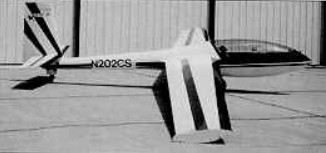
Designed by South African power aerobatics champion Peter Celliers and first flown in 1989, is a new composite aerobatic glider, the Celair Celstar GA 1, designed to JAR 22 specifications (10 g) for competition flying. The machine is stressed to +10g and 10g, with a best glide angle of 23:1.
It has full span mass balanced ailerons. Airbrakes are used for approach control. The main wheel is retractable.
Wing span: 11.2m / 36.75ft
Wing area: 11.54sq.m / 124.22sq.ft
Empty Weight: 265kg / 584lb
Payload: 120kg / 265lb
Gross Weight: 385kg / 849lb
Wing Load: 33.36kg/sq.m / 6.83lb/sq.ft
Water Ballast: 0
Aspect ratio: 10.9
Airfoil: Wortmann FX-71-L-150/25
Structure: glass fiber/ epoxy / aramid
L/DMax: 25
MinSink: 0.89 m/s / 2.9 fps / 1.75 kt
No. of Seats: 1
Celair (Pty) Ltd
South Africa
Developed Eagle 300 six-seat STOL cabin lightplane (first flown 1990); program later offered for sale. Also developed Celstar CG-1 composites aerobatic glider.
Ceita
In 1911 a monoplane was designed and built by Ceita in France.

