Changhe Zhi-11 / Z-11 / H-11

CHAIG Z-11

Development by Chinese Helicopter R&D Institute began in 1991, the Z-11 (Zhishengji-11 / Vertical take-off aircraft 11) appears identical externally to Eurocopter AS 350B Ecureuil except for nose contours, but CHAIG publicity in mid-2001, stated that “China owns its independent intellectual property rights”. Eurocopter (which sold eight Ecureuils to China in 1996) declines to comment on its provenance.

First details officially released at China Air Show in Zhuhai November 1996, together with photographs showing one or two Z-11s in flight, the quoted first flight date of 22 December 1994 is thought to refer to re-engined modification of two secondhand ex-US AStars (Ecureuils) acquired earlier that year. In early 1997, a Chinese government agency announced that the Z-11 had flown for the first time on 26 December 1996.

Technical appraisal was completed in 1996, and small batch production began in 1997. Test programme included flights totalling 1332km in temperatures from —43 to +6°C, including a 2-hour sortie cruising at -38°C. Design was finalised in December 2000, and the Z-11 received CAAC certification in April 2001. CAAC approval for series production for civilian use was announced on 23 December 2002. Power was one 510kW WZ8D turboshaft (licence-built Turbomeca Arriel ID), reportedly produced by Liming engine factory.

Eight said to have been completed by late 1996, of which four had been delivered. All photographs released before late 1998 showed Z-11 in military camouflage with PLA insignia. One report from Aviation Expo China in October 1997 stated that the PLA had ordered 20 military Z-11s, these apparently going to Army Aviation’s training school. Production amounted to ‘several dozen’ by mid-2001, at which time some 10,000 hours flown and 50,000 take-offs and landings. Chongqing Three Gorges General Aviation Airlines (one ordered) reported as first civil customer in mid-2001; China Central Television of Jiangxi Province received one on 25 August 2002.

An armed version, equipped with cannon, ATMs, unguided rockets and a roof-mounted low-light/infra-red sight, has been reported. Later version to be announced is the Z11-MB1, which made its first flight on 7 Match 2003 powered by a 632kW Turbomeca Arriel 2B1A turboshaft.

CHAIG Z-11
Engine: WZ8D turboshaft, 510kW
Main rotor diameter: 10.69m
Tail rotor diameter: 1.86m
Length overall, rotors turning: 13.01m
Fuselage length: 11.24m
Height over tailfin: 3.02m
Height to top of rotor hub: 3.14m
Empty weight: 1120kg
Max take-off weight: 2200kg
Max level speed: 278km/h
Cruising speed: 240km/h
Hovering ceiling IGE: 5240m
Hovering ceiling OGE: 4500m
Max range: 600km
Endurance: 3 h 54 min
Changhe Aircraft Industries / CHAIG / Jingdezhen Helicopter Corporation

Changhe began producing coaches and commercial road vehicles in 1974. These and other automotive products still account for much of output, but batch-produced helicopters have included the Z-8 and Z-l 1. First flew in December 1985 a heavy commercial/military transport and anti-ship helicopter as the Z-8, based on the French Aerospatiale Super Frelon. More recently developed a small multipurpose single-turboshaft helicopter as the Z-11, first flown 1996 and possibly based in part on Eurocopter Ecureuil. Name changed to Jingdezhen Helicopter Corporation in 1998.

CHAIG (formerly Changhe Aircraft Factory), occupied a 433 ha site at Jingdezhen, had a workforce of more than 10,000 in 1998.

CHAIG is responsible for manufacture of the tailcone vertical fin and horizontal stabiliser of the Sikorsky S-92 helicopter. The tail for the first S-92 was delivered to Sikorsky in May 1997. Changhe is also thought likely to become the centre for any Chinese licensed manufacture of the AgustaWestland A 109E Power, which was the subject of Sino-Italian negotiations in late 2002/earIy 2003.

Chargus Vortex

Vortex

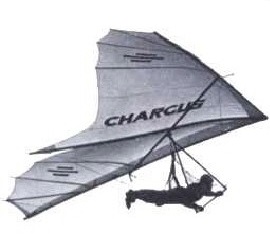
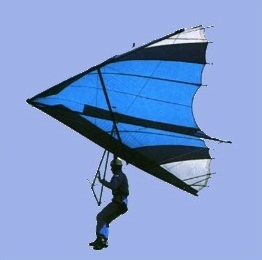
Made in 1978, the Vortex was Chargus’ first contribution to the intermediate glider market. The machine, which was supplied in two sizes, follows the Superscorpion deflexerless concept but with the addition of vortex generators. These are little holes cut in the wing tips just behind the leading edge to give a lower stalling speed than normal. Rigging utilised a difficult to assemble control frame and bolt-on cross booms, like the Mk 1 Superscorpion. Finish was good with lots of attention to details and all tubing is anodised matt black.

The performance of the Vortex is good at slow speeds where it really proves its slow flying, slow sink rate ability. The machine however becomes very light in roll at high speeds and will oscilate badly in rough air, particularly if the pilot is inexperienced and is overcorrecting.

In 1978 the Vortex 110 was priced at £397.00 inc bag and VAT, and the Vortex 120 at £415.00 inc bag and VAT.

Vortex 110
Leading edge: 19 ft 0 in
Keel: 12 ft
Sail area: 196 sq ft
Nose angle: 110 deg
Billow: 0.68 deg
Aspect ratio: 4.6
Span: 30 ft

Vortex 120
Leading edge: 19 ft 0 in
Keel 12 ft
Sail area: 204 sq ft
Nose angle: 120 deg
Billow: 0.68 deg
Aspect ratio: 5.23
Span: 32ft 8 in

Chargus Midas

Midas C

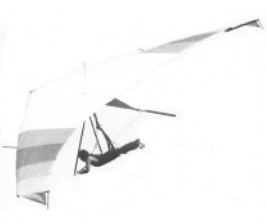
The original Midas was superseded by the 1976 Midas E which was retrospectively re-titled as Midas C. the price including carrying bag, harness and VAT, was £ 450.00 in 1976

The 1977 Midas E was an excellent performing and popular glider. Its short chord at the keel is an unusual feature.

Midas E
Midas Super E

The 1978 Midas Super E has some special features, amongst which are an adjustable C of G strop, large diameter cross boom and short or long keel option. Triple tubular wing posts give greater strength to the airframe and more control to the canopy shape. Aircraft push pins are used for uncomplicated and rapid assembly. Another feature is the floating truncations which greatly contribute to the machine’s speed range, glide ratio and sink rate. The Midas Super E is constructed only of top grade materials and uses American Dacron sail cloth.

Midas C
Sail area: 166 sq.ft
Leading edge: 19 ft 3 in
Keel: 8ft. 3in
Nose angle: 110 deg
Billow 1.6 deg
Aspect ratio: 6.0
L/D: 8 to 1

Midas E
Leading edge 19 ft 11 in
Keel 8ft.3 in
Sail area 188 sq.ft
Nose angle 110 deg
Billow 1.6 deg
Aspect ratio 5.7
L/D 8.5 to 1

Midas Super E
Leading edge: 19 ft 10 in
Root chord: 8 ft
Sail area: 188 sq ft
\Nose angle: 110 degs
Aspect ratio: 5.7
L/D: 9.5:1
Mean chord: 5.74 ft
Keel: 17 ft 5 in
Span: 32 ft 9 in

Chargus Cyclone

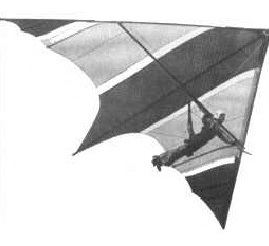
The Cyclone is a high aspect ratio machine which utilises a tight sail and preformed battens. The glider was designed purely for experienced pilots with cross country and competition flying in mind. The Cyclone has single deflexers and unusually a tip to control frame wire and is very sensitive to turning on the various turnbuckles. Handling is a little difficult until the pilot has adapted to the machine’s peculiarities. Pitch and roll on the small 165 model are fairly light which normally leads to quite a lot of pilot induced oscilation. On the large 180 model roll is much heavier, leading to possible discomfort in rough air. Performance is excellent and the sink rate of a well tuned 180 Cyclone is hard to beat. The glider was the fastest of the machines at the time; the large one being faster than the small model.

1979 Cyclone

In 1980-81 the Chargus company brought out the Mk II Cyclone which features a floating keel which improves the handling.

Cyclone 180
Root: 7.66 ft
Sail area: 180 sq ft
Span: 36 ft
Aspect ratio: 7.2
Price: £595.00 inc bag VAT.

Chargus Titan 38

Two seat side-by-side single engined flex wing aircraft with weight shift control. Wing has floating cross tube construction with single surface; mixture of preformed and flexible ribs. Pilot suspended below wing in trike unit, using bar to control pitch and yaw/roll by altering relative positions of trike unit and wing. Undercarriage has three wheels in tricycle formation; no suspension on any wheels. Push right go left nosewheel steering independent from yaw control. Optional brakes on all wheels. Aluminium tube trike unit, with optional pod. Engine mounted below wing driving pusher propeller. Aluminium tubing to British HT30TF specification, anodised. Howe & Bainbridge Dacron sailcloth. Aircraft quality fasteners.
The Titan 38 is designed largely for tuition, it has a side by side seating position, with the pilot and passenger sitting cross armed so that each has a broad grip of the bar. The bar itself doubles as a full width twist grip throttle.
The hang point incorporates a Rose joint allowing the pilot to yaw the trike unit relative to the wing. Excessive yaw movement is prevented by four bungee shock cords, running fore and aft from each end of the trapeze to the trike unit. While this yaw provision could be useful when attempting a. cross wind landing, for example, it is not universally liked by those who have flown the machine.
The driven wheel of the reduction drive incorporates rubber bushes to absorb torsion¬al vibration; in other respects the power unit is a conventional 440 Robin and is offered with optional electric start. Also optional is an extra fuel tank, which can be located behind the seat. The standard vertical cylindrical tanks, one attached to each pole, hold only 1.2 US gal (1.0 Imp gal, 4.5 litre) each.

Wing span 38.0 ft, 11.58 m.
Nose angle 125 deg.
Total wing area 250 sq.ft, 23.2 sq.m.
Wing aspect ratio 5.8/1.
Nosewheel diameter overall 16 inch, 41 cm.
Main wheels diameter overall 16 inch, 41 cm.
Engine: Robin EC44, 40 hp at 5900 rpm.
Toothed belt reduction, ratio 2.0/1.
Power per unit area 0.16hp/sq.ft, 1.7 hp/sq.m.
Total capacity 2.4 US gal, 2.0 Imp gal, 9.1 litre.
Empty weight 2801b, 127kg.
Max take off weight 616 lb, 279kg.
Payload 3361b, 152kg.
Max wing loading 2.46 lb/sq.ft, 12.0kg/sq.m.
Max power loading 15.4 lb/hp, 7.0kg/hp.
Max level speed >42mph, >68kph.
Never exceed speed 45mph, 72kph.
Cruising speed 38mph, 61 kph.
Stalling speed 25 mph, 40 kph.
Max climb rate at sea level 230ft/min, 1.2m/s.
Range at average cruising speed 30 mile, 49km.

Chargus T250/Vortex 120

Single seat single engined flex wing aircraft with weight shift control. Rogallo wing with keel pocket. Pilot suspended below wing in trike unit, using bar to control pitch and yaw/roll by altering relative positions of trike unit and wing. Wing braced from above by kingpost and cables, from below by cables; rigid cross tube construction with single-surface; tapered glass fibre ribs. Undercarriage has three wheels in tricycle formation; no suspension on any wheels. Push right go left nosewheel steering independent from yaw control. Optional brakes on all wheels. Aluminium tube trike unit, with optional pod. Engine mounted below wing driving pusher propeller. Aluminium tubing to British HT30TF specification, anodised. Howe & Bainbridge Dacron sailcloth. Aircraft quality fasteners.
Chargus is known in the British hang gliding world and was one of the first such manufacturers to see the potential of power. The Robin engined T250, usually flown with the Vortex 120 wing, is the company’s only single seat trike unit. The company concentrated on getting the maximum thrust out of the single cylinder engine, by using a toothed-belt reduction drive and a three bladed propeller. The Vortex wing is a single-surface design.

Engine: Robin EC25PS, 22 hp at 6000 rpm.
Propeller: three blade.
Toothed belt reduction, ratio 2.0/1.
Wing span 32.7 ft, 9.97 m.
Length overall 13.0ft, 3.96m.
Chord at root 11.0 ft, 3.35 m.
Total wing area 204 sq.ft, 19.0 sq.m.
Wing aspect ratio 5.2/1.
Wheel track 4.3 ft, 1.31 m.
Wheelbase 4.3 ft, 1.31 m.
Nosewheel diameter overall 12 inch, 30 cm.
Main wheels diameter overall 12 inch, 30cm.
Power per unit area 0.11 hp/sq.ft, 1.2 hp/sq.m.
Fuel capacity 3.0 US gal, 2.5 Imp gal, 11.4 litre.

Chargus Vega

Vega

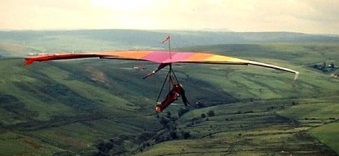
The 1976 Vega is an intermediate glider of the second generation. In November 1976 the price was quoted as £384.00 inc carrying bag, harness and VAT.

The Vega II, made in 1977 was offered in two sizes: ‘A’ 195 sq ft and ‘B’ 220 sq ft.

Vega II

Vega
Sail area: 188 sq ft
Leading edges: 19 ft
Keel: 16 ft
Aspect ratio: 4.47
Billow: 2.75 deg,
L/D: 6.5:1
Nose angle 100 deg

Vega 11 ‘B’
Leading edge 19ft 8in
Keel 15ft. 7in
Sail area 220 sq.ft
Nose angle 100 deg
Billow 2.25 deg
Aspect ratio 4.09
Root chord 15 ft 3 in
L/D 7 to 1

Chard Osprey

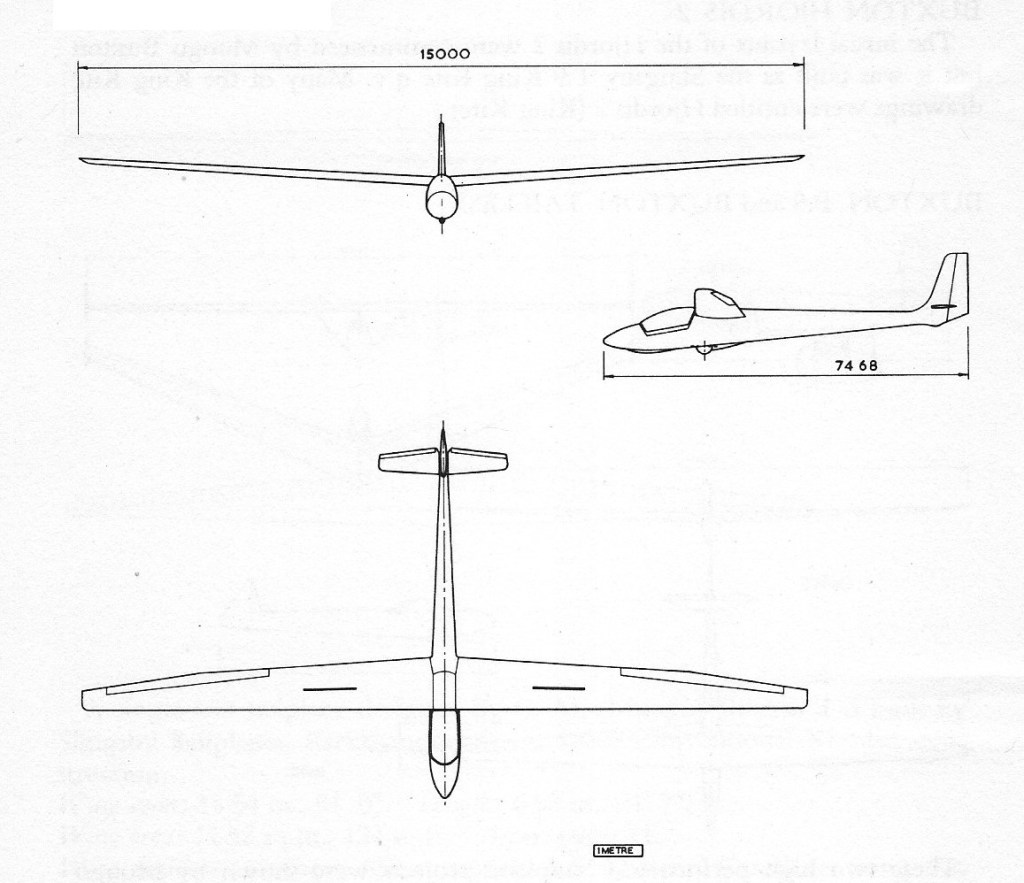
The Chard Osprey standard class glider was designed and built of conventional wooden construction by Keith Chard at Lasham, UK, using a Slingsby T.51 Dart 15 fuselage and tail, c/n 1457. The wings were designed and built by Chard. No flaps or airbrakes were fitted.

The wing sections were Chard KC-24 at root, Chard KC-29 at mid-point, and KC-30 at tip.

It was first flown on 15 May 1966.

Wingspan: 15.0 m / 49 ft 2.5 in
Length: 7.47 m / 25 ft 5 in
Wing area: 12.35 sq.m / 133 sq.ft
Aspect ratio: 18.3
Empty weight: 249.02 kg / 549 lb
AUW: 358.34 kg / 790 lb
Wing loading: 29.04 kg/sq.m / 5.95 lb/sq.ft
Max L/D: 34
Min sink: 0.64 m/sec at 85 kph / 2.1 ft/sec at 53 mph