Experimental assault/cargo glider
Era
Chase Aircraft Corp
Chase Aircraft Corp was established in New York in 1943 by Michael Stroukoff to develop experimental assault/cargo gliders. Produced XCG-14, XCG-14A and CG-18A. Moved to Trenton, New Jersey, late 1946, developing a powered version, 30-troop YC- 122 Avitruc, first flown November 18,1948. Twelve built for USAF trials ,but no further production. Followed by larger C-123 Avitruc, first flown 14 October 1949, derived from XG-20 cargo glider; this project later taken over by Fairchild as C-123B and renamed Provider. An XC-123A prototype (four General Electric turbojets) flew on April 21,1951: first flight of a U.S. transport powered by jet engines. Chase became wholly owned subsidiary of Willys Motors Inc. of Toledo, Ohio, in 1953, itself owned by Kaiser- Fraser. In June 1953 a USAF contract for 300 C- 123Bs was canceled, a smaller contract going to Fairchild that autumn.
Charpentier C-1
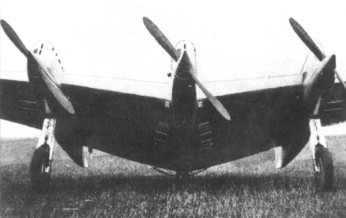
In April 1929, French engineer Jean Charpentier deposited a patent for a twin-engine craft he had named ” plane-aile”. This was followed by a second patent in June 1931, for a twin-engine of transport. These machines remained projects, unlike the following C-1, whose prototype was construct. Having obtained an order from the French government, Charpentier began building the C-1 at the Caudron establishments, in Issy-Les-Moulineaux. The craft was powered by three 6-cylinders Hispano-Suiza line of 100 hp, each with a fixed two-bladed propeller. The C-1 was two-seater, each pilot in a separated open cockpit. The C-1 was damaged during taxy tests at Stamps-Mondésir, in October 1933. Repaired, it took off for the first time in January 1935 with the hands of the Poivre staff sergeant, but crashed almost at once. Extensively damaged, it was not rebuilt.
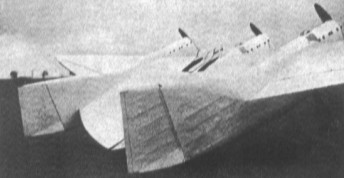
Wing span: 15.00 m
Length: 5.30 m
Wing area: 24.00 sq.m
Max. gross weight: 2000 kg
Charles & Robert Charlières
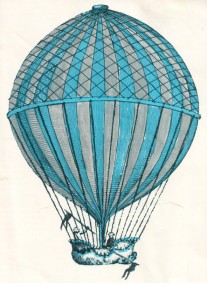
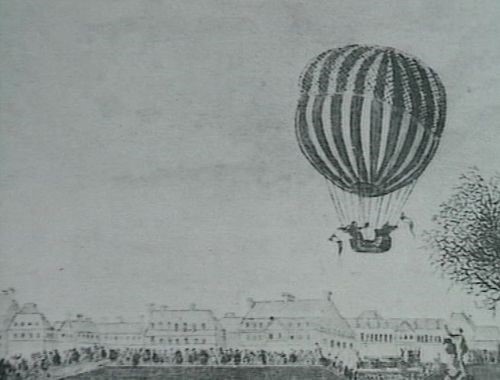
The early successes of the Montgolfiers had prompted the geologist Faujas de Saint-Fond to raise a public subscription for construction of a small silk hydrogen-filled balloon by J.-A.-C. Charles, the physicist, and two mechanics, the brothers Robert. This balloon flew 15 miles, unpiloted, on 27th August 1783; and on 1st December Charles and the elder Robert flew for more than two hours in a 26-foot-diameter hydrogen balloon, from the Tuileries Gardens in Paris, some 27 miles to Nesle. After touching down, Charles went up again by himself, but was so alarmed when the balloon shot up to over 9,000 feet that he never flew again.
More important than the flights themselves was the fact that Charles’s balloon was such a masterpiece of design and manufacture that many of its features — the valve, the net, the suspension of the basket, the provision of ballast, use of a barometer and the gas — have been retained to this day in free balloons.
Charomskiy M-40
The liquid-cooled V-12 turbocharged diesel engine M-40 was a development of the experimental AN-1RTK turbo-supercharged diesel engine that had begun development in the early 1930s. It dropped its predecessor’s supercharger, but added another two E-88 turbochargers and two intercoolers. It failed its State acceptance testing in May 1940, but production began regardless at the Kirov factory in Leningrad which built 58 engines in the first half of 1941. Production ceased in the Fall after a total of 120 engines were finished.
Delivery problems with the Mikulin AM-34FRNV forced the termination of the production of the Petlyakov Pe-8 for lack of suitable engines in 1940, but the M-40 was adapted for use on the Pe-8 in the spring of 1941. However the M-40 tended to “cut out at high altitude because the manually controlled fuel feed depended on a certain engine speed being maintained and it could only be restarted at about 1,500 metres (4,900 ft)”. In August 1941 the M-40s were removed from the few Pe-8s that had received them and placed into storage. In 1944 Factory No. 500 began to disassemble them in order to use their components in the closely related Charomskiy ACh-30B engine.
A boosted version, the M-40F, was tested in the Summer of 1940 and was approved for production the following November, although only a small batch was built in 1941. It was evaluated in a Yermolaev Yer-2 during 1941, but not accepted for use.
Variants:
M-40
main production version
M-40F
boosted version, Power: 1,500 hp (1,100 kW), Weight: 1,200 kg (2,600 lb)
Specifications:
Type: V-12, turbocharged, four-stroke, diesel engine
Bore: 180 mm (7.1 in)
Stroke: 200 mm (7.9 in)
Displacement: 61.04 L (3,725 cu in)
Dry weight: 1,150 kg (2,500 lb)
Turbocharger: 4 x E-88
Fuel type: diesel
Cooling system: liquid-cooled
Power output: 1,250 hp (930 kW)
Compression ratio: 13.5:1
Charomskiy ACh-30 / M-30
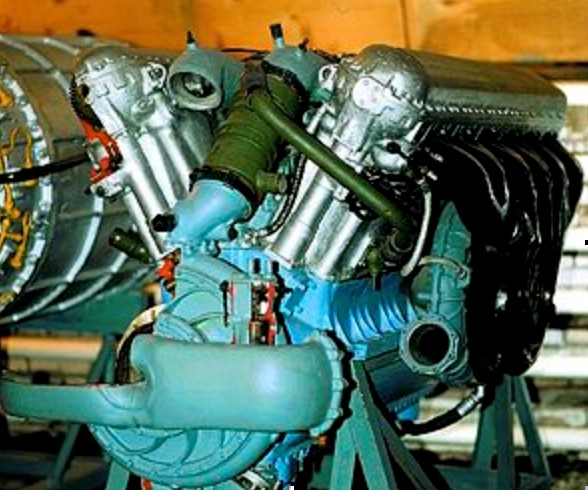
The Charomskiy M-40 was a Soviet turbocharged aircraft diesel engine developed during World War II. It was used in a few Petlyakov Pe-8 heavy bombers until August 1941 when it was removed, because it was unreliable at high altitudes. The engines were stored until 1944 when they were disassembled and their components were used in the closely related Charomskiy ACh-30B.
The Charomskiy ACh-30 was a Soviet liquid-cooled V-12 turbo-supercharged diesel aircraft engine developed during World War II. The initial version was not very satisfactory and it was cancelled when its factory was forced to evacuate in the autumn of 1941. But production was reinitiated in the summer of 1942 and continued until September 1945 to meet the need for an economical engine to power the Soviet long-range bombers like the Petlyakov Pe-8 and the Yermolayev Yer-2.
The ACh-30 was a development of the experimental AN-1RTK turbo-supercharged diesel engine that had begun development in the early 1930s. It was initially designated as the AD-5 when development began in the sharashka attached to Factory (Zavod) No. 82 at Tushino Airport in 1939. Construction of the first five prototypes began at the end of that year and it passed its tests in early 1940. Preparations to begin series manufacture at Factory No. 82 began in May 1940, but actual production was delayed until 1941 when forty-four were built as the M-30. Production was planned to be transferred to the Kharkov Tractor Factory, but this was cancelled before any engines were built. The M-30 had proven to be unsatisfactory in service, as it was unreliable and troublesome at high altitudes and in cold conditions. Specific problems were its failure to deliver full rpms and it suffered from oil blowouts and failures of the oil pumps. Therefore production was cancelled when Factory No. 82 was forced to evacuate in the fall of 1941 because of the German advance on Moscow.
Production was reinitiated in the evacuated workshops of Factory No. 82 by Factory No. 500 in June 1942, thirty-two engines being completed during the year. Development of supercharged versions began about the same time, using geared, centrifugal type superchargers adapted from the Mikulin AM-38 and the Klimov M-105 engines with intercoolers. That from the AM-38 was more successful and was put into production as the M-30B. Thirty-five incomplete M-30 engines were modified beginning in August into M-30Bs and then thirty-four M-30Bs were produced during the rest of 1942. Oddly the ACh-30B, as the engine was now known, was not formally accepted for series production until 19 June 1943, but production had begun quite a bit earlier than that. Factory No. 45 began production in the fourth quarter of 1943. Some 1450 ACh-30Bs were built before production ended at both factories in September 1945.
The ACh-30B was tested as a motorjet where the jet engine’s compressor was driven by the piston engine’s turbochargers. It was bench tested from June 1944 through May 1945, but was never installed in any aircraft. The jet engine’s thrust was 1,925 lbf (8.56 kN) and the equivalent horsepower of the combination was 4,500 hp (3,400 kW). The combination weighed 1,700 kg (3,700 lb).
Versions of the ACh-30 were evaluated on the Ilyushin Il-6 and the ANT-67, a long-range version of the Tupolev Tu-2, but neither aircraft was put into production. It was also proposed for use on the Tupolev Tu-8S and the MN executive transport, but neither of those projects progressed past design proposal stage.
Variants:
AD-5, M-30, ACh-30
four turbochargers, but no supercharger. Weight: 1,200 kg (2,600 lb), Power: 1,500 hp (1,100 kW), approximately 76 built.
M-30F
1942 prototype. Power: 1,750 hp (1,300 kW)
M-30B, ACh-30B
main production variant, 1450 built.
M-30D
Boosted version for an attack aircraft with 2,000 hp (1,500 kW). Factory No. 500 ordered to develop this version, but no further information is known.
ACh-30BF
Boosted version of the ACh-30B. Weight: 1,280 kg (2,800 lb), Power: 1,900 hp (1,400 kW), 17 built by modifying standard ACh-30Bs.
TD-30B
tank engine – a post-war development that later led to the TD11B tank engine.
Applications:
Petlyakov Pe-8
Yermolayev Yer-2
Specifications:
ACh-30B
Type: V-12, turbo-supercharged, four-stroke, diesel engine
Bore: 180 mm (7.1 in)
Stroke: 200 mm (7.9 in)
Displacement: 61.04 L (3,725 cu in)
Dry weight: 1,290 kg (2,800 lb)
Supercharger: geared, centrifugal type supercharger
Turbocharger: 2 x T1-82
Fuel type: diesel
Cooling system: liquid-cooled
Power output: 1,500 hp (1,100 kW)
Compression ratio: 13.5:1
Charles A Zornes Co 1909 Biplane

Built by Charles A Zornes in 1909, a single place open cockpit biplane described in Jane’s as having Voisin-type bowed wings with ailerons; horizontal tail forward, and a vertical one aft.
Engine: 25-35hp chain-driving two pusher props
Wingspan: 37’0″
Length: 41’0″
Seats: 1
Charles A Zornes Co
Lind WA.
USA
Circa 1909 biplane builder
Changshan Fuerdan Paramotor

Engine: YIWUPROMOTION Power STRONG
Volume: 98.2 cu.cm
Power: 18HP at 9700 rpm
Carburetor: Walbro 32
Thrust: 55KG
Drive Method: Belt-Drive & Gearbox Drive
Start Method: Hand
Oil box volume: 8-10 lt
Engine Oil rate: 3%
Propellers diameter: 115cm, 122cm, 130cm
Oil consumed: 2.1-2.4 lt/hr
Reduction Drive Ratio: 1:3.3
Weight: 11.5 KG
Pilot Max Weight: 90KG
Max flight time: Around 3 hours
Coating of Cylinder Bore: Pottery-Plating Technology
Changhe WZ-10
The CAIC WZ-10 (Changhe Aircraft Industries Corporation / Wuzhuang Zhisheng) is an attack helicopter, with this particular model being produced for use by the People’s Republic of China.
The two crew members sit in tandem with the pilot in the rear and seated higher than his gunner at front. Wing stubs provide the ability for the system to wield munitions of various sorts and center around anti-tank missiles. Additionally the WZ-10 is believed to possess anti-aircraft abilities. Standard armament includes a chin-mounted 23mm cannon.
Power is derived from twin turboshafts centering on the Pratt & Whitney Canada PT6C-67C series. These two engines produce 1,531 horsepower each. The systems drive a five-blade main rotor and a four-blade tail unit. The transmission development is based on help from Agusta Westland. In all, the helicopter is believed to be in the same class as modern systems such as the Denel Rooivalk and Eurocopter Tiger and is slated for operational service beginning 2008.
CAIC WZ-10
Engines: 2 x Pratt & Whitney Canada PT6C-67C turboshaft, 1,531hp
Main rotor: five-blade
Tail rotor: four-blade
Length: 46.26ft (14.1m)
Height: 12.63ft (3.85m)
Maximum Speed: 168mph (270kmh; 146kts)
Maximum Range: 497miles (800km)
Service Ceiling: 19,685ft (6,000m; 3.7miles)
Armament: 1 x 23mm cannon in undernose position
Accommodation: 2
Hardpoints: 4
Empty Weight: 12,214lbs (5,540kg)
Maximum Take-Off Weight: 13,228lbs (6,000kg)

