Crosby CR-4

NR92Y

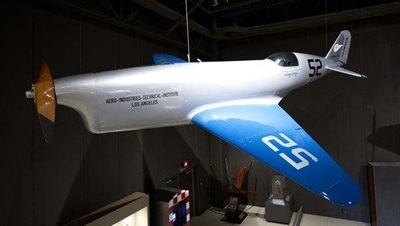
Harry Crosby designed the all-metal CR-4 racer while recuperating from serious back injuries sustained in the crash of its predecessor, the CR-3. The CR-4 incorporated butt joints, flush riveting, and stress skin construction, and was designed to carry a 420 hp ranger V-12 engine. When plans for procuring that engine fell through, Crosby used the Menasco Super Buccaneer from the CR-3.

The airplane first flew in April 1938, but, dogged by engine and gear problems, it didn’t race until 1939. At the 1939 Greve, Crosby was awarded third place despite being flagged down in the 13th lap. He took fourth in the Thompson that year, with an average speed of 244.522 mph. After the race, Crosby and his crew kept the plane in Cleveland to be filmed for the movie Tailspin before trailering it back to California. There the CR-4 spent a few days in a sound stage for engine noise recording and cockpit close-ups for the film.

Before being stored in Crosby’s shop in Burbank, the plane was unofficially clocked at 386 mph, a speed that would have made it faster than Howard Hughes’ racer. Crosby went on to test planes for Northrop, and was ultimately killed testing the XP-79B.

Shortly after the end of World War II, an Air Force pilot named Harry Austell purchased the CR-4 from Crosby’s widow. He intended to restore and race the plane, but Austell apparently never completed that restoration, and the CR-4 itself disappeared. That is until Morton Lester, following up a tip from a friend, discovered the plane’s fuselage on a farm outside Norlina, NC. More searching through the farm’s outbuildings turned up nothing, until Lester looked inside a disused school bus parked in the woods. There he found the plane’s wing panels, landing gear doors, flaps, and other smaller pieces.

Restoration of the plane was begun by Lester and completed by the EAA staff after the aircraft was donated to the museum.

Engine: Menasco C6S-4 Super Buccaneer, 260 hp
Length: 21 ft. 6 in.
Wingspan: 16 ft.
Tailspan: 6 ft. 1 in.
Empty weight: 1540 lbs.
Propeller diameter: 6 ft.
Top recorded speed: 244.52 mph
Crosbie Aeronautic Chariot

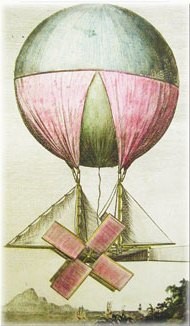
As detailed in the September 1784 issue of Hibernian Magazine, the gondola portion of the craft – with its windmills, masts, and sails – had been built and were on display by August of that year. The article explains how his craft was supposed to work, which in its own way was quite ingenious and clever, even if it was doomed to fail. As events transpired, it wasn’t until January of 1785 that Richard Crosbie was first able to take to the skies. When he did so, it was in a conventional hydrogen balloon, the fixtures and fittings of his “Aeronautic Chariot” having been left behind on the ground. Crosbie went on to make a series of attempts to cross the Irish Sea, none of which were successful.

Crosbie spent much of his childhood devising peculiar contraptions at his family home in Baltinglass, Co Wicklow. By 1783, he was a student at Trinity College, Dublin, listening to the tale of two Frenchmen who spent 25 minutes elevated in the sky within the basket of a hot air balloon.

Crosbie vowed he would one day cross the Irish Sea. His vehicle of choice would be a rubberised silk-covered balloon, filled with hydrogen.

To raise funds for his adventure, Crosbie held an exhibition in Ranelagh Gardens in Dublin. For a small fee, the public was invited to examine both his balloon and the “aeronautic chariot” which would carry himself, his equipment, his scientific instruments and the ballast.

On the final day of his exhibition, he launched the balloon skywards with a cat on board. It travelled north-west, rolled up the Scottish coast and was recovered near the Isle of Man the following day. Crosbie let his fans know that next time, he would be on board.

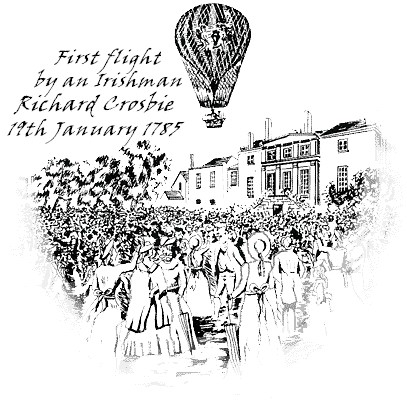
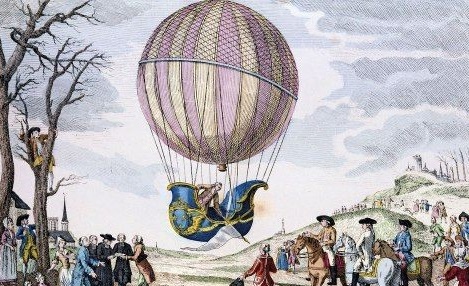
Ticket sales for the big event went through the roof, with forged tickets adding to the mayhem. At 2.30pm on January 19th, 1785, Richard Crosbie stepped into his aeronautical chariot. Ever the showman, the tall aeronaut wore a long, fur-lined robe of oiled silk, a waistcoat and breeches of white quilted satin, Moroccan boots and a leopard skin cap. His balloon was embellished with paintings of Minerva, the Roman goddess of wisdom, and Mercury, the messenger of the gods, carrying the coat of arms of Ireland.

He saluted the 20,000 strong crowd, ordered the ropes cut and ascended into the heavens over Dublin. He was visible for three and half minutes, then disappeared into a cloud. Richard Crosbie became the first Irishman to fly.

His audience roared with delight. As it happened, he only got as far as Clontarf before loosening the valve and returning to earth.

Crosbie might not have crossed the Irish Sea but the flight was hailed as a pioneering scientific achievement across Europe and considered a great victory for Ireland.

The event is recalled by a small plaque in Ranelagh Gardens.

Crosbie, Richard

Richard Crosbie spent much of his childhood devising peculiar contraptions at his family home in Baltinglass, Co Wicklow. By 1783, he was a student at Trinity College, Dublin, listening to the tale of two Frenchmen who spent 25 minutes elevated in the sky within the basket of a hot air balloon.

Crosbie vowed he would one day cross the Irish Sea. His vehicle of choice would be a rubberised silk-covered balloon, filled with hydrogen.

To raise funds for his adventure, Crosbie held an exhibition in Ranelagh Gardens in Dublin. For a small fee, the public was invited to examine both his balloon and the “aeronautic chariot” which would carry himself, his equipment, his scientific instruments and the ballast.

Cropmaster Aircraft Pty Ltd

Australia
Amalgamation of Yeoman Aircraft Pty. Ltd. and Yeoman Aviation Pty. Ltd. which, in 1959, began building prototype Yeoman YA1, first flown January 1960. This one/two-seat agricultural low-wing monoplane started production in 1964 as YA1 Cropmaster. A projected tricycle- landing-gear YA5 Fieldmaster was not built, and in 1967 production rights in the YA1 were sold to the Cameron-Gray Aircraft Company of the U.S.A.