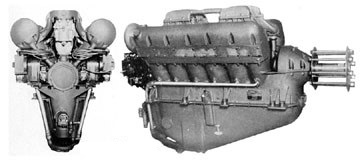
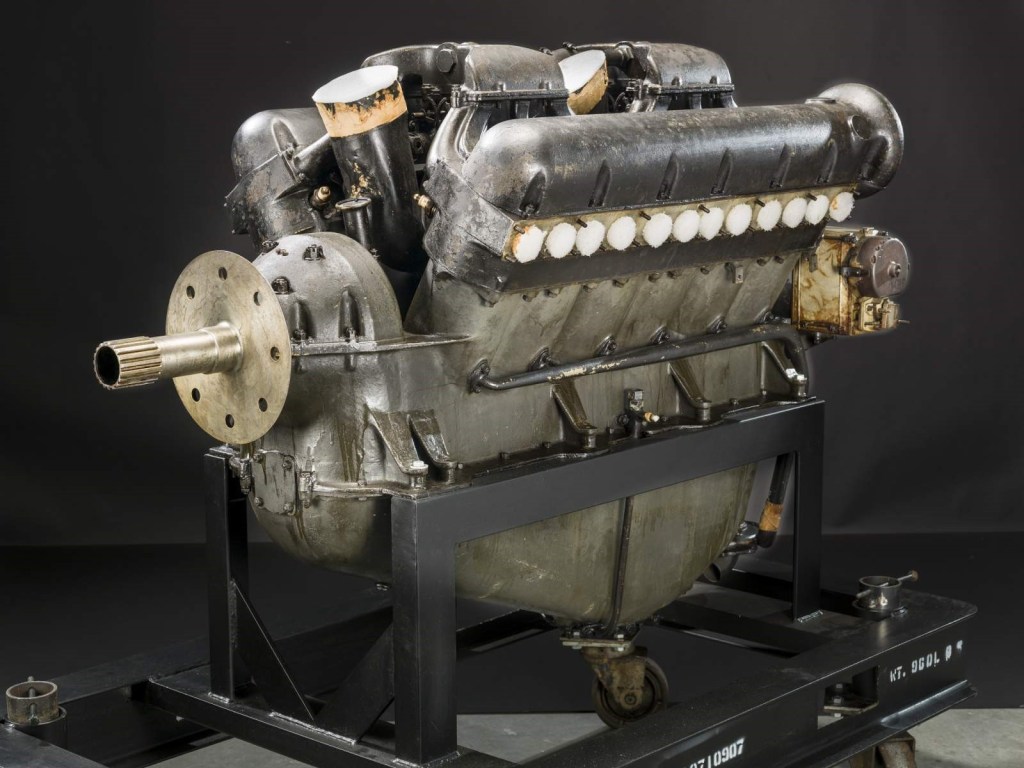
Curtiss R-1454

The Army issued a specification for a new engine, known as the R-1454, on 15 Aug 1923. Development of the engine itself had been carried out by the Army through Wright, Lawrance, and an independent engineer, S D Heron, and had been through many changes, to the cylinders in particular. The fixed-price contract was won by Curtiss, following its bid on 13 Nov 1923, and was for the construction of three engines with an option for three more. The first engine was delivered in Sept 1924 and it gave up to 405hp @ 1650rpm. A modified cylinder developed by Heron (Type M) was fitted to the engine, and the Army instructed Curtiss to proceed with the other engines called for under the contract in Feb 1926.

Output: 400hp
Capacity: 1454ci.
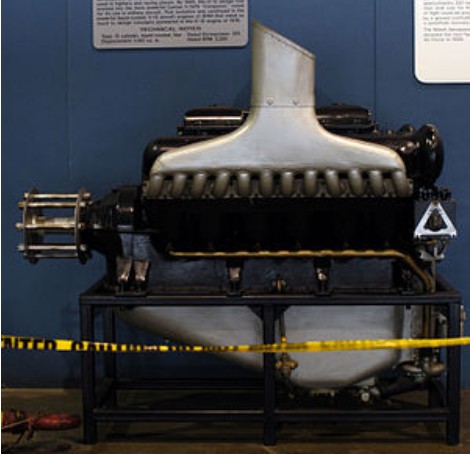
Curtiss-Kirkham K-12

The 1917 Curtiss AB conceptual 12-cyl experimental low-drag, low-weight power engine for fighter planes project was shelved with only one built. The acquired technology went into development of the Curtiss-Kirkham K-12.

Designed by Charles B. Kirkham and first tested in 1916, the V12 K-12 featured a cast aluminum upper crankcase and integral cylinder blocks, four valves per cylinder, and “wet sleeve” construction for improved cooling. It relied upon high rpm and reduction gearing to develop the same power as larger engines. Although technologically advanced, many of the K-12’s innovations challenged the state-of-the-art and created serious reliability problems. Most problems were centered on producing reliable reduction gears. The K-12 design, however, led to the development of the very successful Curtiss D-12 (1922) engine used in fighters and racing planes. By 1926 the D-12 design had evolved into the more powerful Curtiss V-1570 “Conqueror,” noted for its use in military aircraft. That evolution was continued in the powerful liquid-cooled, V-12 aircraft engines of World War II that owed so much to design concepts pioneered in the K-12 engine of 1916.

Curtiss K-12
Type: 12-cylinder liquid-cooled V
Bore: 4.5 in (114.3 mm)
Stroke: 6.0 in (152.4 mm)
Displacement: 1,145.1 cu in (18.77 L)
Cooling system: liquid
Power output: 375 hp / 280 kW at 2,250 RPM
Weight: 307.5 kg (678 lb)
Length 152.4 cm (60 in.)
Width 70.8 cm (27.875 in.)
Height 101.9 cm (40.125 in.)

Curtiss V-3

Curtiss V-3

The 1914 water-cooled Curtiss V-2 and V-3 were designed by Charles Manly and were the first Curtiss V-8.

Russia bought several V-3s, but never received them. Their freighter was sunk on the way by a German U-boat.

V-2
Displacement: 1009.56ci
Power: 180-200hp@1400rpm
Dry weight: 690 lb

V-3
Displacement: 1009.56ci
Power: 180-200hp@1400rpm
Dry weight: 690 lb