Formed from merger on August 9,1929 between Curtiss Aeroplane and Motor Co Inc. and Wright Aeronautical Corporation. Subsequent production mainly by Curtiss Airplane Division of Curtiss-Wright (aircraft still being “Curtiss” types rather than “Curtiss-Wright,” except for those with “CW” designations. In August 1929, stock changed hands, and the Curtiss Wright Corporation be¬came the controlling power in Travel Air. Travel Air’s production had been one ¬tenth of the total U. S. output of commercial airplanes.
In 1936 complete reorganisation dissolved all main subsidiaries except Wright Aeronautical Division. From 1930 onwards main products included F9C Sparrowhawk fighter, carried on board USN airships; F11C/BFC Goshawk for USN and export versions Hawk I/ II/ III/ IV; SBC Helldivers for USN; SOC Seagull for USN; BT-32/ CT-32/ T-32 Condor bomber and civil/military transport; A-8/10/12 Shrike for USAAC; P-36 for USAAC and export Hawk 75s; one CW-20 prototype (later used by BOAC); C-46 Commando (USAAF) and R5C (USN) transport developments of CW-20; CW-21 Demon fighters; SNC trainers for USN, developed from CW-21; P-40 Warhawk/Tomahawk/Kittyhawk fighters for USAAF and other Allied services, of which 13,738 built during Second World War; C-76 Caravan transports for USAAF; O-52 Owl observation biplanes for USAAF/USN; SO3C Seamew for USN and Fleet Air Arm; SB2C Helldiver; AT-9 Jeep twin-engined trainers for USAAF; SC Seahawk scout seaplanes for USN; Republic P-47 Thunderbolt fighters for USAAF. Total wartime production (1940-1945) was 26,755 aircraft and 223,036 aero engines.
After the war many Curtiss factories closed and most aircraft construction discontinued. Some Boeing B-29 modification undertaken until end of 1945, but Curtiss- Wright basically then undertook overhaul and repair of aircraft and manufacture of components, subassemblies and spare parts. By 1952 was concerned exclusively with production of aero engines and propellers. At the end of the 1950s Curtiss-Wright made a brief return to aircraft production with Skydart rocket-propelled target drone and prototype VZ-7AP VTOL “Flying Jeep” for Army trials. Last type produced by the company was the X-19A, a six-seat convertiplane with twin engines driving tandem pairs of tilting propeller/rotors; first flight June 26,1964, but development discontinued 1966. By 1970s main activities of the corporation included nuclear research, data transmission, and research into new advanced engine designs for USAF and NASA, although still made components for Boeing 747 airliners.
The Aerophysics Development Corporation was absorbed by Curtiss Wright Corporation and became its Santa Barbara Division.
Era
Curtiss M / Monoplane
Built to order for Raymond V. Morriss, a Curtiss employee, the single-seat model M made its first flight in January 1914. The Tadpole was the world’s first monoplane flying boat.
Curtiss Tadpole
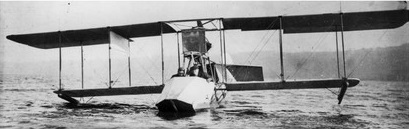
Curtiss built the Tadpole to test the aerodynamic relationship between the planning hull and the rigging of the wings. The first variation used a 100 hp Curtiss OX engine and came with the unequal span wings of the early F Boat, but with inset ailerons and several degrees of sweep. One of the devices tested on this aircraft was a set of moveable struts on the upper and lower wing centre sections that enabled incidence to be adjusted. If the wing were adjusted to a negative incidence while the plane was moored, it would not tend to become airborne during high winds. Continuing experiments were carried out with the Tadpole in the winter of 1914 when it was fitted with outrigger skis and flown from a frozen lake.
Curtiss-Wanamaker Triplane / Curtiss T / Curtiss Model 3
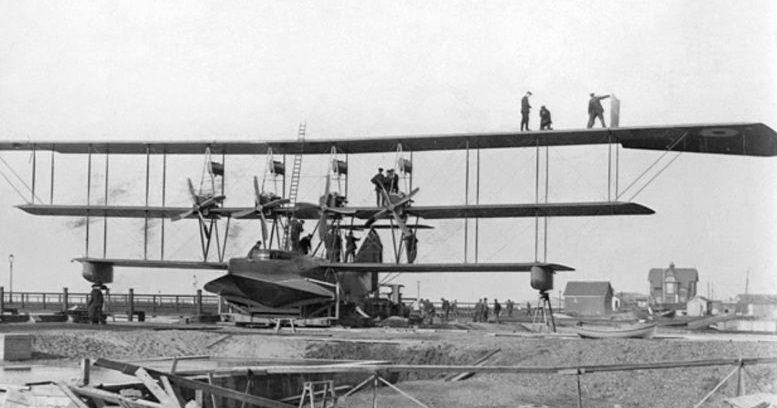
In 1915, the American businessman Rodman Wanamaker who, prior to the outbreak of the First World War commissioned the Curtiss Aeroplane and Motor Company to build a large flying boat, America to win the £10,000 prize put forward by the British newspaper Daily Mail for the first aircraft to cross the Atlantic, commissioned Curtiss to build a new, even larger flying boat for transatlantic flight that became known as the Wanamaker Triplane, or Curtiss Model T, (retroactively re-designated Model 3 when Curtiss changed its designation system).
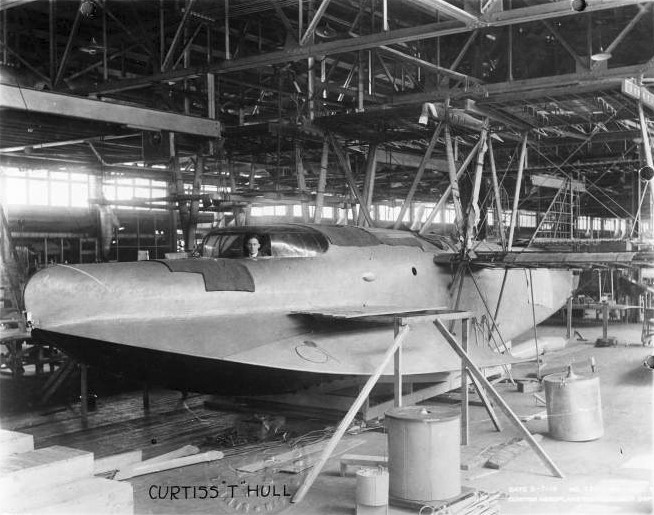
Early press reports showed a large triplane, 68 ft (17.9 metres) and with equal-span six-bay wings of 133 foot (40.5 metre) span. The aircraft, to be capable of carrying heavy armament, was estimated to have an all-up weight of 21,450 pounds (9,750 kilogrammes) and was to be powered by six 140 hp 104 kW) engines driving three propellers, two of which were to be of tractor configuration and the third a pusher.
The British Royal Naval Air Service (RNAS) placed an order for 20 Triplanes. The first one was completed at the Curtiss factory, Buffalo, New York in July 1916. This was the first four-engined aircraft to be built in the United States and one of the largest aircraft in the world.
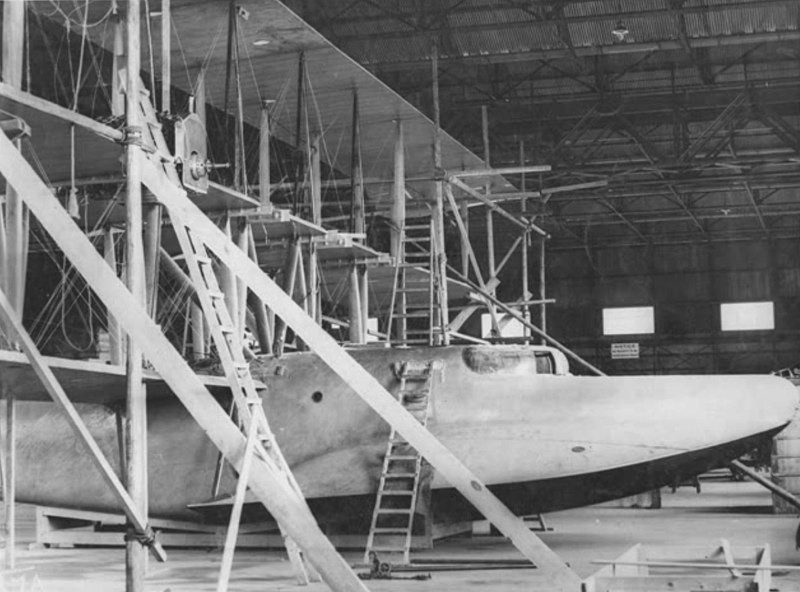
The finished Model T differed from the aircraft discussed in the press in various points. Size and weight were similar, with the upper wing having a span of 134 feet, but the other wings had different spans. It was planned to be powered by four tractor 250 hp (187 kW) Curtiss V-4 engines installed individually on the middle wing, which was unusual for the time. The crew of two pilots and a flight engineer were provided with an enclosed cabin, similar to the Curtiss Model H. To reduce the forces a pilot would need to use on the controls, small windmills could be connected to the aileron cables by electrically operated clutches to act as a form of power assisted controls.
As the planned Curtiss V-4 engines were not available when the prototype, 3073, was completed, it was decided not to fly the aircraft in the United States, but to take it to England by ship where it was reassembled at the naval air station Felixstowe. Initially it was fitted with four 240 hp (180 kW) Renault engines, but these were soon exchanged for four 250 hp Rolls-Royce Eagles.
As the aircraft was damaged beyond repair on the maiden flight it was considered unsuccessful, and the order for the remaining nineteen cancelled. The Wanamaker Triplane did however, provide the inspiration for John Porte of the Seaplane Experimental Station to build a massive five-engined flying boat of similar layout, the Felixstowe Fury.
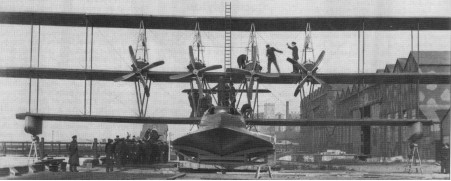
Although 20 Curtiss-Wanamaker triplanes were ordered by Britain, only one, 3073, reached the RNAS.
Engines: 4 × Renault 12F, 240 hp (180 kW) each
Upper wingspan: 134 ft (41 m)
Mid wingspan: 100 ft (30 m)
Lower wingspan: 78 ft 3 in (23.85 m)
Length: 58 ft 10 in (17.93 m)
Height: 31 ft 4 in (9.55 m)
Wing area: 2,815 sq ft (261.5 sq.m)
Empty weight: 15,645 lb (7,096 kg)
Gross weight: 22,000 lb (9,979 kg)
Maximum speed: 100 mph (161 km/h; 87 kn)
Range: 675 mi (587 nmi; 1,086 km) at cruise speed of 75 mph
Endurance: 7 hr
Time to altitude: 10 minutes to 4,000 ft (1,220 m)
Crew: 6
Engines: 4 x RR Eagle Mk1, 250 hp.
Curtiss Robertson
Founded at St Louis, Missouri, in 1928 as division of Curtiss- Wright Corporation with William B. Robertson as president. Main products were Robin three-seat high-wing cabin monoplane (noted for its endurance records) and Kingbird seven-passenger development with twin engines. Neither was produced on a large scale.
Curtiss-Reid Courier
A single-seat lightweight mail-carrying monoplane.
Curtiss-Reid Rambler
Powered by a license-built Cirrus engine, and at least six of these aircraft were supplied to the RCAF
Curtiss-Reid Aircraft Co
Canada
Founded in Montreal in January 1929 by a merger of the Reid Aircraft Company (founded 1928) and the Curtiss Aeroplane & Motor Co of New York. W. T. Reid, formerly chief designer of Bristol Aeroplane Company, had founded Reid Aircraft to build a light biplane of his own design. This was produced by the new company as the Curtiss-Reid Rambler, powered by a license-built Cirrus engine, and at least six of these aircraft were supplied to the RCAF. Opened flying school in 1930. Built also the Courier, a single-seat lightweight mail-carrying monoplane.
Curtiss V-8
The 1912 Curtiss V-8 aero engine was a water-cooled eight-cylinder Vee producing 75-80hp. It was basically the same as the O/OX series.
Curtiss V-4
The circa 1911 Curtiss V-4 aero engine was a water-cooled four-cylinder Vee producing 40-60hp from 1649.34ci with a dry weight of 1,086 lb.

