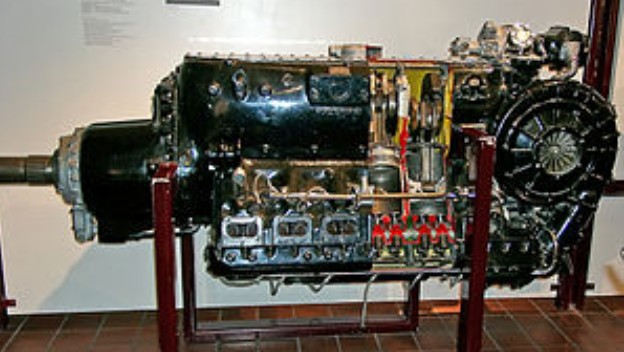
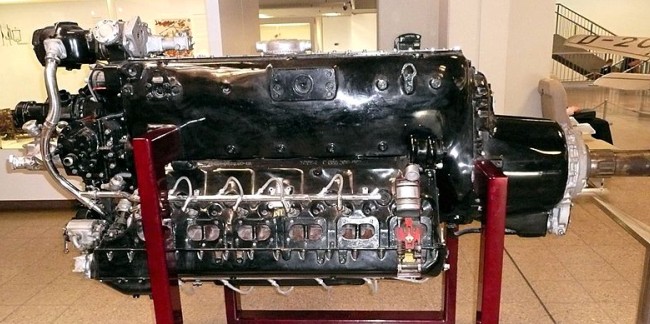
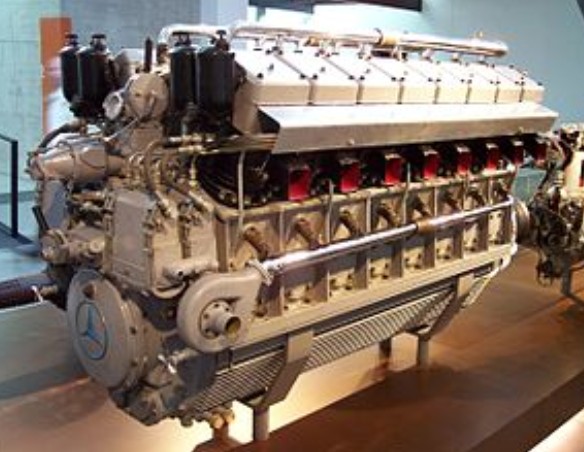
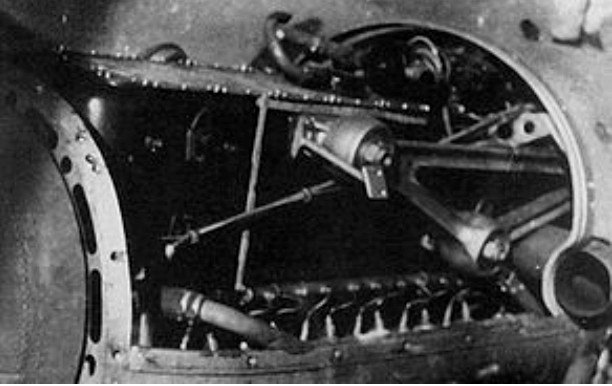
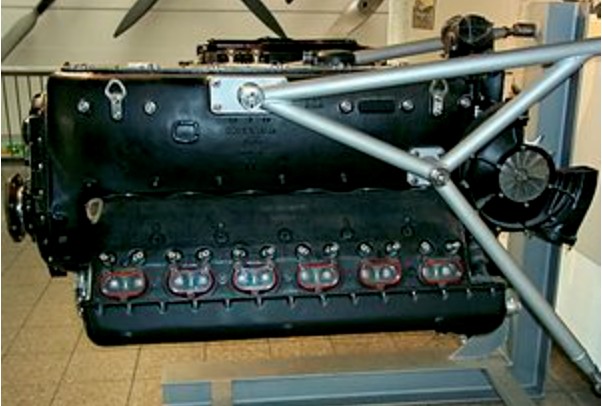
The Daimler-Benz DB 604 was an experimental German 24-cylinder aircraft engine, which did not progress beyond the initial engine testing phase and was ultimately abandoned in September 1942.
The DB 604 was unique among the DB 600 series of aircraft engines by having its 24 cylinders arranged in an X, with four inline rows of six cylinders. The DB 604 was also unique amongst the X-24 engines, in that it was not conceived as a further development of existing Daimler-Benz aircraft engines such as the DB 601, DB 603 or DB 605, which themselves had been twinned-up as two separate powerplants sharing a new common gear reduction case at their front ends, into the “coupled” DB 606, DB 613 and DB 610 “power systems” respectively, starting before World War II.
The DB 604 was a completely new Daimler-Benz engine design featuring a perfectly square stroke ratio of 135 mm x 135 mm. The square stroke ratio enabled the relatively high engine speed of 3,200 rpm. The first engine tested in 1939 on the engine test stand achieved a power output of 1,725 kW (2,350 hp).
Further development of the first test engines led to the DB 604A/B. The only difference between the DB 604A and the DB 604B – as with the similarly suffixed A and B versions of the DB 606 and 610 “coupled” power system engines – was the direction in which the DB 604’s crankshaft turned. The DB 604A/B was equipped with a two-speed supercharger, achieving 1,835 kW (2,500 hp) whilst testing. Development of this promising engine was canceled by the Reich Air Ministry (RLM – German: Reichsluftfahrtministerium) in September 1942.
Specifications:
DB 604A/B Type: Water-cooled 24-cylinder X (4 rows of 6-cylinders) piston engine Bore: 135 mm Stroke: 135 mm Displacement: 46.38 L (2,830 cu in) Dry weight: 1,080 kg (2,379 lb) Power output: 1,835 kW (2,500 hp) at 3,200 rpm at 5,100 m (16,732 ft) Specific power: 25.3 kW/L (0.9 hp/cu in) Compression ratio: 7.0:1 Power-to-weight ratio: 0.59 kW/kg (0.95 hp/lb)
The Daimler-Benz DB 603 engine was a German aircraft engine used during World War 2. It was a liquid-cooled 12-cylinder inverted V12 enlargement of the DB 601, which was in itself a development of the DB 600.
The Mercedes-Benz T80 land speed record car, designed by aircraft engineer Josef Mickl with assistance from Ferdinand Porsche and top German Grand Prix racing driver Hans Stuck, incorporated the third prototype DB 603. It was set up for the land speed record run attempt to operate on an exotic fuel mix based on a 63% methanol, 16% benzene and 12% ethanol content, with minor percentages of acetone, nitrobenzene, avgas and ether. Adding to the power output was a pioneering form of the Luftwaffe’s later MW 50 methanol/water injection boost, and was tuned to 3,000 PS (2,959 hp, 2,207 kW) – enough, it was believed, to propel the aerodynamic three-axle T80 up to 750 km/h on a specially-prepared, nearly 10-kilometre (6.2 mi) length stretch of the roughly north/south oriented Reichsautobahn Berlin – Halle/Leipzig, which passed close to the east side of Dessau (now part of the modern A9 Autobahn) and with the actual length’s location due south of Dessau, reworked to be 25 metres (82 ft) wide with a paved-over median, for the record to be set in January 1940 during Rekord Woche (Record/Speed Week). Due to the outbreak of the war in September 1939, the T80 (nicknamed Schwarzer Vogel, “Black Bird”) never raced. The DB 603 engine was removed from the vehicle for use in fighter aircraft.
Production of the DB 603 commenced in May 1942, and with a 44.52 litre displacement figure, was the largest displacement inverted V12 aviation engine to be produced and used in front line aircraft of the Third Reich during World War II.
The DB 603 powered several aircraft, including the Do 217 N&M, Do 335, He 219, Me 410 and Ta 152C.
DB 603E built in 1944
Variants:
Production versions:
DB 603A, rated altitude of 5.7 km, B4 fuel Power (take-off): 1750 PS (1726 hp, 1287 kW) at 2700 rpm at sea level Combat power: 1580 PS (1558 hp, 1162 kW) at 2500 rpm at sea level
DB 603AA DB 603A with an improved supercharger, rated altitude of 7.3 km, B4 fuel Power (take-off): 1670 PS (1647 hp, 1228 kW) at 2700 rpm at sea level Combat power: 1580 PS (1558 hp, 1162 kW) at 2500 rpm at sea level
DB 603E rated altitude of 7.0 km, B4 fuel Power (take-off): 1800 PS (1775 hp, 1324 kW) at 2700 rpm at sea level Combat power: 1575 PS (1553 hp, 1158 kW) at 2500 rpm at sea level
Prototypes and other versions: DB 603D, a DB 603A with propellers rotating counter-clockwise; production unknown
DB 603F, a DB 603E with propellers rotating counter-clockwise; production unknown
DB 603G (production cancelled) Power (max): 1900 PS (1874 hp, 1397 kW) at 2700 rpm at sea level Combat power: 1560 PS (1539 hp, 1147 kW) at 2700 rpm at sea level
DB 603L/LA (prototype with two-stage supercharger, B4 fuel) Power (max): 2000 PS (1973 hp, 1471 kW)
DB 603N (prototype with two-stage supercharger, C3 fuel) Power (max): 2800 PS (2762 hp, 2059 kW) at 3000 rpm at sea level Continuous: 1930 PS (1904 hp, 1420 kW) at 2700 rpm at sea level
DB 603S (DB 603A with experimental TK-11 turbo-supercharger) – Used for the Heinkel He 274 prototype airframes.
DB 613 Series of experimental “power system” coupled side-by-side twinned DB 603s, arranged as the DB 606 and DB 610 had been previously, and meant to replace the 606 and 610, in prototype form only from March 1940 through 1943.
DB 614 a 2000 PS development.
DB 615 Coupled DB 614 engines
DB 617 A long-range derivative of the DB 603
DB 618 Coupled DB 617 engines
DB 622 A DB 603 with a two-stage supercharger and single-stage turbocharger
DB 623 A DB 603 with twin turbochargers
DB 624 A DB 603 with a two-stage supercharger and single-stage turbocharger
DB 626 A DB 603 with twin turbochargers and intercooler
DB 627 The DB 603 fitted with a two-stage supercharger and after-cooler.
DB 631 An abandoned three stage supercharged DB 603G.
DB 632 A projected development of the DB 603N with contra-rotating propellers.
MB 509 Development as a tank engine for the super-heavy Panzer VIII Maus
Applications: Blohm & Voss BV 155 Blohm & Voss BV 238 Dornier Do 217 Dornier Do 335 Fiat G.56 – two prototypes flown Focke-Wulf Ta 152 Heinkel He 177B – prototype aircraft series Heinkel He 219 Heinkel He 274 Macchi MC.207 – experimental installation, not flown Messerschmitt Me 410 Reggiane Re.2006- experimental installation, not flown
Specifications:
DB 603A Type: 12-cylinder liquid-cooled supercharged inverted Vee aircraft piston engine Bore: 162 mm (6.38 in) Stroke: 180 mm (7.09 in) Displacement: 44.52 L (2,716.9 in3) Length: 2610.5 mm (102.8 in) Diameter: 830 mm (32.7 in) Dry weight: 920 kg (2,030 lb) Supercharger: Gear-driven centrifugal type supercharger Fuel system: Direct fuel injection Cooling system: pressurized water cooling Power output: 1,287 kW (1,750 PS) for takeoff 1,111 kW (1,510 PS) maximum continuous Specific power: 26.7 kW/L (0.59 hp/in3) Compression ratio: 7.5:1 left cylinder bank, 7.3:1 right cylinder bank Specific fuel consumption: 0.288 kg/(kW·h) (0.474 lb/(hp·h)) Power-to-weight ratio: 1.29 kW/kg (0.79 hp/lb)
The Daimler-Benz DB 602 was a German diesel cycle aero engine first run in 1933. It was a liquid-cooled upright V16, and powered the two Hindenburg class airships, LZ 129 Hindenburg and LZ 130 Graf Zeppelin. These engines, under designation MB 502, powered four Schnellboots of 1933 series S10…13 (three engines on each). Then, the engine was modified into V20 MB 501 of 2000 hp that had a variety of applications.
The Daimler-Benz DB 600 was a German aircraft engine designed and built before World War II as part of a new generation of German engine technology. It was a liquid-cooled inverted V12 engine first flown in December 1935, and powered the Messerschmitt Bf 110 and Heinkel He 111 among others. Most newer DB engine designs used in WW2 were based around this engine. The decision by the RLM to concentrate on manufacturing aircraft engines using fuel injection systems rather than carburettors meant that the DB 600 was quickly superseded by the otherwise similar DB 601. Later DB series engines grew in bore, stroke, and horsepower, including the DB 603 and DB 605, but were generally similar to the pattern created with the DB 600.
Variants: DB 600A Up to 1,000 PS (810 kW) at 2350 rpm at sea-level. Reduction Gearing: 1.55
DB 600B Up to 1,000 PS (810 kW) at 2350 rpm at sea level Reduction Gearing: 1.88
DB600C Up to 850 PS (634 kW) at 2350 rpm at 13,120 feet (3999 m) Reduction Gearing: 1.55
DB600D Up to 850 PS (634 kW) at 2350 rpm at 13,120 feet (3999 m) Reduction Gearing: 1.88
DB600G Up to 950 PS (708 kW) at 2350 rpm at 13,120 feet (3999 m) Reduction Gearing: 1.55
DB600H Up to 950 PS (708 kW) at 2350 rpm at 13,120 feet (3999 m) Reduction Gearing: 1.88
Applications: Arado Ar 197 V1. 1937 prototype – naval variant of Arado Ar 68. Dornier Do 17 S-0 Three pre-production aircraft. Focke-Wulf Fw 57 Focke-Wulf Fw 187 V6. Heinkel He 60C One test aircraft. Heinkel He 111 V5: DB 600A, B-1, B-2: DB 600C, G-4: DB 600G, G-5: DB 600C, J-1: DB 600C Heinkel He 112 V7, V8. Heinkel He 114 Three He 114 B-2 exported to Romania. Junkers Ju 90 V1. Henschel Hs 128 V1. Twin engine, pressurised cockpit, high-altitude research aircraft. Messerschmitt Bf 109 V10 through V14. Prototypes. Messerschmitt Bf 110 V1, V2, V3. Prototypes. Messerschmitt Bf 162 V1, V2.
Specifications:
DB 600C Type: Twelve-cylinder liquid-cooled supercharged 60° inverted Vee aircraft piston engine Bore: 150 mm (5.91 in) Stroke: 160 mm (6.30 in) Displacement: 33.93 l (2,070.5 in3) Length: 1,720 mm (67.72 in) Width: 712 mm (28.03 in) Height: 1,000 mm (39.37 in) Dry weight: 575 kg (1,268 lb) Valvetrain: Two intake and two sodium-cooled exhaust valves per cylinder actuated via a single overhead camshaft per bank Supercharger: Gear-driven single-stage single-speed centrifugal supercharger Fuel system: Four two-barrel carburetors Fuel type: 87-octane gasoline Oil system: Dry sump with one pressure and two scavenge pumps Cooling system: Liquid-cooled, ethylene glycol Reduction gear: Spur, 0.53:1 Power output: 773 kW (1,050 PS or 1,036 hp) at 2,400 rpm for takeoff Specific power: 22.8 kW/l (0.5 hp/in³) Compression ratio: 6.8:1 Specific fuel consumption: 302-315 g/(kW•h) (0.50-0.52 lb/(hp•h)) Oil consumption: 7-11 g/(kW•h) (0.18-0.28 oz/(hp•h)) Power-to-weight ratio: 1.34 kW/kg (0.82 hp/lb)
The Daimler-Benz DB 601 was a German aircraft engine built during World War II. It was a liquid-cooled inverted V12, and powered the Messerschmitt Bf 109, among others. The DB 601 was basically an improved DB 600 with direct fuel injection. The DB 601Aa was licence-built in Japan by Aichi as the Atsuta, by Kawasaki as the Ha-40, and in Italy by Alfa Romeo as the R.A.1000 R.C.41-I Monsone.
Based on the guidelines laid down by the Reichswehrministerium (“Reich’s Ministry of Defence”), in 1929 Daimler-Benz began development of a new aero engine of the 30-litre class: a liquid-cooled inverted-Vee 12-cylinder piston engine. This was designated F4, and by 1931 two prototypes were running on the test bench. These were followed by the improved F4 B, which became the prototype for the DB 600. In 1933, Daimler-Benz finally received a contract to develop its new engine and to build six examples of the DB 600. For the year after, the DB 600 was the only German aero engine in the 30-litre class. In total, 2281 DB 600s were built. The DB 601A-1 was a development of the DB 600 with direct fuel injection. Like all DB 601s, it had a 33.9 litre displacement. The first prototype with the direct fuel injection, designated as F4E, was test run in 1935, and an order for 150 engines was placed in February 1937. Serial production begun in November 1937, and ended in 1943, after 19,000 examples of all types were produced.
Variants
DB601 A-1 Up to 1,100 PS (809 kW) at sea-level with 2,400 rpm, up to 1,020 PS (750 kW) at 2,400 rpm and 4.5 km altitude, B4 fuel
DB601 Aa Up to 1,175 PS (864 kW) at sea-level with 2,500 rpm, up to 1,100 PS (809 kW) at 2,400 rpm and 3.7 km altitude, B4 fuel
DB601 B-1/Ba Same as DB601 A-1/Aa for use in Messerschmitt Bf 110 and/or bomber aircraft (different prop/engine ratio, 1:1.88 instead of 1:1.55)
DB601N Up to 1,175 PS (864 kW) at sea-level and at 4.9 km altitude with 2,600 rpm, C3 fuel Up to 1,270 PS (934 kW) at 2.1 km altitude with 2,600 rpm
DB601P Same as DB601N for use in Messerschmitt Bf 110 and/or bomber aircraft (different prop/engine ratio, 1:1.88 instead of 1:1.55)
DB601E Up to 1,350 PS (993 kW) at sea-level with 2,700 rpm, up to 1,320 PS (970 kW) with 2.700 rpm at 4.8 km altitude, B4 fuel Up to 1,450 PS (1,066 kW) at 2.1 km altitude with 2,700 rpm
DB601F/G Same as DB601E for use in Messerschmitt Bf 110, Messerschmitt Me 210 and/or bomber aircraft (different prop/engine ratio,1:1.875 (601F), 1:2.06 (601G) instead of 1:1.685)
DB606A/B Two DB601F or G coupled to work on a single propeller shaft for use in early Heinkel He 177As – 2,700 PS (1,986 kW) at sea level with a mirror-imaged starboard component engine supercharger, and derided as “welded-together engines” by Reichsmarschall Hermann Göring in August 1942, from the problems they caused with engine fires in the He 177A during service.
Applications
DB 601: CANSA FC.20 Dornier Do 215 Heinkel He 100 Henschel Hs 130A-0 Kawasaki Ki-60 Messerschmitt Bf 109 Messerschmitt Bf 110 Messerschmitt Me 210 Savoia-Marchetti SM.88
DB 606: Heinkel He 119 Heinkel He 177 Messerschmitt Me 261
DB 601Aa Type: Twelve-cylinder liquid-cooled supercharged 60° inverted Vee aircraft piston engine Bore: 150 mm (5.91 in) Stroke: 160 mm (6.30 in) Displacement: 33.93 L (2,070.5 in³) Length: 1,722 mm (68 in) Dry weight: 590 kg (1,320 lb) Valvetrain: Two intake and two sodium-cooled exhaust valves per cylinder actuated via a single overhead camshaft per cylinder block. Supercharger: Gear-driven single-speed centrifugal type supercharger (later, hydraulic-driven) Fuel system: Direct fuel injection Oil system: Dry sump with one pressure and two scavenge pumps Cooling system: Liquid-cooled Power output: 865 kW (1,175 PS or 1,159 hp) at 2,500 rpm for takeoff 787 kW (1,070 PS or 1,050 hp) at 2,400 rpm at 3,700 m (12,140 ft) Specific power: 25.52 kW/l (0.56 hp/in³) Compression ratio: 6.9:1 Specific fuel consumption: 270 g/(kW·h) (0.44 lb/(hp·h)) Power-to-weight ratio: 1.47 kW/kg (0.89 hp/lb)
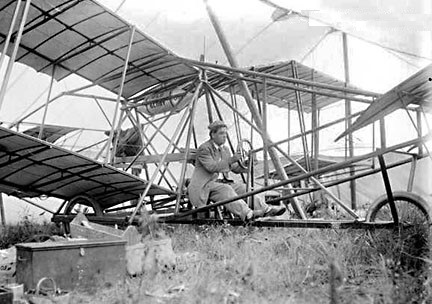
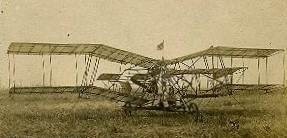
The Daily ‘Old Glory’ built in 1910 in Chicago, Illinois, was an early “gull-wing” aircraft built for entry in one of the popular local air meets. The ship was motorless at the time of the photo.
The machine had the name “Old Glory” painted on the petrol tank that was mounted under the center of the drop in the upper wing. Although apparently built to completion, it is doubtful the machine was ever flown.
A paraglider power-pack with a duralamin frame, auto lock carabiners, and hand engine controls. The engine runs a 2:2.21 reduction unit providing 115 lb thrust. First flown in 1992.