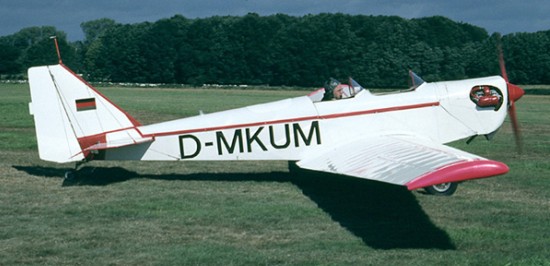
The Sunrise II was the first UL-aeroplane designed and built by Wolfgang Dallach, the prototype first flying in 1986. About 40 Sunrise II were built by Wolfgang Dallach Flugzeugbau and delivered complete or as a building package before production ended in 1991; the airframe remaining in production as the basis for the Sunwheel biplane. Originally powered by a 40 hp, 2 cylinder 4-stroke Lemon-Visas engine, most of the Sunrise UL aeroplanes have modified or replacement heavier engine.
Wolfgang Dallach developed not only the Sunrise and Sunwheel but also the Diabolo and the Fascination. The Wolfgang Dallach Company collapsed. Swiss Light Aircraft had the rights to the “Fascination”, “Evolution”, “Sunwheel” and all derivative aircraft and the type support acquired by the insolvency administrator. But they had never really had the intention to take an active care for UL aircraft. On 1 August 2008 DG Aircraft GmbH took over support of the Dallach “Fascination”, “Evolution”, “Sunwheel” and all derivatives. Wolfgang Dallach was working for DG Aircraft as a freelancer since 2006.
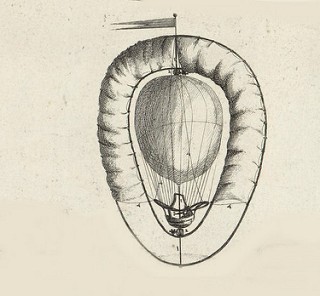
This balloon was most often called the Ballon de Franconville, and was credited to the Comte d’Albon. It was 24 feet high and 16 feet in diameter and had an annular sail that followed the profile of the balloon and was used for steering. This arrangement was used on the balloon when it took off on 16 January 1784 from the gardens of Madame Countesse d’Albon. It was found the 21st of the same month at Montmorency.
DEKO-5 was designed by Polish aeronautical engineers: Marek Debski, Krzysztof Kotlinski, Type: Side-by-side ultra-light, training and observation aircraft – ideal for recreational flyer. First flight, June 1996 Design Features: Pod-and-boom fuselage. Wings braced by V-type struts. Structure: Wing and elevator are made of aluminum tubes and dacron (or ceconite) soft skin. Fuselage structure is construction, as space truss of aluminum tubes with composite joints (Polish Patent). Tail boom is made of two aluminum tubes. Cockpit canopy is made of glassfibre laminate and organic glass. The open cabin offers a very good view. The DEKO-5 is designed to a +4g / -2g load limit Power Plant: One Rotax 582 (65 hp, electric start and brakes), piston engine with reductor gear 2.58. Propeller: Junkers three-blade, carbon fibre, ground-adjustable pitch propeller. System: Ballistic parachute recovery system
Engine: One Rotax 582 (65 hp, electric start) Reduction gear: 2.58. Propeller: Junkers three-blade, carbon fibre, ground-adjustable pitch Stall: 32 kt / 37 mph / 60 kmh Cruise: 57 kt / 65 mph / 105 kmh VNE: 86 kt / 99 mph / 160 kmh Empty Weight: 250 kg / 551 lbs MTOW Weight: 450 kg / 992 lbs Climb Ratio: 600 ft/min / 3 m/s Glide Ratio: 6:1 Take-off distance (50ft obstacle): 590 ft / 180 m Landing distance (50ft obstacle): 460 ft / 140 m
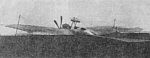
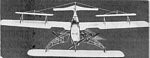
The 1909 Daimler Lutskoy No. 1 monoplane was the largest aircraft built and flown in 1909. Designed by B. G. Lutskoy (Russian) and built by Daimler (Germany) it featured one nose propeller driven by one engine and two wing-mounted propellers driven by another engine.
Founded in November 1998 as the aerospace division of the DaimlerChrysler Group, following the merger of Daimler- Benz and Chrysler Corporation. Headquartered in Munchen, civil aircraft business unit includes Daimler- Chrysler Aerospace Airbus; helicopter activities are via Eurocopter SA and Eurocopter Deutschland GmbH; the military aircraft business unit comprises DaimlerChrysler Aerospace AG. and Dornier Flugzeugwerft GmbH, while other business units include Aero Engines via MTU, Space Infrastructure, Satellites, and Defense and Civil Systems. Programs include the AT-2000 Mako role-flexible military aircraft.
After initial studies on gas turbines in the late 1920s, Daimler-Benz lost interest in them until 1939 with the arrival of Karl Leist. Work began immediately on the DB 670 (aka ZTL 5000), a ducted fan with compressor feeding an afterburner, driven by a DB 604 X-24 engine delivering 1,864 kW (2,500 hp). At a weight of 3,748 lb (1,700 kg), with an expected thrust of 6 kN (1,323 lbf) at a speed of 900 km/h (559 mph) and altitude of 19,685 ft (6,000 m) the DB 670 was abandoned due to the very low power/weight ratio. After a brief interlude studying pulse-jets Leist began work on what was to become the DB007.
Previous design efforts in Germany had investigated ducted fans (turbofans / by-pass turbojets) and contra-rotating compressor spools, but Leist incorporated both into the ZTL6000 (precursor to the ZTL 6001 / DB 007), resulting in a very complex design. Another novel feature was a turbine which passed alternately through the combustion chamber efflux and cooling air tapped from the bypass flow. By the Summer of 1942 design goals had been revised down and the new engine was given the designations ZTL6001(company) and DB 007 / ZTL 109-007 (RLM), ZTL being an acronym for Zweikreiststurbinen-Luftstrahltriebwerk (two-circuit turbojet engine).
Air entered the engine through a conventional air intake, flow splitting after the initial guide vanes to the compressor inside and the ducted fan outside, with a by-pass ratio of approximately 2.45:1. The compressor consisted of seventeen stages of blading, eight carried on the inner drum, rotating at full engine speed, and nine on the outer drum which rotated in the opposite direction at 0.5:1 engine speed. Although extremely complicated mechanically, a compressor efficiency of 80% was expected with a very credible pressure ratio of 8:1. For comparison, typical engines of the era offered pressure ratios on the order of 3.5:1.
Further complication arose from the ducted fan which consisted of three stages of blading attached to the outside of the rotating compressor casing, with stators attached to the inside of the engine outer casing. Calculated efficiency of the fan section was 84%.
Air from the compressor passed to the four linked tubular combustion chambers, spaced evenly around the circumference with gaps to allow cool bypass air tapped from the by-pass duct to cool the turbine directly. Although this resulted in relatively poor turbine efficiency, at 74%, the cooling allowed a far higher Turbine Inlet Temperature (TIT) increasing the overall efficiency of combustion.
The turbine consisted of hollow nickel steel blading on a forged steel turbine wheel which drove the compressor via a hollow shaft and flexible coupling. The inner compressor drum was driven directly but a reduction gearbox drove the outer drum at half speed.
Structural materials comprised mainly of cast aluminium alloys forward of the combustion chamber and welded sheet steel from the combustion chambers aft.
Only bench testing began on a test-bed on 27 May 1943 before the program was cancelled in May 1944 by order of the RLM.
DB 007 / ZTL 6001 Type: Axial flow turbofan Length: 4,998.7 mm (196.8 in) Diameter: 899.2 mm (35.4 in) Dry weight: 1,300.0 kg (2,866 lb) Compressor: 17-stage contra-rotating axial compressor + 3-stage ducted fan Combustors: 4 inter-connected tubular can combustion chambers, with cooling air gaps at the turbine Turbine: Single-stage axial flow turbine with cooling air flow over 30% of the circumference. Fuel type: J-2 diesel fuel (started with gasoline) Oil system: Pressure feed to main bearings, dry sump, oil grade 163 S.U. secs (35 cs) (Intavia 7106) at 38 °C (100 °F) Maximum thrust: 12.50 kN (2,811 lbf) at 12,000 rpm at sea level Overall pressure ratio: 8:1 Bypass ratio: 71% Specific fuel consumption: 137.6 kg/kN/hr (1.35 lb/lbf/hr) Thrust-to-weight ratio: 0.0095 kN/kg (0.974 2.04 lbf/lb) Normal, flight: 5.87 kN (1,320 lbf) at 12,000 rpm at altitude
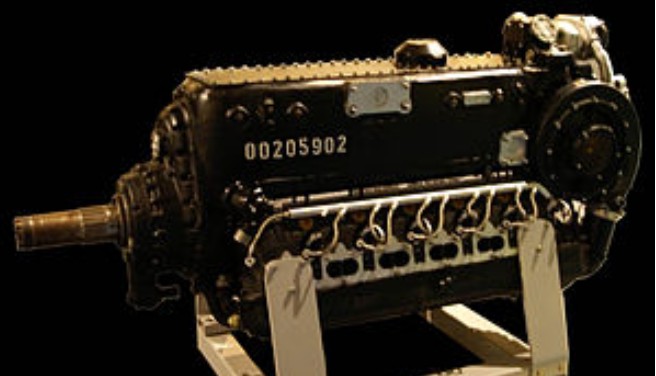
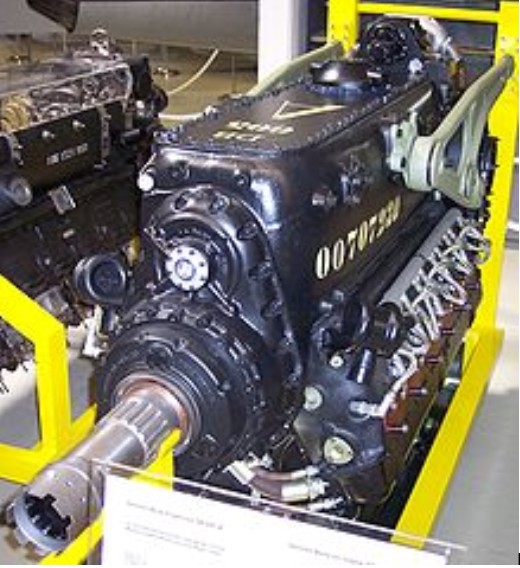
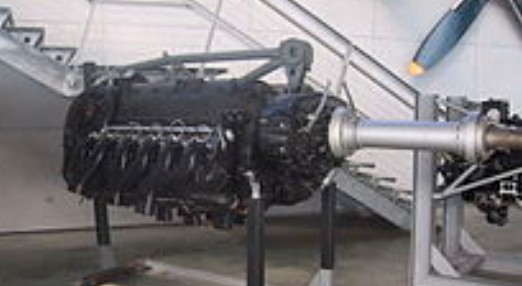
The Daimler-Benz DB 605 is a German aircraft engine, built during World War II. Developed from the DB 601, the DB 605 was used from 1942 to 1945 in the Messerschmitt Bf 109 fighter, and the Bf 110 and Me 210C heavy fighters. The DB 610, a coupled “power system” powerplant comprising a pair of side-by-side configured examples of the DB 605, geared together in the front to turn a single output shaft, was used in Germany’s only operational heavy bomber, the Heinkel He 177.
License-built versions of the DB 605 were used in the Macchi C.205, Fiat G.55, Reggiane 2005 and some other Italian aircraft. It was also initially used in the pusher-design Swedish Saab J21. IAR built the DB605 for licenced Bf-109G production. Approximately 42,400 DB 605s of all kinds were built.
The primary differences between the 605 and 601 were greater displacement, higher revolutions, higher compression ratio and a more powerful supercharger. Through careful study the engineers determined that the cylinders could be bored out to a larger diameter without seriously affecting the strength of the existing block. The difference was minimal, increasing from the 601’s 150 mm cylinder bore to the 605’s 154 mm, but this increased the overall displacement from 33.9 litres to 35.7. Altered valve timing increased the inlet period and improved the scavenging to give greater volumetric efficiency at higher speeds, which improved the maximum allowable RPM from 2,600 in the 601 to 2,800 in the 605. The combination of these changes raised power output from 1,350 PS (1,332 hp) to 1,475 PS (1455 hp). The engine was otherwise similar, notably in size, which was identical to the 601. However, its weight did increase from 700 to 756 kg.
Daimler-Benz DB 605A
In other ways the engine was essentially identical to the 601, being a 12 cylinder, inverted-V (with the crankshaft above the cylinders) design. Both used dual Bosch magnetos firing twin spark plugs for ignition. Fuel injection was powered by a pump supplying up to 90 bar and the oil system used three pumps with a separate 35 litre oil tank. The supercharger was fairly advanced for the era in that it used a barometrically controlled hydraulic clutch (fluid coupling) which allowed the system to automatically compensate for changes in altitude.
One major design difference was the switch from ball bearings to sleeve bearings which, when combined with increasingly poor grades of lubricants, led to serious problems in service, including engine fires; initially, for example, the use of emergency power was forbidden. Although Daimler-Benz redesigned the bearings and added oil slingers and their associated coolers, the RLM considered the DB 605 to be a “sick engine” and the problems had not been fully resolved by the end of the war. Like the 601, the 605 was designed to run on “B4” fuel with an octane rating of 87. In 1944 a series of newer engines was introduced, allowing the engine to run on the 100 octane “C3” fuel and optionally including fittings for various optional power-boosting agent dispensing systems, such as the MW50 methanol-water injection system, and GM-1 nitrous oxide injection system. The DB 605AM, running initially on C3 and MW-50, saw power improved to 1,800 PS (1775 hp) for takeoff. In mid-1944, the requirement for C3 was dropped and standard B4 fuel with MW-50 was used. The DB 605AS(M) improved the maximum rated altitude by using a larger supercharger taken from the DB 603 but was otherwise similar to the A(M). The DB 605ASB’s takeoff power was also rated at 1,800 PS (1,775 hp), while maintaining the high-altitude performance of the ASM. The final version of the A-series was the DB 605ASC of 1945, which improved takeoff power to 2,000 PS (1,973 hp).
As early as 1942 Daimler had also been working on an upgraded D-series engine that could run on either C2 or C3 fuel. The first of these, which appeared in late 1944, were a small series of DB 605DM, followed by the main production series, the DB 605DB/DC. These engines were fitted with an adjustable screw stop which allowed the use of either B4 fuel with MW-50, or C-3 fuel without MW-50, in which case the engine was designated DB 605DB, or the use of C-3 fuel with MW-50, in which case the engine was given the -DC suffix instead. In its DB-suffix form the engine generated 1,800 PS (1,775 hp) for take-off at 1.8 ata, while the DC was capable of 2,000 PS (1,973 hp) at 1.98 ata. If MW-50 was not available for use with the B4 fuel the throttle was limited to 1.45 ata for the entire flight. Thus, this series was ideally suited to catering for the chaotic fuel supply situation prevalent during the last months of the Third Reich. These engines were mainly used in the Bf 109G-10 and K-4 series.
DB 610
Variants: Production versions
DB 605 A(M) Standard fighter engine, up to 1475 PS, 605 AM with MW-50 system up to 1800 PS
DB 605 B Same as 605 A but for use in twin-engined aircraft like Messerschmitt Bf 110, Me 210 (different prop/gear ratio)
DB 605 AS(M) Altitude optimized version of 605 A using the larger DB 603 supercharger, up to 1435 PS, ASM with MW-50 system and up to 1800 PS
DB 605 ASB(M) Altitude optimized late-war version of 605 AS using B4 fuel, ASBM with MW-50 system and up to 1800 PS
DB 605 ASC(M) Altitude optimized late-war version of 605 AS using C3 fuel, ASCM with MW-50 system and up to 2000 PS
DB 605 DM First DB 605 D version, standard MW-50 equipment, up to 1700 PS
DB 605 DB Improved 605 DM, standard MW-50 equipment, first version up to 1850 PS, later reduced to 1800 PS, B4 fuel
DB 605 DC Improved 605 DM, standard MW-50 equipment, up to 2000 PS, C3 fuel
DB 610 Two DB 605 “coupled” (geared together) as a “power system” (71.53L / 4364.8in3), to work on a single propeller shaft for use in Heinkel He 177, up to 2909 PS (2,950 hp) for take off, 2788 PS (2,750 hp) at 2,100 m. Mirror-imaged starboard component engine supercharger.
Prototype/pre-production versions:
DB 605 BS proposed version for twin-engined aircraft, derived from DB 605 AS
DB 605 E proposed version for twin-engined aircraft, derived from DB 605 D
DB 605 L Similar to 605 D but with two-stage supercharger, 2000+ PS
DB 616 A development of the DB 605.
DB 620 Coupled DB628 engines.
DB 621 A projected two stage supercharged DB605
DB 625 A turbocharged DB605
DB 628 The DB 605, fitted with a two-stage supercharger, abandoned in March 1944.
Note: All power ratings in PS (metric horsepower). Unless otherwise noted takeoff/emergency power at sea level.
Applications: Caproni Campini Ca.183bis(intended) Fiat G.55 Macchi C.205 Messerschmitt Bf 109 Messerschmitt Bf 110 Messerschmitt Me 210 Reggiane Re.2005 Saab 21 Savoia-Marchetti SM.91 Savoia-Marchetti SM.92 Savoia-Marchetti SM.93 VL Pyörremyrsky
Specifications:
DB 605AM Type: 12-cylinder liquid-cooled supercharged 60° inverted Vee aircraft piston engine Bore: 154 mm (6.06 in) Stroke: 160 mm (6.30 in) Displacement: 35.7 L (2,176 in³) Length: 2,158 mm (85 in) Width: 760 mm (30 in) Height: 1,037 mm (41 in) Dry weight: 756 kg (1,667 lb) Valvetrain: Two intake and two sodium-cooled exhaust valves per cylinder actuated via a single overhead camshaft per cylinder bank. Supercharger: Single-stage variable-speed centrifugal type supercharger driven through a barometrically controlled clutch; MW50 injection into the supercharger intake. Fuel system: Bosch direct fuel injection Oil system: Dry sump with one pressure and two scavenge pumps Cooling system: Liquid-cooled, pressurized Reduction gear: 0.594:1 Power output: 1,324 kW (1,800 PS/1,775 hp) at 2,800 rpm for takeoff with MW-50 injection 1,250 kW (1,700 PS/1,677 hp) at 2,800 rpm at 4,000 m (13,120 ft) for maximum power with MW-50 injection 794 kW (1,080 PS/1,065 hp) at 2,300 rpm at 5,500 m (18,000 ft) for max continuous Specific power: 35.0 kW/L (0.77 hp/in³) Compression ratio: 7.5/7.3:1 with 87-octane fuel; 8.5/8.3:1 with 100-octane fuel Power-to-weight ratio: 1.68 kW/kg (1.02 hp/lb)