The Danis Sabre was released in 1979.
Patrick Bayle was the pilot of test and piloted it at the world championship in Saint Hillaire du Touvet in September 1979 (member of the team of France world champion).
The Danis Sabre was released in 1979.
Patrick Bayle was the pilot of test and piloted it at the world championship in Saint Hillaire du Touvet in September 1979 (member of the team of France world champion).

A 1981 hang glider.

A 1974 hang glider.
Trainer
Wing area: 19.8 m²
Biplace
Wing area: 26 m²

A 1975 hang glider for Advanced pilots.
Models included the 130A.

A 1975 hang glider for Intermediate pilots.
Slight, very handy, and faster than the famous cylindro-conical gulls, but a drop rate a little higher (1.5 m / s). Very pleasant to fly, with a glide a little more than 5. On the safety side, this wing had no anti-dive devices, and could pass in irreversible dive (aerial-elastic flag).
Wing area: 19.20 m²
Hang glider weight: 18 kg
Packed length short: 6.20 m
Nose angle: 92°

A 1980 hang glider.

A 1979 hang glider.

A 1978 hang glider.

The 1980 Danis Aiglon looks like an SK2 SS but flies better, and with superior maneuverability. The slats are shaped and the profile obtained has a strong camber very forward. The assembly is fast due to the use of a sliding umbrella. On the Aiglon there are four strings of boards to the slats. There are no floating on this device.
For an intermediate pilot, the Aiglon responds well to demands and flies easily and forgives errors.
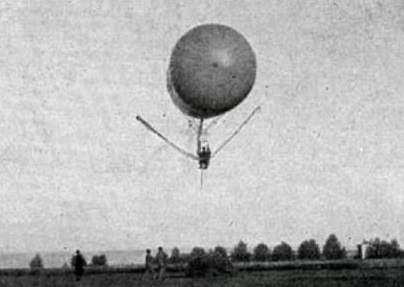
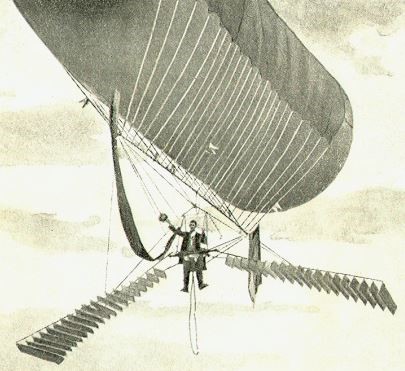
The second man-powered airship constructed by Dr. Konstantin I. Danilewsky of Charkov, Russia (now Ukraine). Supported by industrialist A. A. Pilstrem, and flown by the 20-year old engineer-aeronaut Peter Koziakov it made its first ascent on 18 June 1898. It was controlled by fans, or wings, up to 16′ 4″ long, which could be opened over an arc of 90 degrees. It was trial-flown with some success, making several ascents in alternate configurations, and demonstrated before a Russian board of inspection on 15 August 1898.