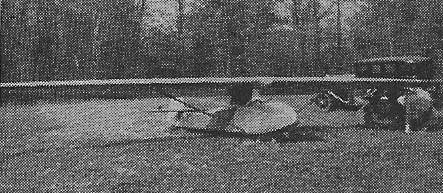
Zander & Weyl built the Dart Flittermouse single-seat ultralight aeroplane in 1936. The one-off Flittermouse G-AELZ was powered by a pusher 25 hp Scott Squirrel and resembled a powered primary glider.
Era
Dart Pup
The Dart Pup was a small high wing, single seat, pusher.
Dunstable Sailplane Kestrel
Dunstable Sailplane offered kit drawings for the Kestrel
Wingspan: 40 ft
Length: 20 ft
Wing area: 150 sq.ft
Aspect ratio: 11
Empty weight: 245 lb
Gross weight: 415 lb
Min sink: 2.9 ft/sec
Glide ratio: 18-1
Dart Aircraft Co / Zander & Weyl / Dunstable Sailplane Co
Founded as Zander and Weyl Ltd at Luton Road, Dunstable in 1934 when E.P.Zander and A.R.Weyl went into partnership to build and repair gliders and light aircraft, along with the Dunstable Sailplane Company in 1935 with works at Hockliffe. W.L. Manuel joined as manager.
In July 1935 the company moved to new premises at the Luton Aerodrome, Barton-in-the-Clay, Bedfordshire, when Latimer-Neeham formed Luton Aircraft Ltd.
Several Zogling gliders were built and in 1935 a series of replicas of early gliders were made for the film “The Conquest of the Air” which was filmed by Alexander Korda at the Denham studios. These replicas included two Lilienthal types, a Wright 1902 glider, and one of Catley’s early gliders. Also, at the time the firm built a ‘Flying Flea’ from approved aircraft materials. This was the first powered aircraft built by Zander and Weyl.
The Flea was followed by the Dunstable Dart which was built after a suggestion, by members of the London Gliding Club, that the Slingsby Falcon 3 would possibly make a reasonable ultralight aircraft if it was fitted with a small engine. Weyl eventually came up with a completely new aircraft.
In 1936 to designs of A. R. Weyl, Zander & Weyl built the Dart Flittermouse single-seat ultralight aeroplane in 1936. Built aircraft subsequently as Dart Aircraft Ltd. First were Dunstable Dart, later named Dart Pup, and Flittermouse, both with parasol wing and pusher propellers. Three Dart Kittens were built in U.K., as well as one in Australia from plans.
In September 1936 the company moved to Phoenix Works at Gerrard Cross, Buckinghamshire, and concentrated on kits and plans for Minor aircraft for home constructors. At the same time Dunstable Sailplane offered kit drawings for the Kestrel sailplane.
In 1936 the company was re-organised financially and the name was changed to Dart Aircraft Ltd. New premises were obtained at 29 High Street North, in Dunstable. The Dunstable Dart aircraft was renamed the Dart Pup, and two new sailplanes were designed and built; the Cambridge and Totternhoe. Also introduced in 1936 was the Dart Flittermouse aircraft and, at the end of the year, the first Dart Kitten ultralight.
In 1937 a revised version of the Kitten was built but financial difficulties followed. E.P. Zander later left the firm to establish another company in Dunstable; Scott Light Aircraft.
Weyl continued to develop the Kitten and in 1938 designed a two-seat version as the Dart Weasel. This was an enlarged version of the Kitten, having tandem seating and a tricycle undercarriage, and was intended for possible Civil Air Guard training but it was not completed.
Operations ceased in 1939 and after the war Weyl continued development of the Kitten and introduced a Mark 3 version for homebuilt construction.
He died in 1965.
da Schio Italia
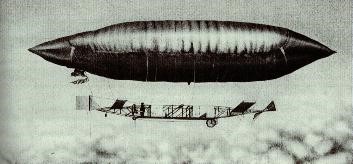
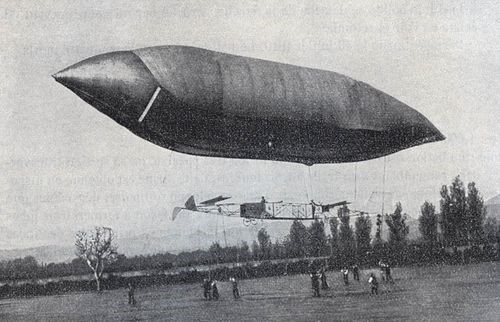
Designed and built by Count Almerico da Schio, the 1905 airship “Italia” was the first Italian dirigible.
The “Italia” had an envelope without a rigid internal structure, a little less than 38 meters long, and containing 1208 cubic meters of hydrogen. It featured many technological innovations patented by A. da Schio, such as an elastic rubber band to allow for additional volume of the envelope rendering it deformable at different altitudes and temperatures. The “aeropiani” (also called rudders) situated at the bow and stern of the gondola, consisting of curved profile surfaces variable in inclination to the line of flight, allowing more stability and governance to the airship.
d’Arrigo Da Vinci Volante Piume
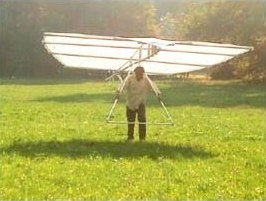
The d’Arrigo Da Vinci Volante Piume Glider is a 2003 realization of a glider design by Leonardo da Vinci of 1490–1496 which was found as a drawing and identified with the name “Piume” (Feather), only coming to light with the rediscovery in 1966 of the da Vinci Madrid Codices. The replica was designed by Angelo d’Arrigo, a hang glider pilot, who actually flew the aerodynamically-modified replica in 2003.
d’Arrigo, Angelo
D’Arrigo was born in Catania, Sicily, April 3, 1961, but grew up from a very early age in Paris, as his parents emigrated there in search of work. He returned to Sicily after graduating from the university in Paris, and from his base on Mt. Etna gained a number of world records and world titles in the field of ultra light flying and free flying.
In 2001 he initiated a sequence of breath-taking events which saw him flying alongside various birds of prey as he attempted to learn from them their techniques for migratory flight by taking advantage of thermal air currents for long distance flight with low energy consumption.
In 2002 he crossed the Sahara and the Mediterranean with an eagle. His hang glider was launched from a microlight.
In 2003 he flew 5,500 kilometres from northern Siberia to the Caspian Sea in Iran in the company of a flock of Siberian cranes who had been born in captivity and, due to imprinting, considered him their parent. The bird is at risk of extinction, and, in order to try to save the species, Russian ornithologists hatched a plan. It called for having the eggs incubated under Angelo’s hang-glider, so the chicks saw this as they hatched. Angelo would then be with the chicks as they fledge. When they were ready to fly, they would fly alongside Angelo so they would consider him their mentor. That way, he could show them the traditional migratory route for their species. They had no other way to learn it. This approach was similar to the one taken in the movie Fly Away Home.
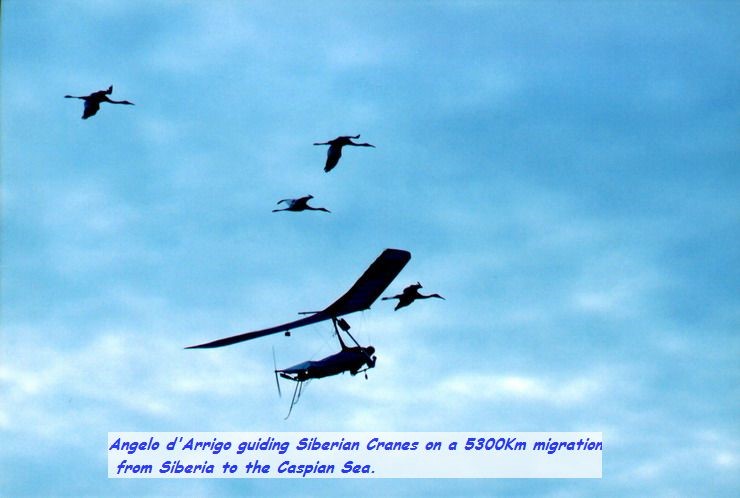
In 2004, he was aerotowed by Richard Meredith-Hardy and released over Mount Everest another world record. He reportedly made this flight over the summit of Everest with a trained Nepalese eagle. However, there were no eyewitnesses to this achievement, even though climbers saw and photographed Meredith-Hardy’s microlight aircraft. No evidence in the form of videos or photography has ever been brought forward, either, despite the fact that d’Arrigo’s hang-glider was equipped with three video cameras and two still cameras. The story is fully narrated in the documentary Flying Over Everest by director Fabio Toncelli.
In 2006 he followed the migratory routes of the condor over Aconcagua in the Andean Cordillera, the highest mountain in the Americas.
On March 26, 2006, he died in an accident during an airshow at Comiso, Italy, at the age of 44. A small Sky Arrow airplane, in which he was a passenger, fell 200 meters to the ground. Both d’Arrigo and the pilot, a general of the Italian Air Force and ex-test pilot, were killed on impact. At the time of his death, Angelo was engaged in planning an expedition to Peru to re-introduce two Andean condors bred in captivity and raised by d’Arrigo at his home on Mount Etna. A documentary about this was being made at the time. It was called “Born to Fly”.
In memory of her husband, his widow Laura instituted a charity, the Fondazione Angelo d’Arrigo, with the aim of helping children in Peru. Angelo d’Arrigo was posthumously given the alternative sportsperson’s award at the 2006 Laureus World Sports Awards.
Darmstadt University Aviation Soc D-36 Circe
The Akaflieg Darmstadt D 36 Circe was designed by Dipl Ing Klaus Holighaus.
Darmstadt University Aviation Soc D-22
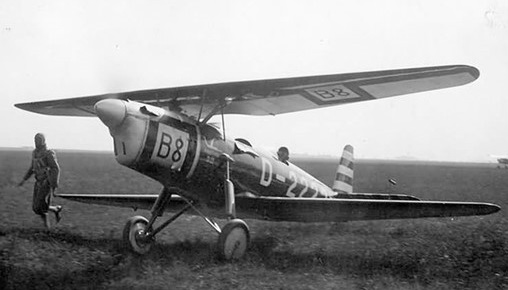
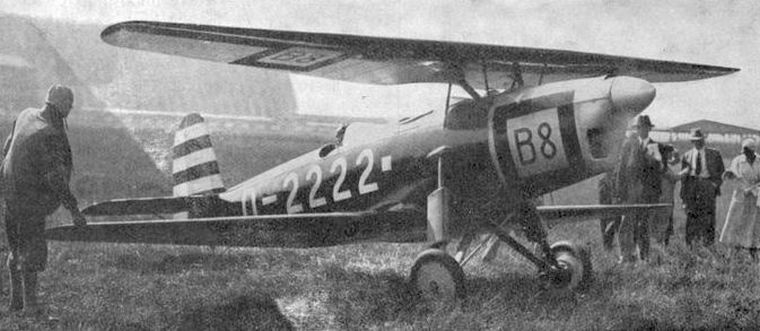
The Darmstadt D-22 was an all-wood sport biplane designed and built in Germany in 1931 by the Akademische Fliegergruppe of Darmstadt University of Technology, a group of aerodynamical engineering students. A development of the Darmstadt D-18 designed by F. Fecher, the D-22 was a slightly enlarged, more streamlined and more powerful German sports-plane built to compete in the 1932 Coupe Deutsch de la Meurthe.
The D-22 had an unorthodox configuration, being a cantilever biplane, with an upper wing placed low, just above the fuselage and ahead of its lower wing. The design emphasized aerodynamics and lightness and the aircraft was small with a streamlined silhouette.
The D-22 boasted an oval cross-section fuselage skinned with plywood and fabric on parts of the single-spar wings. This could, as was required by the rules of the competition, be dismounted and folded rearwards. The crew of two sat in tandem in open cockpits each with its own with windshield. The landing gear was fixed with a tail skid. The engine was mounted in the fuselage nose and drove a two-bladed fixed-pitch propeller.
Propulsion was from a 75.7 kW (101.5 hp) Argus As 8 4-cylinder inverted air-cooled, in-line piston engine driving a 2-bladed fixed-pitch propeller which powered the D-22 to a top speed of 230 km/h (140 mph, 120 kts).
Two were constructed. One was allocated G-ABPX and was known to have a Gipsy III engine.
One was allocated D-2222.
The trial was to be run in two 1,000 km stages separated by a 90-minute refuelling stop and was limited to aircraft with an engine capacity not exceeding eight litres. The starting point of the race was still at Étampes. Suzanne Deutsch de la Meurthe offered one million Francs in prize money while Ministère de l’Air (Air Ministry) offered another three million.
Only one, a D-22A flew in the cup. Not having flaps or slats, she was severely handicapped in the landing trials, eventually finishing 35th out of 43 contestants. However, after this she improved her score after a rally around Europe, where she took the 4th place with a cruise speed of 205 km/h (127 mph; 111 kts). In the maximum speed trial, the D-22A was beaten only by the five Heinkel He 64s, reaching 230.7 km/h (143.4 mph; 124.6 kts). As a result, she eventually finished 17th overall.
Sold in 1933, she competed for several more years in various events.
Wingspan: 24 ft
Length: 21 ft 6 in
DAR DAR-10F
The DAR 10F was the only Bulgarian designed military aircraft to have seen service. It was a trim but conservative light bomber with an 840/960 hp Fiat A74RC38 radial, and with spatted wheels and a crew of two under a glasshouse canopy.
The gun armament was heavy: two 20 mm (0.79 in) MG FF cannon in the wings and two 7.92 mm (0.312 in) MG 17 in the top decking, all firing ahead, and an MG 15 in the rear cockpit. In spite of this the 10F could still carry up to 500 kg (1102 lb) of bombs. Darjaviia Aeroplanna Rabotilnitza flew the prototype in 1941 and a small but unknown number entered Bulgarian service.
Span: 12.65 m (41 ft 6 in)
Length: 9.83 m (32 ft 3 in)
Gross weight: 3420 kg (7540 lb)
Maximum speed: 454 km/h (282 mph)

