Delta Wing Trike

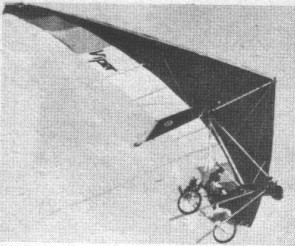
Delta Wing Kites turned to the produc¬tion of trikes intended for mounting under a standard hang glider wing without any mod¬ification to the latter in 1979. The first trikes sold by DWK were similar in every way to European models, using at first the Soarmaster trike unit with the single Chrysler 820 engine developing 10hp at 8000 rpm. In 1980 they offered an option of twin Chryslers or the German Solo 335 engine of 210 cc, which develops 20 hp at 7000 rpm. To accompany the trike unit, DWK offered initially its Phoenix D wing in various sizes, but this was replaced by the Phoenix X series; the trike unit can be used equally well under any other manufacturer’s Rogallo.
Because of the American legislation, the company only builds single seaters.
The company has also built trikes with Yahama KT 100S and Lloyd engines, but standardised on Robin power. Principal trike units offered in 1982 were with Robin EC25PS (22 hp, recoil start, $2250), EC34PM (32 hp, recoil start for $2395 or electric start for $2570), EC34PL (55.5 hp, recoil start $2795), and EC44PM (50hp, electric start, $2670).
Single seat single engined flex wing aircraft with weight shift control. Cage containing landing gear/engine unit is suspended from CG position by strong universal-type joint for easy conversion from hang glider to powered glider. Rogallo wing with keel pocket. Pilot suspended below wing in trike unit, using bar to control pitch and yaw/roll by altering relative positions of trike unit and wing. Wing braced from above by kingpost and cables, from below by cables; cross tube construction with double ¬surface enclosing cross tube. Undercarriage has three wheels in tricycle formation. Bungee-cord suspension and push right go left nosewheel steering independent from yaw control. Aluminium tube trike unit, without pod. Engine mounted below wing driving pusher propeller. 6061T6 alumi¬nium tubing, anodized. Stainless steel vinyl¬-coated rigging.

Trike / Phoenix X
Engine: Robin EC25PS, 22 hp.
Reduc¬tion ratio 2.5/1.
Power per unit area 0.13hp/sq.ft, 1.4hp/sq.m.
Fuel capacity 1.2 US gal, 1.0 Imp gal, 4.5 litre.
Wing span 32.5 ft, 9.91 m.
Total wing area 173 sq.ft,16.1sq.m.
Wing aspect ratio 6.0/1.
Main wheels diameter overall 16 inch, 40 cm.
Empty weight 182 lb, 83 kg.
Max take off weight 432 lb, 196kg.
Payload 250 lb, 113kg.
Max wing loading 2.50 lb/sq.ft, 12.2 kg/sq.m.
Max power loading 19.6 lb/hp, 8.9 kg/hp.

Trike / Dream
Wingspan 31 ‘4”.
Wing area 170 sq.ft.
Empty weight 182 lbs.
Wing loading 1.43 lbs./sq.ft.
Fuel capacity 1.2 USG.
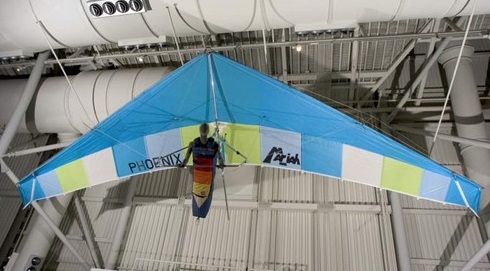
Delta Wing Phoenix / Phoenix Mariah

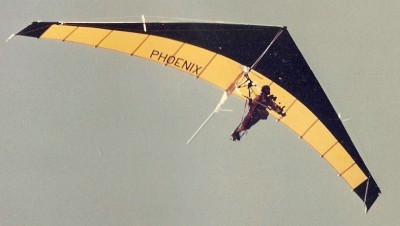
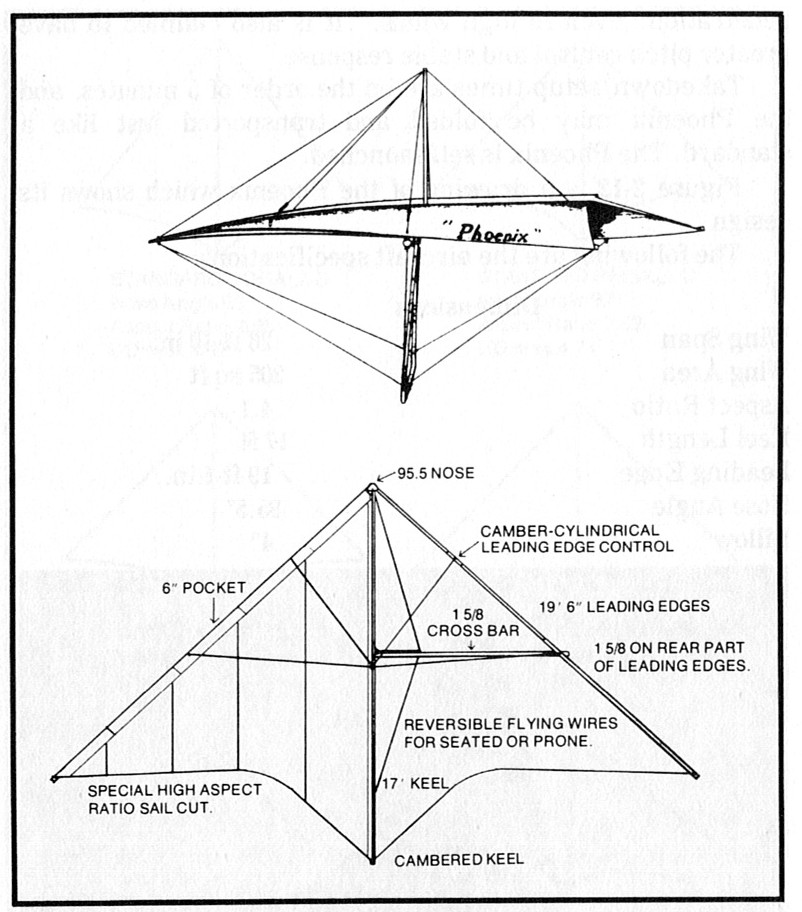
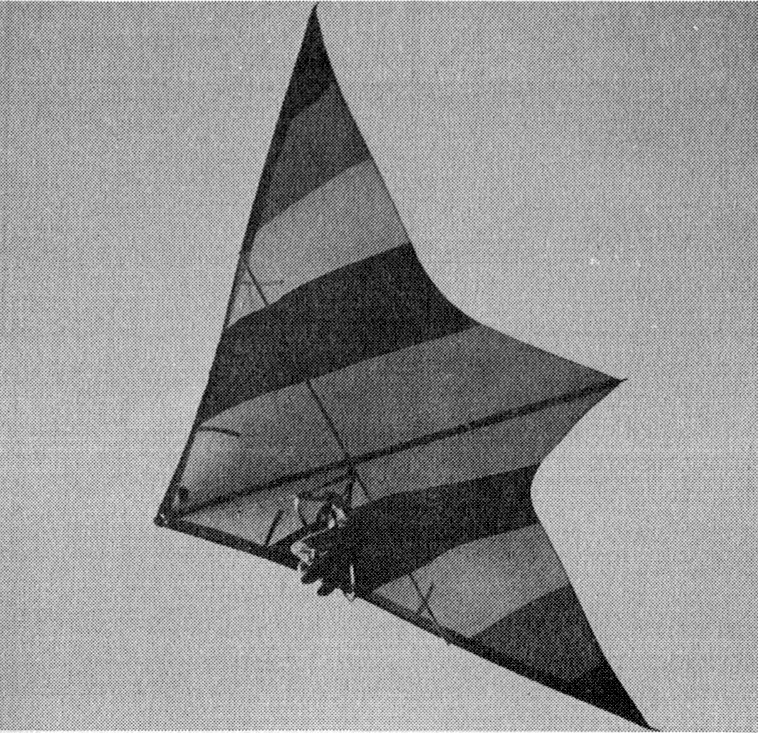
Designed by Dick Boone, the Phoenix is a medium aspect ratio Rogallo hybrid with a ‘fan tail’ sail cut, and cable tensed semi-cylindrical leading edges. It is controlled solely by means of weight shifting.
The Phoenix will perform better than a standard, but not as well as a high aspect ratio kite. It is characterised by a ‘fan tail’ cut trailing edge that is reported to increase the aspect ratio, provide for greater stability and eliminate sail flutter. It incorporates a typical trapeze bar and can be flown either seated or prone, depending on the arrangement of the lower longitudinal cables.
Take down / set up times are on the order of 5 minutes, and the Phoenix may be folded and transported.

Phoenix Mariah M-9

Early in 1977, Bennett asked Boone to design a new high performance Phoenix variant intended for experienced pilots. They named it the Mariah, and it introduced several radical features. The most significant change was yet another increase in aspect ratio. Wingspan increased and wing chord fell as the leading edge convergence angle grew to 120 degrees. Boone also incorporated wires supported by short posts along the wing leading edges. By applying tension to the wires, the pilot could deflect the wing to improve flying and stall characteristics. The wing was more responsive to pilot control inputs, but it was not as stable as previous gliders in the Phoenix line. Bennett and Boone believed that competent, experienced pilots could handle the high-performance wing with no trouble.

It would even be controversial after some doubtful tumblings and very questionable pitch stability. Unsafe in the wrong hands or circumstances. The first double surface with integrated cross-section. It was at the price of a multitude of cables: triple deflectors, transversal cable-stayed, etc. The success was very short after repeated tumblings for lack of batten in intrados. It was better not to have bought it.

Phoenix
Wing span: 28 ft 10 in
Wing area: 205 sq.ft
Aspect ratio: 4.1
Keel length: 17 ft
Leading edge: 19 ft 6 in
Nose angle: 95.5 degrees
Billow: 4 degrees
Empty weight: 42 lb
Max flying weight: 282 lb
Useful load: 240 lb
Best L/D: 6-1
Min sing: 300 fpm
Stall: 16 mph
Cruise: 24 mph

Mariah M-9
Wingspan: 11.4 m (37 ft 5 in)
Length: 2.5 m (8 ft 4 in)
Empty weight: 25 kg (55 lb)
Gross weight: 122 kg (270 lb)

Wing area: 14.1 m²
Wing span: 10.14 m
Aspect ratio: 7.4
Hang glider weight: 23 kg
Minimum pilot weight: 50 kg
Maximum pilot weight: 70 kg
Minimum speed: 24 km/h
Maximum speed: 55 km/h
Packed length: 5.8 m
Number of battens: 14
Nose angle: 120°

Wing area: 15.8 m²
Wing span: 10.82 m
Aspect ratio: 7.4
Hang glider weight: 23 kg
Minimum pilot weight: 70 kg
Maximum pilot weight: 80 kg
Minimum speed: 24 km/h
Maximum speed: 55 km/h
Packed length: 6.1 m
Number of battens: 14
Nose angle: 120°

Wing area: 17.65 m²
Wing span: 11.4 m
Aspect ratio: 7.4
Hang glider weight: 23 kg
Minimum pilot weight: 80 kg
Minimum speed: 24 km/h
Maximum speed: 55 km/h
Packed length: 6.4 m
Number of battens: 14
Nose angle: 120°

Phoenix

Delta Wing Dream / Air Sports International Dream

Dream 205

The Dream was a 1985 hang glider. Delta king kites and Gliders was bought by Teddy Mack in 1991 and renamed Air Sports International.

Air Sports manufactured the Dream line of gliders as hang gliders and trike wings in San Diego California from 1991 to 1997.

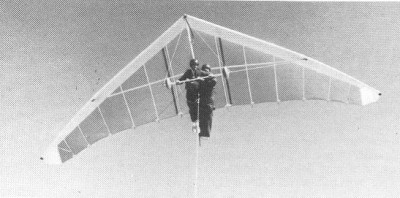
Dick Boone designed the 220 Dream specifically for tandem. It was the first HMGA certified for same. A very popular single surface trainer. The 220 was the de facto standard tandem glider for many years, a superb single surface glider. Very maneuverable, easy to launch, land and set up. They do have the tendency to drop the nose after landing flare.

A batch of Dreams 220 had an instability problem at low A.O.A. as some were made with less angle on the washout tubes. If the bar is pulled in a lot to speed, at first you feel great pressure but then, all of a sudden, the pressure vanishes and the bar wants to continue by itself. Only a short and healthy push restores the bars preassure. The heavier the pilot the faster you get to this occurrence. It seems that at low A.O.A luff lines and washout make the combined reflex effect and the change in the washout tubes produced this tendency to tuck at low A.O.A.

Delta Wing Dream 145

Delta Wing Dream 165

Delta Wing Dream 185
Sail area: 185 sq ft
Span: 34.4 ft
Nose Angle: 120 degrees
Weight of glider: 55 lbs
Pilot proficiency: Beginner / H-1
Pilot weight range: 140-210 lbs
Stall speed at max load: 28 mph
Max speed at min load: 38 mph
Number of battens, each side: 8 (grand total 17 includes nose batten)

Delta Wing Dream 205
Sail Area: 205 sq. ft.
Glider Weight: 55 lbs.
Pilot Hook-in Weight: 150 – 225 lbs.
Skill Level: Novice
SS/DS: Single Surface
KP/TL: Kingpost
VG: No
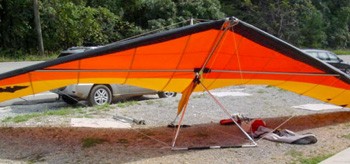
Leading Edge Color: Black
Undersurface Color: Orange
Main Body Color: Gold

Delta Wing Dream 220

Delta Wing Dream 240

Delta Wing Kites and Gliders / Air Sports International

Delta Wing Kites is a specialist in the sale of hang gliders, but then turned to the production of trikes intended for mounting under a standard hang glider wing without any modification to the latter in 1979.
1983: P.O. Box 483, Van Nuys, CA 91408, USA.

Delta king kites and Gliders was bought by Teddy Mack in 1991 and renamed Air Sports International.

The company manufactured The Dream line of gliders as hang gliders and trike wings in San Diego California from 1991 to 1997

Delta Technology DS-26 Nomad

A high-wing monoplane with conventional tail surfaces. The ailerons and elevators are operated by a control stick, while the rudder is operated by pedals. Aluminum tubing is used throughout. The wings are built from premolded leading edge forms and preformed sheet metal structural parts. Wing and tail covering is 1.8-ounce Dacron. Complete kits require final assembly. POWERPLANT: Unitrek 140-10 mounted in pusher position aft and below the main wing. A 1:1.98 reduction unit turns a two-blade wooden Ritz propeller. Fuel is carried in a high density polyethylene tank directly behind the pilot seat on GG. LANDING GEAR: Monowheel main gear with tail skid wheel. The main wheel measures 10 inches, and the rudder-connected tail wheel is 4 inches in diameter. The DS-26 allowed 28-50 hp Rotax engines. Doped double surface wing-covering, conventional three axis airplane controls, full 3600 roll cage, all metal aircraft type structure, 20 minute set-up.
Units delivered to June 1981: 189. Price 1982: $3,860.

Delta Technology DS-26 Nomad Article

In 1984 Delta Technology had completed all design modifications on all three of the company’s Nomad and Honcho ultralights.

”The Nomad 11, Honcho 11 and Super Honcho are now ready to go, and with the completion of our new production facility, we are prepared to deliver in two to four weeks,” a company spokesman said. ”Our intent is to offer a special introduction price on.a limited number of aircraft in order to stimulate interest and awareness in the newly completed models,” he added.

Delta also reduced the price on all three models by $1,000. The Honcho 11 was $3,980, the Nomad 11 $4,380 and the Super Honcho $4,980.

The Honcho 11 features all-metal construction, traditional, strutted wing design, energy-absorbing 360 degree roll-cage fuselage, conventional three-axis controls, strong wing structure with differential ailerons, hydraulically dampened independent suspension and a 10-year lifespan on double-surface wing coverings.

This offer was good until July 31, 1984; however, a limited quantity of aircraft were available. A production number and delivery date was to be issued upon receipt of payment in full or a 50 percent deposit.

DS-26A
Wingspan, 36 ft. 1 in.
Wing area, 147.34 sq.ft.
Aspect ratio, 8.84:1.
Overall length, 22 ft.
Empty weight, 152 lbs.
Usable payload (include fuel), 210 lbs.
Wing loading, 2.46 lbs/sq.ft.
L/D power-off glide ratio, 14.5:1.
Cruise speed (85% power), 35 mph
Stall speed, 24 mph.
Approach speed, 31 mph.
Flair speed, 24 mph.
Liftoff speed, 30 mph.
Takeoff roll distance, 225 ft.
Rate of climb, 185 fpm.
Fuel capacity, 2.5 USG.
Range at cruise, 106 sm.
Engine displace¬ment, 8.2 cu.in.
Rated HP, 10 hp. S
tatic thrust, 85 lbs.

DS-26B
Engine: Solo 335, 20 hp.
Wing span: 11m.
Lenght: 5.62m.
Empty wt: 72kg.
MAUW: 185kg.
Range: 150km.

Delta Sud Vision

A 1984 hang glider for Intermediate pilots.

Vision 137
Wing area: 13.75 m²
Wing span: 9 m
Aspect ratio: 5.89
Hang glider weight: 26 kg

Vision 159
Wing area: 15.9 m²
Wing span: 9.4 m
Aspect ratio: 5.55
Hang glider weight: 28 kg

Vision 176
Wing area: 17.6 m²
Wing span: 9.6 m
Aspect ratio: 5.23
Hang glider weight: 31 kg

DeltaHawk DH200A4 / DH180A4

DeltaHawk DH200A4

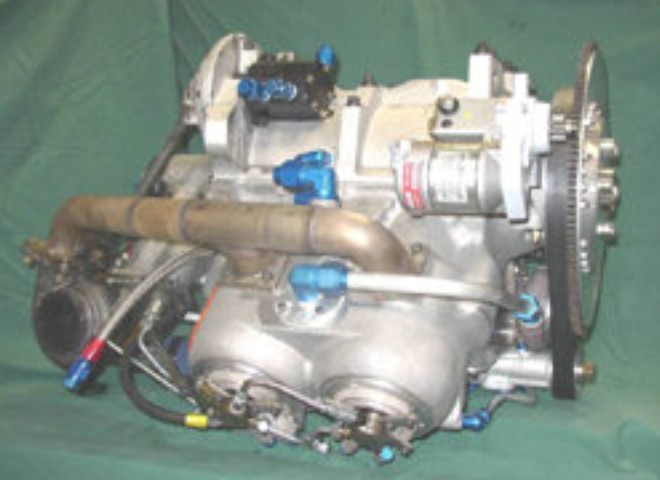
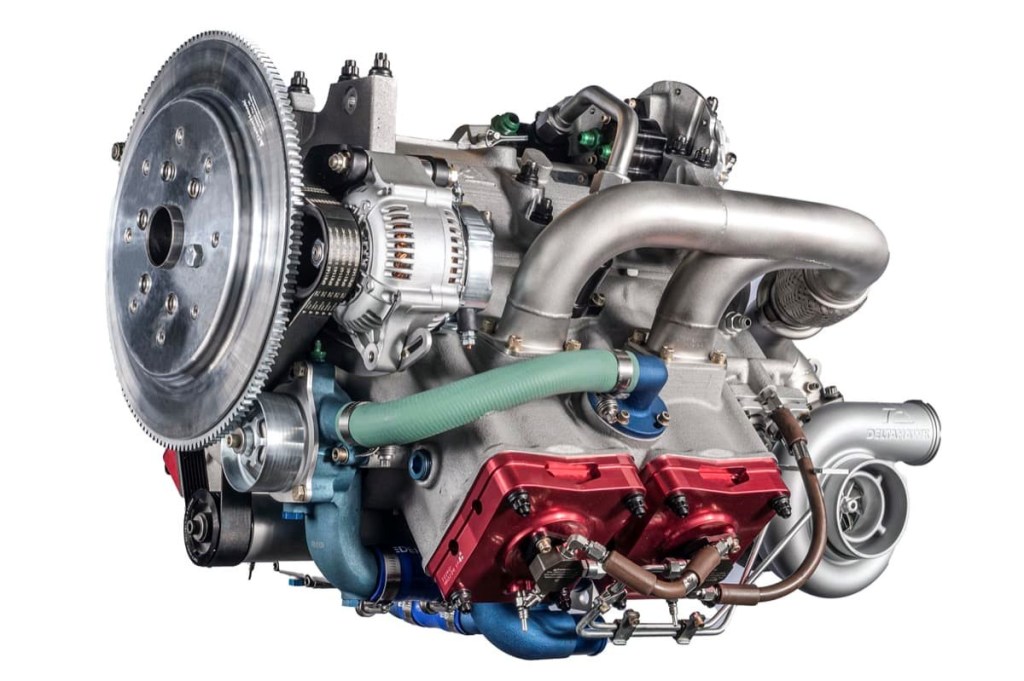
These diesel engines are is manufactured by DeltaHawk and feature a direct drive four cylinder two stroke, inverted V configuration, liquid cooling, direct injection, and turbo-diesel.

Optional Equipment includes hydraulic governor (with constant speed propeller option), a low noise exhaust (meets German noise regulations in combination with 3-blade propeller), and either a 3-blade constant speed or 2-blade fixed pitch propeller.

These firewall forward DeltaHawk engines kits are approved to operate on Diesel and Jet fuel.

DHK180

The 180-hp DHK180 is the first of a family of engines to come from DeltaHawk, according to officials with the Racine, Wisconsin-based company.

Featuring an inverted-V engine block, turbocharging and supercharging, mechanical fuel injection, liquid cooling, direct drive, and 40% fewer moving parts than other engines in its category, the 180-hp DHK180 engine is a clean-sheet design secured by multiple patents, company officials noted.

According to company officials, the new engine is “highly responsive and produces more usable torque than traditional aircraft engines in its class, all while burning significantly less fuel and with a resulting lower net carbon footprint. The engine can burn both Jet-A and sustainable aviation jet fuels.

With FAA certification in hand, performance and technical upgrades were underway, along with additional endurance testing and flight evaluations in multiple aircraft.

The new engine was selected by NASA to power the hybrid propulsion system planned for its Subsonic Single Aft Engine Aircraft (SUSAN) scale flight test vehicle, a proof-of-concept electro-fan design for future regional transport aircraft. The DeltaHawk engine has also been selected by Ampaire for an upcoming aircraft testbed application in support of NASA’s Small Business Innovation Research initiative.

First deliveries were expected in 2024.

DH200A4
Power: 200 hp at 2700 rpm

DH180A4
Power: 180 hp at 2700 rpm