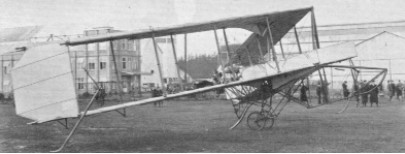
Dunne built a monoplane, the D.7, which was displayed at the 1911 Olympia Aero Show in London, and began making de¬liberate attempts to upset the machine’s equilibrium in flight by letting go of the controls during steep, low level turns. Even the most forgiving aircraft will bite when sorely tried, and sure enough Dunne suffered four major crashes for his fool¬hardiness.
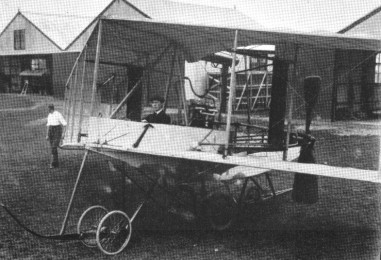
Unfortunately, by that time the War Office decided that it had spent far too much on experiments with aeroplanes a total of about £2.500, at a time when Germany was devoting £400,000 a year to military flying and Dunne lost his official support. He carried on by himself, and in the next few years proved conclusively the soundness of his ideas. After taking off in his D.6 powered biplane, he locked the controls and let it fly itself while he wrote a report.
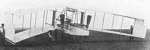
The 1911 Dunne D 6 was designed by John W. Dunne and built by Short Bros.
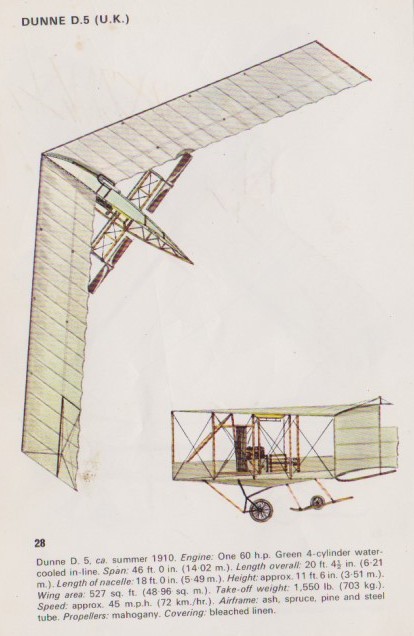
In 1908 Lord Tullibardine offered to help, and with Capper and his assistant, Captain Carden, they set up the Blair Atholl Aeroplane Syndicate and had Short Brothers build them a new tailless biplane with a 60 hp Green engine driving two propellers.
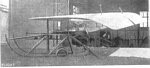
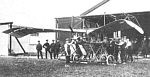
The D.5 was a two seater which Dunne elected to test fly himself. The recalcitrant motor put Dunne and his D.5 into the marsh at the end of Eastchurch aerodrome, in Essex, where the team had moved after leaving Scotland, but during the spring of 1910 his arrow shaped aircraft became a familiar sight in the area and was noted for the steadiness with which it flew. The tests culminated in a 1.25 km (2 mile) flight during which Dunne never touched the controls and a demonstration in front of Orville Wright. The D.5 had combined elevators and ailerons (elevons) at the tips of its wings. These were operated by two levers which could be locked into position on a ratchet to maintain a desired attitude, and the machine’s stability vindicated Dunne’s theories about the tailless configuration.
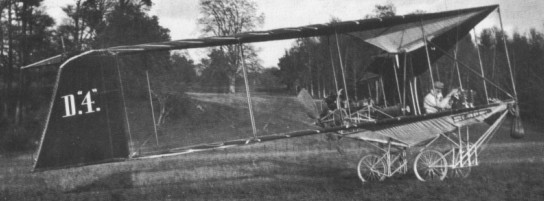
Back at Farnborough during the winter of 1904 the D.1 was redesigned and rebuilt, with a new 25 hp R.E.P. engine and a wheeled landing gear, to re emerge as the D.4. On Dunne’s own admission this D.4 was more of a hopper than a flier. It did make eight flights late in 1908, but the longest was barely 36 m (120 ft) and the War Office declined further financial sup¬port for his experiments.
The D.1 proved the soundness of Dunne’s ideas and was followed by further machines on the same principle; the D.3 was constructed at Farnborough and later ones built privately at Eastchurch. In addition, both seaplane and flying boat versions of the Dunne biplane were built in America by the Burgess Company. But it gradually became apparent that inherent stability was not so essential for a military aircraft as good manoeuvrability.
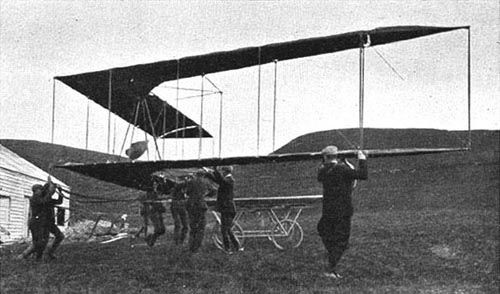
John Dunne came to the Balloon Factory on June 1st, 1906, where he was appointed to the Royal Engineer Committee and placed in charge of the design, construction and testing of aero¬planes. Teamed up with Colonel John Capper, Superintendent of His Majesty’s Balloon Factory at South Farnborough in Hampshire, their first aircraft, the Dunne D.1, was ready in the spring of 1907. It was a single-seat glider with arrow shaped biplane wings. Powered by two 12 h.p. Buchet engines, it was ready by the spring of 1907, and in July was removed in great secrecy to the Marquis of Tullibardine’s Scottish estate at Blair Atholl, in Perthshire, for its first tests. It made one very brief unpowered flight, with Capper at the controls, during which its inherently stable properties were confirmed, but on its first attempt at a proper powered take off, owing to faulty launching tactics it crashed, sustaining extensive damage. Back at Farnborough during the winter the D.1 was redesigned and rebuilt, with a new engine and a wheeled landing gear, to re emerge as the D.4.
The D.1 proved the soundness of Dunne’s ideas and was followed by further machines on the same principle; the D.3 was constructed at Farnborough and later ones built privately at Eastchurch. In addition, both seaplane and flying boat versions of the Dunne biplane were built in America by the Burgess Company. But it gradually became apparent that inherent stability was not so essential for a military aircraft as good manoeuvrability.
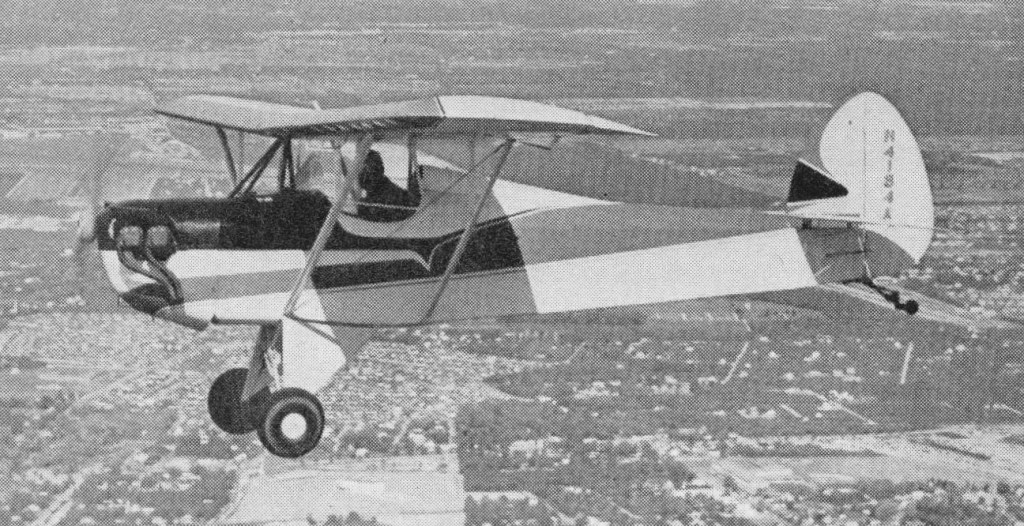
A variation of the Baby Ace of the 1930’s, the Dunn D-1 was built in spare time by E.Dunn around 1959. Power is by a Continental A-65 and cruise is 95 mph.
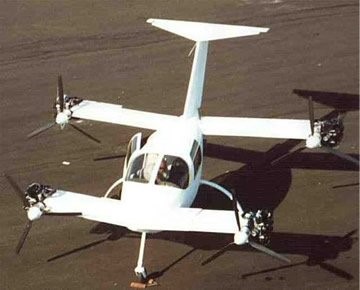
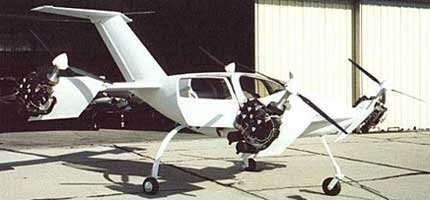
In the late 1990s Duncan Aviation of Michigan developed its Xantus V/STOL design N44CX, named after a species of hummingbird and designed by Terry Duncan, a lead engineer for Williams International.
It featured four 80 hp Hirth F30 engines placed at wingtips fore and aft of the fuselage, and was unveiled to the public for the first time at AirVenture ’99.
The company predicted that the four-passenger tilt-prop aircraft would take off and land vertically, and cruise at 290 mph with a range of up to 800 nm.
After receiving an airworthiness certificate from the FAA on July 7, 1999, the aircraft made its first tentative hovering flight on July 11. Its current disposition is unknown.
USA Based at Opa Locka, this company produced modified Beech 18, increasing performance considerably, under the designation Dumod I. A further development, known originally as the Infinite, later as Dumod II, was produced from 1964. Rights to both acquired by Broome County Aviation in 1972.