Edgley Aircraft Ltd was founded 1974 to develop the EA7 Optica three-seat observation aeroplane, featuring a ducted propulsor powerplant to the rear of the helicopter-like bubble cockpit (first flown December 1979). Ceased trading 1985.
Optica Industries Ltd took over the Optica observation aircraft from Edgley following purchase from receiver by A. Haikney of Aero-Docks in 1985 and formation of this company to restart production in 1986.
Era
Edel Atlas

The Atlas was certified and introduced in 1998.
This is a wing that has good safety mixed with good turns mixed with good glide, and it’s motor friendly. If you want an all around glider this is it.
Power Atlas is easy to launch but is NOT a DHV 1. Just a standard class but totally suitable for the beginner. Comes with short trim risers for a comfortable hand position. 3 mph faster trim speed than original Atlas, thicker lines and great, very short, Trim Risers for extra speed, torque compensation and a comfortable hand position. Designed to inspire the beginning, intermediate or low airtime pilot. The Power Atlas has very good trim speed (37km/h max load) excellent handling and confidence inspiring handling. Very easy launching, fast rising glider. All internal stitching, reinforced attachment points, highest quality.
Atlas L
Wing area: 30.23 sq.m
Certification: DHV 1-2 / Afnor
Pilot weight: 90-110 kg
No. of cells: 35
Wing span: 11.88 m
Aspect ratio: 4.67
Price (1998) 19825£
Atlas M
Wing area: 29.95 sq.m
Certification: DHV 1-2 / Afnor
Pilot weight: 75-95 kg
No. of cells: 35
Wing span: 11.43 m
Aspect ratio: 4.67
Price (1998) 1795 £
Atlas S
Wing area: 25.75 sq.m
Certification: DHV 1-2 / Afnor
Pilot weight: 65-80 kg
No. of cells: 35
Wing span: 10.97 m
Aspect ratio: 4.67
Price (1998) 1775 £
Atlas XL
Wing area: 32.6 sq.m
Certification: DHV 1-2 / Afnor
Pilot weight: 105-120 kg
No. of cells: 35
Wing span: 12.33 m
Aspect ratio: 4.67
Price (1998) 1845 £
Atlas XS
Wing area: 23.65 sq.m
Pilot weight: 60-70 kg
No. of cells: 35
Wing span: 10.51 m
Aspect ratio: 4.67
Price (1998) 15,000 Fr
Edel Galaxy
Paraglider circa 1998.
Wing area: 43 sq.m
Certification: Afnor
Pilot weight: 130-200 kg
No. of cells: 49
Wing span: 13.3 m
Aspect ratio: 4.1
Min sink: 1.1 m/s
Max speed: 40 kph
Price (1998) 2495 £
Edel Sabre

Paraglider circa 1998.
Sabre L
Wing area: 29.3 sq.m
Certification: DHV 2 / Afnor
Pilot weight: 85-105 kg
No. of cells: 62
Wing span: 12.09 m
Aspect ratio: 5
Price (1998) 2165 £
Sabre M
Wing area: 27.03 sq.m
Certification: DHV 2 / Afnor
Pilot weight: 75-95 kg
No. of cells: 35
Wing span: 11.63 m
Aspect ratio: 5
Price (1998) 2325 £
Sabre S
Wing area: 25.43 sq.m
Certification: DHV / Afnor
Pilot weight: 65-85 kg
No. of cells: 62
Wing span: 11.28 m
Aspect ratio: 5
Price (1998) 2095 £
Sabre XL
Paraglider circa 1998.
Wing area: 31.52 sq.m
Certification: DHV / Afnor
Pilot weight: 95-120 kg
No. of cells: 62
Wing span: 12.55 m
Aspect ratio: 5
Price (1998) 2195 £
Edel Sector

Paraglider circa 1998.
Sector L
Wing area: 28.16 sq.m
Certification: DHV 2-3 / Afnor
Pilot weight: 85-105 kg
No. of cells: 78
Wing span: 13.06 m
Aspect ratio: 6.05
Price (1998) 2395 £
Sector M
Wing area: 26.04 sq.m
Certification: DHV 3 / Afnor
Pilot weight: 65-85 kg
No. of cells: 78
Wing span: 12.56 m
Aspect ratio: 6.05
Price (1998) 2345 £
Sector S
Wing area: 23.99 sq.m
Certification: DHV / Afnor
Pilot weight: 65-85 kg
No. of cells: 78
Wing span: 12.05 m
Aspect ratio: 6.05
Price (1998) 21,500 Fr
Ector Aircraft Co Inc
This company was formed to produce the Cessna L-19 Bird Dog, dating from 1950s, under the names of Ector Mountaineer and Super Mountaineer.
Eclipse EA700 / One Aviation Project Canada
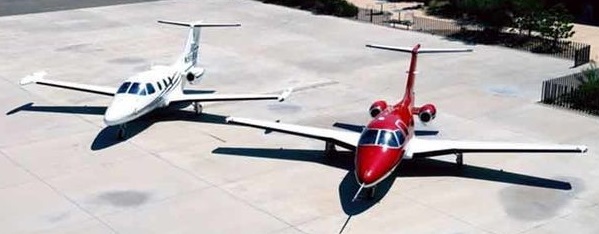
One Aviation successfully flew an aircraft carrying the proof of concept wing shape of the new EA700 Project Canada from the company’s Albuquerque headquarters.
The first flight lasted 1.3 hours and the aircraft, N990NE climbed as high as 15,000 feet to evaluate aircraft handling qualities with the landing gear up down, as well as retracted and also in all flap configurations. Jerry Chambers, Director, Flight Test/Chief Test Pilot was PIC for the flight.
The modified wing included the four-foot wing span extension with the original EA550’s tip tanks removed to match the shape of the wing to be used on the new EA700 still under development. The final shaping of the wing tips for the EA700 was not included on this test aircraft although the wing did include a reshaped inboard wing airfoil and planform.
The flight used a modified EA550 airframe that retained the original fuselage, engines and stabilizers.
The production EA700 will feature a 14-inch cabin stretch making room for a fourth cabin window, a Garmin G3000 cockpit and additional fuel capacity. One Aviation is the parent company to Eclipse Aerospace.
Eclipse 500
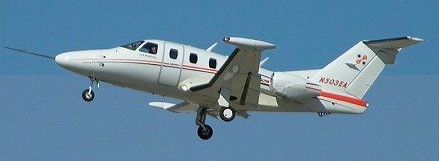
The Eclipse 500 was a project that was to build a lightweight, economical, fast jet, for both private and commercial use. The whole project was based primarily on the use of new EJ22 William jet engine.
The Eclipse 500’s price tag was promised at $837,500 and brought in deposits for more than 2,000 airplanes.
The Eclipse 500 business jet programme was temporarily suspended in 2002 because of problems with the starters and fuel-metering equipment on the aircraft’s compact Williams EJ22 engines. On August 26, 2002, at Albuquerque International Sunport, prototype N500EA first flew with test pilot Bill Bubb. The acceleration is lethargic, especially for an airplane loaded so lightly. In the hot, thin, mile-high air, the EJ22s can generate barely half their rated thrust. After a leisurely takeoff roll of more than 3,000 feet, the airplane lifts off and begins a gentle climb, paralleling the Sangre de Cristo mountains off its left wing. For about an hour, Bubb flies the planned test routine, checking out general handling qualities and systems operation. Overall, the flight is free of major glitches. The Eclipse 500 never again flew with EJ22s.
Three months later, Eclipse Aviation announced: “The EJ22 is not a viable solution for the Eclipse 500 aircraft, and Williams International has not met its contractual obligations.” Williams conceded that it had run into “a number of challenges” with the EJ22 but insisted it had satisfied the contract, implying that the airplane had simply grown too heavy.
Eclipse signed a deal with Pratt & Whitney to develop a smaller version of a more conventional engine. The PW610F would develop 900 pounds of thrust, but it would weigh 260 pounds—triple the weight of the EJ22. The extra power would give the Eclipse 500 a bit better speed and climb, but there was a big downside: an empty-weight gain of 700 pounds and a 20 percent increase in fuel consumption. The price and cost projections eventually ballooned to $1.3 million and 89 cents a mile.
First flight with Pratt & Whitney Canada PW610F turbofan engines was in December 2004. Three years later, flight tests of the P&W-powered Eclipse 500 were proceeding smoothly. The Eclipse 500 became the first of a new class of Very Light Jets (VLJ) when the first jet was delivered in late 2006. The engines are in aft fuselage-mounted nacelles.
Production of the Eclipse 500 was halted in mid-2008 due to lack of funding and the company entered bankruptcy.
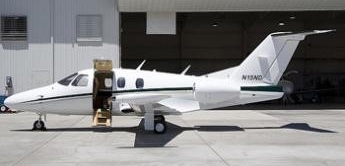
Engines; 2 Pratt & Whitney Canada PW610F turbofans
Takeoff Thrust at Sea Level ISA+15°C (86°F) 900 lb (each) 4.00 kn (each)
Length 33.5 ft 10.2 m
Wingspan 37.9 ft 11.6 m
Height 11.0 ft 3.4 m
Maximum Ramp weight 6,034 lb / 2,737 kg
Maximum Takeoff weight 6,000 lb / 2,722 kg
Maximum Landing weight 5,600 lb / 2,540 kg
Empty weight 3,634 lb / 1,648 kg
Fuel Capacity 1,698 lb/251 gal / 770 kg/950 l
Useful Load 2,400 lb / 1,089 kg
Sea Level Cabin to; 21,500 ft 6,533 m
Cabin Altitude at 41,000 ft; 8,000 ft 2,438 m
Takeoff Distance Sea Level, ISA to 50 ft (15 m) @ MGTOW 2,345 ft 715 m
Landing Distance Sea Level, ISA @ 4,600-lb (2,087-kg) landing weight 2,250 ft 686 m
Rate of Climb – 2 engines 3,424 ft / min 1,044 m / min
Rate of Climb – 1 engine 989 ft / min 301 m / min
Time to Climb – 35,000 ft (10,688 m) 22 min
Takeoff at 5,000 ft (1,524 m) At ISA + 15°C; 3,881 ft 1,183 m
Single Engine Takeoff Climb at 5,000 ft (1,524 m) At ISA + 15°C; 705 fpm / 215 m / min
Max Cruise Speed; 370 kt / 685 km / hr
Vso; 69 kt / 128 km / hr
Vmo; 285 kt / 528 kph / 0.64 Mach
Maximum Altitude; 41,000 ft / 12,497 m
Single Engine Service Ceiling 25,000 ft / 7,620 m
Range 100 nm alternate; 1,125 nm / 2,084 km
Range – Max IFR 45-min res, 4 POB; 1,300 nm / 2,408 km
Cabin length; 148 in /376 cm
Cabin height (max); 50 in / 127 cm
Cabin width (max); 56 in / 142 cm
Seats 6
Eclipse Concept Jet / Eclipse 400
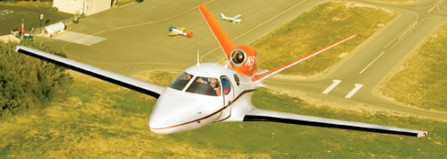
The Eclipse 400 seats four and cruises at 41,000 feet, three miles above its closest competition. Its robust v-tail design provides superior handling and its gold standard Pratt & Whitney Canada PW615F engine produces exceptional thrust and envious fuel economy.
Engines: 1 x Pratt & Whitney Canada PW615F
Length; 29.0 ft
Height; 8.8 ft
Wingspan; 36.0 ft
Max cruise speed (FL350); 330 ktas
Long range cruise speed (FL400); 290 ktas
Max range (FAA IFR + 45-min reserve); 1,250 nm
Service Ceiling; 41,000 ft
Time to Climb to FL250; 13 min
Time to Climb to FL350; 22 min
Stall Speed (VSO); 61 kt
Takeoff Distance to 50 ft. (Sea level, ISA, MGTOW); 2,045 ft
Landing Distance (Sea level, ISA, Max landing weight); 2,100 ft
Seats: 1 + 3
Baggage Capacity, Interior; 18 cu ft
Baggage Capacity, Exterior; 14 cu ft
Eclipse Aviation
Eclipse Aviation was founded by Vern Raburn in Scottsdale, Arizona, in 1998, and in 2000 the headquarters was moved to Albuquerque, N.M.
Construction of the first Eclipse 500 began in 2001.
The Eclipse 500 is flown for the first time on August 26 2002 powered by Williams International EJ22 turbofans.
In 2003 Pratt & Whitney Canada PW610F-A engines were selected to replace the Williams engines and testing of the PW610F engines began in 2004. Assembly of seven test aircraft also began and the first certification flight test aircraft was produced.
After airframe testing, in 2005 the FAA cleared the Eclipse 500 to an initial lifetime of 10,000 hours.
Eclipse Aviation receives full type certification for the Eclipse 500 from the FAA on September 302006. The first production Eclipse 500 receives its Certificate of Airworthiness from the FAA, and the first Eclipse 500 was delivered to a customer.
Eclipse Aviation received its production certificate from the FAA on April 26 2007. The Eclipse Concept Jet (now the Eclipse 400), a single-engine turbofan powered, V-tail, four-place aircraft is revealed at EAA AirVenture in Wisconsin. Eclipse Aviation opens its Jeff Harbers Customer Training Center at Double Eagle II Airport in Albuquerque, NM, and a service center in Gainesville, FL.
In 2008 Eclipse Aviation became the fastest general aviation jet aircraft manufacturer in history to produce its first 100 airplanes. The company opens a service center at the Albany International Airport in New York. On May 30 2008, Eclipse Aviation started taking orders for the Eclipse 400 single-engine jet, the production version of the Eclipse Concept Jet. Eclipse Aviation founder Vern Raburn steps down as President and CEO. Roel Pieper becomes CEO.

