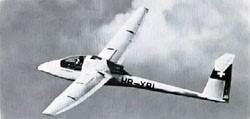
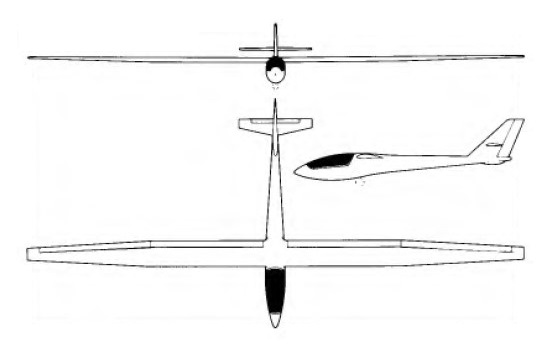
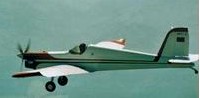
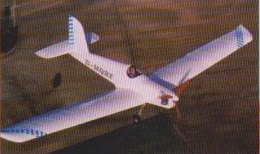
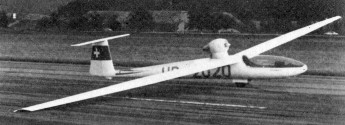
The Prometheus is a production of EFF / Entwicklungsgemeinschaft für Flugzeugbau / Association for the development project and airplane building. It is is a high performance side-by-side glider with two Microturbo 90 kp thrust engines. A self-launching glider, its engines can be stopped and reset running at will.
One was built, registered in 1978 as HB-YBI, and the name Prometheus PV.
With a wingspan of 19.4 m, it weighs 707 kg unladen and 900 at full load. Its radius of action powered flight exceeds 500 Km
In 1980, the manufacturer reported a radio navigation facility and a transponder allowing it to integrate seamlessly restriction in controlled airspace and major airport.
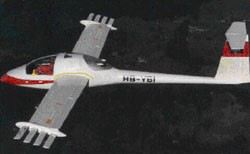
The Prometheus II is linked to an engineer in Switzerland, Ulrich La Roche , who sought to reproduce with WINGGRID, some aerodynamic effect on birds. This work began in the first wind tunnel at Emmen between 1993 and 1994. In 1996, an encounter with Prof . Dr. – Ing. Hans -Reinhard Meyer- Piening would offer the opportunity to validate the concept of a real WINGGRID demonstrator.
In 1997, the Prometheus was chosen for this experiment. To this end, the size was reduced to 12 m. They hoped a glide ratio of 15 to 17, but experience showed that it was 25. The Prometheus II is a high performance glider with a fineness approaching 40, but with a high wing loading.
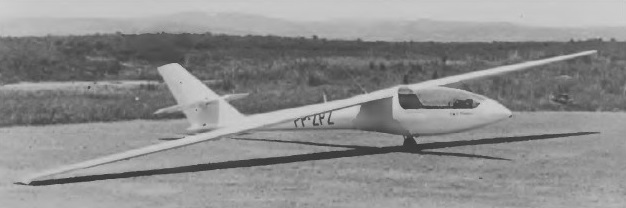
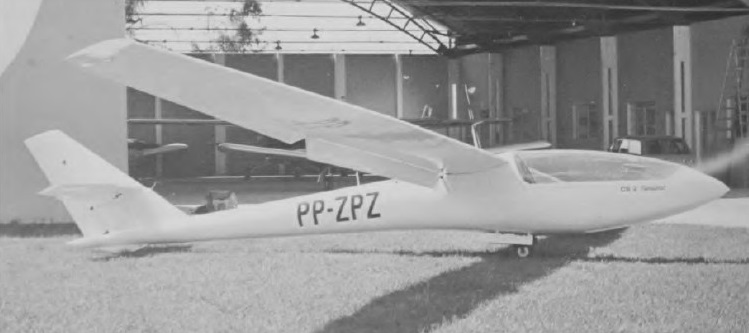
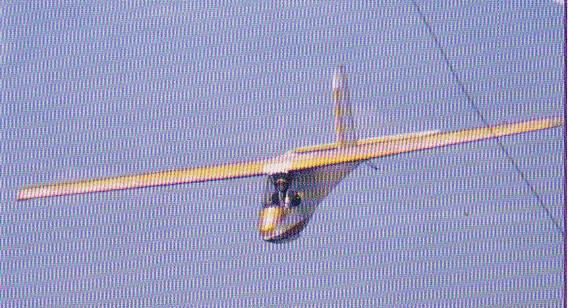
Named after a strong, cold wind common to southern Brazil, the Minuano high performance single-seater was designed by Professor Claudio Pinto de Barros, head of the CEA (Centro de Estudos Aeronauticos, or Air Research Centre) of the Engineering School at Minas Gerais Federal University – the Escola de Engenharia da Universidade Federal de Minas Gerais, or EEUFMG.
The Professor had completed his first sailplane design, the CB-1 Gaivota, when he was a student; design work on the Minuano began in 1969, construction started in 1971 and the prototype first flew on 20 December 1975. Four more Minuanos were ordered, the second being due for completion by the end of 1978, and this incorporates several modifications, being designated CB-2/B.
The cantilever high wing has a single aluminium alloy main par, and the wing skin is of plywood/glassfibre honeycomb sandwich. The flaps and ailerons, which are interconnected, are similar except for having wooden spars and the flaps can be used as air brakes by deflecting up to 90°. Up to 176lb of water ballast can be carried. The all-wood fuselage is a semimonocoque, and there is a retractable unsprung monowheel with an internal shoe brake, and a sprung tailskid. The tail surfaces are plywood covered, and stiffened with foam plastics, and the all-moving tailplane has a trim tab in each half.
CB-2 Minuano Wing span: 15.0 m / 49 ft 2.5 in Length: 7.0 m / 22 ft 11 in Height: 1.43 m / 4ft 8.25 in Wing area: 10.2 sq.m / 109.8 sq ft Wing section: Wortmann FX-61 -163/60-126 Aspect ratio: 22.0 Empty weight: 214 kg / 472 lb Max weight: 304 kg / 670 lb Water ballast: None Max wing loading: 29.8 kg/sq.m / 6.1 lb/sq ft Max speed: 140 kt / 260 km/h Stalling speed: 35 kt / 65 km/h Min sinking speed: 0.55m/sec / 1.8 ft/sec at 39 kt / 72 km/h Max rough air speed: 86.5 kt / 160 km/h Best glide ratio: 38 at 48.5 kt / 90 km/h
CB-2/B Span:49 ft 2.5 in Length: 22 ft 11.75 in Height: 4 ft 8.25 in Wing area: 109.8 sqft Aspect ratio: 22.0 Empty weight: 507 1b Max weight: 882 lb Max speed: 161 mph (in smooth air) Max aero-tow speed: 99 mph Min sinking speed: 1.97 ft/sec at 51.5 mph Best glide ratio: 39:1 at 59 mph
Professor Claudio Pinto de Barros was head of the CEA (Centro de Estudos Aeronauticos, or Air Research Centre) of the Engineering School at Minas Gerais Federal University – the Escola de Engenharia da Universidade Federal de Minas Gerais, or EEUFMG.
The CEA-311 Anequim was built by students of the Center for the study of Aeronautical Engineering at the Federal University of Minas Gerais in Belo Horizonte, Brazil, directed by Professor Paulo Iscold.
The school’s program was started in the early 1960s with a sailplane named CB-1 Gaviota, which was engineered by professor Cláudio Pinto de Barros, who founded CEA at age 25.
CEA stands for the Portuguese name for the Center for Aeronautical Studies. The number 3 denotes an airplane (1 is for sailplane and 2 is for ultralight). And the remaining two numbers are the order numbers for the design. Only seven airplanes have been built at the school, but Anequim is the 11th design produced.
The Prometheus 1 was an experimental powered sailplane from Switzerland, based on the airframe of the FFA Diamant 18.
Design and construction began in late 1970, the wings, Fuselage, tail units and landing gear coming from an original Diamant 18. The aircraft flew for the first time on 21 June 1971, powered by a 176 lb (80 kg) Microturbo Eclair II turbojet engine mounted on a pylon above the wing center-section. This had been later replaced by a more powerful TRS 25 engine.
Engine: One 264 lb (120 kg) st Microturbo TRS 25 turbojet Fuel capacity: 2 x 8.75 Imp gallon (40 litre) wing tanks, 1 x 0.4 Imp gallon (1.8 litre) fuselage tank. Total fuel: 17.9 Imp gallons (81.8 litres). Oil capacity: 0.11 Imp gallons (0.5 litres). Wing span: 59 ft 0.5 in / 18,0 m Wing aspect ratio: 22,5 Length overall: 24 ft 9.5 in / 7,56 m Height over tail: 4 ft 5 in / 1,35 m Tailplane span: 9 ft 6,25 in / 2,90 m Weight empty: 639 lb / / 290 kg Max T-O weight: 1,102 lb / / 500 kg Max level speed / Vne: 146 knots / / 168 mph / / 270 km/h Max cruising speed at S/L: 113 knots / 130 mph / 210 km/h Econ cruising speed at SL: 92 knots / 106 mph / 170 km/h Stalling speed, flaps up: 43.5 knots / 50 mph / 80 km/h Stalling speed, flaps down: 37 knots / 42.5 mph / 68 km/h Max rate of climb at S/L: 591 fpm / 180 m/min Service ceiling: 36,100 ft / 11,000 m T-O run: 984 ft / 300 m T-O to 50 ft (15 m): 1,476 ft / 450 m Landing from 50 ft (15 m): 492 ft / 150 m Landing run: 164 ft / 50 m Range with max fuel: > 135 nm / > 155 miles / >250 km
Incorporated 1925. Carried out three years of research and development in connection with seaplanes and flying-boats. From 1928 was famous for standardized float installations, and by 1947 over 300 types of aircraft had been equipped with Edo floats. During Second World War made sub-assemblies for Grumman Hellcat. First Edo-designed aircraft was the unsuccessful XSOE-1 single-seat observation floatplane. Company name changed in November 1947 to Edo Corporation. In 1962 fitted a Grumman amphibian flying-boat with experimental Gruenberg hydrofoils.
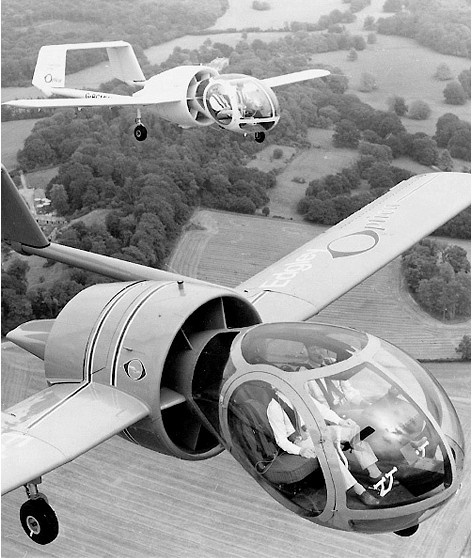
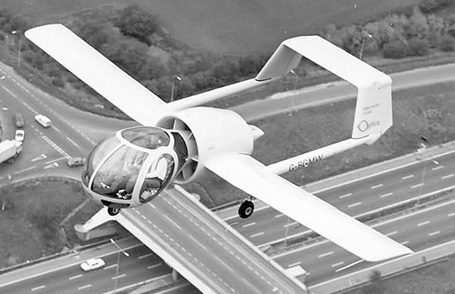
Combining the visibility of a helicopter with slow-flying capabilities, the original concept for the Edgley EA7 Optica was as a three-seat touring aircraft. Designer John Edgley, at that time a post-graduate student at the Imperial College of Science & Technology, London, began the final aerodynamic design in 1974 and a model was wind tunnel tested in 1975. Construction of a prototype began in 1976 in London, and final assembly was carried out at the College of Aeronautics, Cranfield. The first flight was made on 14 December 1979 with a 119kW Avco Lycoming O-320 engine but this was later changed to a 134kW IO-360. The Optica relies on ducted fan technology and a NASA designed aerofoil for its abilities. A one to one direct drive connects a five-bladed fixed-pitch fan to a Lycoming IO-360 200 hp fuel injected engine, enabling quiet operation and low vibration levels. As well as the normally aspirated Lycoming (TBO 1800 hours), a 210 hp turbo-charged Lycoming fit was available and a turbine installation was also being considered.
Mounting the whole cockpit assembly ahead of the fan and engine gives the pilot and passengers a 270 degree panoramic vision, plus almost vertical downward vision; the cockpit canopy design allows photography through the panels. The tricycle landing gear is fixed and unfaired, with maintenance-free solid suspension, and the airframe is of all-metal construction; its internal cabin width of 1.68m permits three-abreast seating, while baggage space and positions for mounting specialised observation equipment are provided behind the seats and in the unrestricted floor area in front of the two passenger seats. A considerable flap area provides for STOL capability, enabling continuous en route flight at a very low loiter speed of 50 kts (57 mph/92 kmh). A power setting of 65 per cent covers 570 nm (1,050 km) at 94 kts (108 mph) for six hours with normal reserves. A mixture of cruise and loiter enables around nine hours airborne while maximum loiter stretches out to 13 hours. Gliding characteristics are good with an approach speed of 65 kts and a threshold speed of 45 kts, 5 kts above the stall with 20 degree flap. The ROC (rate of climb) is around 720 fpm to a ceiling of 14,000 feet.
Considerable interest was shown in the Optica from the time of its first appearance, and at the 1981 Paris air show the announcement of a first production order was made – 25 for Australian distributor H. C. Sleigh Aviation Ltd. With GBP 2.3-million funding, Edgley bought Old Sarum airfield near Salisbury, and set up a production line in existing hangars. Initial plans covered the construction of 200 aircraft, beginning in mid-1983, with first production models to be available at the end of that year for approximately GBP 55,000 each. However, the crash of an early production aircraft in 1985 led to the collapse of the company. In October 1985, Optica Industries was formed to continue activities, and by the end of 1986, 15 aircraft had been produced. In January 1987 the factory was destroyed by arson along with all but one airworthy Optica. The company was reformed again as Brooklands Aircraft (later Aerospace), and the Optica Scout, renamed the Scoutmaster, returned to production with a 194kW Textron Lycoming O-540 engine. Six had been delivered to customers by the end of 1989. In March 1990, after building another five aircraft, all manufacturing was halted and a receiver called in. In July 1990 the Optica project was acquired by Lovaux Ltd at Hum and a resumption of full-scale production and marketing was planned.
Looking for an EDGLY EA-7 PRE-FLIGHT MANUAL. William Wurthmann william.wurthmann4@gmil.com July 2021
Engine; 1 x Avco Lycoming IO-360, 149kW Max take-off weight; 1236 kg / 2725 lb Empty weight; 850 kg / 1874 lb Wingspan; 11.99 m / 39 ft 4 in Length; 8.15 m / 26 ft 9 in Height; 2.31 m / 7 ft 7 in Wing area; 15.84 sq.m / 170.50 sq ft Max. speed; 203 km/h / 126 mph Stall speed; 55 mph Cruise speed; 174 km/h / 108 mph Ceiling; 4265 m / 14000 ft Range; 1046 km / 650 miles Endurance: 12 hr.
Brooklands Optica Scout Length : 26.903 ft / 8.2 m Height : 6.562 ft / 2.0 m Wingspan : 39.37 ft / 12.0 m Wing area : 170.071 sq.ft / 15.8 sq.m Max take off weight : 2899.6 lb / 1315.0 kg Weight empty : 2090.3 lb / 948.0 kg Max. weight carried : 809.2 lb / 367.0 kg Max. speed : 115 kts / 213 km/h Landing speed : 58 kts / 108 km/h Cruising speed : 86 kts / 159 km/h Initial climb rate : 807.09 ft/min / 4.1 m/s Service ceiling : 14026 ft / 4275 m Wing load : 17.02 lb/sq.ft / 83.0 kg/sq.m Range : 572 nm / 1060 km Engine : Lycoming IO 540 V4A, 260 hp Crew : 2+1