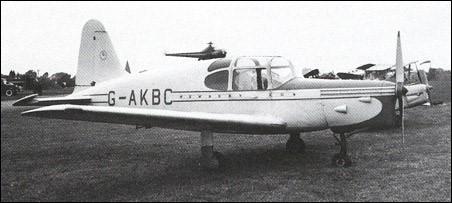
Eon 1 / Type 4 Eon 2

A four-seat single engine light aircraft built by Elliots of Newbury Ltd, of all wood construction. The undercarriage was fixed tricycle.

On 8 August 1947 the Type 4 first flew, registered G-AKBC powered by a 100 hp (75 kW) Blackburn Cirrus Minor, at Welford, Berkshire.

The prototype was later altered to have a DH Gipsy Major engine as the Eon 2.
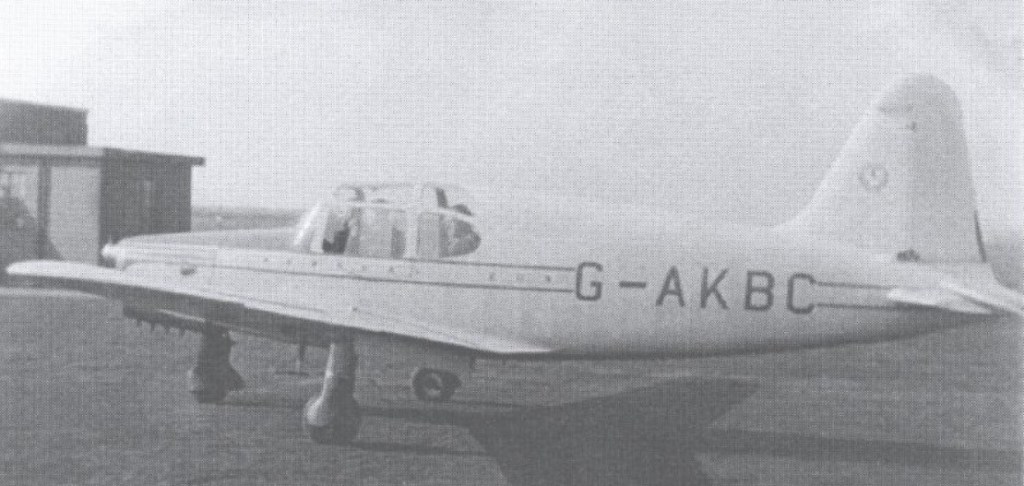
The sole completed Eon aircraft was used as a glider-tug to demonstrate the company’s gliders. The aircraft met its end at Lympne airfield, Kent, on 14 April 1950, when, with a glider attached the pilot started the aircraft by swinging the propeller with the aircraft’s wheels not secured by chocks. The engine started, and the craft moved forward; the pilotless aircraft and the glider were damaged as the aircraft passed through a boundary hedge. The glider pilot had also abandoned his cockpit when he realised what was happening.”

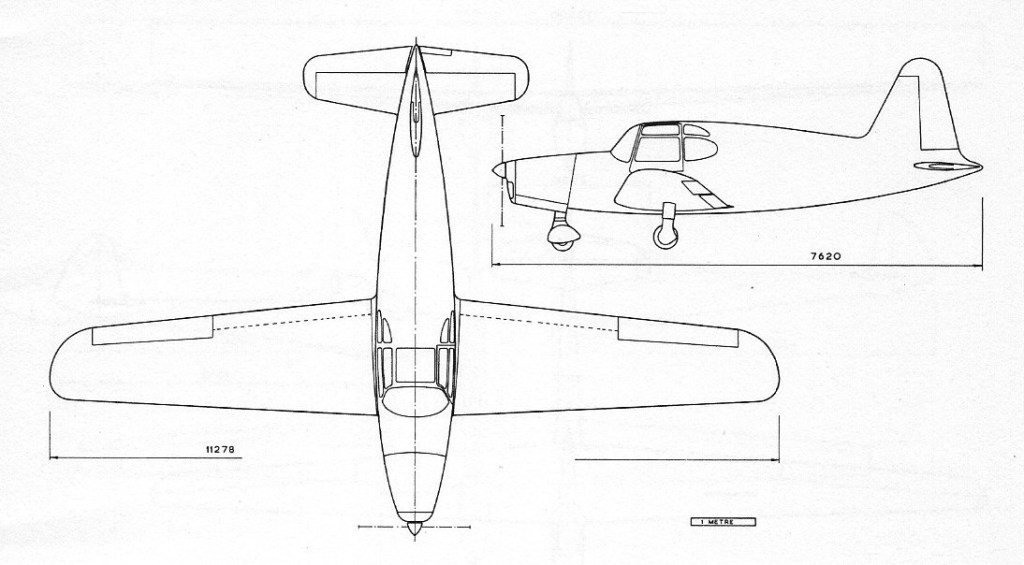
EoN 1
Engine: Blackburn Cirrus Minor II
Wingspan: 11.28m / 37 ft 0 in
Wing area: 15.5 sq.m / 173 sq.ft
Aspect ratio: 8
Length: 7.62 m / 25 ft 0 in
Empty weight: 596 kg / 1314 lb
AUW: 882 kg / 1950 lb
Max speed: 180 kph / 112 mph
Cruise: 160 kph / 100 mph
Seats: 4

Eon 2
Powerplant: 1 × de Havilland Gipsy Major 10, 145 hp (108 kW)
Propeller: 2-bladed fixed-pitch, 6 ft 0 in (1.83 m) diameter
Wingspan: 37 ft 0 in (11.28 m)
Wing area: 173 sq ft (16.1 m2)
Aspect ratio: 8:1
Airfoil: NACA 2R.12
Length: 25 ft 6 in (7.77 m)
Height: 9 ft 9 in (2.97 m)
Empty weight: 1,714 lb (777 kg)
Max takeoff weight: 2,350 lb (1,066 kg)
Fuel capacity: 18 imp gal (22 US gal; 82 L)
Maximum speed: 136 mph (219 km/h, 118 kn)
Cruise speed: 116 mph (187 km/h, 101 kn)
Stall speed: 50 mph (80 km/h, 43 kn) (flaps down)
Range: 350 mi (560 km, 300 nmi)
Service ceiling: 13,400 ft (4,100 m)
Rate of climb: 675 ft/min (3.43 m/s)
Take-off run to 50 ft (15 m): 1,635 ft (498 m)
Landing run from 50 ft (15 m): 1,500 ft (460 m)
Crew: 1
Capacity: 3 passengers
Elliots of Newbury (EoN)

Elliots of Newbury grew out of an old-established joinery works that had existed oa a part of the Albert Works, Newbury, Berkshire site since the mid-nineteenth century. After the 1914-18 wat a change to furniture manufacture was made. During the Second World War Elliots became involved with glider manufacture, one of a number of furniture manufacturers that co-operated in the building of the large transport gliders. Elliots built about one third of the total Horsa production including the development of the hinged nose for the Mark 2 version, and it was also responsible for powered version of the Hamilcar glider. However, Elliots prime interest was the making of furniture. At the end of the war, when the contracts for transport gliders were coming to an end, the firm was hoping to resume furniture manufacture but, for technical reasons, was not “designated” by the Board of Trade for the manufacture of “Utility” furniture.

Early in 1945 the company was approached by Chilton Aircraft Ltd to make one pair of wings for the Chilton Olympia. Elliots had, by then, already planned to manufacture the Newbury Eon four-seat light aircraft but they agreed to make one pair of wings only for the Chilton prototype. Elliots refused to sell Chilton’s the wing jigs and maintained legal rights and ownership of their own manufactured jigs. Chilton’s later gave up all aircraft work and an agreement was subsequently reached whereby Elliots purchased from Chilton the production rights, fuselage jigs, and work in hand on all Olympia sailplanes.

Quantity production of the Eon Olympia commenced in 1946, and was followed in 1948 by the production of two further ex-German designs, the Grunau Baby sailplane and the SG.38 primary glider. Elliots, and their design consultants Aviation & Engineering Products Ltd, introduced improvements in each of the designs before commencing production.

Meanwhile, the Newbury Eon aircraft had its first flight in August 1947, and, in conjunction with their consultants, they produced a Design Study and tendered to the Air Ministry specification T.16/48 for a two-seat training aircraft in competition with Percival, Handley Page, and Auster. No further aircraft were produced by Elliots but aircraft parts were made, under sub-contract.

In 1954 a new version of the Olympia was produced as the original design was nearly fifteen years old. The Olympia 4, later known as the 401, was the first in a series of gradual stages of improvement and led to the 402 in 1956, the 403 in 1957, and finally, in 1958, to the Open Class 419 with its companion the 415 for the fifteen-metre Standard Class. Limited production of these latter types was then initiated. A completely new Standard Class sailplane was introduced in 1961 known as the Type 460. This was put into production and became very popular in Britain, resulting in a special version, the Type 465, being developed for the 1965 World Championships.

In the summer of 1965 the Managing Director of Elliots, M H.C.G. Buckingham died. He had been a keen supporter of the gliding movement for many years. After his death Elliots carried out a review of the firm’s activities and decided that it was time to end glider production due to its increasing unprofitability. A joint advertisement in the April 1966 “Sailplane & Gliding” announced that Slingsby Sailplanes Ltd had taken over the production of Eon Sailplanes. However, no Elliots designed gliders were ever built at Kirkbymoorside although spares were supplied and repairs undertaken.

Ellehammer VI / Ellehammer 1910 Monoplane

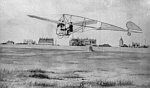
This machine has sometimes been called “Ellehammer”, and while the aircraft was capable of flight, its performance was rather modest, and as a consequence was nicknamed “graesslaamaskinen” (the grass cutting machine, or “Lawn-mower”) in the newspaper Ekstrabladet. With a six-cylinder Ellehammer radial engine and triangular fuselage shape in typical Ellehammer style, the ribs including the cloth could be pushed inboard along the main spar, which then could be folded along the fuselage. The main spars are still in transverse position in this photograph; believed to have been taken at “Kløvermarken” in 1910. Frederik Moltke was to compete with this machine for the first crossing-flight over the Øresund to Sweden. Unfortunately the airplane was not ready when Robert Svendsen had then already overflew the waters.

Span: 27’9″
Length: 24’7″

Ellehammer Helicopter

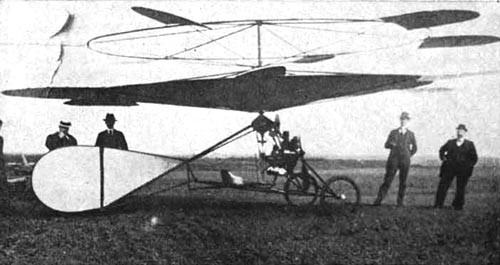
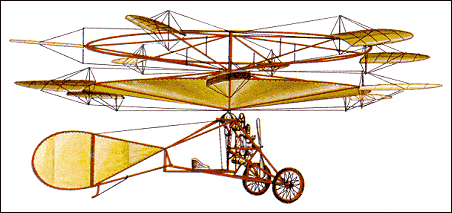
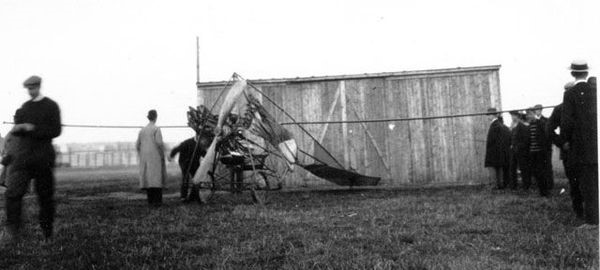
Ellehammer’s first studies of rotary-winged flight began in 1910, and various experiments were carried out in 1911 with a scale model helicopter. The full-sized machine that he built in the following year was a compound helicopter, as its 6-cylinder star-shaped 36hp engine (also designed by Ellehammer) drove both the rotor system by means of a hydraulic clutch, and a conventional propeller. The lifting rotors were two contra-rotating rings, each of 5.97m diameter, the lower one being covered with fabric to increase the lift. At regular intervals round the perimeter of the wings were six vanes, each about 1.50m long and 0.66m wide and pivoting about its horizontal axis. The rotor system was driven via a hydraulic clutch and gearbox, all designed by Ellehammer, and the rotor vanes’ angle could be altered in flight by the pilot as an early example of cyclic pitch control. After several successful indoor take-off tests, during which the machine was probably tethered, Ellehammer’s machine made a free vertical take-off later in 1912, in front of witnesses who included H.R.H. Prince Axel. Tests with the 1912 helicopter continued until late in September 1916, when it overturned after a take-off and the machine was wrecked when the rotors spun into the ground.

Engine; 1 x Ellehammer air-cooled radial, 25kW / 36 hp
Rotor diameter: 7.47m

Ellehammer Aeroplane

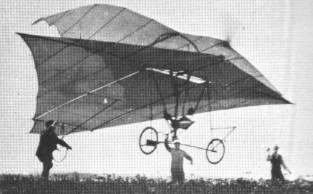
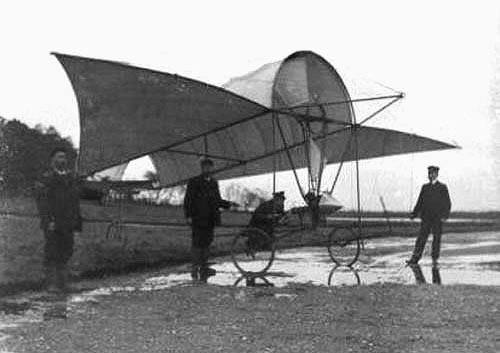
Danish inventor Jacob Christian Hansen Ellehammer’s 1905 first full-scale attempt did not fly. Ellehammer then experimented with an upper “sail”, added it to the machine, and succeeded in making brief tethered ascensions from a circular track on September 12, 1906. Since the island of Lindholon, on which tests were carried out, was too small for a straight flight to have been attempted.

Ellehammer IV Article

Many people acknowledge J.C.H.Ellehammer of Denmark as the first to fly in Europe because of a reported 42 m hop about 20 inches above the ground made on 12 September 1906.

Ellehammer’s work does not seem to have relied on the designs of his predecessors. He did fail to develop a workable control system. Lack of funds finally forced Ellehammer to abandon his experiments.

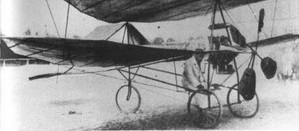
1908 Ellehammer IV

Engine: Ellehammer air cooled radial, 20 hp.
Prop: 4-blade.
Wing span: 30 ft 11.75in (9,35 m).
Length: 20 ft 4 in (6,20 m).
Height: 10 ft 8.25in (3.26 m).
Wing area: 398.3 sq. ft (37.00sq.m).
Gross weight: approx 397 lb (180 kg).
Speed: 35 mph (57 kph).
Seats: 1.

1908 Ellehammer IV
Span: 39’4″
Weight: empty 290 lb
Speed: 42 mph

Ellehammer, J.C.H.

Jacob Christian Ellehammer was first apprenticed as a watchmaker, he then qualified as an electrical engineer; he made one of the earliest motor-cycles built in Denmark, and also designed his own internal combustion engines. His 3-cylinder piston engine of 1903 was perhaps the world’s first radial engine, and his experiments in aviation, started two years later, embraced monoplanes, biplanes, triplanes, flying boats and helicopters.

Ellehammer Article

After the 1912 helicopter, Ellehammer then put aside his helicopter experiments until about 1930, when he began to evolve some new projects. One of these was, in effect, a parasol monoplane in whose wings was a huge circular cut-out with two contra-rotating rotors turning inside it. Even more novel was a proposal in the mid-1930s for a helicopter driven by compressed air. As with the previous project, only a working model was built, powered by a vacuum cleaner motor. In the full-sized aircraft Ellehammer proposed to have a radial engine driving a powerful air compressor. A substantial pylon over the fuselage was topped by a metal disc, made to rotate by the reaction from expelling compressed air through slots in its underside. The centrifugal force of the rotating disc was sufficient to unsheath four spring-loaded rotor blades; when take-off had been accomplished, these were retracted back into the disc and the compressed air stream diverted to an efflux at the rear of the aircraft to give it forward movement.

Elisport CH-7 Angel Kompress

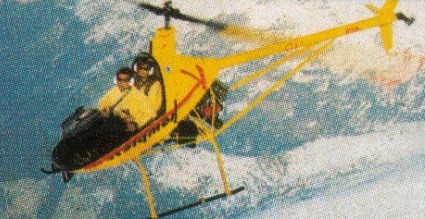
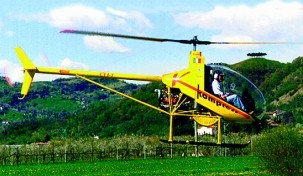
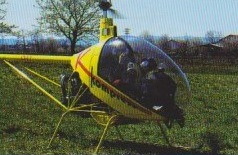
After 7 years of manufacturing and over 120 CH-7 ANGEL flying, Barbero brothers developed in 1996/97 the CH-7 KOMPRESS project, double seat tandem, double control, suitable for training. The Kompress has one-plus-one tandem seating, and a welded 4130 steel tube frame with composite body enclosure.

CH-7 Kompress

Tail boom and skids are of aluminum alloy. Manufactured in Italy.

CH-7 Kompress
Engine: Rotax 914, 115 hp
Rotor span: 7 m
Blade area: 0.18 sq.m
MAUW: 450 kg
Empty weight: 250 kg
Fuel capacity: 40 lt
Max speed: 208 kph
Cruise speed: 165 kph
Minimum speed: 0 kph
Climb rate: 7.5 m/s
Seats: 2
Fuel consumption: 20 lt/hr

CH-7 Kompress
Engine: 115 hp Rotax 914 turbo
Rotor Blades: Composite
Tail rotor: metal
Cruise: 160 km/h
Top Speed: 209 km/h
Empty Weight: 245 kg
Useful Load: 205 kg
Gross Weight: 450 kg
Seats: 2

CH-7 Kompress Charlie
Engine; Rotax 914 Turbo, 115 hp
Gross weight AeCI regulation; Kg 450
Empty weight; Kg 275
Useful load; Kg 205
Fuel capacity; 60 l. / 19 l.aux.
Rate climb; 7,5 m./sec.
In-ground effect hover; 3500 m.
Out-of-ground effect hover; 2500 m.
Service ceiling; m. 5000
Max fuel range; 480 Km/3 h.
Cruise speed; 160 Km/h.
Never exceed speed; 209 Km/h.
Seats; 2

Elisport CH-7 Angel

CH-7

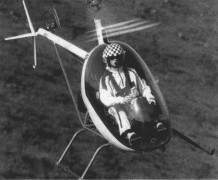
A single seat enclosed helicopter that was originated by Augusto Cicare in 1973. Welded 4130 steel tube frame with composite enclosure. Tail boom and skids are of aluminium alloy. Manufactured in Turin, Italy.

The flight qualities were improved by fitting 8 H 12 blades. It can be powered by a Rotax 912.

Engine: Rotax 582, 64 hp
Rotor span: 6.5 m
Blade area: 0.18 sq.m
MAUW: 360 kg
Empty weight: 205 kg
Fuel capacity: 40 lt
Max speed: 140 kph
Cruise speed: 136 kph
Minimum speed: 0 kph
Climb rate: 10 m/s
Seats: 1
Fuel consumption: 13 lt/hr

CH-7
Engine: 65 hp Rotax 582.
Rotor blades: Composite 19 ft
Metal tail rotor: 40 in
Speed max: 86 mph.
Cruise: 68 mph.
Range: 205 sm.
ROC: 1200 fpm.
Service ceiling: 11,000 ft.
Fuel cap: 10 USG.
Weight empty: 374 lbs.
Gross: 682 lbs.
Height: 6.75 ft.
Length: 23 ft.
Disk span: 19 ft.
Landing gear: skids.
Seats: 1

Engine: 80 hp Rotax 582.
Rotor blades: Composite 19 ft
Metal tail rotor: 40 in
Speed max: 100 mph.
Cruise: 80 mph.
Range: 170 sm.
ROC: 1900 fpm.
Service ceiling: 11,000 ft.
Fuel cap: 10 USG.
Weight empty: 451 lbs.
Gross: 792 lbs.
Height: 6.75 ft.
Length: 23 ft.
Disk span: 19 ft.
Landing gear: skids.
Seats: 1