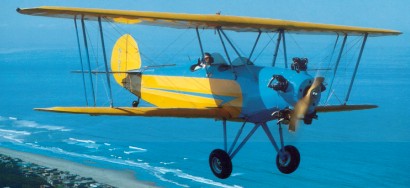
The KR21 C6B received its type certificate on 9 October 1930.
KR21 C6B
Engine: Kinner B5, 125 hp.
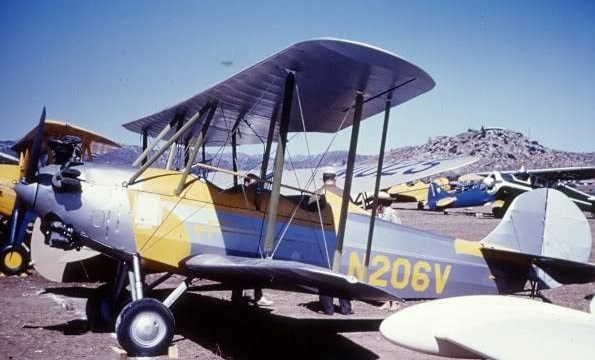
The KR21 C6B received its type certificate on 9 October 1930.
KR21 C6B
Engine: Kinner B5, 125 hp.
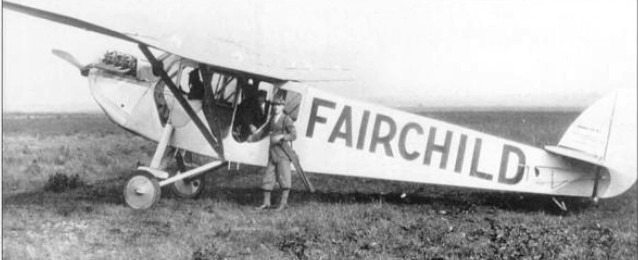
In the early 1920s Sherman Fairchild designed what he considered to be an ideal aircraft for aerial photography and survey. Tenders for construction of a number of these aircraft was prohibitive so Fairchild acquired premises at Farmingdale, Long Island, to build them ‘in house’. The FC-1 was built in Farmingdale, Long Island, New York, and towed 12 miles by truck to Rooservelt Field, where it first flew.
As first flown in mid-1926, the Fairchild FC-1 was of braced high-wing monoplane configuration, with a wing that could be folded for storage, a braced tail unit, tailskid landing gear and power provided by a 67kW Curtiss OX-5 8-cylinder Vee engine. The fuselage had an enclosed-cabin for a pilot and one or two passengers, and there were ample windows and ports for easy use of cameras.
The FC-1 received publicity in 1926’s Ford National Air Tour of the US, flying at an average speed of 90.3 mph. Richard H. Depew flew this first FC-1, carrying Corydon M. Johnson as a passenger. It finished 18th out of a field of 25 aircraft in a tour that began at Ford’s Dearborn Airport near Detroit, Michigan, and covrered 2585 miles.
After extensive testing during 1926, the FC-1 was re-engined with a 149kW Wright J-4 Whirlwind 9-cylinder radial engine, being redesignated FC-1A.
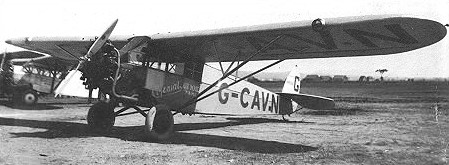
Further tests followed into 1927 and a decision was made to put the aircraft into production for general sales under the designation FC-2. This version differed by having increased cabin volume to seat a pilot plus four passengers, and a Wright J-5 Whirlwind engine (standard) or Curtiss C-6 engine (optional). FC-2s were also available with float or ski landing gear.
Fairchild created the six passenger FC-2W 2. One, the Stars and Stripes, was used by Richard Byrd in his 1928 Antarctic Expedition.
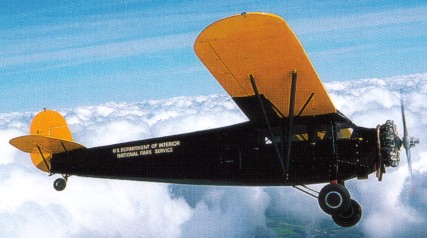
A total of 56 FC-2s were built over an eight-month period from 1 June 1927.
The FC-2C was the first aircraft to be equipped with brakes and hydraulically operated landing gear.
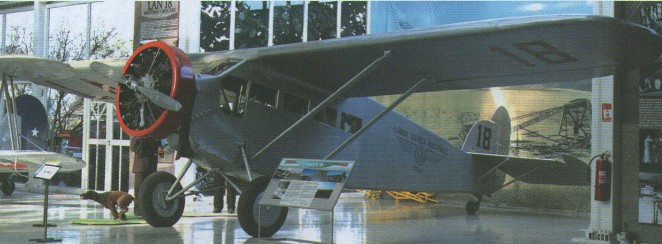
FC-2
Engine; 1 x Wright J-5 Whirlwind 9-cylinder radial, 149kW / 225 h.p.
Take-off weight; 1633 kg / 3600 lb
Empty weight; 980 kg / 2161 lb
Wingspan; 13.41 m / 43 ft 12 in
Length; 9.45 m / 31 ft 0 in
Height; 2.74 m / 8 ft 12 in
Wing area; 26.94 sq.m / 289.98 sq ft
Max. Speed; 196 km/h / 122 mph
Cruise speed; 169 km/h / 105 mph
Ceiling; 3505 m / 11500 ft
Range; 1127 km / 700 miles
FC-1A
Engine: Wright J-4, 200 hp
Top speed: 120 mph
FC-2
Engine: Wright J-5
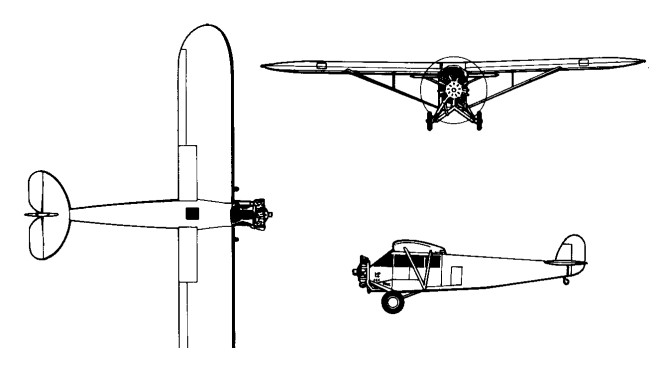
As a result of the recognition achieved with the KRA Midget, Kreider-Reisner began manufacturing the Challenger, which became a popular sport plane in the 1920s. In the Spring of 1929, Fairchild acquired 82% of the common stock in Kreider-Reisner, making the Hagerstown company a subsidary of the Fairchild Aviation Corporation, which eventually became Fairchild Aircraft Company.
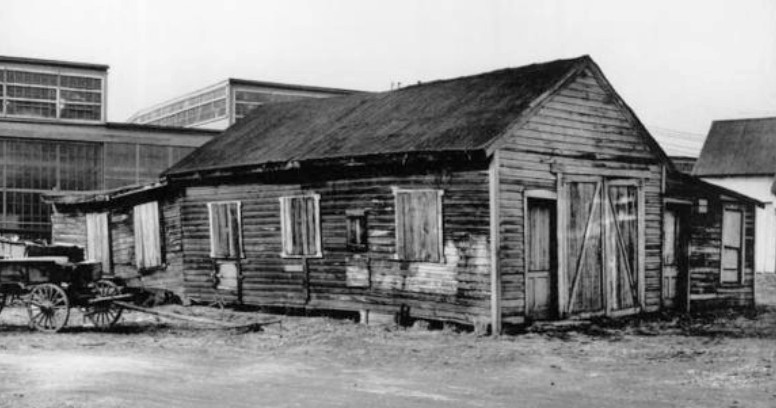
Sherman Fairchild founded Fairchild Airplane Manufacturing Corporation in 1925. Changed to Fairchild Aviation Corporation in 1929 with premises at Lonqueil, Quebec, and the parent company withdrew manufacturing license from Canadian Vickers. When The Aviation Corporation acquired a controlling interest.
Sherman Mills Fairchild Article
Sherman Fairchild withdrew in 1931, retaining a subsidiary, Kreider-Reisner Corporation, Hagerstown, Maryland, which was renamed Fairchild Aircraft Corporation in 1935. This became Fairchild Aircraft Division, Fairchild Engine and Airplane Corporation, in 1939; Fairchild Stratos Corporation in 1961. Fairchild Hiller Corporation in 1964 on acquisition of Hiller Aircraft Company.
In 1964 Fairchild-Stratos Corp purchased Hiller Aircraft with cash, not stock transactions. Hiller capabilities fitted into one of Fairchild’s primary goals – vertical takeoff and landing aircraft. The Hiller plant was to remain in Palo Alto.
Acquiring Republic Aviation Corporation in September 1965 and this becoming the Republic Aviation Division of Fairchild Hiller Corporation and, later, the Fairchild Republic Company division of Fairchild Industries; Fairchild Industries Inc in 1971 (acquired 90 percent interest in Swearingen Aviation Corporation in November 1971, which became Fairchild Aircraft Corporation in 1982). Metro Aviation, with 97 percent shareholding in Fairchild Aircraft Corporation, sold by Fairchild Industries to GMF Investments, but in 1990 Fairchild Aircraft filed for bankruptcy protection and was sold to Fairchild Acquisition Incorporated that year. The name for producer of Metro, Merlin, and Expediter series of twin-turboprop commuter airliner, executive transport and freighter aircraft (plus MMSA multi-mission surveillance aircraft variant of Metro 23) became Fairchild Aircraft Incorporated. Finally, in June 1996 parent company Fairchild Aerospace bought 80% of the German manufacturer Dornier Luftfahrt from Daimler-Benz Aerospace, resulting in Fairchild Aerospace owning all of the renamed Fairchild Dornier U.S.A. Fairchild Aircraft Incorporated and 80% of Fairchild Dornier Germany Dornier Luftfahrt GmbH.
Fairchild built FC-1, FC-2 and Model 71 lightplanes 1925-1931. Continued production of Kreider-Reisner Model 24C8, later supplied in four-seat version as USAAF UC-61 Forwarder and as RAF Argus. M-62 Cornell trainer introduced 1940 with variety of engines. Wartime production was Bristol Bolingbroke for RCAF, and 300 Curtiss Helldivers for U.S. Navy 1943-1945. AT-21 gunnery trainer entered production in 1942. C-82 Packet twinboom cargo/troop transport flown September 1944; superseded by developed C-119, first flown November 1947. In the early 1950s, the number of Fairchild employees reached approximately 10,000 who built 1112 C-119s between 1948 and 1952. Manufactured 326 C-123 Providers 1954-1958, designed by Chase Aircraft. License-production of Fokker F-27/FH- 227 airliner began 1957; 205 built. Hiller UH-12 and H-1100 helicopters continued in production after acquisition of Hiller company. Production of Pilatus Turbo-Porters begun June 1966; 15 of COIN version delivered to USAF as AU-23A Peacemaker, transferred to Royal Thai Air Force. In 1967 work initiated on 52 USAF AC-119 gunships. Contracts awarded after acquisition of Republic for weapons delivery enhancement of F-105 Thunderchief, subcontract assemblies for McDonnell Douglas F-4, Boeing 747.
In 1964 Fairchild-Stratos Corp purchased Hiller Aircraft with cash, not stock transactions. Hiller capabilities fitted into one of Fairchild’s primary goals – vertical takeoff and landing aircraft. The Hiller plant was to remain in Palo Alto.
Won USAF A-X competition for close-support aircraft, prototype YA-10A flown 10 May 1972; production of A- 10A Thunderbolt II ended 1984 after 713 built, and were in U.S. service in A-10A attack and OA-10A forward air control variants with the USAF, Air National Guard and Air Force. Main feature of A-10A is nose-mounted GAU-8/A Avenger 30 mm seven-barrel cannon with 1,174 rounds of armor-piercing ammunition. Also manufactured wings for Merlin and Metro twin-turboprop aircraft.
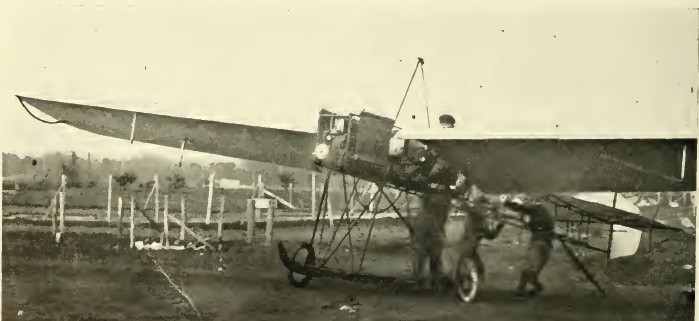
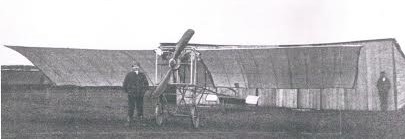
A mid-wing monoplane of mainly conventional configuration, entirely of steel construction and characterized by the vertical radiators on each side of the 100 hp six-cylinder two-stroke Emerson engine. It was the design of Walter L. Fairchild of Mineola and flew for the first time on May 11, 1911 with Auguste Denis as pilot.
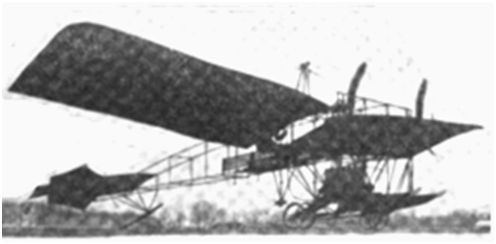
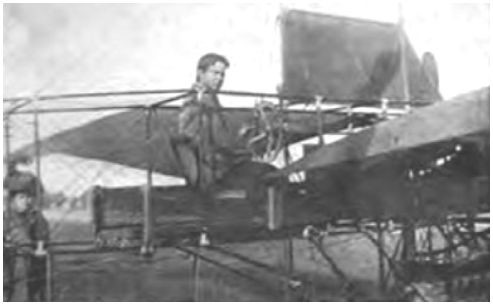
A monoplane built by Walter L. Fairchild with twin tractor propellers chain-driven by a six-cylinder 100-125 hp, two-cycle Emerson engine set on platform on undercarriage. The fuselage was built of steel tubing, lightness and strength achieved by careful use of different sizes and thicknesses of tubes, the strength of each part and portion calculated in detail. All the tubes of the frame where especial strength was thought advisable were stuffed with elm, giving them great strength. It was flown frequently, but crashed in February 1911.
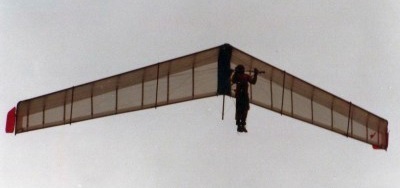
A 1979 hang glider, the Ewen Fagan EF6 has advantages over the modern glider mostly due to the variable glide angle due to rudders and superb controllability.
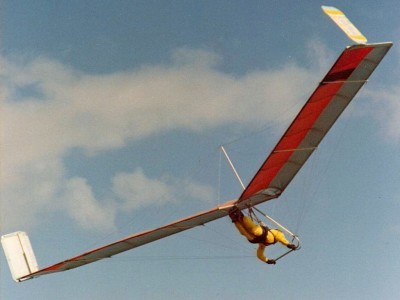
A 1977 hang glider, the EF5 is an Australian rigid designed by Ewen Fagan. Very similar to Manta Fledging, it was sold as a plan and kit by its designer. It was later (early 80’s) sold by Skyland Kites, Qld, Australia. It was sold as a kind of kit, you could buy the machined parts, the cables and the sewn sails. The aluminum tubes had to be purchased on site.
Graham John had the company Skyland Kites and manufactured and sold a range of hang gliders from about 1975 to 1980 on the Gold Coast of Australia. He had an EF5 in his shop and may have manufactured a few.
Piloting similar to Fledge. The EF5 was mostly a Manta Fledge copy with a few modifications. Like all the older tip rudder controlled rigid wings it was a bit difficult to ground handle in wind as rudder application dragged the tips back – not down. Also roll lagged yaw a bit – ie the wing would yaw first then roll. But in the air it was much more responsive than the flex wings of the day (pre billow shift). It is reactive in pitching and quickly accelerates in dive. Put it in dynamic stall with a rudder engaged and one will spin: engage the other rudder and it comes out. If you gradually put it in stall with both rudders engaged, it will stop and descend vertically – a good way to lose altitude fast enough without gaining speed. When flying along the terrain with a wing close to the ground, using the opposite control automatically raises the wing close to the ground, with a control wing tips that does not have a conventional delta.
The EF5 12 metre could be chopped down to a 10 metre around. It liked the fast descent you could do by pulling both rudders on at once. It could do a breathtakingly fast dive and interesting spins.
EF5-12M
Wing span: 12 m
EF5
Wing area: 13 m²
Wing span: 9.8 m
Aspect ratio: 7.3
Hang glider weight: 30 kg
Nose angle: 150°
Dihedral: 7°
Washout: 7°
LD: ≈11:1

A 1977 hang glider Ewen Fagan.
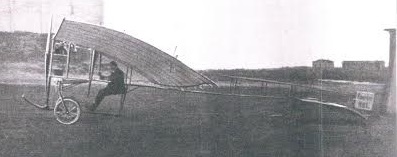
A 1910 tractor monoplane powered by a 40 hp Anzani three-cylinder engine built in Germany. Had a steel tube fuselage that was covered with fabric.
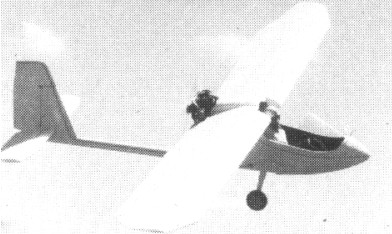
The Sapphire is designed as an efficient ultralight for use in a wide range of strip and weather conditions. Extensive testing over the last 2 years has resulted in only minor modifications having to be effected. The sleek glider like aircraft is constructed of fibreglass foam, aluminium and fabric wing and tail coverings. Cockpit is open but glider type fuselage and windscreen gives protection from the elements. Undercarriage is con¬ventional tail-dragger.
Designed in Australia by Scott Winton, of fibreglass and aluminium construction, the 95/10 has wing tanks, rather than previous fuselage tank, and fabric covered wings in place of fibreglass on the earlier, heavier models. All are three axis control.
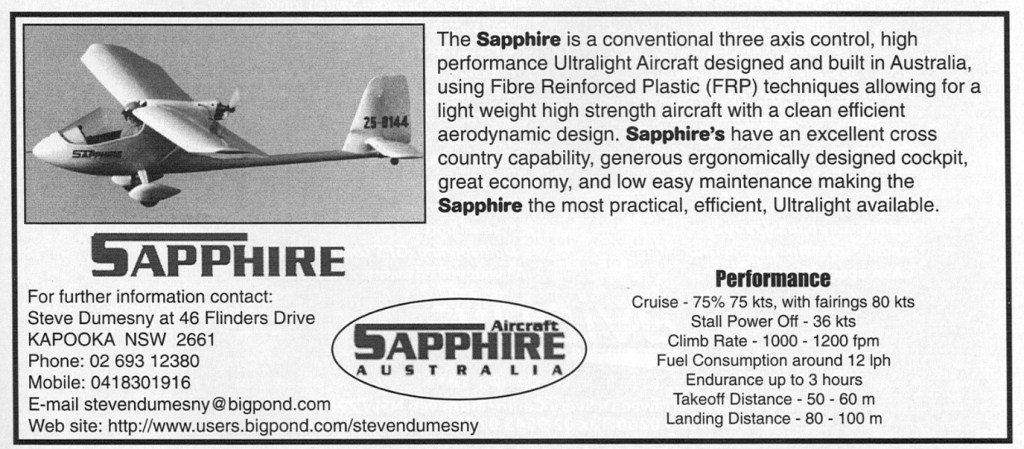
Sapphire
Engine: Rotax 377, 35hp.
Wing span: 8.84m.
Length: 4.88m.
Empty wt: 141 kg.
MAUW: 249 kg.
Range: 306 km.
Fuel capacity: 24 ltr.
Econ cruise speed: 73 kts.
Stall: 29kts.
Sapphire 95/10
Engine: Rotax 447, 40 hp.
Stall: 32 mph.
Cruise: 80 mph.
Vne: 110 mph.
ROC: 1400 fpm.
Take-off dist: 120 ft.
Ldg dist: 300 ft.

