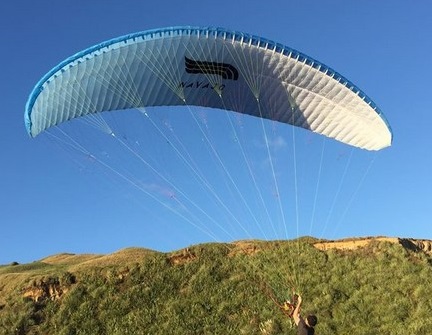
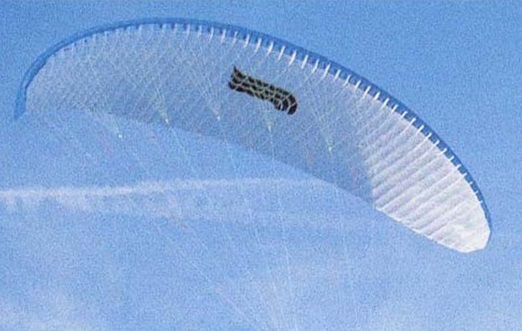
Flame L Wing area: 28.5 sq.m Certification: DHV 2GH Pilot weight: 80-100 kg No. of cells: 52 Wing span: 12.05 m Aspect ratio: 5.09 Min sink: 1.1 m/s Max speed: 45 kph Price (1998) 2445 £
Flame M Paraglider circa 1998. Wing area: 26.42 sq.m Certification: DHV 2GH / Afnor Pilot weight: 65-85 kg No. of cells: 52 Wing span: 11.59 m Aspect ratio: 5.09 Min sink: 1.1 m/s Max speed: 45 kph Price (1998) 2445 £
Flame XL Paraglider circa 1998. Wing area: 30.55 sq.m Certification: DHV 2GH / Afnor Pilot weight: 95-120 kg No. of cells: 52 Wing span: 12.47 m Aspect ratio: 5.1 Min sink: 1.1 m/s Max speed: 45 kph Price (1998) 2445 £
Colt L Wing area: 27 sq.m Certification: AFNOR Pilot weight: 90-110 kg No. of cells: 70 Wing span: 12.97 m Aspect ratio: 6.23 Min sink: 1 m/s Max speed: 50 kph Price (1998) 2999 £
Colt M Wing area: 25.23 sq.m Certification: Afnor Pilot weight: 75-95 kg No. of cells: 70 Wing span: 12.54 m Aspect ratio: 6.23 Min sink: 1 m/s Max speed: 50 kph Price (1998) 2999 £
Colt XL Wing area: 28.93 sq.m Certification: Afnor Pilot weight: 100-125 kg No. of cells: 70 Wing span: 13.42 m Aspect ratio: 6.23 Min sink: 1 m/s Max speed: 50 kph Price (1998) 24,700 Fr
1998: Bullachbergweg 34 a, D-87645 Schwangau, Germany From 1996, Stephan Müller supervised design and build while Stephen Hüglin handled production and testing.
Navajo 25 1993: € 3400 Area: 25.10 m² Span: 11.80 m Ratio: 5.30 Surfaces: Skytex 44 g/m No. of chambers: 50 Wing-Weight: 5.9 kg Box-Cell-Closed: 50/52/10 Risers: 3(5A/5B/5C) Lines: 1.5/1.0 mm Kevlar Lines total: 7.35 m Pilot weight: 60/78 kg Best sink rate: 1.2 m/s Maximum speed: 38 kph Maximum speed (with speed system) 48 kph Minimum speed: 20 kph Glide ratio: 8.5 Best glide ratio: 1.4 m/s › 33 km Certification: ACPUL/SHV 10A
Navajo 28 1993: € 3500 Area: 27.70 m² Span: 12.40 m Ratio: 5.50 Surfaces: Skytex 44 g/m Wing-Weight: 6.2 kg Box-Cell-Closed: 52/54/10 Risers: 3(5A/5B/5C) Lines: 1.5/1.0 mm Kevlar Lines total: 7.40 m Pilot weight: 75/95 kg Best sink rate: 1.2 m/s Best glide ratio: 1.4 m/s › 33 km Certification: ACPUL/SHV 10A
Navajo 30 1993: € 3500 Area: 31.20 m² Span: 12.60 m Ratio: 5.10 Surfaces: Skytex 44 g/m Wing-Weight: 6.5 kg Box-Cell-Closed: 52/54/10 Risers: 3(5A/5B/5C) Lines: 1.5/1.0 mm Kevlar Lines total: 7.50 m Pilot weight: 90/117 kg Best sink rate: 1.2 m/s Best glide ratio: 1.4 m/s › 33 km Certification: ACPUL/SHV 10A
Firebird’s 2003 (successor for the Matrix) DHV 1-2 Grid has passed certification. The most interesting design feature of the glider is the circular shape of the air intakes on the wingtips, which has a “significant impact” on handling, glide, speed, performance and safety, according to the design team. This design feature came out after research and tests done with the aid of aircraft development industries. Finally, they concluded that “the most efficient for rammed air and an increase of pressure was with pure round intakes. The Grid is intended for recreational pilots and those who want “fun without worries”. According to its creators, it has a light, precise handling and reacts to every input given. “It will do the turn the way you want, steep, flat, precise”, they say. It has a maximum speed of about 48k/h according to DHV test reports.
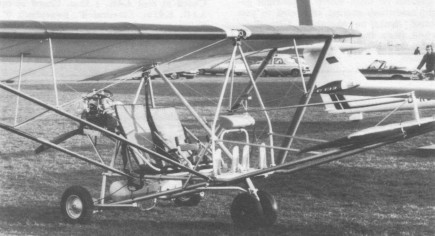
Side by side two seat single engined high¬wing monoplane with conventional three axis control. Wing has swept back leading and trailing edges, and constant chord; no tail, canard wing. Pitch control by fully flying canard; yaw control by tip rudders; roll control by spoilers; control inputs through stick for pitch/roll and pedals for yaw. Wing braced from below by struts; wing profile; double surface. Undercarriage has four wheels in ‘tricycle’ formation; suspension on all wheels. No ground steering. Brakes on all wheels. Aluminium tube framework, without pod. Engine mounted below wing driving pusher propeller. Easily distinguishable from other Fledge derivatives by its unusual double nosewheel, the T1 is basically a two seat version of the M1. It was first shown at the Aero 83 Exhibition at Friedrichshafen in March 1983 and was placarded as having made its first flights the month before. The standard version includes electric start, while options include wheel fairings and floats.
Engine: Hirth 276A13, 40 hp at 7000 rpm. Propeller diameter 63 inch, 1.60 m. Belt reduction, ratio 2.04. Max static thrust 252 lb, 114 kg. Power per unit area 0.22 hp/sq.ft, 2.4 hp/sq.m. Length overall 10.5ft, 3.20m. Wing span 32.8 ft, 10.0 m. Constant chord 5.6 ft, 1.70 m. Canard span 6.7 ft, 2. 00 m. Main wing area 183 sq.ft, 17.0 sq.m. Rudder area 9.7 sq.ft, 0.90 sq.m. Wing aspect ratio 5.9/1. Wheel track 5.3 ft, 1.60 m. Empty weight 327 lb, 148kg. Max take off weight 707 lb, 320kg. Payload 380 lb, 172 kg Max wing loading 3.86 lb/sq.ft, 18.8 kg/sq.m. Fuel capacity 6.9 US gal, 5.7 Imp gal, 26.0 litre. Max power loading 17.7 lb/hp, 8.0kg/hp. Load factors: +6.0, 3.0 ultimate. Never exceed speed 56mph, 90kph. Economic cruising speed 44mph, 70kph. Stalling speed 28mph, 45 kph. Max climb rate at sea level 600 ft/min, 3.1 m/s. Best glide ratio with power off 8/1 at 37mph, 60kph. Take off distance 100ft, 30 m. Landing distance 65 ft, 20 m. Range at average cruising speed 112 mile, 180km.
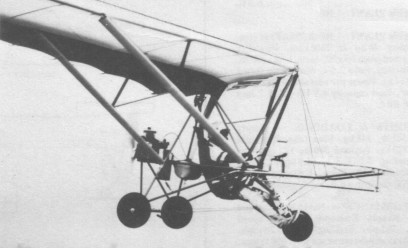
The prototype of the single seater M1 from Firebird made its first flight in 1979 and by 1983 more than 100 examples have been produced. The wing is directly descended from the famous Fledgling designed by Klaus Hill, originally as a hybrid control hang-¬glider. This wing, with its rudders at its wing tips, was powered in 1978 in the USA and the following year in Europe, by Firebird. Just as Pterodactyl does with its Ptraveler and Ascen¬der, Firebird uses it with a variable incidence canard. There is one fundamental difference between Firebird’s approach and that of the Americans, in that the German manufacturer chooses to support the wing with two profiled struts under each half wing, thus dispensing with all the ground and flight rigging wires. The other principal difference is the power pack, which on the Firebird has to conform with West Germany’s stringent noise regulations. With Konig en¬gine and three bladed propeller, the standard arrangement on the M1, under 60 dB is recorded using the regulation measuring conditions. Complete with electric start and battery, the M1 cost DM 17,408 in 1983, while options in¬clude an extra fuel tank, an instrument panel, floats and a parachute of 755 sq.ft (70 sq.m) area, which is usable at speeds up to 155 mph (250 kph) and which gives a rate of descent of 1300 ft/min (6.7 m/s) with a 442 lb (200 kg) load. Wing profile; FNI 4 81; double surface. Undercarriage has three wheels in tricycle formation; steel spring suspension on nosewheel and no suspension on main wheels. Push right go left nosewheel steering independent from yaw control. Brake on nosewheel. Aluminium tube/carbon fibre framework, without pod. Engine mounted below wing driving pusher propeller.
Engine: Konig SC430, 24 hp at 4200 rpm. Propeller diameter 53 inch, 1.34 m (three blade). Belt reduction, ratio 2.2/1. Max static thrust 143 lb, 65 kg. Power per unit area 0.15hp/sq.ft, 1.6 hp/sq.m. Height overall 9.4 ft, 2.85 m. Wing span 32.8 ft, 10.00 m. Chord at root 5.6 ft, 1.70 m. Chord at tip 4.6ft, 1.40m. Dihedral 5 degs. Sweepback 38 degs. Canard span 6.6ft, 2.00m. Canard chord 2.1 ft, 0.63 m. Total wing area 175 sq.ft, 16.3sq.m. Main wing area 161 sq.ft, 15.0 sq.m. Canard area 14.0 sq.ft, 1.3 sq.m. Wing aspect ratio 6.7/1. Wheel track 6.9 ft, 2. 10 m. Wheelbase 4.6 ft, 1.40 m. Nosewheel diameter overall 14 inch, 35 cm. Main wheels diameter overall 16 inch, 41 cm. Empty weight 2161b, 98kg. Max take off weight 420 lb, 190 kg. Payload 204 lb, 92 kg. Main fuel capacity 3.4 US gal, 2.8 Imp gal, 13.0 litre Reserve fuel capacity 2.6 US gal, 2.2 Imp gal, 10.0 litre in. Max wing loading 2.60 lb/sq.ft, 12.7 kg/sq.m. Max power loading 17.5 lb/hp, 7.9 kg/hp. Load factors +4.0, 2.0 design; +6.0, 3.0 ulti¬mate. Max level speed 50 mph, 80 kph. Never exceed speed 56 mph, 90kph. Economic cruising speed 37mph, 60kph. Stalling speed 24mph, 40kph. Max climb rate at sea level 400 ft/min, 2.0 m/s. Min sink rate 350ft/min at 34mph, 1.8m/s at 55 kph. Best glide ratio with power off 8.5/1 at 37mph, 60kph. Take off distance 100ft, 30 m. Landing distance 65 ft, 20 m. Range at average cruising speed 93 mile, 150 km.
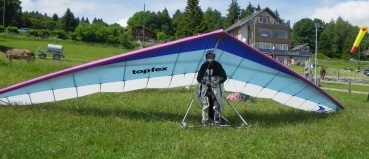
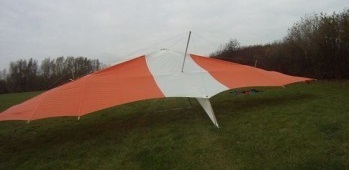
The 1984 Topfex is just a good hang glider for intermediate pilots, a little heavy to control.
Topfex 160 Wing area: 16.1 m² Wing span: 10.4 m Aspect ratio: 6.71 Hang glider weight: 25 kg Minimum pilot weight: 65 kg Maximum pilot weight: 105 kg Packed length: 5.8 m Packed length short: 2.2 m Number of battens: 29 Nose angle: 127°
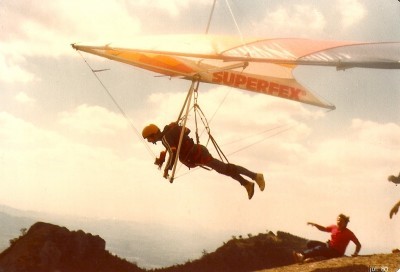
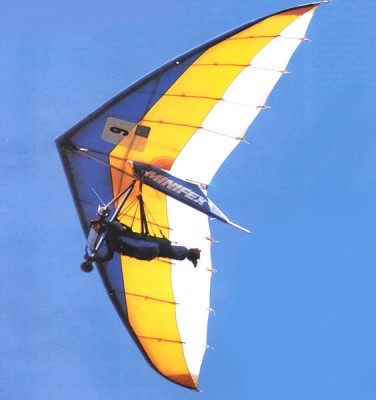
There are two versions of this glider, the 1984 Minifex and, since 1985, produced Minifex M2. The 1984 is DHV3 and the M2 is DHV2 for advanced pilots.
Both versions can be extra short packed at about 1.65m. This is done by tiling the front leading tube into 3 pieces and using fibre glass for the outer wing tips.
Minifex 1984 Wing area: 14.1 m² Wing span: 8.95 m Aspect ratio: 5.68 Minimum speed: 26 km/h Maximum speed: 80 km/h Packed length: 4.45 m Packed length short: 1.67 m
Minifex M2 140 1985 Wing area: 14.1 m² Wing span: 9 m Aspect ratio: 5.74 Hang glider weight: 20 kg