First Class Shadow II

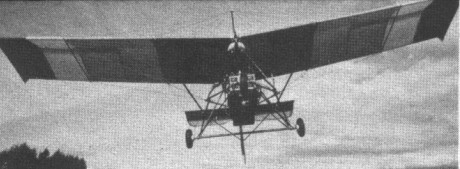
An open cockpit high-wing, wire-braced monoplane, pusher prop. Side-by-side two-place seating, center-mounted 3-axis control sticks.

Engine: Rotax 503, 48 hp.
Prop: Ultra prop, composite. 59in diameter.
Wingspan 32ft.
Wing area 160 sq.ft.
Empty weight 310 lbs.
Gross weight 750 lbs.
Cruise speed 42 mph.
Stall speed 26 mph.
Vmax 60 mph.
Climb 500 fpm.
Takeoff run 150ft.
Lan¬ding roll 135ft.
Landing gear: Tricycle, aluminum.

First Class Shadow

A 40 per¬cent, double-surface, high-wing monoplane, open cockpit, 3-axis stick control to elevator/spoilers, rudder foot-pedal controlled.

Engine: Rotax 377, 36 hp.
Prop: Ultra prop, 3-bladed, 59in diameter.
Wingspan 32 ft.
Wing area 160 sq.ft.
Empty weight 251 lbs.
Gross weight 576 lbs.
Cruise speed 45 mph.
Stall speed 20 mph.
Vmax 60 mph.
Climb 900 fpm.
Takeoff run 80ft.
Land¬ing roll 75ft.
Undercarriage: Tricycle, aluminum.
Price 1984: US$4,995.

Firewall Forward CAM 125

The Firewall Forward CAM 125 is a 125 hp (93 kW) four-cylinder, four-stroke, liquid-cooled piston aircraft engine built by Firewall Forward Aero Engines. The engine is based on a Honda automotive piston engine. Unit cost was US$11250 in 2005.

Applications:
Europa XS

CAM 125
Type: Four-cylinder, four-stroke piston engine
Bore: 75 mm (2.95 in)
Stroke: 84.6 mm (3.33 in)
Displacement: 1590 cm3 (97 cu in)
Length: 33.25 inches (845 mm)
Width: 21.5 inches (550 mm)
Height: 23 inches (580 mm)
Dry weight: 247 pounds (112 kg)
Valvetrain: Overhead camshaft
Fuel type: 90 Octane petrol or 100LL aviation petrol
Cooling system: Uses a water-glycol mixture with a camshaft belt driven water pump.
Reduction gear: 2.4:1 reduction ratio (6,000 rpm engine, 2,500 rpm propeller).
Starting system Electric gear reduction starter.
Power output: 93.2 kW (125 hp) at propeller flange
Specific power: 130 kW/L (1.28 hp/cu in)
Compression ratio: 9.2:1
Specific fuel consumption: 0.43 lb/bhp/hr at 70% power

Firestone XR-9 / GA-45

In 1943 Firestone absorbed G and A Aircraft of Pitcairn Field, Willow Grove, and this included the CG-4A, a troop-carrying glider, and the XO-61, a pusher-type autogyro. Between 1943 and 1945 the G and A was modified and developed into a dual tandem helicopter, the XR-9B.

G&A Aircraft had previously built six examples of the XO-61 two-seat gyroplane for the U.S. Army. This experience was applied to the design of a new helicopter for the U.S. Army, designated Model 45.

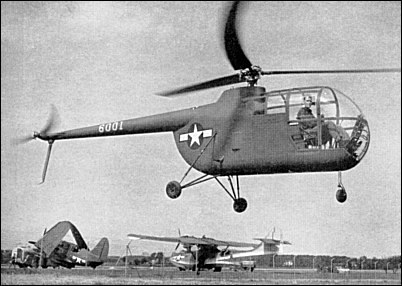
Conceived in 1943, the Model 45 was a conventional pod and boom helicopter with tandem seating, a fixed tricycle undercarriage and a three-blade main rotor. Completed in 1944 with co-operation from the Army Air Force’s Air Technical Service Command, the main rotor had three blades (and a fixed-type head); the tail rotor was 1.98 metres in diameter.

The helicopter was made of welded steel tube covered with an alloy skin, while the tail boom had a balsa-wood core covered with alcad. For storage purposes this helicopter could be broken down into three parts: rotor blades, fuselage and boom assembly.
The prototype incorporated an experimental electro-hydraulic governor, which by acting on the simultaneous pitch control maintained a constant predetermined rotor speed, irrespective of the power used. With automatic assistance from this governor, the pilot could rise or descend vertically just by using his throttle.

The original Model 45B design used a 126hp XO-290-5 engine and the Model 45C (military XR-9A) was a development with a two-blade rotor. Neither of these were actually built and the prototype (which carried the identity 6001) was designated XR-9B and was fitted with a 135hp Lycoming O-290-5 engine.
Firestone also built a civil version, the Model 45D (NX58457), with side-by-side seating but development of helicopters was abandoned by Firestone in 1947.

XR-9B
Number of seats: 2
Engine: 1 x Lycoming O-290-7, 135hp
Rotor diameter: 8.53m
Length: 8.41m
Width at landing wheels: 2.74m
Height: 2.6m
Gross weight: 800kg
Cruising speed: 128km/h
Inclined climb: 305m/min
Absolute ceiling: 3050m
Range: 400km

Firestone / Pitcairn Autogiro Co / Pitcairn-Larsen Autogiro Co Inc / Pitcairn-Cierva Autogiro Company (PCA) / AGA Aviation Corp / G&A Aircraft Inc

The youngest son of John Pitcairn, co-founder of Pittsburgh Plate Glass Company, Harold was born in 1897 and took an early interest in aviation. Inspired by the first flight of the Wright brothers in 1903, he began flight training as an air cadet in the last days of WWI, and would eventually earn a pilot’s license signed by Orville Wright.

1924: (Harold F) Pitcairn Air Service
air field, flight school, FBO
Bryn Athyn PA.
USA

Pitcairn was established in the mid-1920s in Philadelphia, Pennsylvania. Pitcairn and Agnew Larsen, who he had met in pilot training, produced the Mailwing airmail series biplanes including PA- 5 Mailwing high-performance single-seat mailplane used on U.S. Air Mail routes.

1925: Pitcairn Air Lines
sold to Eastern Air Transport in 1929 as origin of Eastern Air Lines
1925: Pitcairn Aircraft Inc
Pitcairn Air Field #2
Willow Grove PA.
USA

In 1928 Harold Pitcairn ordered a Cierva C.8W (the W was for the American Wright Whirlwind engine), which arrived at Pitcairn Field, Willow Grove, Philadelphia, PA and on December 18, 1928. It made the first rotary-wing flight in America, piloted by Cierva pilot H. C. A. “Dizzy” Rawson, followed the next day by Pitcairn.

In early 1929, Cierva and Pitcairn negotiators agreed that the Pitcairn-Cierva Autogiro Company (PCA) would be formed in America with the rights to license Cierva’s patents. Pitcairn threw himself into the development and promotion of the Autogiro – and the results of the next 16 months would earn him and his associates the Collier Trophy for the greatest aviation achievement for 1930.

1929: Autogyro operations as Pitcairn-(Juan de la) Cierva Autogiro Co.

c.1930: Autogiro Co of America (aka AGA) as patent licensee (to Buhl, Kellett, Sikorsky, etc).

Pitcairn Aviation Inc turned to autogiro construction with PAA-1 of 1931 and the name changed to Pitcairn Autogiro Company in the early 1930s. They sold a number of PA-18 and -19 autogiros, including a military version of the PA-34 two-seater to the USAAC. Plant and contracts were taken over in 1940 by Pitcairn-Larsen Autogiro Company, in turn succeeded very shortly afterwards by Aga Aviation Corporation.

Feb 1941: Pitcairn-(Agnew E) Larsen Autogiro Co Inc.

Dec 1941: Renamed AGA Aviation Corp (pres: Virgil H Frazier).

In 1943 G and A was acquired by the Firestone Aircraft Company of Akron, Ohio, together with almost 200 patents concerned with rotary-wing aircraft. G and A built gliders and experimental autogiros in the Second World War, and carried out subcontract manufacture.

1946: Acquired by G&A (Gliders & Aircraft) Div, Firestone Rubber Co.

After the company became the G & A Aircraft Division of Firestone, the emergence of Bell and Sikorsky in a depleted post-war market discouraged continuing the helicopter development in the early 1940s.

Firestone was formed in 1946 by name change from G&A Aircraft Inc., a subsidiary of Firestone Tire and Rubber Company.

1947: Firestone Aircraft Co.
Firebird Skysports CX

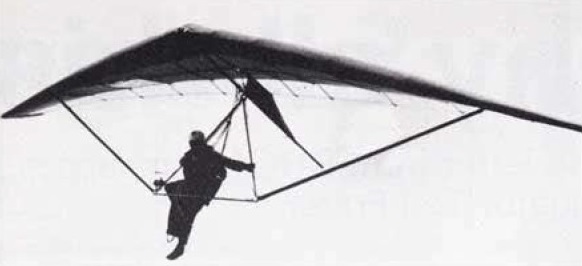
In an effort to reduce the drag as much as possible in the 1982 Firebird CX, the suppresson of the kingpost and all the top rigging is eliminating a good part of the profile drag but brought problems for the pitch stability and the structural strength in negative.

For pitch stability, three solutions were found: the truncated tips assure sail washout, a small keel post inside the keel pocket keeps the centre chord in place and the battens are reflexed at the back.

For strength in negative G there is an 8 inch long king post inside the profile and two carbon fibre compresson struts instead of side cables. With fairngs, the produce less drag than the to rigging would.

The control frame is wider than usual to keep the carbon fibre compression struts as short as possible.

Firebird Skysports Ignition

Paraglider new in 1998.

Ignition L
Wing area: 20.08 sq.m
Certification: DHV
Pilot weight: 90-120 kg
No. of cells: 43
Wing span: 12.35 m
Aspect ratio: 4.9
Price (1998) 1999 £

Ignition M
Wing area: 26.94 sq.m
Certification: DHV
Pilot weight: 60-80 kg
No. of cells: 43
Wing span: 11.48 m
Aspect ratio: 4.9
Price (1998) 1999 £

Ignition XL
Wing area: 31.16 sq.m
Certification: DHV
Pilot weight: 90-120 kg
No. of cells: 43
Wing span: 12.35 m
Aspect ratio: 4.9
Price (1998) 1999 £