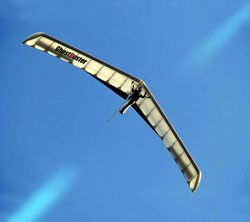
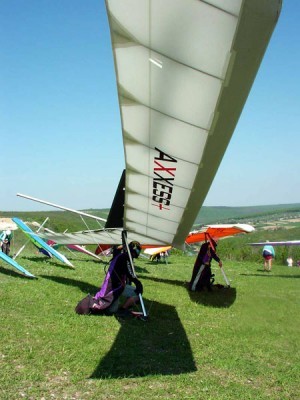
Wing area: 12.6 m² Wing span: 13 m Aspect ratio: 13.4 Hang glider weight: 35 kg Minimum pilot weight: 90 kg Maximum pilot weight: 150 kg Minimum speed: 30 km/h Maximum speed: 110 km/h Max glide ratio (L/H): 17.60 Max glide ratio speed: 55 km/h Minimum sink rate: 0.7 m/s Packed length: 5.9 m Nose angle: 150°
A 2002 rigid wing hang glider for advanced pilots.
The rigid AXXESS is super stable in flight (calm and turbulent) and has a formidable landing facility, with well dimensioned flaps. The assembly with integrated slats is easy. The decoupling of the wings facilitates the transport.
Flight Design no longer produces wings and rigid. But fliegerboehm continues the manufacture of rigid Axxess.
Axxess Wing area: 13.5 m² Wing span: 13.1 m Aspect ratio: 12.7 Hang glider weight: 39 kg Minimum pilot weight: 90 kg Maximum pilot weight: 115 kg Packed length: 6.3 m Nose angle: 127°
Axxess + Wing area: 12.6 m² Wing span: 13.1 m Aspect ratio: 13.6 Hang glider weight: 39 kg Minimum pilot weight: 90 kg Maximum pilot weight: 115 kg Packed length: 6.3 m Nose angle: 127°
The company’s four-seat C4 project has slowed down its planned U.S. certification schedule to take advantage of anticipated streamlining of the Part 23 process by FAA, so deliveries could slide into 2015.
Flight Design entered receivership in 2016. Work on the C4 had come to a standstill after the company ran into financial difficulty. Production had also slowed to a trickle as the company workforce was trimmed to 10 people in Germany and around 60 in the Ukraine.
Flight Design completed the sale of all major company assets to the German investment group Lift Holding, allowing for the resumption of work on the C4, a Part 23-certified four-seater with a projected selling price of $250,000.
Wing area: 44 sq.m Certification: Afnor Pilot weight: 140-195 kg No. of cells: 70 Wing span: 15.4 m Aspect ratio: 5.4 Min sink: 1.1 m/s Max speed: 39 kph Price (1998) £ 2600
S2 VT 23 Wing area: 23 sq.m Pilot weight: 60-85 kg No. of cells: 50 Wing span: 10.9 m Aspect ratio: 5.2 Min sink: 1.1 m/s Max speed: 46 kph Price (1998) 17,390 Fr
S2 VT 26 Wing area: 26.8 sq.m Certification: Afnor Pilot weight: 80-105 kg No. of cells: 50 Wing span: 11.8 m Aspect ratio: 5.2 Min sink: 1.1 m/s Max speed: 46 kph Price (1998) 17,730 Fr
S2 VT 30 Wing area: 30.6 sq.m Pilot weight: 100-130 kg No. of cells: 50 Wing span: 12.6 m Aspect ratio: 5.2 Min sink: 1.1 m/s Max speed: 46 kph Price (1998) 18,100 Fr
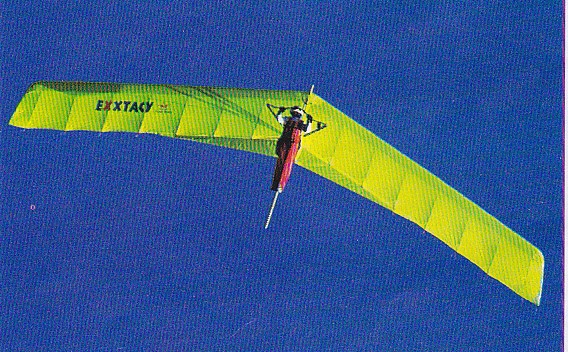
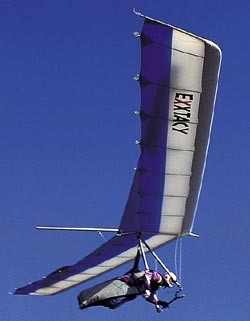
A rigid wing light hang glider from 1996. Very safe to fly, sink rate below 0.8m/s, glide ratio above 16, speed range from 32 to more than 110 km/h.
Handling at take off is typical rigid wing stuff: does not require any assistance in strong winds, as the spoiler will lift up and bring the wings level without any pilot input. Normal cruising speed is about 35km/h in thermals, 50 km/h straight.
Very light in turns and very stable trajectory at speed hence excellent for aero-towing. In thermals, its stability in roll requires sensitive pilot input to climb well. Not much affected by turbulence, only in pitch. Landing is easier than on a flex wing.
When folded, the weight and bulk can be problematic but splitting the wing in two halves helps.
Flight Design no longer produces wings and rigid. But fliegerboehm continues the manufacture of rigid Exxtacy.
From 1999 the Exxtacy was improved: reduced weight 35kg / 38 kg; length of the large model: 570 cm and the weight of the mini / maxi 100 kg / 160 kg.
Tthere is a biplace model.
Exxtacy 135 Wing area: 13.8 m² Wing span: 11.4 m Aspect ratio: 9.4 Hang glider weight: 39 kg Minimum pilot weight: 90 kg Maximum pilot weight: 140 kg Minimum speed: 36 km/h Max glide ratio (L/H): 17.5 Minimum sink rate: 0.75 m/s Packed length: 6.2 m Nose angle: 127°
Exxtacy BI 160 Wing area: 14.8 m² Wing span: 12.2 m Aspect ratio: 10.05 Hang glider weight: 39 kg Minimum pilot weight: 100 kg Maximum pilot weight: 160 kg Vne: 100 kph Minimum speed: 30 km/h Max glide ratio (L/H): 17.5 Minimum sink rate: 0.75 m/s Packed length: 6.2 m Nose angle: 127° Price (1998) £ 5500
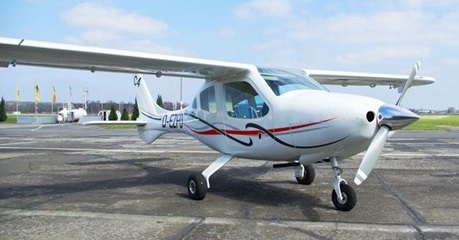
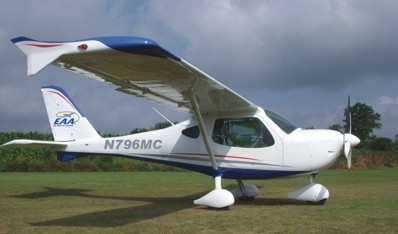
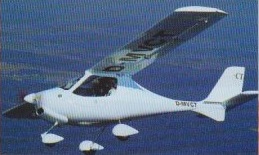
Created to complement the existing CTsw and CTLS, the MC offers utility and performance in a metal airframe. Constructed from Aluminum, steel and composites, the MC features a steel space frame, all aluminum flying surfaces and a composite cabin and cowling. The focus with the MC was to provide more utility with a giant cabin and easy-to-maintain modular construction. Designed with training and commercial fleet uses in mind, the MC visibility, baggage area and easy cabin entry are features. The metal flying surfaces of the MC are buck riveted and corrosion proofed for maintenance free flying. The steel pilot cage is covered with easy to remove composite shells to allow quick access to the landing gear and controls for annual or 100 hour inspections. The main landing gear is the Flight Design nobounce composite gear introduced on the CTLS. The cabin of the MC has a width of nearly 52 inches, 2-way adjustable seats and extra-wide cabin doors. The four-point safety harnesses, wing located fuel tanks and the BRS 1350 parachute system are standard. Standard features include 2 blade composite propeller, conventional three-axis controls, electric pitch trim system, cabin door gas struts, two large capacity baggage compartments, two cockpit storage compartments, electric pre-selector flap system, one piece molded windshield, steerable nose wheel, hydraulic brakes, durable, two-part urethane paint.
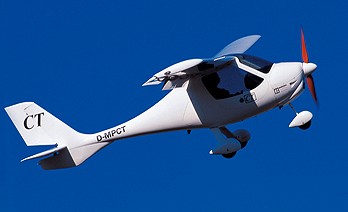
An ultralight composite aircraft, the Flight Design CT2K has been developed, and now has less weight, increased power and higher performance, with additional load-carrying capability. The design of the wing and the aircraft structure has been tested for a take-off weight up to 600 kg, so the Flight Design CT2K can comply with different certification criteria in different countries. 2009 CT2K price: 55862 EURO In spring 2003 CT2K was complimented with the CTSW (CTSW = CT Short Wing). Due to 80 cm shorter wings and increased ground effect CTSW has even greater aerodynamic stability and is easy to land. This aircraft had 5 km/h increased maximum level-flight speed while having slightly reduced climb speed. Both CT2K and CTSW were also available as VLA versions. 2009 price for the CTSW was 60000 EURO.
CT 180
In 2012 Flight Design had 11 registrations in the US. CTLSi (with the fuel-injected Rotax 912iS engine) are selling well, and the CTLS, MC and CTLS-Club models continue in the popular lineup. 2012 Prices: US$156,500 (CTLSi); US$143,800 (CTLS); US$136,860 (CTLS-Club).
CTLS
CT 180 Engine: Rotax 912, 80 hp Wing span: 9.30 m Wing area: 10.80 sq.m MAUW: 450 kg Empty weight: 275 kg Fuel capacity: 100 lt Max speed: 225 kph Cruise speed: 210 kph Minimum speed: 64.4 kph Climb rate: 5 m/s Certification: VZ Seats: 2 Fuel consumption: 15 lt/hr Price (1998): 60 000 DM
Flight Design CT Engine: Rotax 912S, 100@SL TBO: 1500 hrs. Fuel type:100/100LL Propeller: Neuform FP Landing gear type: Tri./Fixed Max ramp weight: 1320 lb Gross weight: 1320 lb Landing weight: 1320 lb Empty weight, std: 646 lb Useful load, std: 674 lb Useful fuel, std: 34 USgals Payload, full std. fuel: 470 lb Wingspan: 28 ft Overall length: 20 ft. 4 in Height: 7 ft. 11 in Wing area:107 sq. ft Wing loading: 12.3 lbs./sq. ft Power loading: 13.2 lbs./hp Wheel size: 6.00 x 6 in Seating capacity: 2 Cabin doors: 2 Cabin width: 49 in Cruise speed 75% power: 112 kt Max range (w/ reserve) 75% power: 600 nm Fuel consumption 75% power: 4.5 USgph Vso: 39 kt Best rate of climb SL: 960 fpm Service ceiling: 14,000 ft Takeoff ground roll: 295 ft Takeoff over 50-ft. obstacle: 525 ft 2006 price: US$92,900
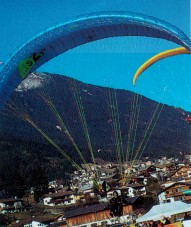
B4 VT 23 Paraglider circa 1998. Wing area: 24.2 sq.m Certification: Afnor Pilot weight: 65-85 kg No. of cells: 66 Wing span: 12 m Aspect ratio: 6 Min sink: 1.1 m/s Max speed: 51 kph Price (1998) £ 2400
B4 VT 26 Paraglider circa 1998. Wing area: 27.8 sq.m Certification: DHV 3GH / Afnor Pilot weight: 81-105 kg No. of cells: 66 Wing span: 12.9 m Aspect ratio: 6 Min sink: 1.1 m/s Max speed: 51 kph Price (1998) £ 2500
B4 VT 30 Paraglider circa 1998. Wing area: 31.2 sq.m Certification: DHV 3 / Afnor Pilot weight: 95-125 kg No. of cells: 66 Wing span: 13.7 m Aspect ratio: 6 Min sink: 1.1 m/s Max speed: 51 kph Price (1998) £ 2600