The Shark was built in New Zealand by Warren Bird of Flight Sails NZ.
Flight Sails sometimes made sails for Pacific Kites
Hang glider builder
The Shark was built in New Zealand by Warren Bird of Flight Sails NZ.
Flight Sails sometimes made sails for Pacific Kites
Hang glider builder
New Zealand
Flight Engineers Ltd was a joint company formed by agricultural operator Barr Brothers and Marine Helicopters Ltd. to maintain own fleets, but also undertook license-assembly of Transavia PL-12 Airtruk agricultural aircraft from 1973. T320 version powered by Continental Tiara engine introduced 1977. Production ended 1980.
An evolution of the original Seasprite with a new twin tail and the installation of two engines.

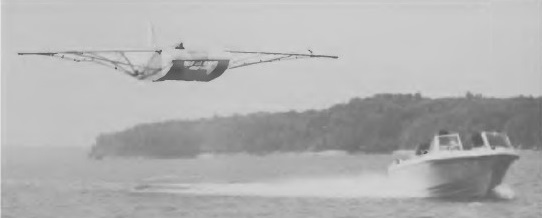
This single- or two-seat homebuilt glider is distinguished by an aerofoil-shaped fuselage and bat-like sailwing type wings, the tail unit being carried on an aluminium boom. It is an unpowered Stage 1 version of an aircraft which, in fully developed powered form, will be known as the Flightsail VII, the Seasprite being of more simplified construction, and it is being marketed as plans to amateur constructors.
The fuselage is a framework of aluminium tubing, the sides and top of which are covered with polyethylene foil, except for the upper part of the nose section, which has a transparent covering of polyester film and Plexiglas. Alternatively, the structure can be covered with aluminium foil for only a minimal weight increase, and this has a much longer life. The underside of the fuselage has catamaran-type twin floats, built of plastics with a plywood covering, enabling the Seasprite to be operated off water if so desired.
The wings are of triangular planform with aluminium tube leading edges and wire trailing edges, the whole being covered in polyethylene. They can be folded rearwards when not in use but are otherwise braced to the fuselage sides. The wing tips pivot about their leading edges to provide roll control. The tail is built as a single fin/tailplane unit pivoting only in the vertical plane for control in pitch.
The pilot sits in an open cockpit in the centre section, to the right of the aluminium boom carrying the tail unit, and his weight is balanced by a counterweight at the port wing tip if a second pilot or passenger is not carried.
One Seasprite has been fitted with twin tail booms preparatory to adding a small pusher engine between them, this being an interim stage, as the Seasprite II, in the development of the Flightsail VII.
Wingspan 34 ft 0 in
Length 20 ft 0 in
Height 8 ft 0 in
Wing area: 166.0 sqft
Aspect ratio: 6.96
Empty weight: 165 lb
Max weight: 500 lb
Lift off speed 30 mph
Cruise speed 35 mph
Max aero-tow speed: 35 mph
Best glide ratio: 6:1 at 50 mph
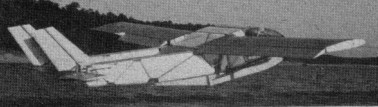
Design begun in 1966 and first first flown in October 1970, the Flightsail VII can either be towed behind a 70-hp ski boat or it can have a 90-hp Continental pylon mounted above the fuselage to fly the Flightsail under its own power. The structure is built from bolted aluminum, foam and epoxy. This two-seater amphi¬bian features twin booms and twin tails.
Engine 90-hp Continental
Gross wt. 1600 lb
Empty wt. 1100 lb
Fuel capacity 12 USG
Wingspan 39 ft
Length 29 ft
Top speed 95 mph
Cruise 80 mph
Stall 35 mph.
Climb rate 500 fpm.
Takeoff time 20 sec
Range 200 miles
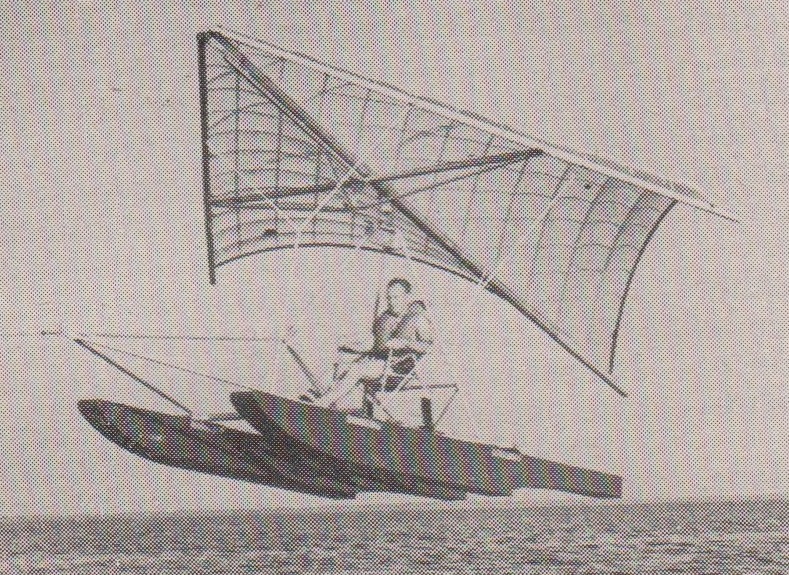
Flight Dynamics Inc, of Raleigh, NC, were promoting in 1963 The Flightsail. An adaptation to sport of the flexible wing developed for the National Aeronautics and Space Administraion. The wing is a polyethylene covering on an airframe of commercial aluminium tubing and angle stock.
Capable of taking off from land or water, Flightsail is controlled in flight by an aircraft-type control stick that regulates the tilt of the wing.
Easily towed aloft by a 40 – 50 hp outboard, flying is best with a breeze of about 5 mph, lift-off being between 25-50 mph ground speed.
In 1963 it was claimed the Flightsail could be built at a total cost of US$250, including wheels and floats.
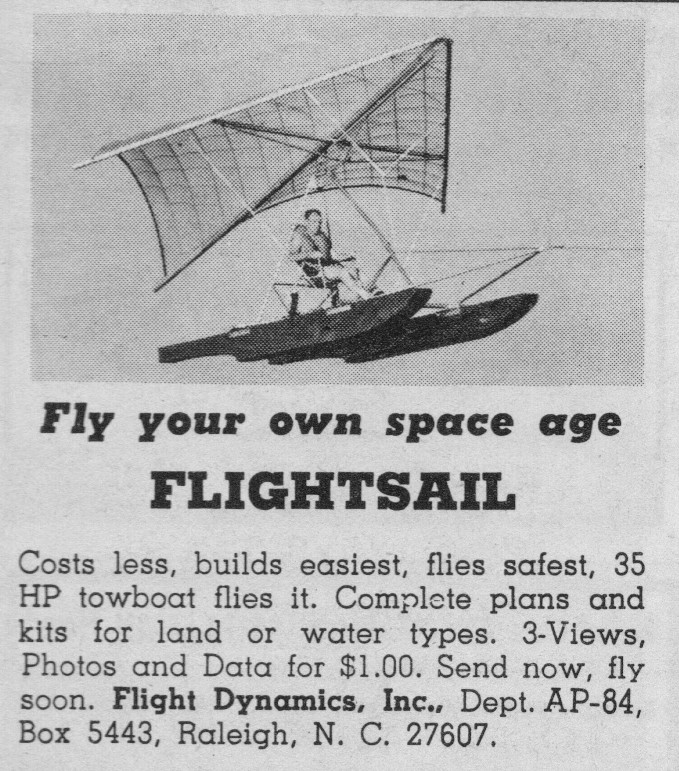
1980: Box 5070, Raleigh, NC 27607, USA.
Glider and LSA builder
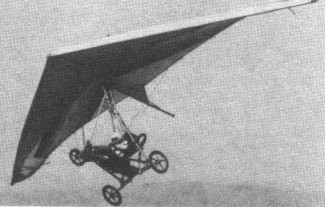
Single seat single engined flex wing aircraft with weight shift control. Rogallo wing with keel pocket. Pilot suspended below wing in trike unit, using bar to control pitch and yaw/roll by altering relative positions of trike unit and wing. Wing braced from above by kingpost and cables, from below by cables; rigid cross tube construction; 60% double ¬surface enclosing cross tube; pre formed ribs. Undercarriage has three wheels in tricycle formation; steel spring suspension on nose¬wheel and bungee suspension on main wheels. Push right go left nosewheel steering indepen¬dent from yaw control. Brakes on main wheels. Aluminium tube trike unit, without pod. Engine mounted below wing driving pusher propeller. Wing has foam insert in leading edges.
Flight Designs Jetwing ATV Article
The Jetwing ATV (All Terrain Vehicle) is an original concept: it is not purely a trike in the conventional sense, because its wheels can be replaced by floats. By removing the wing and fitting the rear of the floats with a triangular tubular structure supporting a large rudder, the Jetwing can be transformed into a speedboat. Using its pusher propeller it can be turned into a go kart by refitting the wheels but leaving the wing off, while also available as an option are skis.
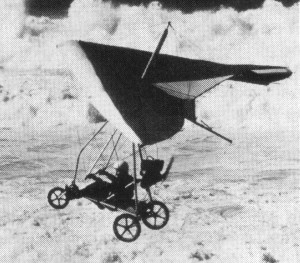
The price of the trike unit was US$3000 in 1982 and bought together with the Demon hang glider wing it costs a total of US$4995. Flight Designs does not recommend the use of any other Rogallo with its trike unit and it is worth noting that its Demon Rogallo is not related to the British wing of the same name, made by Hiway.
The later Jetwing ATVs had a belt reduction drive of 2.2/1 ratio, with a max static thrust of 220 lb (100 kg).
Engine: Kawasaki TA440, 30 hp at 5500 rpm.
Prop¬eller diameter and pitch 36 x 16 inch, 0.91×0.40 m.
No reduction. Power per unit area 0.17hp/sq.ft, 1.8hp/sq.m.
Fuel capacity 5.0 US gal, 4.2 Imp gal, 18.9 litre.
Length overall 12.0 ft, 3.65 m.
Height overall 12.0ft, 3.65m.
Wing span 33.5ft, 10.18m.
Mean chord 5.3ft, 1.60m.
Total wing area 175 sq.ft, 16.27 sq.m.
Wing aspect ratio 6.3/1.
Nosewheel diameter overall 16 inch, 40 cm.
Main wheels diameter overall 20 inch, 50 cm.
Empty weight 216 lb, 98 kg.
Max take off weight 480 lb, 218 kg.
Payload 264 lb, 120 kg.
Max wing loading 2.74 lb/sq.ft, 13.4 kg/sq.m.
Max power loading 16.0 lb/hp, 7.3kg/hp.
Load factors; +4.0, 2.0 ultimate.
Max level speed 47 mph, 76 kph.
Never exceed speed 52 mph, 84kph.
Max cruising speed 37mph, 60kph.
Stalling speed 22 mph, 35 kph.
Max climb rate at sea level 400 ft/min, 2.0 m/s.
Min sink rate 350 ft/min at 23 mph, 1.7 m/s at 37 kph.
Best glide ratio with power off 7/1 at 25 mph, 40 kph.
Take off distance 50 ft, 15 m.
Landing distance 75ft, 23 m.
Service ceiling 10,000ft, 3050 m.
Range at average cruising speed 160 mile, 257 km.
In 1981 Flight Designs Inc was incorporated into Pioneer International Corporation which has been well known for half a century in the aerospace industry as specialising in parachutes.
1982-3: Flight Designs, PO Box 1503, Salinas, California 93902, USA.
Flight Designs was bought out by Pioneer Parachute in 1982.
A 1981 hang glider with cambered aluminum ribs.
It is pretty easy on the handling side and the speed trim is real nice hands off. This glider was really nice to fly on a 15-20 mph day. An easy landing trainer.
It was available in two models: Javelin 168 and Javelin 208.

