Flygindustri AB

Sweden
Subsidiary of Junkers FlugzeugWerkeAG., established at Linhamm, Malmo, effectively escaping restrictions on aircraft construction in Germany. Civil production included the A 20 two/three-seat mail/freight aircraft introduced in 1923, G 23/G 24 three-engined nine-passenger airliners in 1924/25 and the single-engined, six-passenger W 34 built up to 1935. Three-engined K-30C bomber built 1924 and supplied to Russia as R 42; K-37 twin-engined light bomber flown 1927; 174 built in Japan by Kawasaki and Mitsubishi. K-47 monoplane appeared 1928, used as research aircraft for dive-bombing techniques, benefiting later Ju 87 program.

Fly-Fan Shark

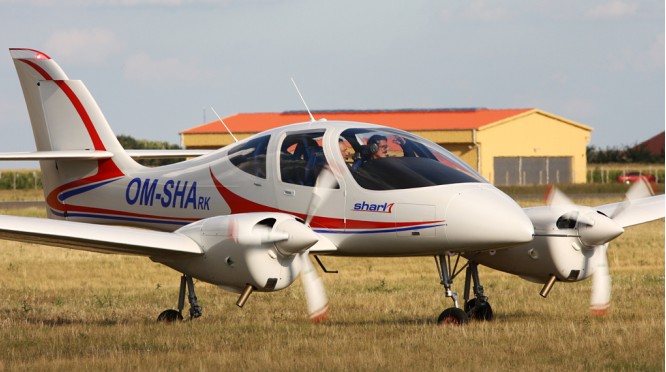
The Fly-Fan Shark is a Slovak light aircraft designed by Frantisek Sustek and under development by Fly-Fan of Trenčín. The design was introduced at the Aero show held in Friedrichshafen in 2007 as a mock up and in 2011 as a flying aircraft. The aircraft first flew on 29 June 2011 and was intended to be supplied as a complete ready-to-fly-aircraft.

The Shark was designed with the goal of providing similar performance to other twin-engined light aircraft, but on 30% less power. It features a cantilever low-wing, a five-seat enclosed cabin, retractable tricycle landing gear and twin wing-mounted engines in tractor configuration.

The aircraft is made from Kevlar and carbon fibre. Its 11.4 m (37.4 ft) span wing employs a Jd 16 (40) 162 airfoil at the wing root, transitioning to a Jd 17 (40) 157 at mid-span and a Jd 15 (35) 136 at the wing tip. The wing has an area of 16.2 sq.m (174 sq ft) and mounts split flaps that can be extended 50 deg. The standard engines fitted are a pair of 160 hp (119 kW) Lycoming O-320-D1A four-stroke powerplants.

The aircraft has an empty weight of 1,221 kg (2,692 lb) and a gross weight of 1,500 kg (3,300 lb), giving a useful load of 279 kg (615 lb).

Engines: 2 × Lycoming O-320-D1A, 120 kW (160 hp)
Propellers: 3-bladed MT-Propeller or Hartzell Propeller constant speed, 1.78 m (5 ft 10 in) diameter
Length: 8.9 m (29 ft 2 in)
Wingspan: 11.4 m (37 ft 5 in)
Height: 3.07 m (10 ft 1 in)
Wing area: 16.2 m2 (174 sq ft)
Airfoil: wing root: Jd 16 (40) 162 airfoil, mid-span: Jd 17 (40) 157, wing tip: Jd 15 (35) 136
Empty weight: 1,221 kg (2,692 lb)
Gross weight: 1,500 kg (3,307 lb)
Cruising speed: 260 km/h (162 mph; 140 kn)
Stall speed: 140 km/h (87 mph; 76 kn)
Never exceed speed: 330 km/h (205 mph; 178 kn)
Range: 1,600 km (994 mi; 864 nmi)
Endurance: 8 hours
Maximum glide ratio: 16:1 at 160 km/h (99 mph)
Rate of climb: 10.6 m/s (2,090 ft/min)
Wing loading: 92.6 kg/m2 (19.0 lb/sq ft)
Crew: one
Capacity: four passengers

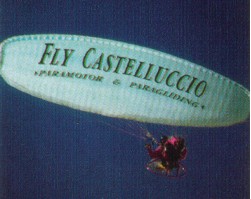
Fly Castelluccio PPG / Mach

Circa 1998 with a kit cost of US$7900. A tandem version sold for US$8900.
Attachable trikes were available.

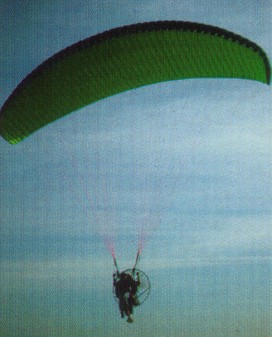
The Mach 1 paratrike uses a modified paraglider wing with the German-manufactured Solo 210cc two-stroke petrol engine. This has electronic ignition, electric starter, in-flight battery charging and its Walbro carburettor and tuned exhaust gives an extra 5 kg of thrust. Power to the 1.22-metre diameter wooden propeller is via a 2.5:1 Polyvee Belt Drive reduction unit, giving 60 kg of thrust at 6,300 rpm. Fuel capacity has been increased from the standard 8.5 to 10 litres, giving a 5-hour endurance at approximately 27 knots.

Engine: Zanzoretta MZ34, 28 hp
Wing span: 11.7 m
Wing area: 32.2 sq.m
Fuel capacity: 2.3 USG
Empty weight: 62 lb
Gross weight: 72 lb
Cruise: 18 mph
Rate of climb: 600 fpm
Takeoff dist: 20 ft
Landing dist: 15 ft
Seats: 1

Mach 1
Engine: Solo 210cc.
Fuel cap: 10 lt.
Endurance: 5 hr.
Cruise: 27 kts.
Wing area: 32 sq.m.

Mach 1 Bi
Empty weight: 24.5 kg
Engine: Zanzottera, 28 hp
Reduction: 1:2.5
Prop diameter: 122 cm
Fuel capacity: 2 x 9 lt
Price (1998): £2595

Mach 1 L
Empty weight: 18 kg
Engine: Solo, 14 hp
Reduction: 1:2.5
Prop diameter: 122 cm
Fuel capacity: 2 x 9 lt
Price (1998): £225

Mach 3 L
Empty weight: 17.5 kg
Engine: Vittorazi, 17 hp
Prop diameter: 118 cm
Fuel capacity: 8.5 lt
Price (1998): £2295

Mach 3 LC
Empty weight: 17.5 kg
Engine: Vittorazi, 17 hp
Prop diameter: 130 cm
Fuel capacity: 8.5 lt
Price (1998): £2595

Mach 4
Empty weight: 17 kg
Engine: Solo, 14.5 hp
Reduction: 1:2.5
Prop diameter: 114 cm
Fuel capacity: 8.5/5.5 lt
Price (1998): £2595

Mach 4 C
Empty weight: 18 kg
Engine: Solo
Prop diameter: 139 cm
Fuel capacity: 8.5/5.5 lt
Price (1998): £2595
Fly Castelluccio Super Smile

Paraglider circa 1998.

Super Smile L
Wing area: 29 sq.m
Pilot weight: 80-110 kg
No. of cells: 35
Wing span: 11 m
Aspect ratio: 4.1
Min sink: 1.1 m/s
Max speed: 42 kph
Price (1998) 4,400,000 Lr

Super Smile M
Wing area: 27 sq.m
Pilot weight: 60-85 kg
No. of cells: 35
Wing span: 10.7 m
Aspect ratio: 4.1
Min sink: 1.1 m/s
Max speed: 42 kph
Price (1998) 4,200,000 Lr

Fly Castelluccio Quasar

Paraglider circa 1998.

Quasar L
Wing area: 30 sq.m
Certification: Afnor
Pilot weight: 80-110 kg
No. of cells: 48
Wing span: 11.4 m
Aspect ratio: 5.2
Min sink: 1.1 m/s
Max speed: 45 kph
Price (1998) 4,700,00 Lr

Quasar M
Wing area: 28 sq.m
Certification: Afnor
Pilot weight: 65-90 kg
No. of cells: 46
Wing span: 11 m
Aspect ratio: 5.2
Min sink: 1.1 m/s
Max speed: 45 kph
Price (1998) 4,700,00 Lr

Fly Castelluccio Nexus

A training paraglider circa 1998.

Nexus 26
Wing area: 26 sq.m
Pilot weight: 56-79 kg
No. of cells: 81
Wing span: 13 m
Aspect ratio: 6.2
Min sink: 1 m/s
Max speed: 58 kph
Price (1998) 5,500,000 Lr

Nexus 28
Wing area: 28 sq.m
Pilot weight: 70-85 kg
No. of cells: 84
Wing span: 13.5 m
Aspect ratio: 6.3
Min sink: 1 m/s
Max speed: 58 kph
Price (1998) 5,600,000 Lr

Nexus 30
Wing area: 30 sq.m
Pilot weight: 85-110 kg
No. of cells: 87
Wing span: 14 m
Aspect ratio: 6.4
Min sink: 1 m/s
Max speed: 58 kph
Price (1998) 5,700,000 Lr