eight/nine-seat commercial transport
Era
Focke-Wulf A.16
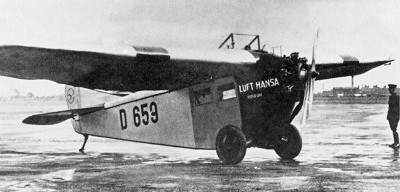
A three/four-seat commercial transport.
Engine; 1 x Siemens Sh.11 7-cylinder radial, 56kW
Wingspan; 13.90 m / 45 ft 7 in
Length; 8.50 m / 27 ft 11 in
Height; 2.30 m / 7 ft 7 in
Max take-off weight; 970 kg / 2138 lb
Max. speed; 135 km/h / 84 mph
Ceiling; 2500 m / 8200 ft
Range; 550 km / 342 miles
Crew; 1
Passengers; 4
Focke-Wulf A 7 Storch
Financial support followed success of A 7 Storch two-seater, flown November 1921.
Focke-Wulf Flugzeugbau GmbH
An association between Heinrich Focke and Georg Wulf was formalized January 1,1924 with formation of Focke-Wulf Flugzeugbau AG. at Bremen. Financial support followed success of A 7 Storch two-seater, flown November 1921.
First company design was A16 three/four-seat commercial transport, followed by the eight/nine-seat A17, the more powerful 650 hp BMW Vl-powered A 29 and the three-crew/ten-passenger A 38 airliners.
In 1931 acquired license to build Cierva C.19 Mk IV autogiro. Focke concentrated on rotary-wing activities, fixed-wing design was entrusted to Kurt Tank, formerly of BFW and of Rohrbach Metallflugzeug GmbH. Albatros Flugzeugwerke GmbH, Berlin, amalgamated with Focke- Wulf. On Focke’s resignation to form Focke-Achgelis, Tank appointed technical director. Reorganized June 1936 as GmbH under control of AEG. Ceased operations 1945, reformed 1951 and combined with Weser Flugzeugbau to form Vereinigte Flugzeugtechnische Werke.
S 24 Kiebitz two-seat trainer won 1931 German Aerobatic Championship flown by Gerd Achgelis, who conducted maiden flight of Fw 44 Stieglitz trainer late summer 1932, widely used by embryo Luftwaffe and in European and South American countries. First Tank design produced in any numbers (approximately 1,000) was Fw 56 Stosser fighter/dive-bomber advanced trainer, followed in 1935 by Fw 58 Weihe communications aircraft/crew trainer and in 1938 by Fw 189 reconnaissance aircraft. Fw 200 Condor airliner flown July 1937, developed into Fw 200C long-range reconnaissance aircraft. With production total of more than 19,000, Fw 190 fighter was the most notable of Focke-Wulf’s designs; after the first flight on June 1,1939, entered squadron service August 1941. High-altitude version, with revised high aspect ratio wing, designated Ta 152.
Focke-Wulf joined VFW in 1964.
Focke-Kolthoff-Wulf A.V / A.IV
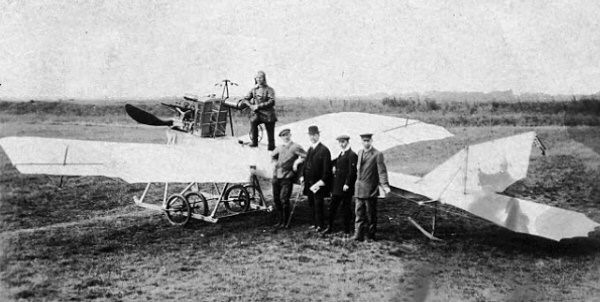
This monoplane with Taube-like wings tips and a big rudder (sometimes identified as the A.V) was built in 1912 in Bremen (Germany). The engine was a 50 hp Argus, and it flew for the first time on July 28th, 1912.
Focke-Kirchhoff-Tiemann hang glider / Focke A II
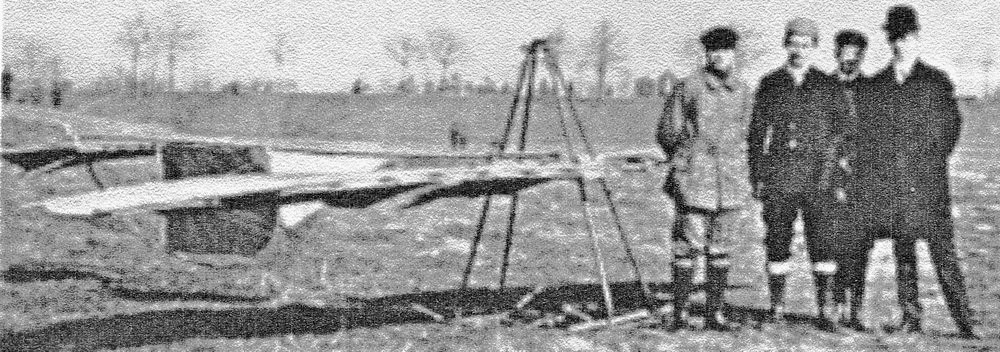
This glider, which was later designated Focke A II, was actually built by three high school students: Henrich Focke, Frido Kirchhoff and Carl Tiemann. It was flown in late 1909 at the Osterdeich in Bremen.
Focke-Borgward BFK.1 Kolibri
Experimental Helicopter, Germany, 1958
The automobile manufaturer Borgward in Bremen tried to expand its operations with helicopters and the Kolibri was designed together with Prof. Heinrich Focke.
The project was shut down because of economical problems of the Borgward factories.
Engine: Lycoming, 237 hp
Rotor diameter: 30.84 ft / 9.4 m
Max take off weight: 2646.0 lb / 1200.0 kg
Crew: 1+2
Focke-Achgelis Fa.336
After termination of the work on the Fa.330 “Wagtail” it was next decided to transform the Fa.330 into a helicopter with engine. It was soon determined as unfeasible. Instead the Focke Achgelis engineers developed a new helicopter, which received the designation Fa.336. It was a single-seat device with outside features, reminiscent of the Fa.330.
Like the Fa.330, the Fa.336 could be stowed away and dismantled in a similar manor. Instead of a swash plate, a new design was applied to increase blade angle. This new design was developed for Focke Achgelis by Mr. Wewoloschky, an engineer who was conscripted to help solve this problem.
Deviating from Focke’s building principle, the Fa.336 had a tail rotor with horizontal drive shaft. The construction from steel tube corresponded to that of the Fa.330. The Fa.336 remained only a design, because there were very few specialists in the whole design engineering department, and those were divided and indispensable for the care of the Fa.223 and its development.
Engine: Zuendapp Z9-92, 60hp / 45kW
Total length: 6.8m
Marin rotor: three-blade
Rotor diameter: 7.5m
Tail rotor: 1.5m
Crew: 1
Focke-Achgelis Fa-330 Bachsteize
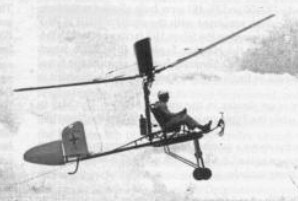
Early in 1942, Focke Achgelis at Laupheim were asked to design a simple single-seat gyro kite which surfaced U-boats could tow aloft to extend the observer’s range of view. At this time, the U-boats were being forced away from the dense shipping areas around the coasts of Britain and the United States to hunt further out into the Atlantic where there was greater safety, but where their low position in the water made searching for, and shadowing, the spread-out convoys a very difficult task.
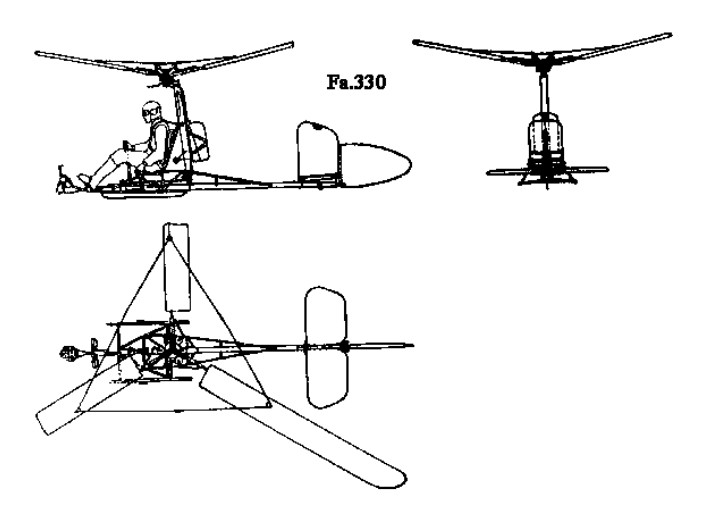
The gyro kite, designated Fa 330 Bachstelze, was seen as of solution. The machine could be easily assembled or dismantled in a few minutes and stowed through a U-boat hatch. The body structure consisted of two main steel tubes, one horizontal and one vertical. On the horizontal tube was mounted the pilot’s seat with controls and a small instrument panel, and landing skids, and, at the rear end, a simple tailplane, fin and rudder. The vertical tube, behind the pilot’s seat, formed a pylon for the rotor.
The freely-rotating rotor had three blades, each of which consisted of a tubular-steel spar with plywood ribs and thin plywood and fabric covering. Each rotor blade had flapping and dragging hinges with adjustable dampers. Blade pitch could only be adjusted, with screws, on the ground before take-off. The best results were normally obtained with the blade pitch as coarse as possible, although starting was then more difficult. In addition to the flapping and dragging dampers, there were also inter blade connecting cables and blade-droop cables, the latter being attached to the blades and to an inverted tripod extending upward from the rotor hub. The rotor axis was slightly ahead of the machine’s c of G, and the towing cable attachment point was slightly ahead and below the c of G.
Movement of the control column tilted the rotor head in the appropriate direction for longitudinal and lateral control, and operation of the rudder pedals gave directional control. The tailplane was not adjustable. The Fa 330 was launched from the deck of the surface-running U-boat by giving the machine a slight backwards tilt once the rotor was revolving. If there was a wind, a push by hand sufficed to get the rotor moving, but otherwise a pull-rope was wound around a grooved drum on the rotor hub. In case this rope did not slip off when the rotor started, an over-ride mechanism was fitted.
Pilot training was given in a wind-tunnel at Chalais-Meudon near Paris, and the kite was very easy to operate and could be flown hands-off for up to 10 seconds. It is believed that two or three crew members of each Fa 330 equipped U-boat learned to fly it.
Having 150m of towing cable available, it was possible to maintain an altitude of 120m thereby extending the possible range of vision very usefully to 40km compared with only 8km on the U-boat deck. In an emergency, the pilot, who had telephone contact with the U-boat, pulled a lever over his head which jettisoned the rotor and released the towing cable. As the rotor flew away and up, it pulled out a parachute mounted behind the pylon. At this stage, the pilot, attached to the parachute, unfastened his safety belt to allow the remainder of the Fa 330 to fall into the sea while he made a normal parachute descent. In a normal descent, the kite was winched in to the deck and, upon landing, the rotor brake applied.
Although designed by Focke Achgelis, the Fa 330 was built by the Weser-Flugzeugbau at Hoykenkamp, near Bremen. This particular factory manufactured Focke-Wulf Fw 190 fuselages, a few Fa 223 helicopters and about two hundred Fa 330s. Variations made in the basic design were an increase in rotor diameter to 8.53m on late machines and the option of adding simple landing wheels to the skids.
Training to handle this autogyro was given in a wind tunnel at Ghalais Meudon in France. An original Fa 330 is still preserved in the French Air Museum.
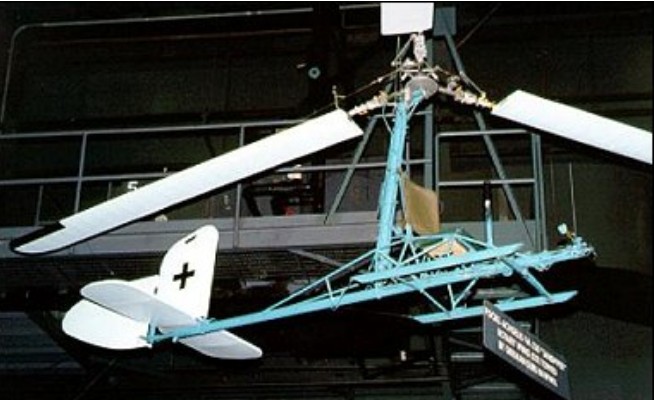
The principal U-boat class to use the Fa 330 was the ocean-going Type IX which had a surface displacement of 740 tons, a surface speed of 18kt and a submerged speed of 7.5kt. Among the operational U-boats of the Kriegsmarine, only the Type IX-D/2 supply U-boat had a faster surface speed of 19.2kt, and this type possibly used the Fa 330 also. Little is known of actual operations with the kite, or how many were issued, but there is no doubt that the use of the gyro kite was unpopular, because, in an emergency, the U-boat had either to delay its dive in order to pick up the kite’s pilot, or dive and hope to pick him up later. The advantages of a self-propelled machine seem clear. The first Fa 330s were probably issued in mid 1942 but were used in the South Atlantic only on rare occasions. From June 1942, the U-boat forces swung their main effort from the Atlantic to the Gulf of Aden and the Indian Ocean, where more use of the gyro kite was made. U-861, for example, used her kite on a patrol in the Indian Ocean off Madagascar. However, the new theatre of operations provided opportunities to exchange the Fa 330 for, in the eyes of the commander, something more usable. At Penang, Malaya, the Japanese had permitted the establishment of a U-boat base in the summer of 1943, and it was here that an Fa 330 was exchanged for a small Japanese floatplane. On another occasion, at ihe Surabaya (Java) U boat base, a gyro kite was exchanged for a Japanese floatplane to supplement the two Arado reconnaissance aircraft which kept watch over the harbour.
More Fa 330s survive today than any other examples of German rotary-wing aircraft, not only because they were built in by far the greatest numbers, but probably also because their small size does not make great demands on valuable preservation space.
There was also a proposal, designated Fa 336, to build a powered version of the Fa 330 with landing wheels and a 60hp engine.
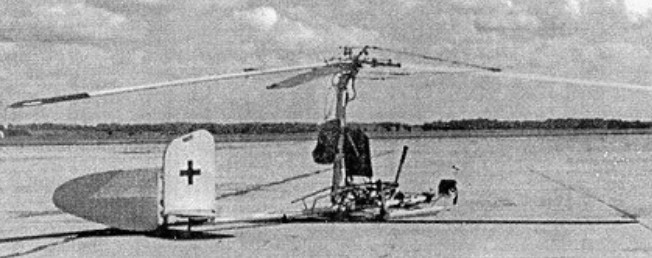
Fa 330
Rotor diameter: 23.983 ft / 7.31 m
Length: 4.4m
Empty weight: 180.8 lb / 82.0 kg
Max. speed : 22 kts / 40 km/h
Landing speed : 13 kts / 25 km/h
Crew: 1
Fa 330A
Rotor Diameter 8.5 m (28 ft)
Length 4.5 m (15 ft 8 in)
Height 1.7 m (5 ft 6 in)
Weight Empty, 75 kg (165 lb)
Focke-Achgelis Fa 266
The obvious promise in the Fw 61’s basic design led to a development contract for a 6-passenger feeder transport, the Fa 266 for Deutsche Lufthansa, and a prototype of this aircraft (D-OCEB) was completed during the early part of 1939. War intervened, however, before this machine could be flown, and it was subsequently developed for a military role with the type number Fa 223.

