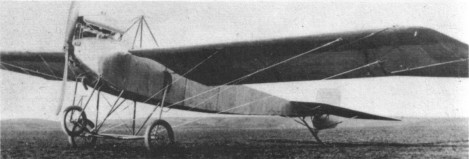
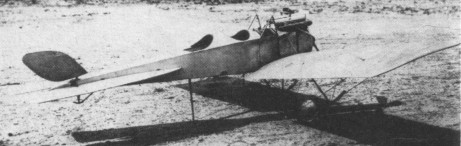
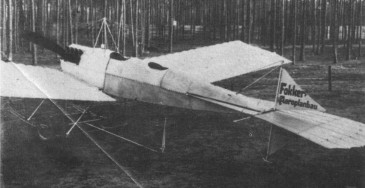
In May 1914 Fokker produced a light, maneuverable aeroplane, the M.5. It was designed by Kreutzer and based on a French Morane Saulnier type H which Fokker had bought second hand. Fokker adapted an untested patent design by Franz Schneider of the LVG company dating from 1913 that interrupted the stream of bullets as the propeller blade passed in front of a machine-gun muzzle to work with a standard Parabellum 08/14 7.02mm weapon.
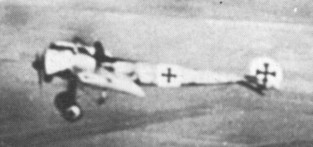
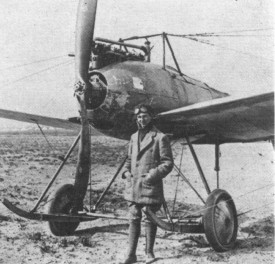
The Eindecker (monoplane) was a version of the M.5k general-purpose aeroplane fitted with a forward-firing machine-gun and interrupter gear to prevent bullets from hitting propeller blade(s). The inspiration for this otherwise combat aeroplane was Roland Garros’s Morane-Saulnier Type L, which came down behind the German lines on 19 April 1915 and was then found to be fitted with a gun and steel deflector plates. The High Command ordered 30 as the Fokker E.I, with the 60-kW (80-hp) Oberursel U.0 rotary, and was the world’s first true fighter. Deliveries were from June 1915.
M.5K/MG. The K means Kurz = (short wing) and MG means Maschinengewehr (machine gun).
The Fokker E.I was a mid-wing monoplane with externally braced wings and a tapered box-section fuselage. There was no rudder or elevator as such, the entire fin and tailplane being moveable surfaces. There were no ailerons, lateral control being effected by wing warping. External cables that ran through a king post in front of the cockpit moved the controls. The basic structure was steel, but there was no armour protection for the pilot or fuel tanks. Power came from a 59.7 kW / 80 hp nine-cylinder Oberurel rotary engine.
E.I (the later designation the M. 5K/MG). E.I means Eindecker (monoplane) number one. The M.5K/MG, or E.I had an 80 hp. Oberursel engine and was armed with an LMG 08 machine gun. Span 8.95m, the length 6.75m, height 2.88m. Maximum speed 130 kph.
M.5L L means Lang = (long wing).
Some of the first E.Is were issued in ones and twos to various frontline units and flown by experienced pilots. The first to score in an Eindekker was Lt. Kurt Wintgens. His first confirm victim was a Voison downed on 15 July 1915.
Two other early recipients were Max Immelman and Oswald Boelcke of Feldflieger Abteilung 67. On August 1st, 1915 Lieutenant Max Immelmann achieved his first air combat victory flying a Fokker M.5K/MG, and was followed 18 days later by Boelcke. At the end of October Immelmann and Boelcke gained their fifth and sixth victories respectively.
A total of 54 E.Is was produced for the German army, navy and the Austro-Hungarian army by June 1916. The E I was soon superseded by the generally similar E II. The E.I and E.II were built in both armed and unarmed versions, and mainly used for training, before the armed versions were re-engined with a 74.6 kW / 100 hp Oberursel rotary and re-designated E.III.
Engine: Oberursel U.0 rotary, 60-kW (80-hp) Wing Span: 8.95 m Length: 6.75 m Height: 9 ft 1¾ in / 2.4 m Empty Weight: / 358 kg Gross Weight: 563 kg Max Speed: 130 km/h Ceiling: 3,000 m Endurance: 1½ hours Crew: 1 Armament: 1 Spandau machine gun, 7.92 mm
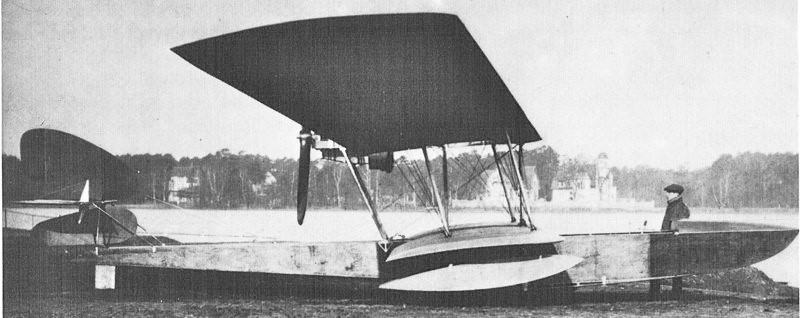
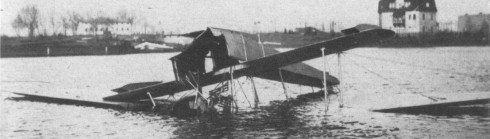
The first Fokker flying boat – identified as the W.1 – dating from February 1913. A characteristic two-seat sesquiplane biplane with a Renault engine of 70 hp fitted in pusher configuration on the top wing. The machine was intended by Fokker to participate in the Monaco seaplane contest of 1913. During an early test flight the W.1 crashed in the water being completely destroyed, with Fokker and his mechanic narrowly escaping. Fokker never turned to flying boats during WW1 again.
The M.I to M.IV were designed at the instructions of Fokker by a Mr Palm. With the failure of the M.IV he was fired, to be succeeded by Martin Kreutzer.
Fokker’s first big order was for ten M.II with a total value of 299,800 Marks. The aircraft had a 100 h.p. Argus or Mercedes engine. Its span was 13.2 metres, length 8.5 metres and the maximum speed was 100 kph.
Engine: 100 h.p. Argus or Mercedes Wingspan: 13.2 m Length: 8.5 m Maximum speed: 100 kph
A picture postcard of 1913 depicted a Spin with enclosed cockpit. A variation of the Spin about which little is known. The fuselage is enclosed, like that of the M.II, but in a totally different manner.
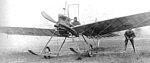
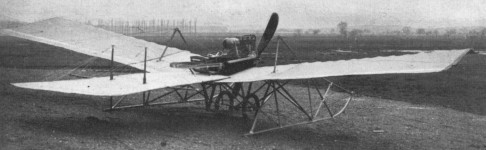
Fokker set to work on a new aircraft, at Nieder Walluf on the Rhine, with the help of boat builder Jacob Goedecker, who also wanted to fly. It was on this second Spin that Fokker taught himself to fly on the Grosser Sand at Gonsenheim. At the beginning of May 1911 he flew a few curves, following them with a complete cir¬cle a few days later. On May 12th von Daurn finally got his money’s worth when Fokker took him along as a passenger.
Another goal was reached on May 16th, when Anthony Fokker obtained his pilot’s licence. He had agreed with von Daum that the latter would become the owner of the aircraft as soon as Fokker had gained his licence. Von Daum wanted to start training right away, but Fokker tried to talk him out of it because he had received an invitation from his former home, Haarlem, to give a flying demonstration on the Queen’s Birthday. There was money to be made, and he was afraid that von Daum would crash “his” aircraft again.
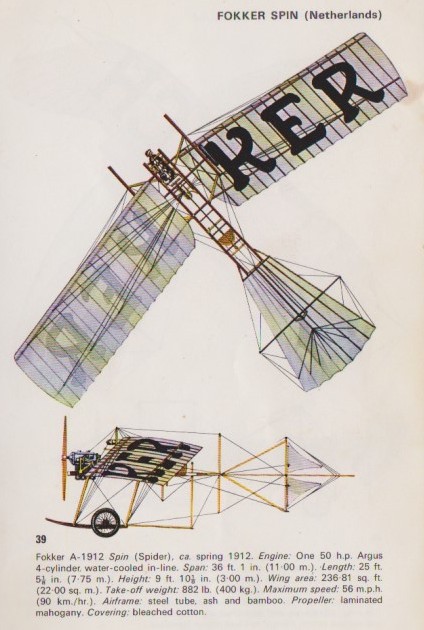
However, von Daurn could not be dis¬suaded. After a reasonable start to his fly¬ing attempts he suddenly seemed to forget everything he had previously learned, and dived into the ground from a height of 10 metres. He shook the bits and pieces from him, and advised Fokker to “take his damned aircraft away, and fly to hell with it”. Fokker purchased von Daum’s share in the venture for 1200 Marks, and so became the owner of the wreckage and, more importantly, the 50 h.p. Argus engine. Meanwhile, a third Spin was being made by Goedecker, and on August 31, 1911 Fok¬ker gave his first flying demonstration over Haarlem. The military version of the Spin was called the M.I. The initial version was the A 1912; the later B 1912 had a 100 hp engine, and a few others were fitted with 70 hp Renaults.
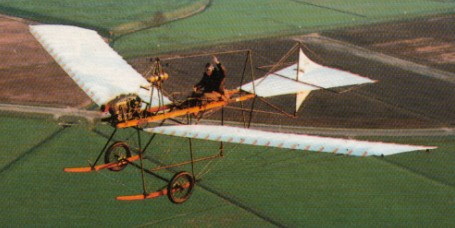
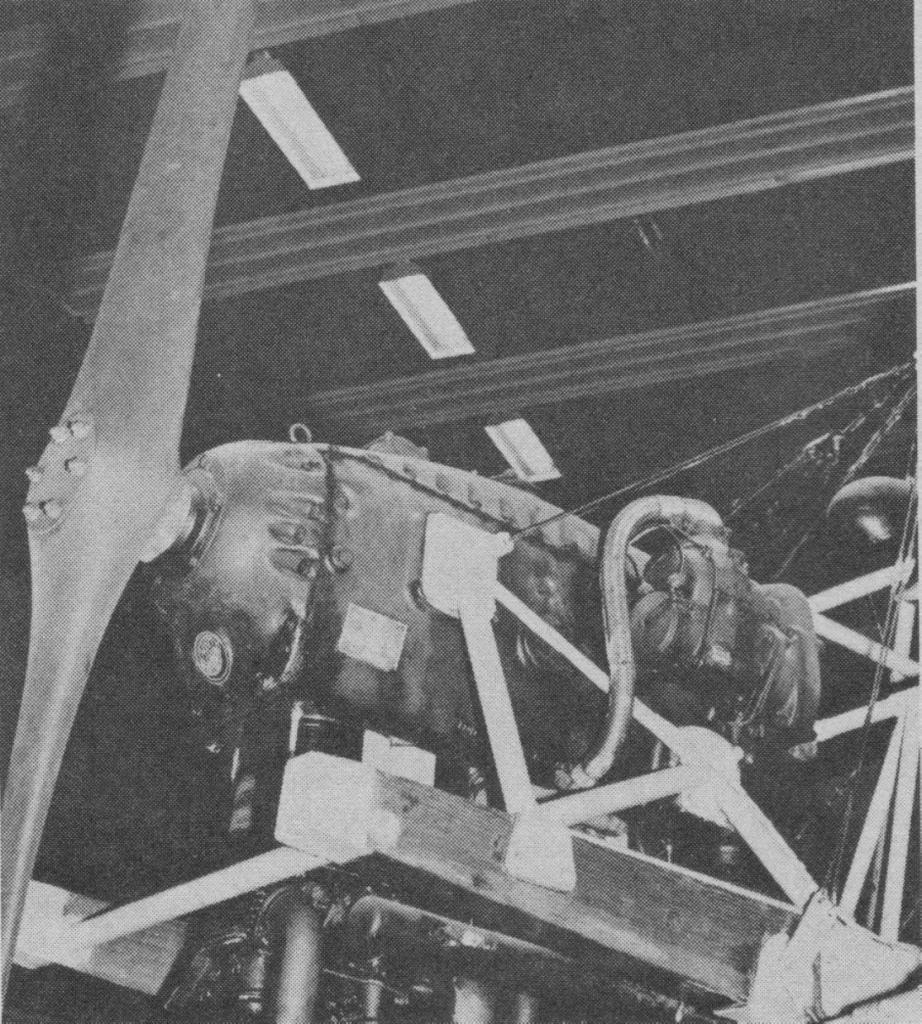
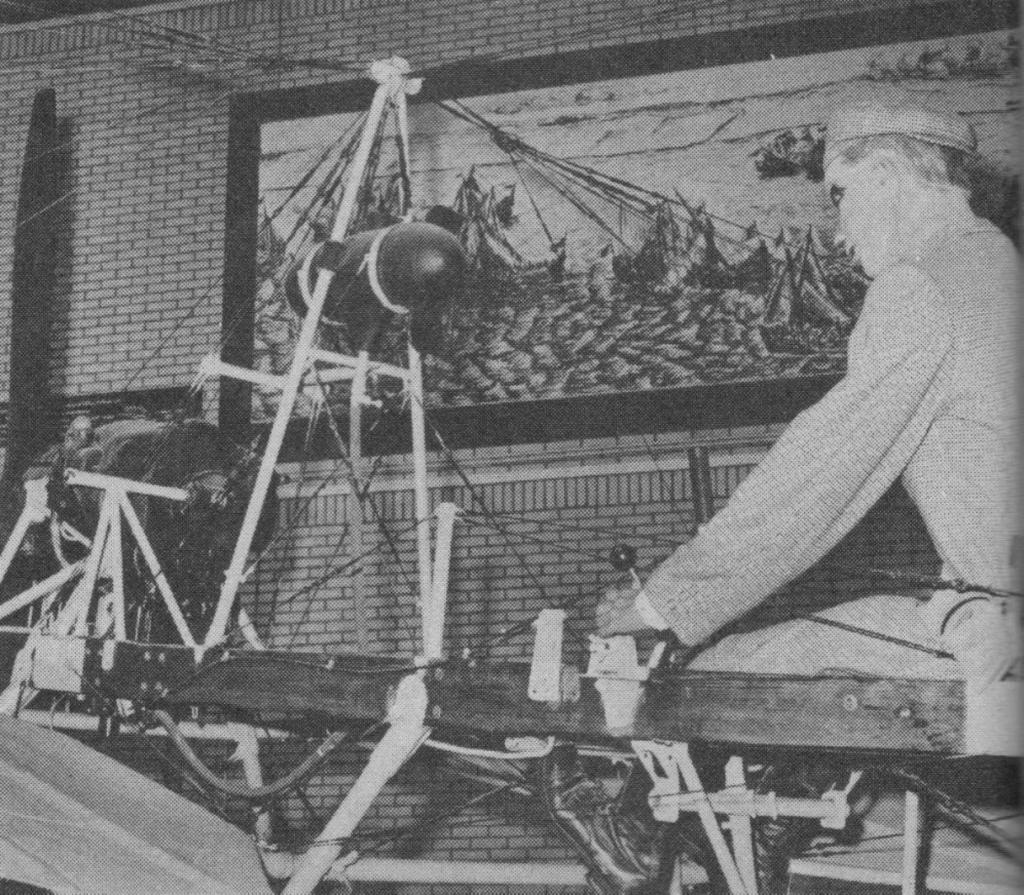
A replica of the 1911 Haarlem aircraft was made by the Fokker works in 1936. It was similar tubular steel and wood construction with same quality fabric cover, but the engine a more powerful Hirth 504 A-1 of 105 hp. Stored through WW 2 it was reassembled and reconditioned in 1953, then reconditioned again in 1959 for exhibition at the Aeroplanorama.
A-1912 Engine: One 50 hp Argus four¬ cylinder in line. Prop: 2-¬blade. Wing span: 36 ft 1 in (11.00 m). Length: 25 ft 5 in (7,75 m). Wing area: 236.81 sq.ft (22.00 sq.m). Gross weight: 882 lb (400 kg). Max speed: 56 mph (90 km/h). Crew: 1.
The first aircraft built by Anthony Fokker, the Spin of 1910. Anthony Fokker decided to build his own aeroplane. A fellow pupil from the school at Zahlbach, the 50 year old Lieutenant von Daum, became his partner, donating the cash for the engine, and Fokker contributed his knowledge, his labour and 1500 Marks. The machine, named the ‘Spin’ (Spider), was constructed in an empty Zeppelin shed at Baden Baden. By the end of 1910 it had been completed, and Fokker was able to make the first hops in it. To start with, the ‘Spin’ had no rudder, but this did not mat¬ter to Fokker, who went almost out of his mind with joy. At Christmas 1910 he went home, only to be greeted with the sad tidings that von Daum had tried to fly the ‘Spin’ in Fokker’s absence and smashed into the only tree on the airfield during take off.
Antony Fokker was born on 6 April 1890 on the island of Java in the Dutch East Indies, but came with his family to the Netherlands four years later. In his youth, Fokker showed a greater disposition toward design and invention than toward formal schooling. During his adolescence he acquired a passion for cars, inventing a tire that could not be punctured, and then discovered aviation. His real desire was to learn to fly, but as his parents opposed this course most vehemently, the young Fokker contented himself initially with model planes built of wood and paper.
Anthony Fokker Article
Enrolling in an engineering school, after his military service had been cut short by an accident, the young Fokker finally obtained the structured educational basis which finally allowed him to construct his first plane, the Spin, in 1910.
After gaining his pilot’s license in 1911, Fokker moved to Germany, which he saw as a nation more likely than the Netherlands to take aviation to its bosom. Registered originally Fokker Aviatik GmbH, on 22 February 1912, Antony Fokker’s first company operated under Fokker Aeroplanbau GMBH at Berlin-Johannisthal then, moved to Schwerin, Mecklenberg, in 1913. Name changed later to Fokker Flugzeugwerke.
In 1912 Fokker sold his first plane to the German army, but the two years before the outbreak of the First World War were a distinct uphill struggle for the young Dutchman in financial terms. All this changed with the beginning of the war. Fokker accepted all commissions placed with him by the Imperial German air service, despite the fact that he might not be able to honour all of them. During the course of the war the Fokker company grew very considerably, producing for Germany many aircraft types both indifferent and good. Indifferent types included the Eindecker series of armed monoplanes that nevertheless ushered in the concept of the true fighter, while good types included the classic Dr 1, DVII and D VIII fighters. The Fokker company was also notable for the development of the world’s first effective synchronizer gear to allow a fixed fuselage-mounted machine gun to fire directly forward without shooting off the propeller blades.
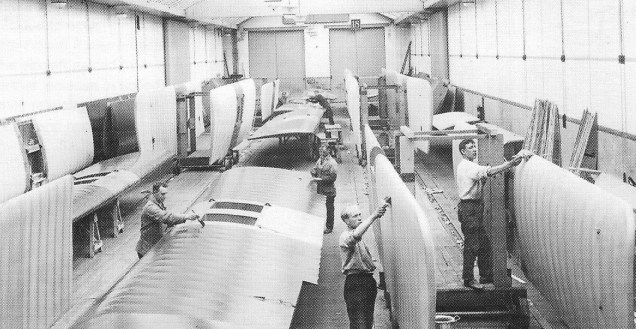
Some civil aeroplanes were built at Schwerin in 1918 under the supervision of Platz, but production soon ended, and the Fok¬ker Aeroplane Works, where some 3,350 aeroplanes had been built during the War, was liquidated. It became Schwerin Indus¬trial Works Ltd, producing yachts, motor¬boats, canoes and, later, bedsteads and scales. The defeat of Germany and the revolutionary fever that swept the country toward the end of 1918 persuaded Fokker to beat a precipitate retreat to the Netherlands during November. The company was liquidated following Fokker’s return to Holland after the First World War. Here Fokker rebuilt his aviation empire, on 21 July 1919, founding the NV Koninklijke Nederlandse Vliegtuigenfabriek Fokker with factory at Veere, Zeeland, assembly at Amsterdam, with a series of important warplanes and a family of monoplane transports, including the classic F VII.
Fokker rented the Witteman-Lewis aircraft factory at Teterboro, together with the adjoining airfield at Hasbrouck Heights, New Jersey, USA, as the Netherlands Aircraft Manufacturing Company. In May 1924 a new company was formed, the Atlantic Corporation, with Lorillard Spencer as President and Robert B. C. Noorduyn as General Manager. Later named the Fokker Aircraft Corporation of America and, under the overall ownership of the General Motors Corporation in 1930, the General Aviation Corporation. Often known as “The Flying Dutchman”, Fokker died on 23 December 1939 but his name survives as the manufacturer of some of the world’s most important short-haul airliners. Production during Occupation included Arado Ar 196 floatplanes, Bucker Bu 181 Bestmann trainers and Dornier Do 24 flying-boats. Postwar activity included conversion of military Dakotas and Skymasters for civil use, license-production of various types including 24 Hawker Sea Furies, 460 Hunter F.4, and F.6 fighters; final assembly and parts manufacture of 350 Lockheed F.104Gs; share in European manufacturing program for F-16 fighter; associate member of Airbus Industrie On February 1st, 1947 an agreement was signed between Fokker, Aviolanda and De Schelde’s aviation department by which the long awaited merger was achieved. The name of the new conglomerate was “United Netherlands Aircraft Factories ¬Fokker”. To commemorate Fokker’s thirty years of aircraft manufacture in the Netherlands, they were granted the title “Royal Dutch Aircraft Manufacturer Fokker” on 21 July 1949. On April 1st, 1949 it became apparent that the merger between Fokker, Aviolanda and De Schelde had failed, and the con¬trolling body appointed Messrs. Vos, Beel¬ing, and During directors of the Fokker factory. A new factory at Schiphol was opened in 1951. On February 16th, 1954 Avio Diepen ¬became a subsidiary of Fokker. The aircraft construction department of the Royal Company De Schelde, joined Fokker on May lst, 1954.
Around 1960 Fokker was looking for and American partner. Lockheed turned down the proposal because they thought it could not be profitable, but Northrop agreed to by a twenty-one percent share.
Formed a joint company with Vereinigte Flugzeugtechnische Werke in 1969. VFW and Fokker joined in 1970 to form VFW-Fokker. In the 1970s German interest in general aviation was maintained by one or two smaller companies, but there has also been quite a large R&D investment by Rhein Flugzeugbau, a subsidi¬ary of VFW Fokker, in ducted fan propulsion for a new generation of lightplanes represent¬ed by its revolutionary Fanliner. By 1995 Fokker was a member of the Daimler-Benz Aerospace group. In March 1996 company filed for bankruptcy, but Stork Group bought Fokker Aviation to continue as Fokker Aircraft BV for product support, electronic systems and components, aerostructures, and special products. Several attempts to purchase the aircraft manufacturing business by foreign companies came to little, leading to the end of all aircraft production in May 1997 (latterly under trustees). Until production ended after Fokker collapsed due to financial problems on 15 March 1996, Fokker have developed and constructed over 100 different types of aircraft, both for military and civil aviation.