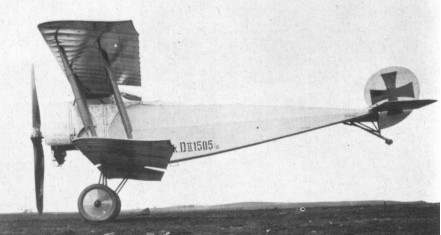
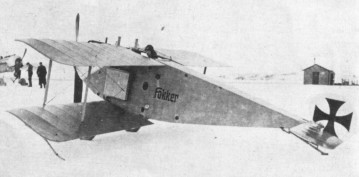
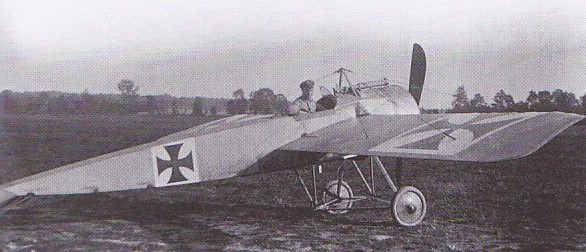
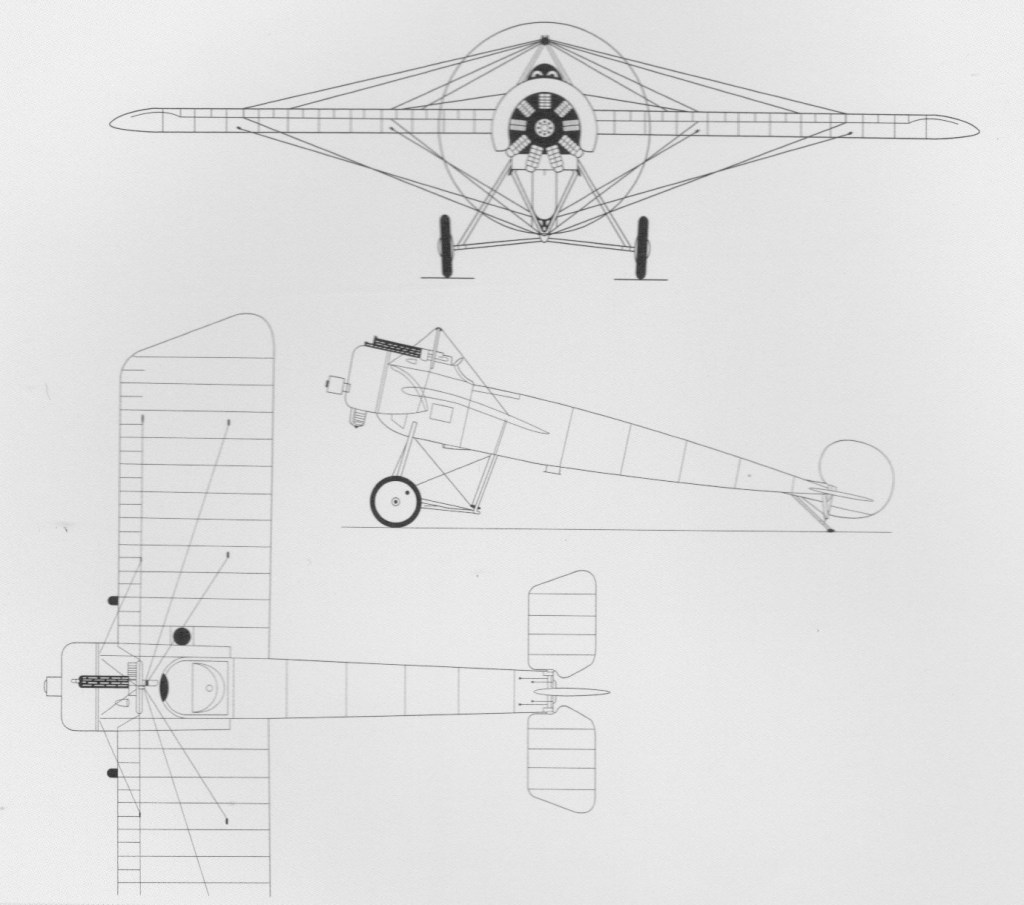
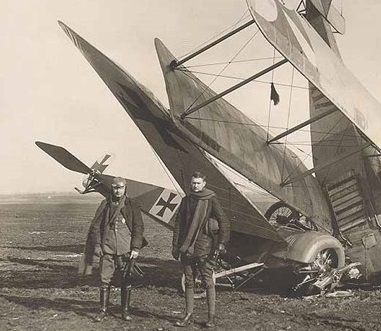
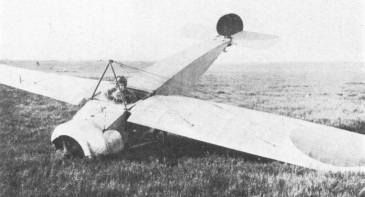
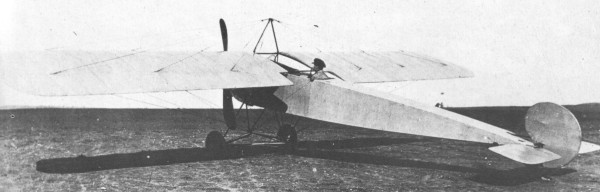
The D II appeared later than the D I but was derived from the earlier M.17z prototype. The D II had shorter wings and a longer fuselage, and as it was powered by a 75-kW (100-hp) Oberursel U.l rotary engine it was lighter and more manoeuvrable than the D I. M.17E, a version of the M.16E with a 100 h.p. Oberursel rotary engine instead of the liquid cooled Mercedes of the latter. Equipped with one machine gun, the M.17E was not put into production. The D.II (M.17ZF) fighter, designed by Martin Kreutzer, appeared early 1916 and was completed before the D.I. With a 100 h.p. Oberursel engine it attained a speed of 150 kph, and the armament comprised one machine gun. A total of 77 of this type were produced.
The M.16E, of 1915, an experimental fighter with one machine gun, did not go into production. Thirty M.16Z two seaters were used by the Austro Hungarian army with the designation B.3. The M.16Z had a 160 h.p. Mercedes or a 200 h.p. Austro Daimler engine.
The E III was superseded by the generally similar E IV. The final attempt to wring extra capability out of the basic design was the overweight E IV with two guns and the 119-kW (160-hp) U.III rotary.
Total E-series production was about 300 aircraft, including 49 E.IV, the last in July 1916.
The E I was soon superseded by the generally similar E II with the 75-kW (100-hp) U.I rotary for improved performance and then by the definitive E III with detail modifications. The final attempt to wring extra capability out of the basic design was the overweight E IV with two guns and the 119-kW (160-hp) U.lll rotary. Total E-series production was about 300 aircraft including 258 E.III.
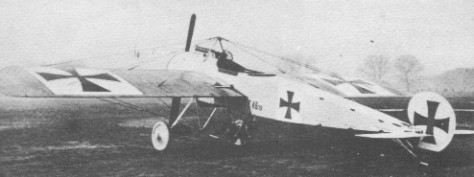
The E.I and E.II were built in both armed and unarmed versions, and mainly used for training, before the armed versions were re-engined with a 74.6 kW / 100 hp Oberursel rotary and re-designated E.III. They also had lengthened wings, could carry more fuel and had greater ammunition capacity.
E.III converted from an E.I
One E.III was part of trials of an early stealth experiment. The fabric covering was replaced with a transparent Cellon material, allowing all the internal structure to be seen, but otherwise reducing the visibility of the aircraft from a distance. Although it was relatively effective camouflage, the material itself lost its tautness when wet, thus affecting the flying qualities. The Cellon, an early form of Cellophane plastic, would also tear severely following minor damage, and so it was not used in service.
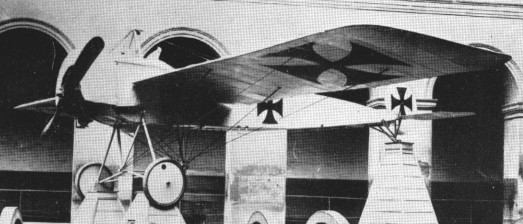
Of the 309 Fokker Eindeckers produced, only a single E.III survived. Captured by the RFC in April 1916, it hung for many years without covering in the Science Museum in London.
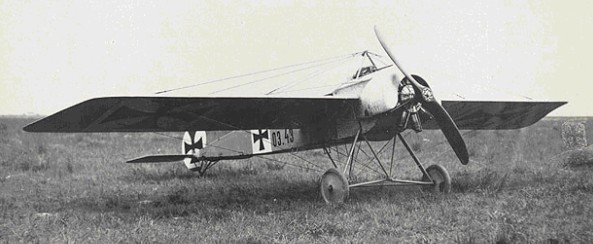
The E I was soon superseded by the generally similar E II with the 75-kW (100-hp) U.I rotary for improved performance. The E.II was slightly longer and heavier, even though it had shorter wings.
Early Fokker E.II – originally equipped with a 7 cylinder 80 hp Oberursel U.0 – later refitted with a 100 hp Oberursel U.I. On the early E.II, the upper longeron is straight, and the standard production E.II had an auxiliary longeron to support the larger diameter cowling ring and cowling needed for the 9 cylinder 100 hp U.I engine.
The E.I and E.II were built in both armed and unarmed versions, and mainly used for training, before the armed versions were re-engined with a 74.6 kW / 100 hp Oberursel rotary and re-designated E.III. They also had lengthened wings, could carry more fuel and had greater ammunition capacity.
Number Built: 59
Engine: Oberursel U.I rotary, 75-kW (100-hp) Wing Span: 8.95 m Length: 6.75 m Height: 9 ft 1¾ in / 2.4 m Max Speed: 130 km/h Ceiling: 3,000 m Endurance: 1½ hours Crew: 1 Armament: 1 Spandau machine gun, 7.92 mm
The experimental fighter, the M.9, also called K.I (K= Kampfflugzeug =fighting aeroplane), first appearing in April 1915. In addition to the pilot, two 80 h.p. Oberursel engines were positioned in the central nacelle, and the two fuselages each had an air gunner in the nose. During tests the aeroplane proved useless.
Fokker built 30 to 40 M.8 (A.1) trainer aircraft and artillery spotter of September 1914. Halberstadt later built them under license as the Halberstadt A.2.
Fokker received his first wartime order for the M.7. The first large order came from Austria, and was for a dozen M.7 scouts. About 20 were built, the first being completed in Jan¬uary 1915.
The parasol winged, two seat M.6 made its debut in June 1914. The machine had an 80 h.p. Oberursel engine. The only one built crashed at Schwerin and was destroyed.