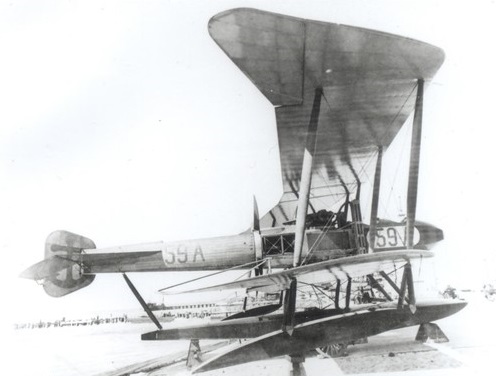
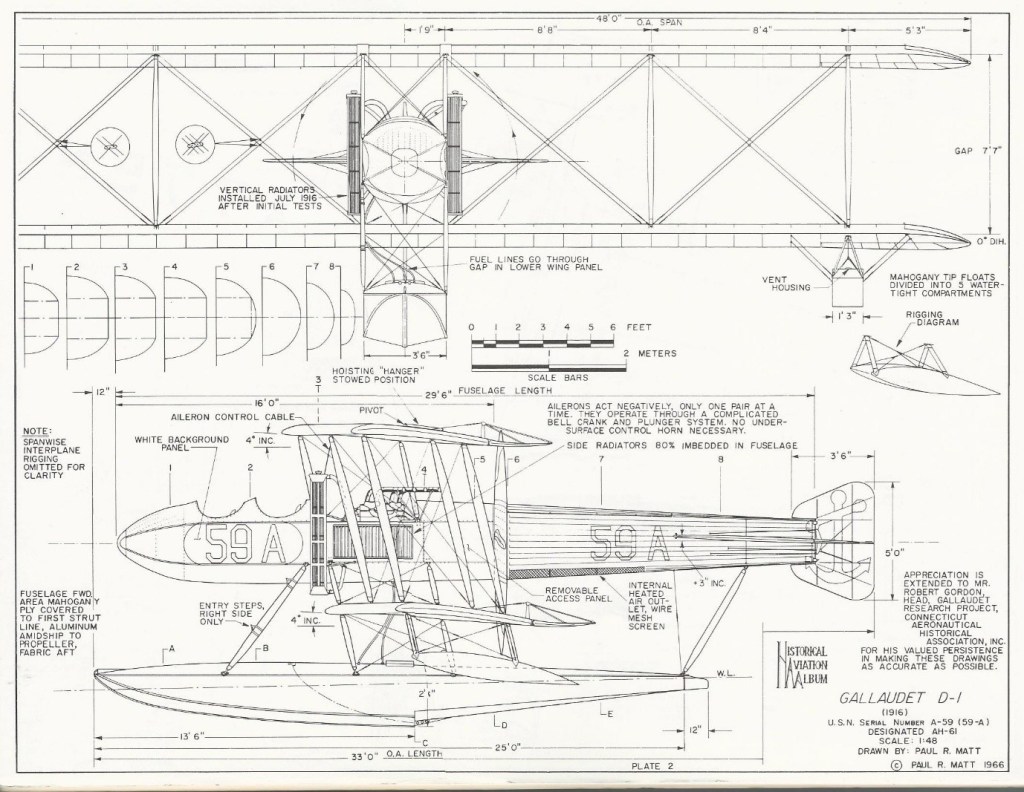
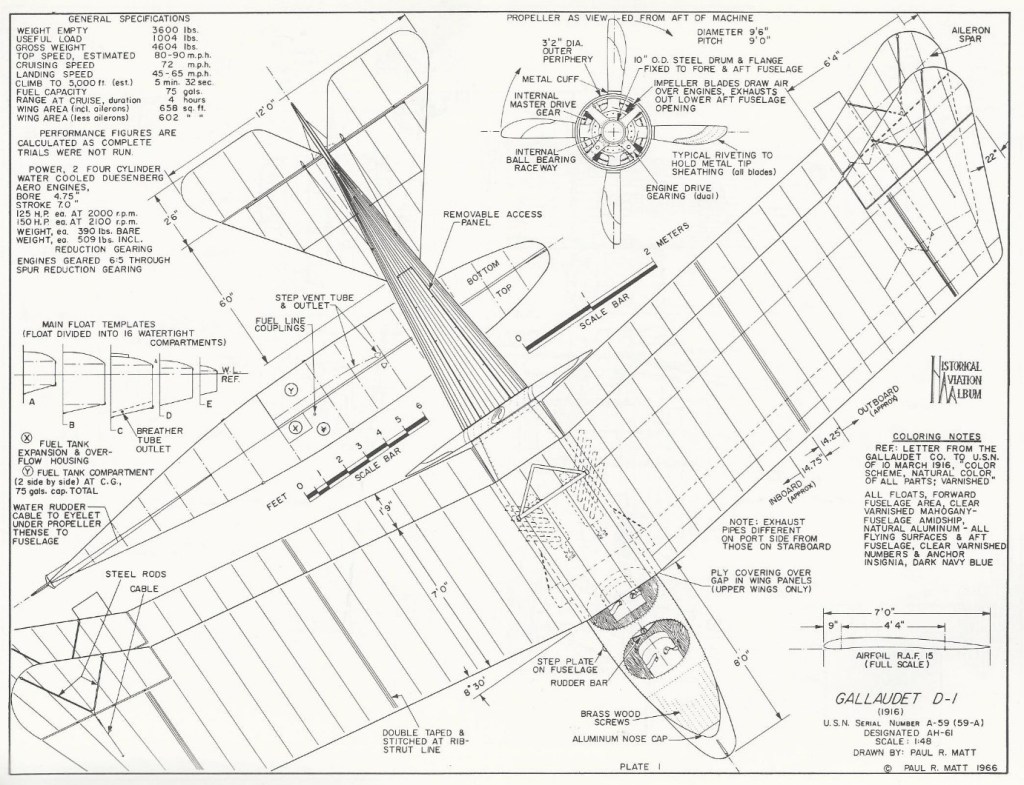
In response to a requirement by the U.S. Navy for light floatplanes capable of being launched off catapults by ships underway, the Gallaudet Aircraft company began development of the “D-4”, based on the earlier Gallaudet D-1. The D-1 (A59) was powered by two 150 hp Duesenberg engines mounted side by side, and first flown on 17 July 1916. Following delivery of the D-1 in January 1917, the firm reorganized as Gallaudet Aircraft Corporation, and moved to Greenwich, Rhode Island.
Despite numerous mechanical difficulties the Army bought four of the improved D-2 version.
In an effort to produce an aircraft with the best possible forward visibility for the observer, Gallaudet developed the D-2 into the D-4.
D-1 Wingspan: 48 ft Length: 33 ft Gross weight: 4,604 lb Max speed: 90 mph
The Gallaudet #1 of 1911 was an open cockpit monoplane with a single float. The 125hp Emerson Aerial engine was mounted amidships turning two props, one at the nose and one at the tail.
Designed by Edson Gallaudet, only one was built, which made test flights only.
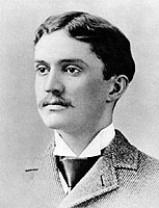
Edson Gallaudet was a grandson of Thomas Hopkins Gallaudet, specialist in education of the deaf and co-founder of what evolved into Gallaudet University in Washintgon, D.C. He earned a Ph.D. in electrical engineering in 1896 and was a physics instructor at Yale from 1897 to 1900.
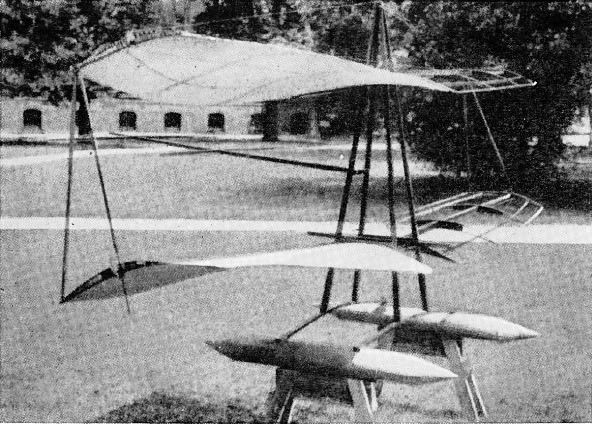
The Gallaudet Kite of 1898 was built by Edson Fessenden Gallaudet, an engineer (PhD) and then working as a physics instructor at Yale, this hydro-bike kite was built to test wing-warping controlled by a system of gears and rods. Its wingspan was 11 and ½ feet, its length just over eight feet.
The original is currently on display at the Early Flight Gallery in the National Air and Space Museum.
Gallaudet worked for several engineering firms from 1900 until 1908. Then he founded Gallaudet Engineering Company in Norwich, Connecticut, and evidently wasted no time. His first airplane came a year later, with others to follow.
1908: (Edson) Gallaudet Engr Co Inc, Norwich CT., USA
His 1912 A-1 Bullet was a sleek monoplane of pusher layout. The motor, a 100-hp Gnome rotary, was enclosed in the fuselage and drove its three-blade rear-mounted prop through a lengthy driveshaft.
In 1916, Gallaudet’s D-1 floatplane optimized ship-catapult launching with its uniquely positioned propulsion. Dual Duesenberg 125-hp 4-cylinder engines were side by side amidships in the D-1’s fuselage. A four-blade propeller was in the middle as well, driven by a 6:5 spur gear and seemingly splitting the fuselage in two.
The U.S. Army bought four of its D-2 variants. A pair of D-4s followed, with the observer given the forward cockpit for a better view. The D-4 swapped dual Duesenbergs for single Liberty power. A prototype crashed in flight testing; the second one was accepted by the U.S. Navy for observation duties.
Gallaudet then turned his company’s attention to constructing Curtiss HS-2L flying boats, many serving in anti-submarine patrols during World War I.
Following delivery of the D-1 in January 1917, the firm reorganized as Gallaudet Aircraft Corporation, and moved to Greenwich, Rhode Island. Later built 5-seat biplane tourer, the Liberty Tourist, and rebuilt 25 DH-4s for U.S. Army.
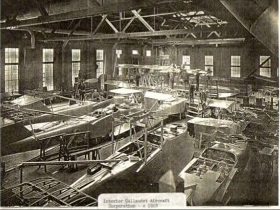
Aircraft under construction at the Gallaudet Aircraft manufacturing plant at Chepiwanoxet in 1918.
A 1919 catalog for the Gallaudet Aircraft Corporation lists the Chummy Flyabout. This was a two-place land-based monoplane, again with Gallaudet-unique propulsion. Two Indian motorcycle engines, each producing from 18 to 20 hp, were mounted in the nose and drove a pair of pusher props.
Later, in 1923, Gallaudet designed and built an aircraft of all-metal construction.
Gallaudet retired in 1924, keeping scientific memberships and a low profile until his death at age 74 in 1945. His company evolved into Consolidated Aircraft, renowned for the B-24 Liberator heavy bomber and PBY Catalina flying boat.
Galaxy Aerospace was a new company, founded 1997 and partly owned by Israel Aircraft Industries, to promote the IAI Astra SPX and promote and fit-out the 8-18 passenger Galaxy wide-body intercontinental business jet developed by IAI (first flown December 1997). In June 2001 Gulfstream bought Galaxy Aerospace from Israel Aircraft Industries.
Excalibur 25 Wing area: 26 sq.m Pilot weight: 60-70 kg No. of cells: 43 Wing span: 12 m Aspect ratio: 5.5 Min sink: 1 m/s Max speed: 50 kph Price (1998) 34,990 ÖS
Excalibur 27 Wing area: 28.3 sq.m Pilot weight: 70-80 kg No. of cells: 45 Wing span: 12.64 m Aspect ratio: 5.6 Min sink: 1 m/s Max speed: 50 kph Price (1998) 35,990 ÖS
Excalibur 29 Wing area: 30.8 sq.m Pilot weight: 80-90 kg No. of cells: 47 Wing span: 13.1 m Aspect ratio: 5.6 Min sink: 1 m/s Max speed: 50 kph Price (1998) 36,990 ÖS
Excalibur 31 Wing area: 32.7 sq.m Pilot weight: 90-100 kg No. of cells: 49 Wing span: 13.64 m Aspect ratio: 5.7 Min sink: 1 m/s Max speed: 50 kph Price (1998) 36,990 ÖS
Excalibur 33 Wing area: 34.4 sq.m Pilot weight: 100-120 kg No. of cells: 51 Wing span: 13.95 m Aspect ratio: 5.7 Min sink: 1 m/s Max speed: 46 kph Price (1998) 36,990 ÖS