The original 1981 Wills Wing Duck was built in four models: 130, 155, 180, and 200.
It has been described as launched well and had a good glide but trying to core a thermal always felt like dancing with a fat lady. It had heavy bar pressure and slow roll response. It landed like a brick. It was a pig. It does OK with a trike. The tips dig in during turns and is probably spirally unstable to some extent.
But others say a 155 was the lightest handling double surface glider I ever flew – scratching light inches from a cliff face was a pleasure. Unfortunately it also had the smallest flare window of any glider I ever flew, which led to some sound whacks and a shoulder that bothers me to this day. I would have flown it a lot longer if I wasn’t afraid to land it.
Duck 2
The 1984 Duck 2 was described as scary in turbulence and landing was not nice at all as it does not turn.
The Wills Wing Condor was a 1997 hang glider for novice pilots.
Condor 330 Wing area: 30.7 m² Wing span: 11.9 m Aspect ratio: 4.6 Hang glider weight: 24 kg Minimum pilot weight: 45 kg Maximum pilot weight: 90 kg Maximum speed: 51 km/h
The original Talon for advanced pilots was a very good wing, solid, powerful and very easy to pose.
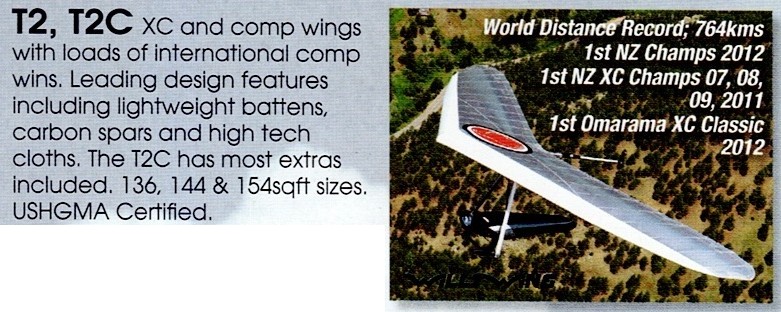
In 2005 Wills Wing developed the Talon 2 (T2) for advanced pilots.
T2
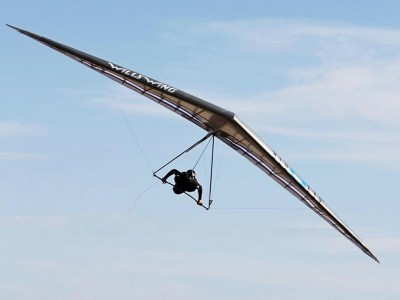
The T2 handling is light and predictable. In strong conditions it was a very physically demanding wing to fly, otherwise very nice glider in light conditions. Heavier pitch and a bit slower in roll – but so reassuringly stable and predictable. Launches with ease, but landing has been a chore due to the weight. For XC and aerobatics this glider is like cheating compared to other gliders but landing in no wind or high altitude can be a problem. 1/3 VG works best for those conditions. Bring it in fast and pop it. It tells you when it’s ready to stall.
T2
The T2C of 2008 displays an excellent maneuverability in all conditions. It is able to store a lot of energy to make loops or wings over very easy.
T2C
A light wing and well built with good materials. In flight, slightly unstable spiral, it reacts well to turning. It can be pushed in thermal and warns when going too far by a nice stall.
Talon 140 Wing area: 13 m² Wing span: 9.8 m Aspect ratio: 7.4 Hang glider weight: 34 kg Minimum pilot weight: 63 kg Maximum pilot weight: 77 kg Maximum speed: 120 km/h Nose angle: 127°
Talon 150 Wing area: 13.9 m² Wing span: 10.2 m Aspect ratio: 7.5 Hang glider weight: 35 kg Minimum pilot weight: 77 kg Maximum pilot weight: 91 kg Maximum speed: 120 km/h Nose angle: 127°
Talon 160 Sail Area: 160 sq. ft / 14.9 m² Wing span: 10.4 m Aspect ratio: 7.2 Glider Weight: 79 lb / 36 kg Minimum pilot weight: 180 lb / 91 kg Maximum pilot weight: 255 lb / 109 kg Maximum speed: 120 km/h Nose angle: 127° Skill Level: Advanced SS/DS: Double Surface KP/TL: Topless VG: Yes
T2 144 Wing area: 13.4 m² Wing span: 9.8 m Aspect ratio: 7.4 Hang glider weight: 32 kg Minimum pilot weight: 63 kg Maximum pilot weight: 82 kg Packed length: 5 m Packed length short: 3.9 m Nose angle: 127°
T2 154 Wing area: 14.3 m² / 154 sq. ft Wing span: 10.2 m Aspect ratio: 7.5 Hang glider weight: 33 kg / 73 lbs Minimum pilot weight: 82 kg / 175 lb Maximum pilot weight: 91 kg / 255 lb Packed length: 5.2 m Packed length short: 4.1 m Nose angle: 127° Skill Level: Advanced SS/DS: Double Surface KP/TL: Topless VG: Yes
T2C 136 Wing area: 12.6 m² Wing span: 9.6 m Aspect ratio: 7.3 Hang glider weight: 31 kg Minimum pilot weight: 68 kg Maximum pilot weight: 95 kg Minimum speed: 34 km/h Maximum speed: 85 km/h Max glide ratio speed: 74 km/h Packed length: 4.8 m Packed length short: 3.7 m Nose angle: 127°
T2C 144 Wing area: 13.4 m² Wing span: 9.8 m Aspect ratio: 7.3 Hang glider weight: 32 kg Minimum pilot weight: 72 kg Maximum pilot weight: 107 kg Minimum speed: 34 km/h Maximum speed: 85 km/h Max glide ratio speed: 74 km/h Packed length: 5 m Packed length short: 3.9 m Nose angle: 127-132° USHPA Rating: 4 Vd: 120 (km/h HGMA Cert. 5/22/2006 Sugg. Retail $6475.00
T2C 154 Wing area: 14.3 m² Wing span: 10.2 m Aspect ratio: 7.4 Hang glider weight: 33 kg Minimum pilot weight: 84 kg Maximum pilot weight: 129 kg Minimum speed: 34 km/h Maximum speed: 85 km/h Max glide ratio speed: 74 km/h Packed length: 5.2 m Packed length short: 4.1 m Nose angle: 127-132° USHPA Rating: 4 Vd: 120 (km/h HGMA Cert. 10/6/2006 Sugg. Retail $6475.00
Wills Wing’s take on a novice-intermediate double surface glider, the Eagle was built 2000 to 2006.
Eagle 145 Wing area: 13.4 m² Wing span: 9.2 m Aspect ratio: 6.2 Hang glider weight: 25 kg Minimum pilot weight: 57 kg Maximum pilot weight: 68 kg Maximum speed: 74 km/h
Eagle 164 Wing span: 9.7 m Sail Area: 164 sq. ft / 15.2 m² Aspect ratio: 6.2 Glider Weight: 58 lb / 26 kg Pilot Weight: 150-250 / 68-113 kg Maximum speed: 74 km/h Skill Level: Novice SS/DS: Double Surface KP/TL: Kingpost VG: No
Eagle 180 Wing area: 16.7 m² Wing span: 10.1 m Aspect ratio: 6.1 Hang glider weight: 28 kg Pilot Weight: 175-275 lb / 80-125 kg Maximum speed: 74 km/h
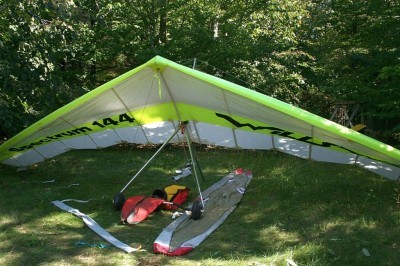
The 1991 Spectrum is an excellent wing easy to take off and fly. Good turning and behaves well at minimum drop rate in marginal condition. Its ability to penetrate is surprising.
Spectrum 144 Wing area: 13.37 m² Wing span: 9.44 m Aspect ratio: 7 Hang glider weight: 24 kg Minimum pilot weight: 50 kg Maximum pilot weight: 95 kg Packed length: 5.5 m Packed length short: 3.7 m Number of battens: 19 Nose angle: 120°
Spectrum 165 Sail Area: 165 sq. ft / 15.32 m² Wing span: 10.35 m Aspect ratio: 7 Glider Weight: 61 lbs / 28 kg Pilot Hook-in Weight: 140 – 240 lb / 63-108 kg Packed length: 6 m Packed length short: 3.9 m Number of battens: 19 Nose angle: 121° Skill Level: Novice SS/DS: Double Surface KP/TL: Kingpost VG: No
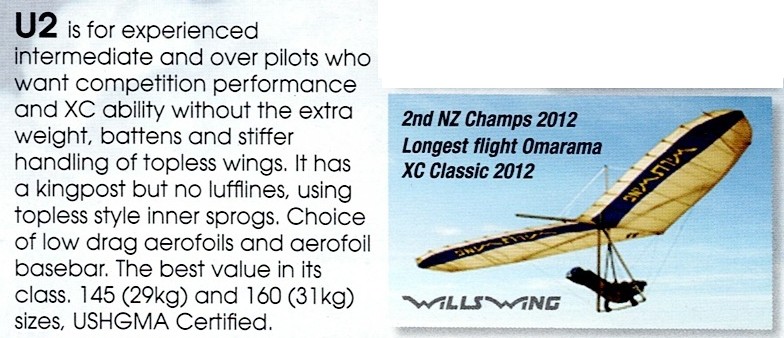
The 2004 U2 for intermediate pilots is described as great stability, combined with easy roll response, and overall very easy handling, combined with good performance. On a U2 you can point your nose in any direction and the glider will follow. Easy to take off and set. In the air, it is very handy and actually goes where you want. Good plané all tense and still controllable.
U2 145 Wing area: 13.5 m² / 145 sq. ft Wing span: 9.5 m Aspect ratio: 6.8 Hang glider weight: 29 kg / 63 lb Minimum pilot weight: 65 kg / 140 lb Maximum pilot weight: 100 kg / 220 lb Maximum speed: 85 km/h Nose angle: 125° Skill Level: Intermediate SS/DS: Double Surface KP/TL: Kingpost VG: Yes
U2 160 Wing area: 14.9 m² / 160 sq. ft Wing span: 10.1 m Aspect ratio: 6.8 Hang glider weight: 31 kg / 68 lb Minimum pilot weight: 72 kg / 160 lb Maximum pilot weight: 117 kg / 255 lb Maximum speed: 85 km/h Nose angle: 125° Skill Level: Intermediate SS/DS: Double Surface KP/TL: Kingpost VG: Yes
The 1997 Fusion is a topless model hang glider for advanced pilots.
The Fusion SP can be stiff to turn when VG is tight. Glide is great. Just be aware and allow for the extended glide when landing, it seems to go forever in ground effect. Flare window is reasonable. Try 1/4 VG for a clean break on flare.
Fusion 141 Wing area: 13 m² Wing span: 10 m Aspect ratio: 7.7 Hang glider weight: 35 kg Minimum speed: 30 km/h Number of battens: 30
Fusion 150 Wing area: 13.9 m² Wing span: 10.4 m Aspect ratio: 7.7 Hang glider weight: 36 kg Minimum pilot weight: 65 kg Maximum pilot weight: 110 kg Minimum speed: 32 km/h Number of battens: 28 Nose angle: 127°
The Wills Wing Falcon has USHGMA certification, 7075 airframe for strength and light weight (19 23 kg). Fly prone or seated (with PG harness). The Falcon can be rigged both flat or on the A frame. Hang glider pilots are amazed at the manoeuvrability, superior climb and easy landings.
The Falcon 225 Tandem skyfloater can be used for tandems but is probably better suited for learner or solo pilot over 90kgs.
Shortening of the rear wires and keel suits motor harness.
One version of the Falcon primary single surface glider held the world record for cross country distance on a single surface glider at 205 miles (330 km).
The Falcon model line has gone through changes from the original Falcon, to the Falcon 2, to the Falcon 3. The Falcon 225 was rated for 185-440 pounds (meant to be tandem-capable), while the Falcon 2 225 was rated 185-300 pounds (meant for solo use). There is no Falcon 3 225 because the Falcon 3 195 is rated up to 275 pounds. The Falcon 3 Tandem was also approved for solo use by very large pilots.
The original 1995 Falcon for novice pilots is described as a breeze to land and handles superbly. It keeps at the top of the stack easily.
Falcon
The 2002 Falcon 2 has a cleaner leading edge and trailing edge (no bungees) than the Falcon 1, and carries more weight per size. Still for novice pilots, a great flier, and very light in weight. The only downside is that they don’t penetrate headwinds like a double-surface, so range is reduced.
The 170 Falcon 2, is 22kg single surface, low stall speed, simplicity, turns flat on narrow coastal soaring, easy landing but is a little bit tricky to start without assistance as the nose want to rise (no problem in weak winds).
The 195 Attack Falcon 2 with mylar sail and Slipstream control bar (airfoiled base bar) was a fine hang glider.
Falcon 2
Wills Wings Falcon 3 170
The Falcon 3 was a 2006 version. The Wills Wing Falcon 3 has improved handling and performance with full mylar leading edge inserts, and now short packs to approximately 2m. It was available in four sizes.
Falcon 140 Wing area: 13 sq.m Certification: USHGA / DHV 1 Pilot weight: 45-75 kg Wing span: 8.47 m Nose Angle: 118 degrees Aspect ratio: 5.5 Hang glider weight: 20 kg Minimum speed: 24 km/h Maximum speed: 85 km/h Number of battens: 13 Price (1998) £ 2195
Falcon 145 Pilot weight: 50-64 kg / 110-140 lb
Falcon 170 Wing area: 15.8 sq.m Certification: USHGA / DHV Pilot weight: 65-100 kg Wing span: 9.32 m Nose Angle: 118 degrees Aspect ratio: 5.5 Hang glider weight: 21 kg Minimum speed: 28 km/h Maximum speed: 85 km/h Number of battens: 13 Price (1998) £ 2195
Falcon 195 Wing area: 18.2 sq.m Certification: USHGA / DHV 1 Pilot weight: 70-125 kg Wing span: 10.5 m Hang glider weight: 23 kg Nose Angle: 118 degrees Aspect ratio: 5.6 Minimum speed: 24 km/h Maximum speed: 85 km/h Number of battens: 13 Price (1998) £ 2195
Falcon 225 Bi Wing area: 20.9 sq.m Certification: USHGA / DHV Pilot weight: 80-200 kg Wing span: 10.91 m Hang glider weight: 27 kg Nose Angle: 118 degrees Aspect ratio: 5.7 Maximum speed: 85 km/h Price (1998) £ 2650
Falcon 2 140 Wing area: 13 m² Wing span: 8.2 m Aspect ratio: 5.5 Hang glider weight: 20 kg Minimum pilot weight: 50 kg Maximum pilot weight: 64 kg Maximum speed: 67 km/h
Falcon 2 170 Wing area: 15.8 m² Wing span: 9.1 m Aspect ratio: 5.5 Hang glider weight: 22 kg Minimum pilot weight: 64 kg Maximum speed: 67 km/h
Falcon 2 195 Wing area: 18.1 m² Wing span: 10.1 m Aspect ratio: 5.6 Hang glider weight: 24 kg Minimum pilot weight: 77 kg Maximum pilot weight: 100 kg Maximum speed: 67 km/h
Falcon 2 225 Wing area: 20.9 m² Wing span: 10.7 m Aspect ratio: 5.7 Hang glider weight: 28 kg Minimum pilot weight: 100 kg Maximum pilot weight: 122 kg Maximum speed: 67 km/h
Falcon 2 Tandem Wing area: 20.9 m² Wing span: 10.7 m Aspect ratio: 5.7 Hang glider weight: 32 kg Minimum pilot weight: 100 kg Maximum pilot weight: 204 kg Maximum speed: 67 km/h
Falcon 3 170 Wing area: 15.8 m² Wing span: 9.1 m Aspect ratio: 5.5 Hang glider weight: 22 kg Minimum pilot weight: 64 kg Maximum pilot weight: 77 kg Minimum speed: 29 km/h Maximum speed: 77 km/h Packed length: 5.4 m Packed length short: 1.8 m
Falcon 3 195 Wing area: 18.1 m² Wing span: 10.1 m Aspect ratio: 5.6 Hang glider weight: 24 kg Minimum pilot weight: 77 kg Maximum pilot weight: 100 kg Minimum speed: 29 km/h Maximum speed: 77 km/h Packed length: 5.9 m Packed length short: 2.1 m
The 1987 Sport was for advanced pilots. The Sport 150 was regarded as easy to land, maybe a little tendency to accellerate when the lift arrives, but could be gentle on flat take off with little wind, if not expected. An excellent wing to progress after a single surface or a pleasure wing for less ambitious. The Sport AT 167 is the same wing except improved fittings.
Sport
The 2004 Sport 2 for intermediate pilots has almost the same sail form as the Eagle except for the curved tips. It has aerofoil uprights and speed bar. All this with a VG make the Sport 2 more performant than the Eagle, and lighter in roll. The glider lands best in nil wind with about a quarter to one third vg and lands beautifully. A great glider to progress to from the single surface sky floaters.
The Sport 2 is a very stable glider with easy and predictable flight characteristics. It tows extremely well and is stable to winching. Landing is almost too easy. Very responsive glider, it gives plenty of feedback so the different phases of the landing procedure are very obvious.
Sport 2
From the 3 available hanging points of the Sport 2 155 it was supposed to use the one in the middle. However, hanging in the middle the aerotowing was with a lot of yaw, the trim speed was 42km/h, quite more than the 30-32 kph that should be, the landing quite fast. After moving the hang loop to the rear point everything became perfect. No yawing on aerotow, 32 kph on trim, stable and straight forward, and beautiful landing. So, take care of the hanging point.
The 1986 Sport American was built in three models: 143, 153, and 163.
Sport AT
The 1986 Sport AT trapeze mounting was a bit primitive compared to the normal Sport.
Sport 167 Wing area: 15.50 m² Wing span: 10.20 m Aspect ratio: 6.7 Hang glider weight: 30 kg Minimum pilot weight: 57 kg Maximum pilot weight: 95 kg Minimum speed: 28 km/h Maximum speed: 85 km/h Max glide ratio (L/H): 9.1 Max glide ratio speed: 34 km/h Minimum sink rate: 0.96 m/s Packed length: 4.85 m Number of battens: 22 Nose angle: 124°
Sport 2 135 Wing area: 12.5 m² Wing span: 8.9 m Aspect ratio: 6.4 Hang glider weight: 24 kg Minimum pilot weight: 59 kg Maximum pilot weight: 73 kg Minimum speed: 30 km/h Maximum speed: 85 km/h Packed length: 4 m Packed length short: 3.4 m
Sport 2 155 Wing area: 14.4 m² / 155 sq. ft Wing span: 9.6 m Aspect ratio: 6.4 Hang glider weight: 27 kg / 59 lb Minimum pilot weight: 70 kg / 150 lb Maximum pilot weight: 97 kg / 250 lb Minimum speed: 30 km/h Maximum speed: 85 km/h Max glide ratio: 12/1 at 51 Kph Packed length: 5.1 m Packed length short: 3.7 m Skill Level: Intermediate SS/DS: Double Surface KP/TL: Kingpost VG: Yes
Sport 2 175 Sail Area: 175 sq. ft Glider Weight: 70 lb Pilot Hook-in Weight: 175 – 255 lb Skill Level: Intermediate SS/DS: Double Surface KP/TL: Kingpost VG: Yes
Sport AT 150 Wing area: 14 m² Wing span: 9.5 m Aspect ratio: 6.3 Minimum pilot weight: 50 kg Maximum pilot weight: 70 kg Nose angle: 124°
Sport AT 167 Wing area: 15.3 m² Wing span: 10.3 m Aspect ratio: 6.8 Minimum pilot weight: 60 kg Maximum pilot weight: 90 kg Nose angle: 124°
 All Aero