Wilmington
DE
USA
Circa 1910 built the Delaplane
Wilmington
DE
USA
Circa 1910 built the Delaplane
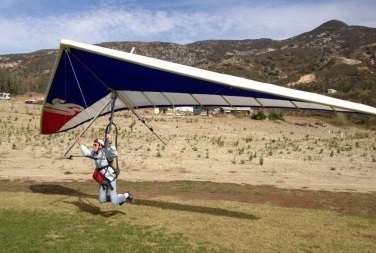
The 1997 Wills Wing Ultrasport hang glider is for advanced pilots.
The 166 is a great wing to couple to a motorized harness (FLPHG) such as Explorer, Mosquito, DoodleBug, etc. Enhanced control under both power and full VG are possible with the Wills Wing tip winglets.
Ultrasport 135
Wing area: 12.5 m²
Wing span: 9.1 m
Aspect ratio: 6.9
Hang glider weight: 27 kg
Minimum pilot weight: 42 kg
Maximum pilot weight: 75 kg
Maximum speed: 74 km/h
Nose angle: 127°
Ultrasport 147
Wing area: 13.6 m²
Wing span: 9.8 m
Aspect ratio: 7.3
Hang glider weight: 29 kg
Minimum pilot weight: 60 kg
Maximum pilot weight: 90 kg
Maximum speed: 74 km/h
Nose angle: 127°
Ultrasport 166
Wing area: 15.4 m²
Wing span: 10.4 m
Aspect ratio: 7
Hang glider weight: 32 kg
Minimum pilot weight: 75 kg
Maximum pilot weight: 120 kg
Maximum speed: 74 km/h
Nose angle: 127°
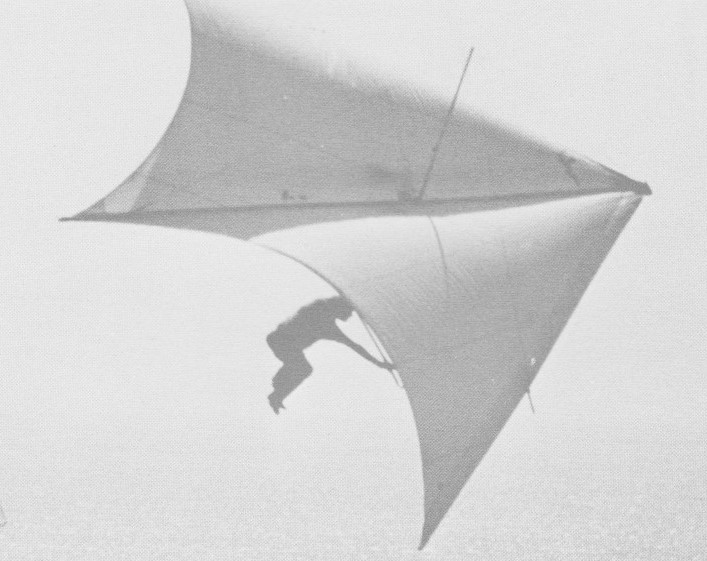
The Swallowtail was designed to be a high performance glider with the parachuting abilities of a standard. It features battens at the wingtips for chord extension. Seated or prone cable set-ups came as standard equipment. Quick release turnbuckle allows the kingpost to be dropped without undoing the turnbuckle. A wide control bar is fitted.
All tubing is 6061-T6 anodised aluminium. The main frame is 1.5in x 0.049, sleeving is 1 5/8in x 0.058 and the control bar legs and kingpost are 1ib x 0.065. Bushings are 2024-T3 aluminium tubing.
Flying wires are 3/32in 7 x 7 cable, and kingpost and wing wires are 5/64in 7 x 7 cable; all stainless steel.
All nuts and bolts at AN grade aircraft quality. Kingpost tangs, noseplates and wingposts are specially made from aluminium.
The sail is Howe and Baibridge 3.8oz or 4.5oz stabilised dacron, doube zig-zag stitched with non-rot V-46 polyester thread. It was available in 10 colours.
Seated or prone harness were optional.
The 1975 Super Swallowtail is a swept wing, high aspect ratio, high performance Rogallo. It has a cambered S-keel, very low billow, and anhedral in the crossbar. The wing tips are roached and have fibreglass foam tapered battens to accomplish the chord extension without any of the problems of a rigid tip. Double wingposts curve the leading edges. They, along with the light billow and sail roach, maintain perfect washout control in the SST. It is easy to pull out of a dive, and can be flown hands off for minutes at a time, even in turbulent air, returning to straight and level flight.
Seated and prone cable set-ups came as standard on the Super Swallowtail. A quick release turnbuckle allows the kingpost to be dropped without undoing. All tubing is 6061-T6 anodised aluminium. The main frame is 1.5in x 0.049, sleeving is 1 5/8in x 0.058 and the control bar legs and kingpost are 1in x 0.065. Bushings are 2024-T3 aluminium tubing.
The flying wires are 3/32in 7×7 cable, and kingpost and wingpost wires are 5/642 7×7, all stainless steel. All nuts and bolts are AN grade aircraft quality. Kingpost tangs, noseplate and wingposts are specially made from aluminium. The sail is made from Howe & Bainbridge 3.8-4.5o stabilised dacron, double zig-zag stitched with non-rot V-46 polyester thread, in ten colour choices.
The Super Swallowtail 100B was reported as being very stable. According to the manufacturer it is easy to pull into a dive, yet hard to keep it there. It can be flown hands-off for minutes at a time, even in turbulent air, returning to straight and level flight on its own after a gust upsets its glide path. This may well be attributed to a large extent to the greater sweepback angle of the quarter chord line.
Take down / set up times are under 10 minutes and the Super Swallowtail may be transported like a standard.
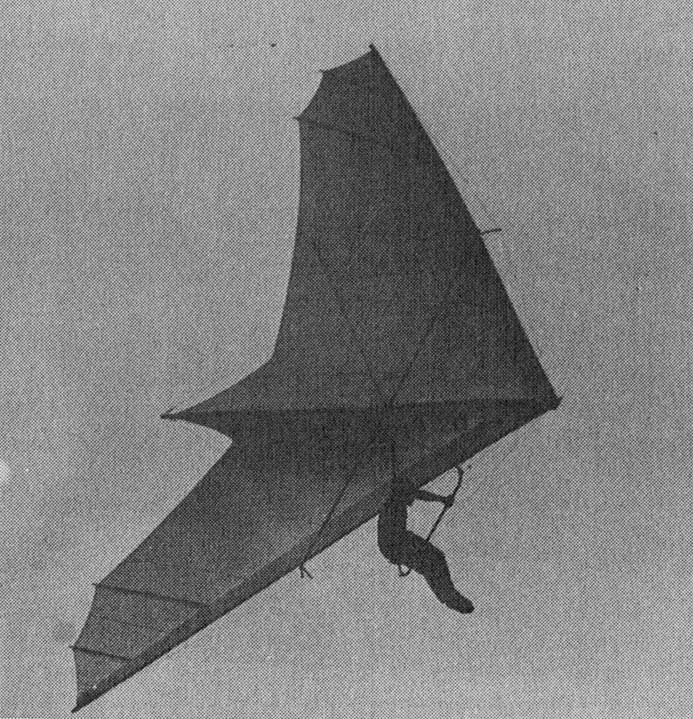
Swallowtail 19 x 19
Leading edge: 19 ft
Keel length: 19 ft
Wing span: 26.9 ft
Wing area: 190 sq,ft
Aspect ratio: 3.81
Nose angle: 90˚
Sail billow: 3.1˚
Weight: 42 lb
Pilot weight: 100-150 lb
Takeoff speed: 10 mph
Stall speed: 16 mph
Max speed: 45 mph
Best glide ratio (L/D): 6-1
Best L/D speed: 31 mph
Min sink: 396 fpm
Swallowtail 20 x 20
Leading edge: 20 ft
Keel length: 20 ft
Wing span: 28.2 ft
Wing area: 227 sq,ft
Aspect ratio: 3.52
Nose angle: 90˚
Sail billow: 3.1˚
Weight: 43 lb
Pilot weight: 140-195 lb
speed: 10 mph
Stall speed: 16 mph
Max speed: 45 mph
Best glide ratio (L/D): 6-1
Best L/D speed: 31 mph
Min sink: 396 fpm
Swallowtail 21 x 20
Leading edge: 21 ft
Keel length: 20 ft
Wing span: 29.8 ft
Wing area: 240 sq,ft
Aspect ratio: 3.7
Nose angle: 90˚
Sail billow: 3.1˚
Weight: 44 lb
Pilot weight: 185-240 lb
speed: 10 mph
Stall speed: 16 mph
Max speed: 45 mph
Best glide ratio (L/D): 6-1
Best L/D speed: 31 mph
Min sink: 396 fpm
Swallowtail 22 x 20
Leading edge: 22 ft
Keel length: 20 ft
Wing span: 31.1 ft
Wing area: 260 sq,ft
Aspect ratio: 3.72
Nose angle: 90˚
Sail billow: 3.1˚
Weight: 45 lb
Pilot weight: 230-280 lb
Takeoff speed: 10 mph
Stall speed: 16 mph
Max speed: 45 mph
Best glide ratio (L/D): 6-1
Best L/D speed: 31 mph
Min sink: 396 fpm
Super Swallowtail 100M
Leading edge: 20 ft
Keel length: 15 ft
Wing span: 31.1 ft
Wing area: 165 sq,ft
Aspect ratio: 5.87
Nose angle: 100.5˚
Sail billow: 1.9˚
Weight: 42 lb
Pilot weight: 100-145 lb
Takeoff speed: 12 mph
Stall speed: 14 mph
Max speed: 45 mph
Best glide ratio (L/D): 8-1
Best L/D speed: 22 mph
Min sink: 220 fpm
Super Swallowtail 100C
Leading edge: 21 ft
Keel length: 15 ft
Wing span: 32.6 ft
Wing area: 182 sq,ft
Aspect ratio: 5.85
Nose angle: 100.7˚
Sail billow: 1.8˚
Weight: 43 lb
Pilot weight: 120-160 lb
Takeoff speed: 12 mph
Stall speed: 14 mph
Max speed: 45 mph
Best glide ratio (L/D): 8-1
Best L/D speed: 22 mph
Min sink: 220 fpm
Super Swallowtail 90
Leading edge: 22 ft
Keel length: 16 ft
Wing span: 32 ft
Wing area: 189 sq,ft
Aspect ratio: 5.42
Nose angle: 91.1˚
Sail billow: 2.3˚
Weight: 44 lb
Pilot weight: 140-175 lb
Takeoff speed: 12 mph
Stall speed: 14 mph
Max speed: 45 mph
Best glide ratio (L/D): 8-1
Best L/D speed: 22 mph
Min sink: 220 fpm
Super Swallowtail 100B
Leading edge: 22 ft
Keel length: 16 ft
Wing span: 34.7 ft
Wing area: 200 sq,ft
Aspect ratio: 6.0
Nose angle: 101.3˚
Sail billow: 1.5˚
Weight: 44 lb
Pilot weight: 155-200 lb
Takeoff speed: 12 mph
Stall speed: 14 mph
Max speed: 45 mph
Best glide ratio (L/D): 8-1
Best L/D speed: 22 mph
Min sink: 220 fpm
Super Swallowtail 100A
Leading edge: 22 ft
Keel length: 16 ft
Wing span: 34.6 ft
Wing area: 212 sq,ft
Aspect ratio: 5.71
Nose angle: 100.9˚
Sail billow: 1.7˚
Weight: 45 lb
Pilot weight: 190-220 lb
Takeoff speed: 12 mph
Stall speed: 14 mph
Max speed: 45 mph
Best glide ratio (L/D): 8-1
Best L/D speed: 22 mph
Min sink: 220 fpm
Super Swallowtail 100P
Leading edge: 22 ft
Keel length: 16 ft
Wing span: 37 ft
Wing area: 220 sq,ft
Aspect ratio: 6.22
Nose angle: 110˚
Sail billow: 1.5˚
Weight: 50 lb
Pilot weight: 210-250 lb
Takeoff speed: 12 mph
Stall speed: 14 mph
Max speed: 45 mph
Best glide ratio (L/D): 8-1
Best L/D speed: 22 mph
Min sink: 220 fpm
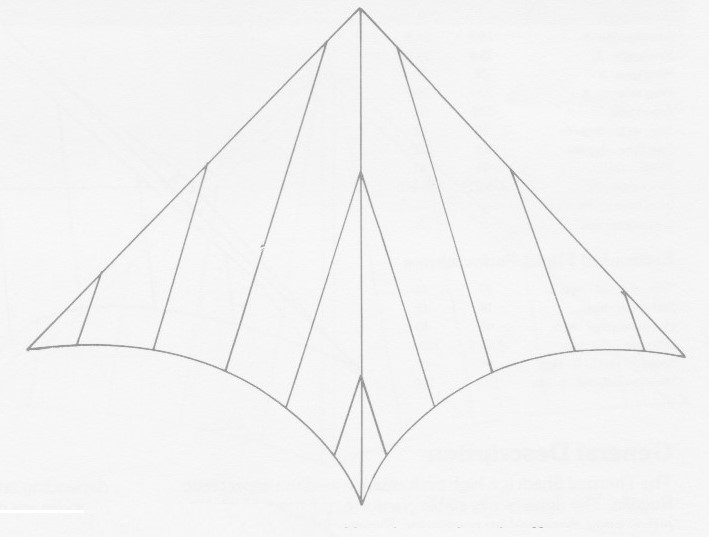
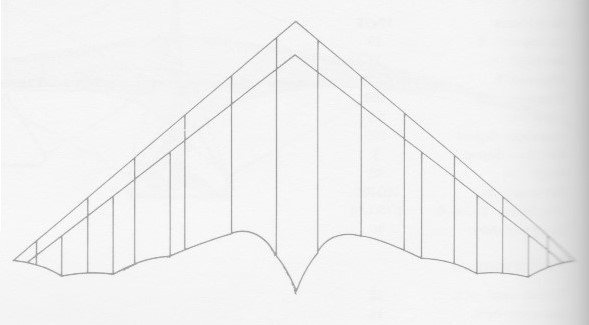
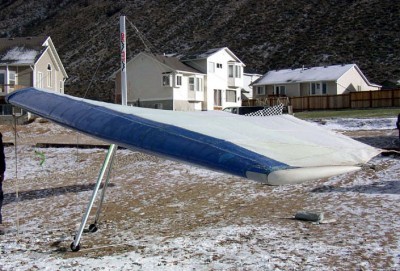
A 1986 hang glider for intermediate pilots. The trademark of the Super Sport is its lack of yaw stability. It is a bit much for newer pilots as it displays a lot of adverse yaw. No VG.
It’s not that easy to fly, and a tail fin is sometimes used with this glider to help the yaw stability, but it flies much better without it.
Super Sport 143
Wing area: 13.3 m²
Wing span: 9.45 m
Aspect ratio: 6.7
Hang glider weight: 26 kg
Minimum pilot weight: 45 kg
Maximum pilot weight: 85 kg
Packed length: 5.4 m
Packed length short: 3.6 m
Number of battens: 25
Nose angle: 121°
Super Sport 153
Wing area: 14.2 m²
Wing span: 10 m
Aspect ratio: 7
Hang glider weight: 28 kg
Minimum pilot weight: 69 kg
Maximum pilot weight: 95 kg
Packed length: 5.6 m
Packed length short: 3.8 m
Number of battens: 27
Nose angle: 121°
Super Sport 163
Wing area: 15.5 m²
Wing span: 10.45 m
Aspect ratio: 7.2
Hang glider weight: 30 kg
Minimum pilot weight: 70 kg
Maximum pilot weight: 122 kg
Packed length: 5.8 m
Packed length short: 4 m
Number of battens: 27
Nose angle: 121°
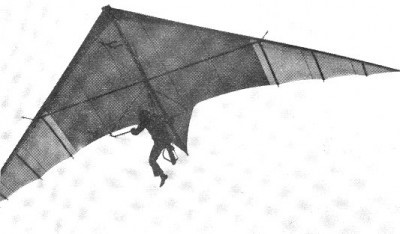
A 1975 hang glider.
SST 100
Wing area: 19.5 m²
Wing span: 10.40 m
Aspect ratio: 5.55
Hang glider weight: 20 kg
Number of battens: 6
Nose angle: 100°
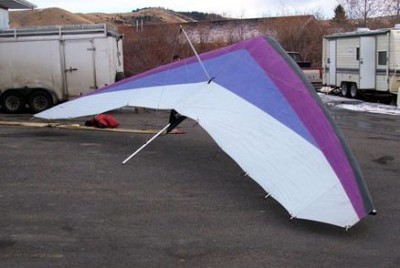
A 1984 hang glider for novice pilots, built in two models: 168 and 188.
Skyhawk 168
Minimum pilot weight: 59 kg
Maximum pilot weight: 86 kg
Skyhawk 188
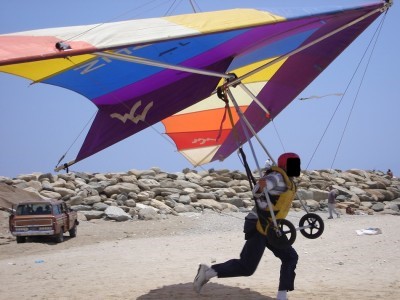
A 1979 single surface hang glider for novice pilots built in three models: 179, 209, and 229. They had a very tall keel pocket, lightly loaded, low profile airfoil.
It had very light handling even near stall. You could slow this thing way down and have exceptional control when scratch soaring next to a mountain. An absolute joy to fly because you could always nail the best parts of a thermal and climb to the best of your ability. It was tail heavy on launch but landed easy.
It had excellent stall recovery, a big floater for most part, not great penetration, could get as high as any doubles, but hang it up when wind over 20. It was a good sturdy single surface, and gained reputation for tandem glider….used flat foam core fiberglass battens with couple aluminum tube tips battens, and one AL tube, neg washout stop, near tips.
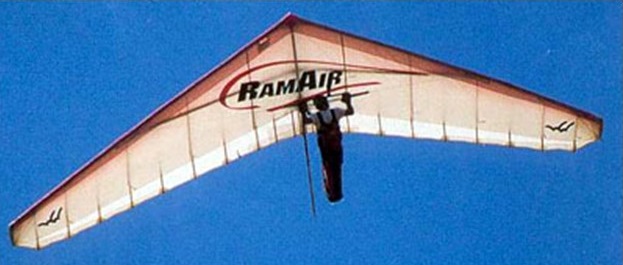
A 1993 hang glider.
Ramair 146
Wing area: 13.55 m²
Wing span: 10 m
Aspect ratio: 7.5
Hang glider weight: 30 kg
Minimum pilot weight: 50 kg
Packed length: 5.8 m
Packed length short: 3.9 m
Number of battens: 20
Nose angle: 127°
Ramair 154
Wing area: 14.3 m²
Wing span: 10.4 m
Aspect ratio: 7.5
Hang glider weight: 32 kg
Minimum pilot weight: 65 kg
Maximum pilot weight: 113 kg
Packed length: 5.9 m
Packed length short: 4 m
Number of battens: 22
Nose angle: 127°
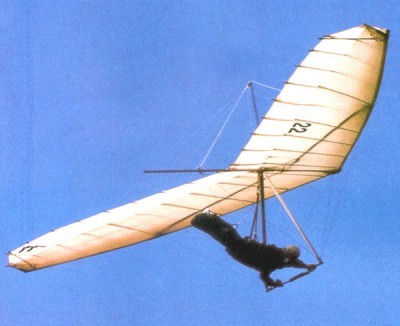
The 1984 Wills Wing HP has all the tubes shiny anodized and the bumpers have a respectable diameter, 50.8 cm or two inches. It uses for the mounting of the top of the trapezium a profile which prohibits the mounting on the ground of the apparatus, unless it is complicated gymnastics.Therefore you must climb on the trapezium, thread the top 20 slats, 8 lower and 4 intermediates The tension of the trailing edge is not ensured by an elastic but by pre-stretched nylon cords that ensure a better stability of the settings.
It is necessary to open the intrados, to mount a hoist and to set the transversal. Two cables coming from its joint are then fixed to the keel by bolt, butterfly and broken ring. The hoist is then dismantled and hidden in the intados. You attach the nose hood perfectly realized and finish by introducing in the intrados the cover that is fixed on the keel thanks to a strap studied for.
The take-off does not present any difficulty if care is taken during the first steps. A measurement of the roll rate of 45 ° to 45 ° shoulder against the trapezoid will give 5 seconds. It becomes very difficult to stay in the corner of the trapeze, especially since the sail is tense.
With the H.P. system, the small displacement of the keel acts as aerodynamic controls. The outer sail tightens as the inner sail relaxes causing a wing effect which can be seen by measuring in flight the heights of the sail above the sticks. This aerodynamic steering effect should be amplified by a less taut sail. Only the leading edge tension and pilot centering are adjustable. Each action in roll is associated with a movement of inverse yaw. This phenomenon combined with the low yaw stability common to all pendulum-controlled aircraft makes straight line flight difficult. The wing takes the inverse course of the roll correction. You get used to it but it is disconcerting.
The damping effect of the floating keel disappears and the vibrations caused by the heat bubbling of the thermal days are felt in the horizontal bar.
The bar is provided at its ends with two holes for adjusting the dihedron. At the inner or weak dihedron hole, H.P. is completely unstable spiral. At the outer hole, the stability becomes neutral beyond 30 ° of inclination. A surprise is the take-off speed: 33 and 35km / h on a buggy with 27 to 28km / h on the other wings.
The neutral booster is always present and grows linearly according to the displacement of the bar. The landing must be well prepared by raising the hands very high on the trapezium and pushing a little earlier than on other devices due to the higher speed.
The idea of removing the keel pocket is not new but Will Wings was the first one to return to this type. In maneuverability, it can not be said that there has been an improvement but the gain in finesse at intermediate speed is incontestable.
The HP 2 was also produced in 1984.
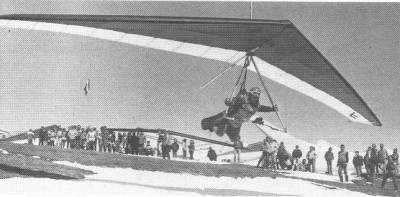
The 1989 HP AT 158 for advanced pilots is regarded as an excellent flying glider. Launch is easy and effortless with a 10-12 knot wind. Pull VG on and it will stay banked in tight thermals with little effort while staying easy to control. It will fly fast when needed to get through turbulance and sink and slow when you want to maximize minimal lift. Landing is a bit difficult because of its small flare window that requires high authority.
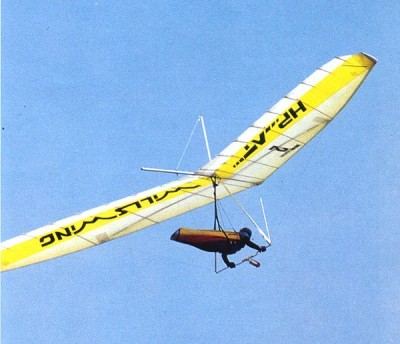
HP 170
1984
Wing area: 15.86 m²
Hang glider weight: 31 kg
Minimum pilot weight: 68 kg
Maximum pilot weight: 113 kg
HP 2 170
1984
Wing area: 16.72 m²
Hang glider weight: 35 kg
Minimum pilot weight: 80 kg
Maximum pilot weight: 130 kg
HP AT 145
1989
Wing area: 13.47 m²
Wing span: 10 m
Aspect ratio: 7.5
Minimum pilot weight: 50 kg
Maximum pilot weight: 107 kg
Nose angle: 127°
HP AT 158
1989
Wing area: 14.68 m²
Wing span: 10.35 m
Aspect ratio: 7.5
Hang glider weight: 31 kg
Minimum pilot weight: 65 kg
Maximum pilot weight: 115 kg
Nose angle: 127°
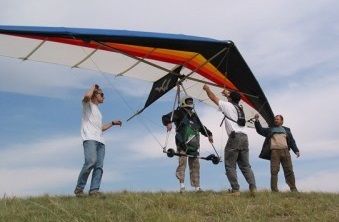
The 1981 Wills Wing Harrier was for novice pilots. It was built in three models: 147, 177, and 187.
The Harrier was a great turning glider. Easy to launch and land with excellent energy retention for a single surface glider. It had great static balance, very light handling, a very good sink rate and was one of the best scracth soaring gliders of all time. It was difficult to land as flare timing was critical. The Harrier2 was supposed to land easier but was tough. The Harrier 177 was said to “climb on a beer fart. And turn? Power steering. But never, not once, landed well”.
 All Aero