Hicks Kestrel / Merlin

The Hicks Merlin, initially called the Hicks Kestrel, was a single-seat high performance sailplane designed and built by W.E. Hicks at the Newcastle Gliding Club from 1933 to 1936.

A parasol, braced three-piece wing with no air-brakes or flaps. The undercarriage was a main skid and tail skid. It was fitted with an “Automatic Rudder”.

It was first flown on 2 February 1936 at Moat Law, UK.

No B.G.A. CofA was issued. As the fuselage contours were shaped around Eddie Hick’s profile the Merlin was of ‘little use to any other person’.

It was eventually purchased for £1 for the Newcastle Club bonfire and burnt pre-war.

Wingspan: 10.46 m / 34 ft 4 in
Length: 4.50 m / 14 ft 9 in
Wing area: 7.43 sq.m / 80 sq.ft
Aspect ratio: 14.8
Wing section: Gottingen 652
Empty weight: 40.82 kg / 90 lb
AUW: 116.12 kg / 245 lb
Wing loading: 15.63 kg/sq.m / 3.2 lb/sq.ft
Max L/D: 20
Min sink: 0.61 m/sec / 2.0 ft/sec

HIBM Blériot AK-01X / AK-2000X

HIBM AK-2000X (01)

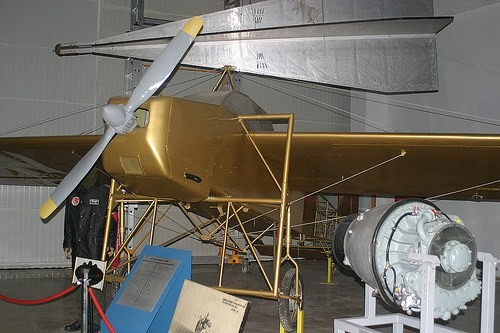
From 8 Febuary to 15 May 1914, four Turkish airmen flew a 2500 km long-haul flight – Istanbul-Damascus-Jerusalem-Cairo-Alexandria, in a Blériot XI. To commemorate this in part tragic, but very successful in the end, flight, the Turkish state television TRT decided to film a recreation.

In 2001 HIBM built two modified, but flyable replicas of the aircraft. Because the replicas corresponded little to the original Blériot XI aircraft, there was some discord. With two Blériot AK-2000X aircraft a re-enactmet of the same route of 1914 was carried out during 15 May -18 June 2001.

Variants:
Blériot AK-01X
One built

Blériot AK-2000X
Two built

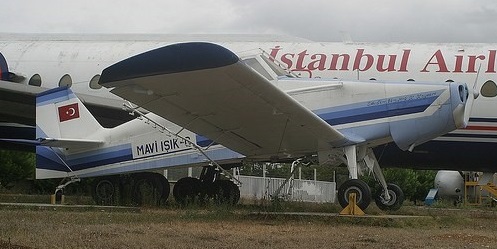
HIBM Mavi Isik

HIBM Mavi Isik G-1 (001)

In 1978 2.HIBM constructed and developed the Mavi Isik 78-XA-1 agricultural aircraft. The maiden flight (TC-TXA) was successfully conducted in February 1979 in Kayseri. The sequent Mavi Isik-B (1980) and Mavi Isik-G-1 (1983) were developed from the prototype. It did not enter series production. Instead, Turkey bought Pezetel M-18A Dromader agricultural / fire-fighting aircraft.

HIBM / Ikmal Hava ve Bakim Merkezi

Turkish aircraft in the true sense began only after the founding of the Republic in 1923. A small delegation was dispatched to Europe to procure aircraft for the new Turkish Air Force. After evaluation it was decided to obtain 16 Bréguet XIV A-2, 39 Caudron C-27 and 32 Caudron C-59 aircraft. These aircraft were dismantled in 1924 and shipped to the Gaziemir / Izmir Air Force Base under French supervision. After the first requirements of the Turkish Air Force, the armed force withdrew from the assembly of planes however, this plan did not last long. When in the course of technical development, the maintenance became more complicated and more complex, the maintenance facilities of these forces were again entrusted with the manufacture of spare parts or installation or modernization of aircraft. So the 1st Air Supply and Maintenance Center emerged (1 Ikmal Hava ve Bakim Merkezi, 1.HIBM) in Eskisehir (1926), the 901 Home Depot and production plant for aircraft (the 901.Hava Araci Ana Depo ve Fabrika Komutanligi, nine hundred and first HAADFK) in Polatlı (1948, 1962 in Ankara) and the 2nd Air Supply and Maintenance Center (2nd Hava Ikmal ve Bakim Merkezi, 2.HIBM) in Kayseri (1950).

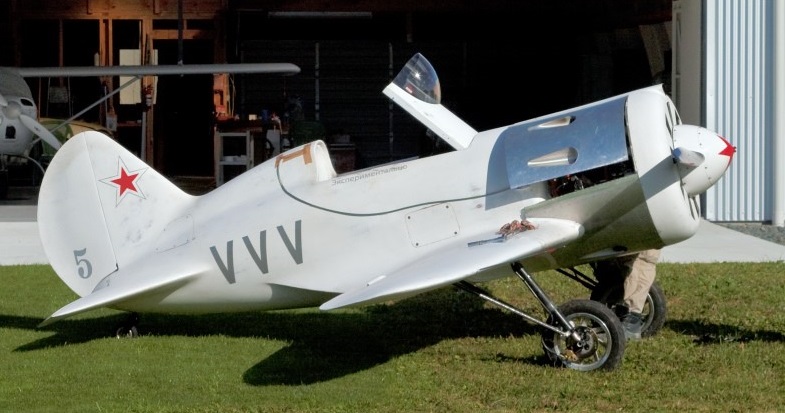
Heydecke V16

A home built 2/3 scale Polikarpov I-16 replica built by Volker Heydecke of Drury, New Zealand. Volker Heydecke is a mechanical engineer but did not weld a single piece on this airplane. He trusted a licensed airplane welder to do this. The only welded truss-system is the engine mount. There are a few welded brackets made from steel, the undercarriage is bolted. The rest is self supported composite structure (monocoque).

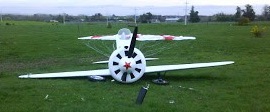
On Saturday, 29 August 2009, around 1730 hrs, the pilot was conducting stalls as part of the test flying regime. On on the second stall, the left wing dropped and the aircraft entered a spin. Standard recovery techniques did not arrest the spin, so the pilot transmitted a distress message and deployed the aircraft ballistic recovery chute. The aircraft sustained damage to the propeller and undercarriage on landing in a farm paddock. The pilot was able to vacate the aircraft with only minor injuries.

Serial: V16001

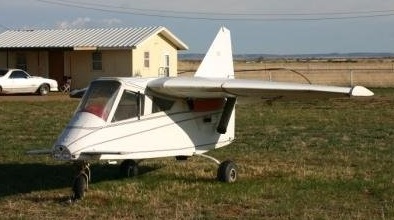
Heuberger-Rinker H-5 Stinger

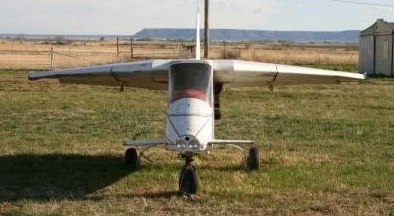
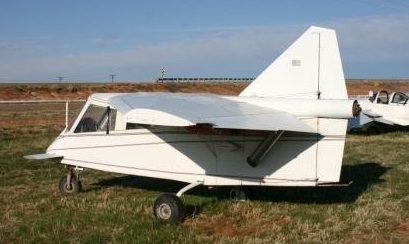
The Heuberger-Rinker H-5 Stinger N3638G was a designed by Lawrence K. “Larry” Heuberger, who started its construction at Tucumcari, New Mexico, around the early 1960s.

Prior to completion the project was acquired (around 1968) by Bud Rinker of Santa Barbara, Cal., who almost certainly did some limited testing in 1970.

Engine: 140hp Lycoming O-290-G
Wingspan: 16ft 6 in
Length: 14ft 8 in
Seats: 2
Est. performance
Max. speed: 180 mph
Cruise: 160 mph
Ceiling: 10,500ft
Climb rate: 1.200ft/minute.

Heuberger Sizzler

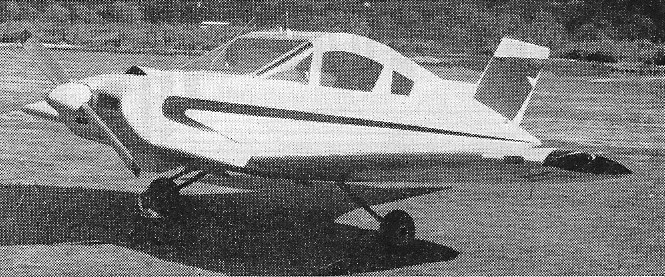
Lawrence K. “Larry” designed and built the Sizzler in 1957. The two-place Sizzler features a T-tail arrangement and gets a fair amount of lift from its fuselage. The low-wing monoplane is built entirely of metal and flush-riveted throughout. Compound curves are no problem on the Sizzler, which uses flap panels. It stands on tricycle landing gear and carries a 125-hp Continental engine.

N75345

At least two were built (the prototype N75345 of Mr. Heuberger and C-GSIM of Mr. James Sim in Canada).

Engine: Lycoming O-290-D, 125 hp
Wingspan 18 ft 4 in
Length 20 ft 7 in
Wing area: 100 sq.ft
Gross Wt. 1350 lbs.
Empty Wt. 950 lb
Fuel capacity 33 USG
Payload: 510 lb
Top speed 175 mph
Cruise 160 mph
Stall 70 mph
Climb rate 900 fpm
Takeoff run 1200 ft
Landing roll 700 ft
Range 600 sm

Heuberger Doodle Bug

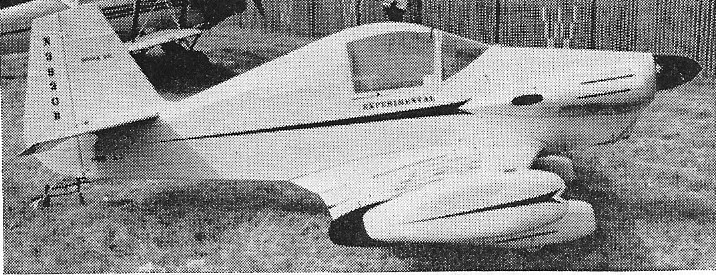
This fast single-seater picked up three trophies when it flew to the 1955 EAA Fly-In at Oshkosh, Wisconsin. The Doodle Bug was registered N3930B cn.A.1. With its 12½-gallon main fuel tank and a pair of 6½-gallon fiberglass tip tanks, the Doodle Bug boasts an amazing 700-mile range. It is built from welded steel tube. The fuselage and tail group is fabric covered. The wings are all metal.

Engine: 90-hp Continental.
Gross Wt. 970 lb
Empty Wt. 616 lb
Fuel capacity 25 USG
Wingspan 18 ft
Length 16 ft 6 in
Top speed 196 mph
Cruise 170 mph
Stall 70 mph
Climb rate 2000 fpm
Takeoff run 1000 ft
Landing roll 800 ft
Range 700 sm