Jurca MJ-5 Sirocco

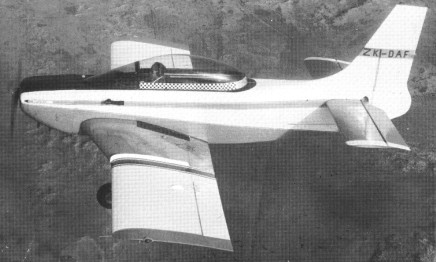
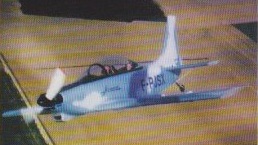
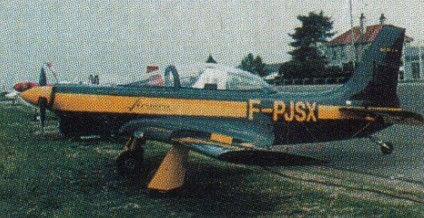
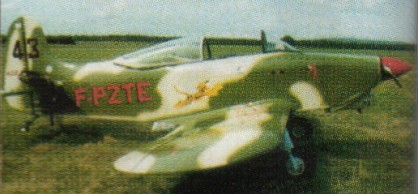
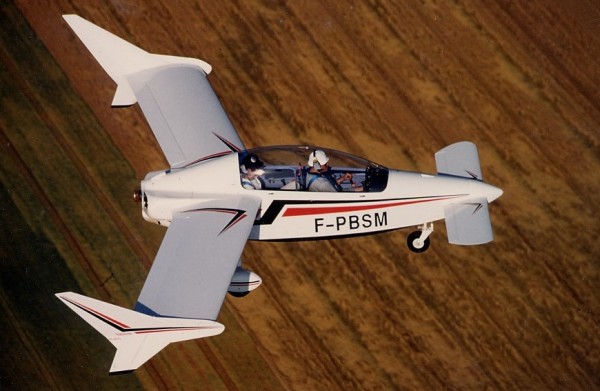
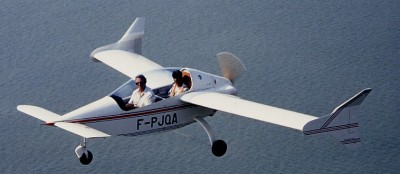
The prototype MJ.5 Sirocco tandem two-seat aerobatic monoplane, built in France, was first flown in 1962. The Sirocco, an all-wood, fiberglass or fabric-covered low-wing design, can be identified by its rooster tail. The Sirocco sports retractable landing gear.

Flying with or without wing end plates, the inboard wing fence is employed in either case. The prototype flew with a Hirth engine, but 90 to 100 hp Continental or 105 hp Potez engine may be fitted. The original prototype was still flying after 30 years.

Gallery

Engine: Lycoming, 160 hp.
HP range: 125-200.
Weight empty: 1260 lbs.
Gross: 1860 lbs.
Height: 8.5 ft.
Wingspan: 21.45 ft
Wing area: 107.6 sq.ft.
Speed max: 196 mph.
Cruise 162 mph.
Stall: 64 mph.
ROC: 1850 fpm.
Service ceiling: 16,400 ft.
Seats: 2.
Landing gear: nose or tail wheel.
Takeoff run 820 ft.
Landing roll 750 ft.
Range 570 sm.

Engine: Lycoming, 150 hp.
Cruise: 115 kts.
Wing span: 23ft 4in.
Length: 21 ft.
MAUW: 1500 lbs.
Fuel cap: 25.5 Imp Gal.

Engine: Lycoming O-320, 160 hp
Wing span: 7.02 m
Wing area: 11 sq.m
MAUW: 840 kg
Empty weight: 560 kg
Fuel capacity: 170 lt
Max speed: 300 kph
Cruise speed: 240 kph
Minimum speed: 100 kph
Climb rate: 11 m/s
Seats: 2
Fuel consumption: 45 lt/hr
Plan price (1998): US$500

Jurca MJ-2 Tempete

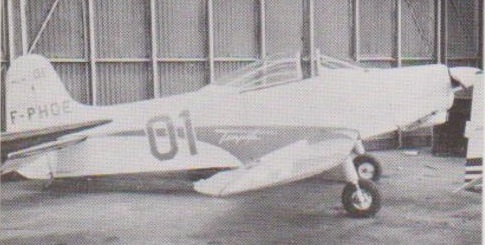
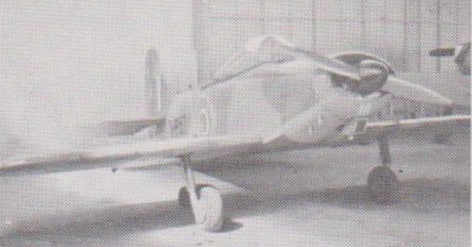
Marcel Jurca incorporated many Jodel Components in the design of the MJ-2 Tempete. The Tempete is a cantilevered low-wing monoplane that can be fitted with engines ranging in horsepower from 65 to 125.

MJ-2 Tempete prototype – Guyancourt, 1965

The single-seat wood/fabric aerobatic MJ.2 Tempete was first flown in 1956.

The standard version is powered by a 65-hp engine. Another common version powered by a 90-hp engine cruises at 120 mph and climbs to 3280 in three minutes.

MJ-2 LX-PUT cn 18, Findel, Luxembourg 5 August 1975. Built as F-PNUD Continental O-200-A

Engine: Lycoming, 110 hp.
HP range: 65-180.
Height: 7.8 ft.
Length: 18.5 ft.
Wing span: 19.5 ft.
Wing area: 85.9 sq.ft.
Weight empty: 639 lbs.
Gross: 950 lbs.
Fuel cap: 16 USG.
Speed max: 120 mph.
Cruise: 102 mph.
Range: 375 sm.
Stall: 62 mph.
ROC: 555 fpm.
Take-off dist: 820 ft.
Landing dist: 800 ft.
Service ceiling: 11,500 ft.
Seats: 1.
Landing gear: retractable tail wheel.

Jurca, Marcel

France
Developed a very extensive range of light aircraft, available for home construction from plans. These include MJ.2 Tempete single-seat wood/fabric aerobatic monoplane (first flown 1956), MJ.5 Sirocco tandem two-seat aerobatic monoplane (first flown 1962), MJ.8 as 75 percent scale replica of Fw 190 fighter, MJ.9 as 75 percent scale replica of Bf 109 fighter, MJ.10 Spitfire as 75 percent scale wooden replica of Supermarine fighter, MJ.12 as 75 percent scale replica of P-40 fighter, MJ.53 Autan side-by-side two-seater (first flown 1991), MJ.77 Gnatsum as 75 percent scale wooden replica of P-51 Mustang fighter, and a range of full-size replicas of Second World War fighters, including MJ.80/Fw-190, MJ.90/Bf- 109 and MJ.100/Spitfire.

1998:
2, allée des bordes
F-94430 Cheneviére
France

Marcel Jurca died in October 2001, aged 81.

Junqua-Diffusion Ibis RJ.03

Developed from the RJ.02 Volucelle, the RJ.03 Ibis tandem two-seat canard monoplane, first flown 1991, was offered in plans form for home construction.
In March 1992 the Ibis received its French certification at Pau airport in France.
Totally enclosed in wood (spruce, douglas fir), it requires no fabric coverings.
By utilizing a combination of “Styrodur” (polystyrene) with identically-matching plywood ribs and depression-bonding of surface-coatings, its surface finish matchs that of synthetic-fibre aircraft.

Fitted with “flaperons” on the wings, its approach speed is identical to that of classic aircraft bearing the same load per sq.m. With little nosing-up during approach, rearward and forward visibility is excellent. Due to the use of a nonlaminar surface on the canard, flights are not affected by rain.

The fuel consumption is only 13 l/h at 200 km cruising speed or 10 l/h at 180 km. The rate of climb is 700 fpmat max. take-off weight with only 60 hp.

The IBIS is designed to be used with different types of engines (VW-1830cc, VW-1915cc, French JPX-475T, Australian JABIRU 2200cc, Limbach-2000 EC) and can be fitted with certain types of rotary engines (MID-WEST).
The structure comprises 7 frames, 4 longerons and diagonal struts. It is covered with plywood and requires no padding. The fuselage is assembled on the model plane principle, upside down on a table, and after construction of the different frames. The 150 pages handbook, included in the instruction document pack, will give you all the necessary explanations as regards: construction, adjustments and test flight techniques.

The canard wing is rectangular, with no twisting or dihedral angle. It has round tips which are bevelled on the underside. The trailing edge is fitted with a built-in slotted flap, which runs along the whole length of the wing. The canard structure consists of a “box-form spar” the same thickness as the profile and which joins 8 identical plywood former-ribs. The whole structure is filled with “Styrodur” foam, and covered with thin plywood which is glued by suction using the same technique as that employed in the construction of certain model planes.
The wing spar is a “box-form” construction and consists of two caps braced together by means of plywood strips on each side. It is in one single piece, at an angle to the airframe. Width and height are constant along whole thickness of the profile. There is no dihedral angle or twisting. All wing ribs are identical, and are in plywood. They are made in a single operation using a metal template and a joiner’s spindle moulding machine. This can be done very quickly. The wing is filled with blocks of “styrodur” foam hollowed out to allow passage of flight control linkages and is covered with thin plywood glued by suction. This method represents a saving of circa 40% on the production time required for standard wood and fabric wing construction. The wing can be dismantled only for major overhaul.
Each stabilizer consists of two half-stabilizers made of main plywood longerons and 5 plywood ribs. Thc stabilizers are completely filled with “styrodur”, and covered with glued plywood. The rudders are incorporated in the profile of the stabilizers.
The cabin is heated. Internal luggage stowage is behind the passenger’s head. The one-piece canopy, opens laterally.
The front undercarriage is mounted on a steering wheel, and is connected to the rudder dual controls; it is not retractable. It is made of steel tubes and fitted with a wheel mounted on a rocker, rubber shock absorbers with brakes on the rear-weels. The main undercarriage is made of glued laminated plywood, for weight, easy assembling and low cost. It is highly efficient even on grass runways.
The dual flight control system is the “rigid linkage” type with ball, bell-crank levers and rod connecting joints. The steering and rudder controls are the only system making use of cables. Flight control of the plane is performed through: flaperons (flaps/ailerons) running the whole length of the main wing span, elevator on the canard wing, rudders on stabilizers. The IBIS is flown in a totally classic way.
Fuel tanks are in epoxy resin and are incorporated in the leading edge of the wing. They have a capacity of 60 litres; they are equipped with a feed-tank and have a single refuelling point on the wing or on the luggage hold. The tanks are fitted with an electric fuel gauge and with a single pipe leading from the lower part of the feed-tank. There is no manual system for transferring fuel.
The IBIS plane has been designed for use with VW (Volkswagen) engines in the 60 to 80 HP range, i.e. engines of at least 1830 CC or any more powerful VW engine. Any four stroke four cylinder engine, without reducing gear, weighing 75 kg or less, in good working order (and roughly equivalent to the VW or up to 20 kg lighter) presently in use or coming on line, can be mounted on the IBIS.
It is also possible to use the French engine “JPX 4T 75A” 80 HP, the German “LIMBACH 2000 EC” 68 HP or Australian “JABIRU 2200” 80 HP. All of these engines are without a reduction gearbox.
A two-stroke engine is not recommended as its specific consumption is much greater than that of the four-stroke engines. Some rotary engines can also be considered as alternative solutions. The 65 HP Continental engine is too heavy.
Plans (set of 12 drawings and a 160 pages contruction handbook) of the IBIS aircraft are available in French and English version.
Estimated construction time is put at 2200 hours.
The IBIS RJ03 is classified in a “light aircraft category”. It cannot be modified as “ultra-light”.

Engine: VW
Wing span: 6.3 m
MAUW: 470 kg
Empty weight: 260 kg
Fuel capacity: 60 lt
Max speed: 250 kph
Cruise speed: 203 kph
Minimum speed: 95 kph
Climb rate: 3.5 m/s
Seats: 2
Plan price (1998): 3000 F

Engine: VW, 60 hp.
HP range: 60-80.
Wing span: 6.30 m / 20.66 ft
Length: 4.90 m / 16 ft.
Height: 5.6 ft.
Wing area: 52 sq.ft.
Vertical stabilizer height: 1.76 m / 5.6 ft
Fuselage width: 0.64 m / 26 in
Cabin height: 1.04 m / 3.15 ft
Cabin width at pilot elbow: 0.64 m / 26 in.
Max. take-off weight: 470 kg / 1034 lbs
Weight empty: 260 kg / 572 lbs.
Fuel capacity: 60 lt / 16.2 US.G
Payload (full fuel): 170 kg / 374 lbs
Front pilot weight limits: 65-95 kg / 143-209 lb
Vmo / Vne: 161 mph / 260 km/h / 140kts
Normal cruise 65%: 200 km/h / 108 kt / 124 mph
Long range cruise: 180 km/h / 97 kt / 112 mph
Max. range: 900 km (485 nms) + VFR reserves – 559 sm
Approach speed: 120 km/h / 65 kts / 74 mph
Stall speed: 95 km/h / 52 kts / 59 mph
ROC: 650 fpm.
Vz: 3.5 m/s
Takeoff distance: 1050 ft
Landing distance: 1500 ft
G-loading: +4.5 and -3.0
Seats: 2 tandem.
Landing gear: nose wheel.

Engine: VW 1835 cc
Wing span: 6.30 m / 20.66 ft
Length: 4.90 m / 16 ft.
Height: 5.6 ft.
Wing area: 52 sq.ft.
Vertical stabilizer height: 1.76 m / 5.6 ft
Fuselage width: 0.64 m / 26 in
Cabin height: 1.04 m / 3.15 ft
Cabin width at pilot elbow: 0.64 m / 26 in.
Climb rate: 700 fpm at M.T.O. weight.
Fuel capacity: 60 lt / 16.2 US.G

Junqua-Diffusion RJ.02 Volucelle

In 1987, Roger Junqua and his son Jean-Claude presented a small, all-wood two seater canard at the International Amateurs Builders air show in Brienne-le-Chateau in France.
The “VOLUCELLE”, as it was called, with its futurist lines, after testing, turned out to be an excellent airplane. However, it remained a prototype which was used as a research and test-bed airplane for the development of the “IBIS”.

Junqua-Diffusion Internationale

1995-8: S.C.A.M., 69 Rue Garibaldi, 94100 St Maur, France.

Roger Junqua

Roger Junqua, an ex French Air Force airplane mechanic, had always been very interested in amateur airplane construction. He has worked on the ” Dewoitine 500″ and the “Spitfire” as well as taking part in the design and construction of M. Gatards “Poussin” and “Pigeon” designs. All represents more than 50 years experience.
Airline pilot Jean-Claude Junqua has flown on most airplane types, from DC4 to Learjet, from Boeing to Piper or Falcon and Convair and had a total of 15,000 hours. He was the test pilot for the “VOLUCELLE” and “IBIS” and prepared the plans for the latter airplane.

Junkers Larsen

John M. Larsen immigrated to the U.S. in 1892 from Denmark. As an engineer he designed, produced and sold cooling machines in the U.S.A. In 1919 he intended to sell U.S. aircraft in Denmark, but during his stay in Europe he also saw the Junkers F13 and was interested in selling the Junkers F13 within the USA. Together with Junkers he founded the Junkers Larsen Corporation in 1920, which was responsible for the marketing of Junkers aircraft in the USA. Larsen managed to sell some of the modified F13 as JL6 to the U.S. Army and to the U.S. Postal Office. But due to a series of crashes the JL6 was grounded by both. Larsen also converted one JL6 to a war machine as JL12, but the U.S. Army was not interested in this aircraft and the joint venture was stopped after a few sales, in 1920.

Junkers Jumo 223 / Jumo 224

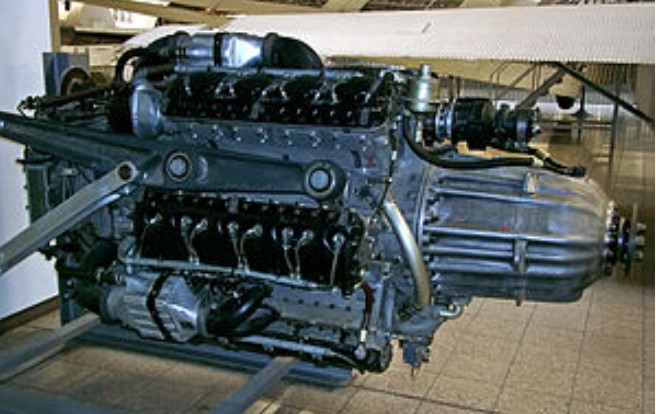
The Junkers Jumo 223 was an experimental 24-cylinder aircraft engine based on the Junkers Jumo 205. Like the Jumo 205, it was an opposed piston two-stroke diesel engine. It had four banks of six cylinders in a rhomboid configuration, with four crankshafts one at each vertex of the rhombus, and 48 pistons. It was designed for a power of 2,500 horsepower at 4,400 rpm, and weighed around 2,370 kg.

Only one example is known to have been built. It is rumoured to have been taken to Moscow after the war, where development may have continued.

In 1942 the 223 was abandoned in favour of an even larger engine, the Jumo 224 with an intended output power of 4,500 horsepower.

The Jumo 223 series was influential to the successful three-crankshaft Napier Deltic engine.

Junkers Jumo 222

The Jumo 222 was a high-power multiple bank in-line piston aircraft engine design from Junkers, designed under the management of Ferdinand Brandner of the Junkers Motorenwerke. Such was the performance of the engine compared to contemporary designs that many developments of wartime Luftwaffe piston-engined aircraft designs were based around it, at least as an option. The design failed to mature even after years of intensive development, dooming the entire Bomber B program along with it. Only a small number were built, never leaving the prototype phase, but the design nevertheless continued appearing, endlessly, on proposals for new Luftwaffe multi-engined designs long after most had given up hope it would ever work.

Design work on the Jumo 222 started in 1937. The engine was configured with six inline cylinder banks spaced at equal angles around the crankcase, each bank having four cylinders each. The engine looked like a radial due to the arrangement, but the internal workings were more like a V engine with crossflow heads, and it was liquid-cooled like most inlines. Looking at a complete Jumo 222 from a “nose-on” view, the half-dozen cylinder banks were arranged at 60° equal angles from each other, such that neighbouring banks had their exhaust ports (at the “60°, 180° & 300°” spaces) and intake ports (at the “0°, 120° & 240°” spaces) facing each other, resulting in simpler “plumbing” from the rear-mounted supercharger and resulting in only three sets of exhaust headers. The trio of exhaust header sets would have been most likely present at the bottom of an engine nacelle, and on the upper quarters to either side (appearing like the exhausts for many Allied “upright” V-style aviation engines) for the shortest possible exhaust outlet routing.

Each cylinder had two intake valves and a single sodium-cooled exhaust valve, a high-pressure fuel injector between the intakes, and two spark plugs. With a bore and stroke of 135 mm (5.3 in), the original Jumo 222A/B engine design had a displacement of 46.4 L (2,831.5 in³), in the same general displacement class as the Double Wasp American eighteen cylinder air-cooled radial of 1939/40 origin. The 222A/B model was forced to run at a fairly low 6.5:1 compression ratio, the best possible given the low-octane fuels available in Germany, but by increasing the speed of the engine to 3,200 rpm, the 222 delivered 1,850 kW (2,500 hp) at takeoff. The only disappointing feature was the simple, single-stage two-speed supercharger, but even with this limitation, the engine still generated 1,641 kW (2,200 hp) at 5,000 m (16,400 ft). The dry weight was 1,088 kg (2,399 lb), only some 17 kg (39 lb) heavier than the air-cooled Double Wasp.

Compared to the contemporary BMW 801 and Daimler-Benz DB 605, the 222 was a huge leap in performance. It had only a slightly larger displacement figure than the 801’s 41.8 L (2,550.8 in³), and about ¼ more than the 605’s 35.7 L (2,178.5 in³), but delivered considerably more power, 1,850 kW (2,500 hp) compared to 1,193 kW (1,600 hp) in the 801 and 1,119 kW (1,500 hp) in the 605. That represents 40 kW/L for the 222, while only 29 kW/L for the 801, and 31 kW/L for the 605. Even more impressively the power-to-weight ratio was 1.7 kW/kg (1.04 hp/lb) for the 222, whereas the 605 delivered an otherwise excellent 1.4 kW/kg (0.88 hp/lb), and the 801 a fairly poor 1 kW/kg (0.60 hp/lb). The 222 also had similar exterior dimensions as these smaller engines, 1.16 m (3.81 ft) across compared to 1.27 m (4.17 ft) for the 801, and 2.4 m (7.9 ft) long compared to 2.3 m (7.5 ft) for the 605.

The comparison was even more favourable against other high-power engines under development. The cumbersome DB 606, the first-ever “high-output” powerplant developed by the German aviation engine industry starting in February 1937, consisted of two DB 601’s mounted to a single reduction gear case on their front ends, that delivered 1,790 kW (2,400 hp) from a whopping 1,515 kg (3,340 lb), and was 2.1 x 1.6 x 1.1 m (6.9 x 5.2 x 3.6 ft) in size. Their troubled use and deficient installation design in the He 177, Germany’s only heavy bomber aircraft to see production and front-line service, prompted Reichsmarschall Hermann Göring to derisively label them in the late summer of 1942 as “welded-together engines”. Conversely, the RLM was excited by the possibilities of the much more compact Jumo 222’s design features, and the X engine configuration, 24 cylinder DB 604, of similar weight and displacement to the 222A but with somewhat lower specific power output. The RLM based their entire Bomber B program around pairs of these engines, which would deliver a bomber with the warload of the He 177 and even better speed than the Ju 88, a truly universal design.

The first prototype engine ran on April, 24th 1939, and was later air-tested on the nose-engine mount of a Ju 52. Production called for two primary models, the 222A and 222B, which differed only in the direction that they spun, intended to be used for left and right-hand engines on twin-engine designs. However, continued testing went poorly, and Junkers eventually decided it was best to stop development of these “Series I” engines and move onto a modified “Series II”. The new 222A-2 and B-2 ran at a slightly slower rpm but had slightly larger cylinders of 140 mm/5.5 in bore (49.88 litres, 3043.86 in³) for the same net performance, while the A-3 and B-3 used a different supercharger for better performance at higher altitudes. Both continued to prove unreliable, and were fitted only experimentally.

By late 1941, Junkers decided the best course of action was to make more radical changes to the design, and introduced the 222C and 222D models. With a new bore and stroke of 145×140 mm (5.7×5.5 in), the engine displacement increased a second time, to 55.5 L (3,386.8 in³), just very slightly larger than the contemporary Wright Duplex Cyclone American 18-cylinder air-cooled radial engine, which at the time was having its own significant problems ironed out, partially from the use of combustible magnesium-alloy metal for its crankcase. Back at the original 3,200 rpm, the Jumo 222 C/D models could deliver just under 2,200 kW (3,000 hp) when they started running in the summer of 1942. However, the problems were not cured, and only a handful were built. The RLM had been waiting for three years at this point, and eventually gave up and had all designs based on it look for alternate engines. Later that year, they gave up on that as well, and cancelled the entire Bomber B program outright.

Junkers still did not give up. Using the original 46.4 litre displacement A/B design, they added a new two-stage supercharger including a trio of aftercoolers, one per pair of neighboring cylinder banks for high-altitude use, producing the 222E and F-series. Although sea-level performance was unchanged, the engine was able to produce 1,439 kW (1,930 hp) at 9,000 m (29,530 ft). By this point it appeared that the problems were finally being worked out, but bombing of the Junkers Motorenwerke’s headquarters factories in Dessau made production almost impossible. A final attempt for even higher altitude performance resulted in the turbocharged 222G and H, built only to the extent of a few testbed prototypes.

The Jumo 222 was a massive and very costly failure. 289 examples of the Jumo 222’s were built in total, none of which saw active service. It also served to seriously hamper Luftwaffe piston-engined designs from 1940 to 1942, while many personnel within the Luftwaffe’s government-operated technology development offices (like Oberst Edgar Petersen’s chain of several Erprobungsstelle installations) and German military aviation corporate engineering departments waited for the Jumo 222 to finally start working. Meanwhile, all calls for four-engine adaptations in place of twin-engine Jumo 222 powered designs were rejected because it was felt it would place too much strain on the German engine industry. In the end there was nothing to show for it, and late in the war the Luftwaffe was flying barely updated versions of their original pre-war designs.

Variants:
None of the JuMo 222 variants achieved operational service.
JuMo 222A-1
JuMo 222A-2
JuMo 222A-3
JuMo 222B-1
JuMo 222B-2
JuMo 222B-3
JuMo 222C
JuMo 222D
JuMo 222E
JuMo 222F
JuMo 222G
JuMo 222H

Specifications:
Jumo 222A
Type: 6-bank, 24-cylinder supercharged liquid-cooled in-line aircraft engine
Bore: 135 mm (5.3 in)
Stroke: 135 mm (5.3 in)
Displacement: 46.5 L (2,830 in³)
Length: 2,400 mm (94.5 in)
Diameter: 1,160 mm (45.7 in)
Dry weight: 1,088 kg (2,399 lb)
Valvetrain: Two intake valves and one sodium-cooled exhaust valve per cylinder
Supercharger: Single-stage two-speed centrifugal type supercharger
Fuel system: Fuel injection
Cooling system: Liquid-cooled
Power output:
1,838 kW (2,465 hp) at 3,200 rpm for takeoff
1,397 kW (1,870 hp) cruise
Specific power: 39.5 kW/L (0.87 hp/in³)
Compression ratio: 6.5:1
Specific fuel consumption: 0.29 kg/(kW·h) (0.477 lb/(hp·h))
Power-to-weight ratio: 1.69 kW/kg (1.03 hp/lb)