By the time Lawrance merged with Wright, it had already developed the J-2, a more powerful version of the J-1 with slightly enlarged bore and displacement. However, Lawrance decided the J-1 was large enough, and the J-2 never went into production; only two examples were built.
Over the next two years, Wright gradually refined the J-1 engine, introducing the J-3, J-4, J-4A, and J-4B. The changes improved the engine’s reliability, cooling, and fuel consumption, but the basic design, dimensions, and performance were unaltered.
The J-4 was the first engine to bear the Whirlwind name; previous engines had no name, only a designation.
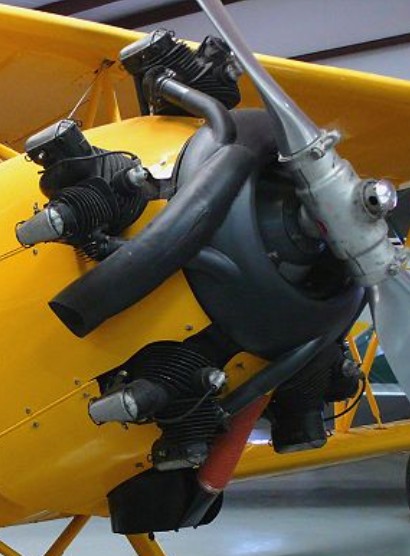
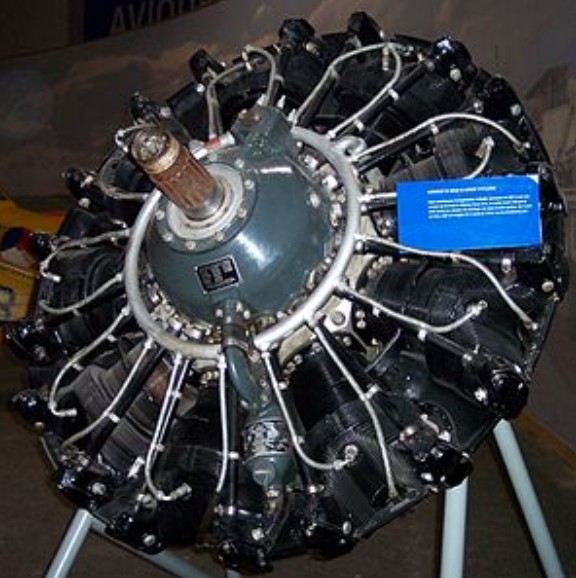
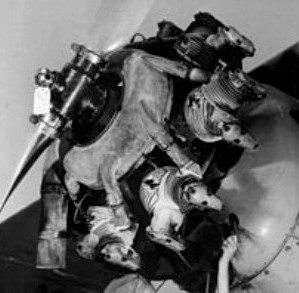
The Wright R-540 Whirlwind was a series of five-cylinder air-cooled radial aircraft engines built by the Wright Aeronautical division of Curtiss-Wright. These engines had a displacement of 540 cu.in (8.85 L) and power ratings of around 165-175 hp (123-130 kW). They were the smallest members of the Wright Whirlwind engine family.
Wright introduced the J-6 Whirlwind family in 1928 to replace the nine-cylinder R-790 series. The J-6 family included varieties with five, seven, and nine cylinders. The five-cylinder version was originally known as the J-6 Whirlwind Five, or J-6-5 for short. The U.S. government designated it as the R-540; Wright later adopted this and dropped the J-6 nomenclature.
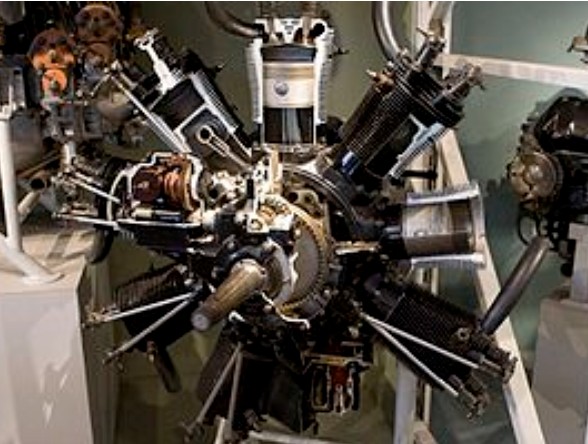
The R-540 cylinders are of a steel barrel over which an aluminium alloy head is screwed and shrunk. Intake ports are at the rear with exhaust ports on the forward side of cylinder.
The crankcase assembly is composed of four major castings of aluminium alloy. The cam follower housing carrying the tappet guides is cast integral with the main section of the crankcase.
Two-piece single-throw crankshaft with one-piece master rod and “H” section articulated rods.
Aluminium alloy pistons, cross ribbed on under side of head, and fitted with full floating hollow pins held in place by expanding spring wire locks.
Rotary induction system of Wright design, with “pre-heating” device on carburettor. Provision is made for obtaining, at all times, a clean supply of air to the carburettor.
Lubrication system is designed to eliminate all external oil pipes to the engine.
Equipment supplied was air cleaner and heater, nose cowling, complete exhaust manifold, priming pump, ignition switch, tool kit, external oil filter, and instruction book.
Accessories available at extra cost were Ecllipse hand inertia starter, Eclipse generator, Eclipse generator control box, standard steel propeller hub, fuel pump, Eclipse combination hand and electric inertia starter, Eclipse hand starter with booster magneto, Eclipse electric inertia starter, propeller hub for wooden propeller, metal propeller, and hubs for two or three blade props.
Like all the members of the J-6 Whirlwind family, the R-540 had larger cylinders than the R-790. The piston stroke of 5.5 in (14.0 cm) was unchanged, but the cylinder bore was expanded to 5.0 in (12.7 cm) from the R-790’s bore of 4.5 in (11.4 cm). While the R-790 was naturally aspirated, the R-540, like the other J-6 engines, had a gear-driven supercharger to boost its power output.
Wright gradually refined the R-540, using suffix letters to indicate successive versions. For example, the R-540A had 165 hp (123 kW), while the R-540E of 1931 had power boosted to 175 hp (130 kW) thanks to an improved cylinder head design. Wright sometimes named these versions according to their power, e.g. “Whirlwind 165” or “Whirlwind 175”.
Produced from 1929 to 1937, around 500 were built.
The engine was built in Spain as the Hispano-Suiza 5Q or Hispano-Wright 5Q without modification apart from the use of Hispano’s patented nitriding finishing process.
The R-540 was the smallest, least powerful member of the Whirlwind family and was designed for light aircraft. One of the more popular types to use it was the Curtiss Robin, a light civil utility aircraft. A few were also used in prototype military trainer aircraft that were evaluated by the U.S. Army but not put into production.
The R-540 sold well at first, with over 400 engines being built in 1929. However, with the impact of the Great Depression, sales plummeted, and only about 100 further examples were built over the next eight years. Wright finally ceased production of five-cylinder Whirlwinds in 1937, concentrating on larger engines and leaving the market for small radials to companies like Kinner and Warner.
Since R-540 engines were found solely in light aircraft, they weren’t often used for groundbreaking flights. However, there were a couple of noteworthy exceptions which took advantage of the Whirlwind family’s reputation for high reliability. In 1935, the brothers Al and Fred Key set a new flight endurance record of 653 hours, 34 minutes in the Curtiss Robin J-1 Ole Miss, flying over Meridian, Mississippi, from June 4 to July 1. Their plane was refueled and resupplied in flight, and they could perform simple engine maintenance by walking out on a small catwalk extending between the cabin and the engine. Douglas “Wrong-Way” Corrigan’s famous unauthorized transatlantic flight from New York City to Dublin, Ireland on July 17–18, 1938, used a Curtiss Robin with an R-540 built from the parts of two used engines.
Applications: Curtiss Robin J-1 Kreider-Reisner Challenger C-4C (Fairchild KR-34C) Spartan C3-165 Stinson Junior SM-2AA and SM-2AB Travel Air E-4000 Waco BSO
Specifications:
Type: 5 cylinder, air cooled fixed radial Military Rating: 165 hp at 2000 rpm Commercial Rating: 165 hp at 2000 rpm Displacement: 540 cu.in Compression ratio: 5.1-1 Bore: 5 in Stroke: 5 1/2 in Length: 40 5/8 in Diameter: 45 in Weight: 370 lb Fuel consumption: not more than .55 lb/hp/hr Oil consumption: not more than .035 lb/hp/hr Lubrication: Pressure pumps Ignition: Scintilla dual Carburation: Stromberg, single barrel Spark plugs: 2 per cylinder Price: $3000
R-540E Type: 5-cylinder supercharged air-cooled radial piston engine Bore: 5.0 in (127 mm) Stroke: 5.5 in (140 mm) Displacement: 540 cu in (8.85 L) Length: 41.1 in (104.4 cm) Diameter: 45.0 in (114.3 cm) Dry weight: 420 lb (191 kg) Valvetrain: 2 valves per cylinder, pushrod-actuated Supercharger: gear-driven, 7.05:1 impeller gear ratio Fuel type: 65 octane Reduction gear: Direct drive Power output: 175 hp (130 kW) at 2,000 RPM at sea level Specific power: 0.324 hp/cu-in (14.7 kW/L) Compression ratio: 5.1:1 Power-to-weight ratio: 0.417 hp/lb (0.685 kW/kg)
Developed by Wright Aeronautical, on the lines of the Wright-Hisso engines produced during the First World War, using monobloc cylinder blocks and gear driven overhead camshafts. The T-1 of 1921 had a power output of 500 hp (373 kW), and went into production as the T-2 in 1922 with an increase in power to 525 hp (391 kW).
The T-3 was the third in the line of ‘T’ (Tornado) series engines. The T-3 and T-3A appeared from 1923 producing 575 hp (429 kW) with the final development, the T-4, producing 675 hp (503 kW) by December of that year. Wright attempted to build a racing version of the T rated at 700 hp (522 kW) to rival the Curtiss D-12, but this was not pursued.
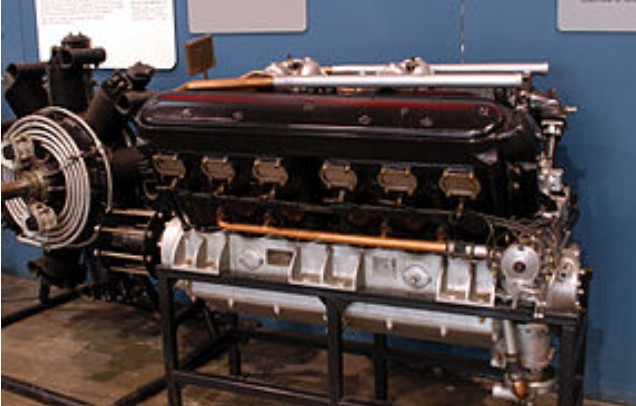
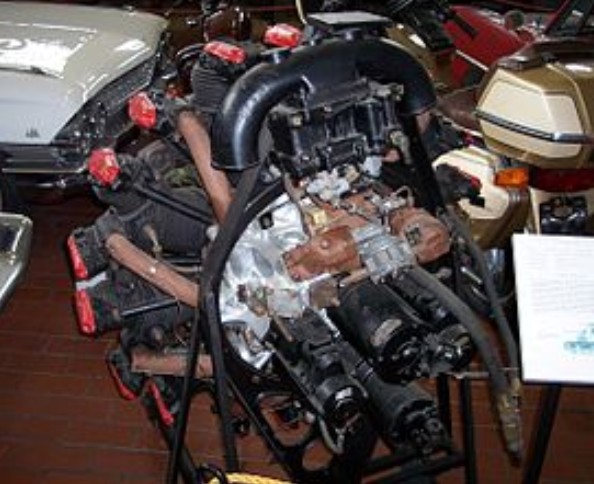
The Wright T-3 Tornado, also given the USAF designation Wright V-1950.
Applications: Curtiss CS Martin SC Martin T2M Martin T3M Wright F2W Dayton-Wright XO-3
Specifications: T-3 Type: V-12 aircraft piston engine Bore: 5.75 in. (146mm) Stroke: 6.25 in. (158.8mm) Displacement: 1,947.54 cu in (31.9 L) Dry weight: 1,000 lb (453.6 kg) Cooling system: Air-cooled Power output: 575 hp (429 kW) Power-to-weight ratio: 0.575 hp/lb (0.95 kW/kg)
In 1932, the R-1750 was developed to a capacity of 1823 cu in. This was the F model Cyclone, designated R-1820 Cyclone 9. This engine introduced a forged aluminium crankcase and was developed through the 1930s to reach 890 hp. It used a General Electric supercharger, and Wright concluded that this feature limited the potential power output of the engine.
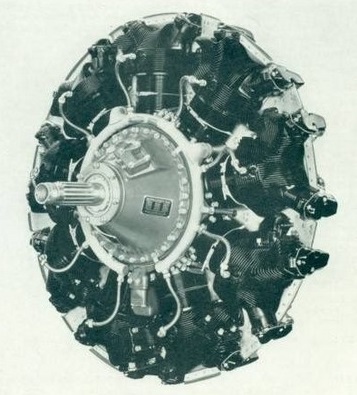
Wright R-1820 Cyclone, 675 hp
For the next development, the G-Series of 1937, Wright developed its own single-speed supercharger. The G-series was developed to deliver 1200 hp at 2500 rpm and made up the bulk of R-1820 Cyclone production during World War 2. It was installed in the Boeing B-17 Flying Fortress. The final phase of development of the single row radial design was the H-Series at 1350 hp.
In 1949 the Cyclone 9HE weighed less than 1400 lb and delivered nearly 1500 bhp. The first two were delivered to Douglas for installation in the new DC-3 Super. Apart from new engines, the DC-3 Super has a new tail unit and outer-wing panels, a strengthened undercarriage with complete wheel retraction, and re-arranged internal accommodation. The Cyclone 9HE engines would boost speed by 45 mph to 234 mph and maximum loaded weight increase from 25,200 lb to 27,300 lb.
The engine remained in production well into the 1950s.
The R-1820 was built under license by Lycoming, Pratt & Whitney Canada, and also, during World War II, by the Studebaker Corporation. The Soviet Union had purchased a license for the design, and the Shvetsov OKB was formed to produce the engine as the M-25. In Spain the R-1820 was license-built as the Hispano-Suiza 9V or Hispano-Wright 9V.
The Shvetsov M-25 was a licensed production variant of the Wright R-1820-F3. The first M-25s were produced from kits imported from the United States; the main difference between the later M-25 and the R-1820-F3 was the use of metric components. 13,888 M-25s were produced in the USSR at factories in Perm and Kazan. There were a number of sub-variants which differed from the original M-25 in that they had reduction gears, rather than direct drive. Performance was similar to the equivalent Wright engines. The M-25 was later developed into the ASh-62.
The Shvetsov M-25 was a licensed production variant of the Wright R-1820-F3. The first M-25s were produced from kits imported from the United States; the main difference between the later M-25 and the R-1820-F3 was the use of metric components. 13,888 M-25s were produced in the USSR at factories in Perm and Kazan. There were a number of sub-variants which differed from the original M-25 in that they had reduction gears, rather than direct drive. Performance was similar to the equivalent Wright engines. The M-25 was later developed into the ASh-62.
Shvetsov M-25
The R-1820 was built under license by Lycoming, Pratt & Whitney Canada, and also, during World War II, by the Studebaker Corporation. The Soviet Union had purchased a license for the design, and the Shvetsov OKB was formed to produce the engine as the M-25. In Spain the R-1820 was license-built as the Hispano-Suiza 9V or Hispano-Wright 9V.
The R-1820 was at the heart of many famous aircraft including the early Douglas airliners (prototype DC-1, the DC-2, earliest civilian versions of the DC-3, and the limited-production DC-5), B-17 Flying Fortress, and SBD Dauntless bombers, the early versions of the Polikarpov I-16 fighter (as M-25), and the Piasecki H-21 helicopter.
TC9J2, a Turbocompounded R-1820 Offered in the Early 1950s.
The R-1820 also found limited use in armored vehicles in two forms. The G-200 was a nine-cylinder gas-burning radial that developed 900 hp (670 kW) @ 2,300 rpm and powered the M6 Heavy Tank. The Wright RD-1820 was converted to a diesel by Caterpillar Inc. as the D-200 and produced 450 hp (340 kW) @ 2,000 rpm in the M4A6 Sherman.
Variants: Unit numbers ending in/with W indicate engines fitted with water-methanol emergency power boost system.
R-1820-04 700 hp (522 kW)
R-1820-1 575 hp (429 kW)
R-1820-4 770 hp (574 kW)
R-1820-19 675 hp (503 kW)
R-1820-22 950 hp (708 kW)
R-1820-25 675 hp (503 kW), 750 hp (559 kW), 775 hp (578 kW)
R-1820-32 1,000 hp (750 kW)
XR-1820-32 800 hp (596 kW)
R-1820-33 775 hp (578 kW)
R-1820-34 940 hp (701 kW), 950 hp (708 kW)
R-1820-34A 1,200 hp (895 kW)
R-1820-40 1,100 hp (820 kW), 1,200 hp (895 kW)
R-1820-41 850 hp (634 kW)
R-1820-45 800 hp (596 kW), 930 hp (694 kW)
R-1820-50 850 hp (634 kW)
R-1820-52 1,000 hp (750 kW)
R-1820-53 930 hp (694 kW), 1,000 hp (750 kW)
R-1820-56 1,200 hp (895 kW), 1,350 hp (1,007 kW)
R-1820-57 1,060 hp (790 kW)
R-1820-60 1,200 hp (895 kW)
R-1820-62 1,350 hp (1,007 kW)
R-1820-66 1,200 hp (895 kW), 1,350 hp (1,007 kW)
R-1820-72W 1,350 hp (1,007 kW), 1,425 hp (1,063 kW)
R-1820-74W 1,500 hp (1,118 kW)
R-1820-76A, B, C, D 1,425 hp (1,063 kW)
R-1820-78 700 hp (522 kW)
R-1820-80 700 hp (522 kW), 1,535 hp (1,145 kW)
R-1820-82WA 1,525 hp (1,137 kW)
R-1820-86 1,425 hp (1,063 kW)
R-1820-97 1,200 hp (895 kW), Fitted with turbosupercharger
Applications Boeing B-17 Flying Fortress Boeing 307 Brewster F2A Curtiss AT-32-A Condor Curtiss SBC-4 Helldiver Curtiss P-36 Mohawk Curtiss SC Seahawk Curtiss-Wright CW-21 Douglas A-33 Douglas B-18 Douglas DC-2 Douglas DC-3 (DST, G-102 and G-202) Douglas Super DC-3, R4D-8 / C-117 Douglas DC-5 Douglas SBD Dauntless FMA AeMB.2 Bombi General Motors FM-2 Wildcat Grumman TF-1 / C-1 Trader Grumman FF-1 Grumman F3F Grumman HU-16 Albatross Grumman J2F Duck Grumman S-2 Tracker Lockheed 14 Lockheed Lodestar Lockheed Hudson Martin B-10 North American NA-44 North American O-47 North American P-64 North American T-28B/C/D Trojan Northrop YC-125 Raider Piasecki H-21 Polikarpov I-16 Ryan FR Fireball Sikorsky S-58/HUS/HSS/H-34
Vehicles: M4A6 tank M6 heavy tank
Specifications:
GR-1820-G2 Type: Nine-cylinder single-row supercharged air-cooled radial engine Bore: 6 1⁄8 in (155.6 mm) Stroke: 6 7⁄8 in (174.6 mm) Displacement: 1,823 in³ (29.88 L) Length: 47.76 in (1,213 mm) Diameter: 54.25 in (1,378 mm) Dry weight: 1,184 lb (537 kg) Valvetrain: Two overhead valves per cylinder with sodium-filled exhaust valve Supercharger: Single-speed General Electric centrifugal type supercharger, blower ratio 7.134:1 Fuel system: Stromberg PD12K10 downdraft carburetor with automatic mixture control Fuel type: 87 octane rating gasoline Oil system: Dry sump with one pressure and one scavenging pump Cooling system: Air-cooled Power output: 1,000 hp (746 kW) at 2,200 rpm for takeoff Specific power: 0.46 hp/in³ (20.88 kW/L) Compression ratio: 6.45:1 Specific fuel consumption: 0.6 lb/(hp•h) (362 g/(kW•h)) Oil consumption: 0.35-0.39 oz/(hp•h) (13-15 g/(kW•h)) Power-to-weight ratio: 0.84 hp/lb (1.39 kW/kg)
Shvetsov M-25 Type: 9-cylinder, air-cooled, radial engine Bore: 6.125 in (155.6 mm) Stroke: 6.875 in (174 mm) Displacement: 1,823.1 in³ (29.876 L) Dry weight: 499kg (999lb) Supercharger: Single speed, single stage, geared centrifugal supercharger Fuel system: 1 K-25 (Solex) Carburetor Power output: 700-800hp depending on model Compression ratio: 6.4:1
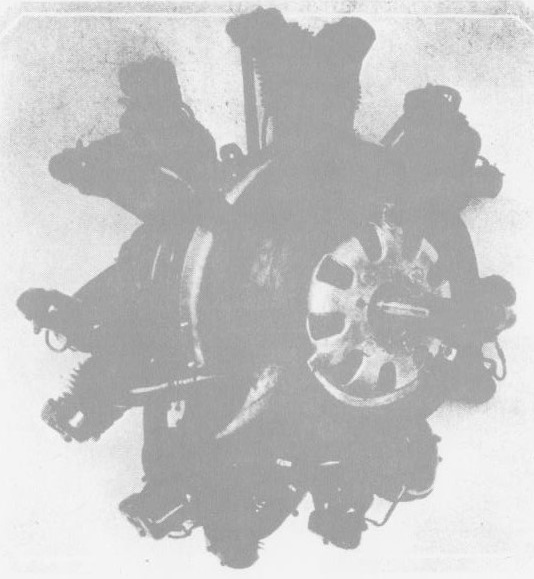
Wright introduced the J-6 Whirlwind family in 1928 to replace the nine-cylinder R-790 series. The J-6 family included varieties with five, seven, and nine cylinders. The nine-cylinder version was originally known as the J-6 Whirlwind Nine, or J-6-9 for short. The U.S. government designated it as the R-975; Wright later adopted this and dropped the J-6 nomenclature.
Model designations included Whirlwind 330, 365, and 420.
The R-975 cylinders are of a steel barrel over which an aluminium alloy head is screwed and shrunk. Intake ports are at the rear with exhaust ports on the forward side of cylinder.
The crankcase assembly is composed of four major castings of aluminium alloy. The cam follower housing carrying the tappet guides is cast integral with the main section of the crankcase.
Two-piece single-throw crankshaft with one-piece master rod and “H” section articulated rods.
Aluminium alloy pistons, cross ribbed on under side of head, and fitted with full floating hollow pins held in place by expanding spring wire locks.
Rotary induction system of Wright design, with “pre-heating” device on carburettor. Provision is made for obtaining, at all times, a clean supply of air to the carburettor.
Lubrication system is designed to eliminate all external oil pipes to the engine.
Equipment supplied was air cleaner and heater, nose cowling, complete exhaust manifold, priming pump, ignition switch, tool kit, external oil filter, and instruction book.
Accessories available at extra cost were Ecllipse hand inertia starter, Eclipse generator, Eclipse generator control box, standard steel propeller hub, fuel pump, Eclipse combination hand and electric inertia starter, Eclipse hand starter with booster magneto, Eclipse electric inertia starter, propeller hub for wooden propeller, metal propeller, and hubs for two or three blade props.
Like all the members of the J-6 Whirlwind family, the R-975 had larger cylinders than the R-790. The piston stroke of 5.5 in (14.0 cm) was unchanged, but the cylinder bore was expanded to 5.0 in (12.7 cm) from the R-790’s bore of 4.5 in (11.4 cm). While the R-790 was naturally aspirated, the R-975, like the other J-6 engines, had a gear-driven supercharger to boost its power output.
Wright gradually developed the R-975, at first using suffix letters to indicate successive versions. The original R-975 (or J-6-9) was rated for 300 hp (224 kW), while the R-975E of 1931 could do 330 hp (246 kW) thanks to an improved cylinder head design. Wright later added numeric suffixes to show different power levels. The R-975E-1, introduced the same year as the R-975E, was rated at 365 hp (272 kW) thanks to higher-compression pistons and a slightly greater RPM limit. An even more powerful version, the R-975E-3, was also introduced that year, with greater supercharging and a still higher RPM limit, and was progressively refined until the final model of 1935 could reach 450 hp (336 kW) for takeoff.
As the most powerful Whirlwind engine to be commercially produced, the R-975 also became the most popular. It was a powerplant for a variety of civil utility aircraft, such as the Beechcraft Staggerwing, and was also used for some early airliners, like the Ford Trimotor 4-AT-E and the Lockheed Electra 10B. In addition, it powered several U.S. military training aircraft, the North American BT-9 and Vultee BT-15 Valiant for the Army and the Curtiss-Wright SNC-1 Falcon for the Navy. It was even used in a fighter aircraft, the Curtiss F9C Sparrowhawk parasite fighter used on U.S. Navy airships.
However, the R-975 faced heavy competition from Pratt & Whitney’s R-985 Wasp Junior and from their larger R-1340 Wasp. Pratt & Whitney sold many more Wasp Juniors for aircraft use than Wright sold R-975s.
Wright’s production of the R-975 continued until 1945, with over 7000 engines being produced by the company.
In 1939 the U.S. Army, which had already been using Continental R-670 radial engines in its light tanks, chose Continental Motors to build the R-975 under license as the engine for its M2 medium tanks. Subsequently, the same engine was selected for the M3 Lee medium tank, the M4 Sherman medium tank, the Canadian Ram tank, the M7 Priest self-propelled gun, the M18 Hellcat tank destroyer, and other Allied armored vehicles based on these. Continental versions of the R-975 for armored vehicles included the R-975E-C2, the R-975-C1, and the R-975-C4. Continental built over 53,000 R-975 engines for armored vehicles, far more than were ever built by Wright.
When installed in a tank, the R-975 did not have the benefit of being cooled by an air slipstream or propeller blast, so a cooling fan was attached to the power shaft and surrounded by a shroud to provide the same effect.
After the war, Continental introduced its own R-975 version for aircraft, the R9-A. Though it was basically similar to other R-975 engines, and its compression ratio and supercharger gear ratio were unchanged from the R-975E-3, other improvements in the R9-A allowed it to achieve 525 hp (391 kW) for takeoff, surpassing any Wright version. A military version, the R-975-46, could reach 550 hp (410 kW), and was used in Piasecki’s HUP Retriever and H-25 Army Mule helicopters. Continental’s production of R-975 engines continued until 1945.
The engine was built in Spain as the Hispano-Suiza 9Q or Hispano-Wright 9Q without modification apart from the use of Hispano’s patented nitriding finishing process and, on one version only, the 9Qdr, an epicyclic output speed reducer. The R-975 was also produced under licence by Continental Motors as the R-9A, and by Fábrica Nacional de Motores in Brazil.
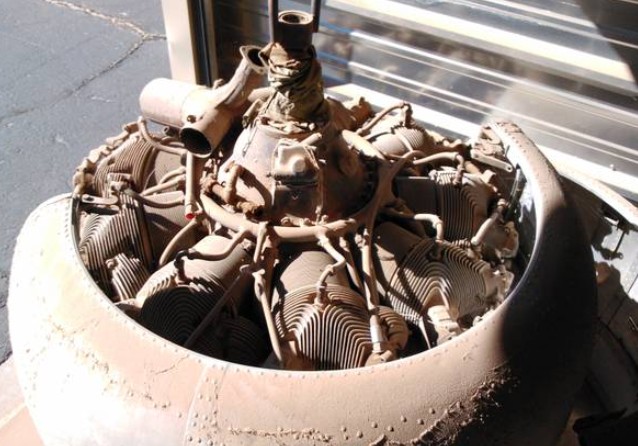
Complete 1950s R975 with matching numbers – Fernie Chavez
Variants: J-6-9 (R-975) 300 hp (224 kW) at 2,000 RPM. R-975E 330 hp (246 kW) at 2,000 RPM. Higher power from improved cylinder head. R-975E-1 365 hp (272 kW) at 2,100 RPM. Higher compression ratio. R-975E-3 420 hp (313 kW) at 2,200 RPM up to 1,400 ft (427 m), 450 hp (336 kW) at 2,250 RPM for takeoff. Increased supercharging, slightly higher compression ratio.
R-975E-C2 400 hp (298 kW) at 2,400 RPM. Built by Continental Motors under license. Designed for use in armored vehicles. Continental R9-A 500 hp (373 kW) at 2,300 RPM up to 4,000 ft (1,219 m), 525 hp (391 kW) at 2,300 RPM for takeoff. Continental’s improved post-war version. Hispano-Suiza 9Q Licence built R-975 J-6 Whirlwind Hispano-Suiza 9Qa variant of the Licence built R-975 J-6 Whirlwind Hispano-Suiza 9Qb variant of the Licence built R-975 J-6 Whirlwind Hispano-Suiza 9Qd variant of the Licence built R-975 J-6 Whirlwind Hispano-Suiza 9Qdr variant of the Licence built R-975 J-6 Whirlwind
Applications: Beechcraft Staggerwing B17R, C17R, and D17R Bellanca CH-300 Pacemaker Cessna DC-6A Chief Curtiss-Wright CW-22 Curtiss-Wright SNC-1 Falcon Dewoitine D.31 Dewoitine D.35 Curtiss F9C Sparrowhawk Fokker Standard Universal Fokker T.VIII Ford Trimotor 4-AT-E Ireland N-2B Neptune Keystone-Loening K-84 Commuter McDonnell XV-1 North American BT-9 Pitcairn-Cierva PCA-2 Ryan B-5 Brougham Stinson Detroiter SM-1F Travel Air 6000B VL Pyry Vultee BT-15 Valiant Waco JTO and JYO
Continental R-975 Kangaroo armoured personnel carrier M3 Lee M4 Sherman M7 Priest M18 Hellcat M12 Gun Motor Carriage M40 Gun Motor Carriage Piasecki H-25 Ram tank Sexton self-propelled gun Sikorsky S-53 Skink anti-aircraft tank
Specifications:
Type: 9 cylinder, air cooled fixed radial Military Rating: 300 hp at 2000 rpm Commercial Rating: 300 hp at 2000 rpm Displacement: 972 cu.in Compression ratio: 5.1-1 Bore: 5 in Stroke: 5 1/2 in Length: 41 7/16 in Diameter: 45 in Weight: 520 lb Fuel consumption: not more than .55 lb/hp/hr Oil consumption: not more than .035 lb/hp/hr Lubrication: Pressure pump Ignition: Scintilla, dual Carburation: Stromberg, single bbl Spark plugs: 2 per cylinser Price: $4800
R-975E Power, continuous: 330 hp (246 kW) at 2,000 RPM Compression ratio: 5.1:1 Supercharger gear ratio: 7.8:1 Octane rating: 73 Dry weight: 635 lb (288 kg)
R-975E-1 Power, continuous: 365 hp (272 kW) at 2,100 RPM Compression ratio: 6.1:1 Supercharger gear ratio: 7.8:1 Octane rating: 73 Dry weight: 660 lb (299 kg)
Whirlwind R-975E-3 Type: 9-cylinder supercharged air-cooled radial piston engine Bore: 5.0 in (127 mm) Stroke: 5.5 in (140 mm) Displacement: 972 cu in (15.93 L) Length: 43.0 in (109.2 cm) Diameter: 45.0 in (114.3 cm) Dry weight: 675 lb (306 kg) Valvetrain: 2 valves per cylinder, pushrod-actuated Supercharger: gear-driven, 10.15:1 impeller gear ratio Fuel type: 80 octane Reduction gear: Direct drive Power output: 420 hp (313 kW) at 2,200 RPM up to 1,400 ft (427 m); 450 hp (336 kW) at 2,250 RPM for takeoff Specific power: 0.43 hp/cu-in (19.7 kW/L) Compression ratio: 6.3:1 Power-to-weight ratio: 0.62 hp/lb (1.02 kW/kg)
Continental R9-A Power, continuous: 500 hp (373 kW) at 2,300 RPM Power, takeoff: 525 hp (391 kW) at 2,300 RPM Compression ratio: 6.3:1 Supercharger gear ratio: 10.15:1 Octane rating: 91 Dry weight: 705 lb (320 kg)
Wright introduced the J-6 Whirlwind family in 1928 to replace the nine-cylinder R-790 series. The J-6 family included varieties with five, seven, and nine cylinders. The seven-cylinder version was originally known as the J-6 Whirlwind Seven, or J-6-7 for short. The U.S. government designated it as the R-760; Wright later adopted this and dropped the J-6 nomenclature. Model designations included Whirlwind 235, 250, 285, and 320.
The R-760 cylinders are of a steel barrel over which an aluminium alloy head is screwed and shrunk. Intake ports are at the rear with exhaust ports on the forward side of cylinder.
The crankcase assembly is composed of four major castings of aluminium alloy. The cam follower housing carrying the tappet guides is cast integral with the main section of the crankcase.
Two-piece single-throw crankshaft with one-piece master rod and “H” section articulated rods.
Aluminium alloy pistons, cross ribbed on under side of head, and fitted with full floating hollow pins held in place by expanding spring wire locks.
Rotary induction system of Wright design, with “pre-heating” device on carburettor. Provision is made for obtaining, at all times, a clean supply of air to the carburettor.
Lubrication system is designed to eliminate all external oil pipes to the engine.
Equipment supplied was air cleaner and heater, nose cowling, complete exhaust manifold, priming pump, ignition switch, tool kit, external oil filter, and instruction book.
Accessories available at extra cost were Ecllipse hand inertia starter, Eclipse generator, Eclipse generator control box, standard steel propeller hub, fuel pump, Eclipse combination hand and electric inertia starter, Eclipse hand starter with booster magneto, Eclipse electric inertia starter, propeller hub for wooden propeller, metal propeller, and hubs for two or three blade props.
Like all the members of the J-6 Whirlwind family, the R-760 had larger cylinders than the R-790. The piston stroke of 5.5 in (14.0 cm) was unchanged, but the cylinder bore was expanded to 5.0 in (12.7 cm) from the R-790’s bore of 4.5 in (11.4 cm). While the R-790 was naturally aspirated, the R-760, like the other J-6 engines, had a gear-driven supercharger to boost its power output. Over time, Wright refined the R-760, using suffix letters to indicate successive versions. The original R-760 (or J-6-7) was rated for 225 hp (168 kW), while the R-760E of 1931 could do 250 hp (186 kW) thanks to an improved cylinder head design. Wright later added another suffix to show different power levels. The R-760E-1, introduced the same year as the R-760E, had a takeoff power rating of 300 hp (224 kW) thanks to higher-compression pistons and a greater RPM limit. The even more powerful R-760E-2 of 1935 could reach 350 hp (261 kW) for takeoff due to increased supercharging and an even higher RPM limit. On the other hand, the R-760E-T, designed for trainer aircraft, had the R-760E-1’s high-compression pistons, but the supercharger was removed, thus giving just 235 hp (175 kW).
The R-760 was a direct replacement for the R-790, with similar displacement and power. The U.S. Navy used it as the powerplant for several biplane primary trainers, including the Consolidated NY, the Curtiss N2C Fledgling, and the Naval Aircraft Factory N3N Canary. The last of these was produced in large numbers, with most of the engines built under license by the Naval Aircraft Factory. Trainers usually had the unsupercharged R-760E-T engine.
A variety of civil utility aircraft also used the R-760, including models built by Beechcraft, Cessna, Curtiss-Wright, Howard DGA-8, Stearman, Stinson, and Waco. These aircraft generally used the various supercharged versions of the R-760.
Production of the R-760 continued until 1945, with about 1400 examples being built by Wright, and more under licence by foraign anufacturers such as Fábrica Nacional de Motores in Brazil.
Applications: Beechcraft Staggerwing Cessna DC-6B Scout Consolidated NY-3 Curtiss N2C-2 Fledgling Fairchild Model 45 Howard DGA-8 Naval Aircraft Factory N3N Canary St. Louis YPT-15 Stearman C3R Business Speedster Stinson Junior Stinson Reliant Waco CSO and CTO Waco CJC, CJC-S, DJC, DJC-S, and DJS Waco CUC, DQC-6, EQC-6, DGC-7 & 8, EGC-7 & 8 Waco CRG
Specifications:
Type: 7 cylinder air cooled fixed radial Military Rating: 225 hp at 2000 rpm Commercial Rating: 225 hp at 2000 rpm Displacement: 756 cu.in Compression ratio: 5.1-1 Bore: 5 in Stroke: 5 1/2 in Length: 40 23/32 in Diameter: 45 in Weight: 445 lb Fuel consumption: not more than .55 lb/hp/hr Oil consumption: not more than .035 lb/hp/hr Lubrication: Pressure pumps Ignition: Scintilla dual Carburation: Stomberg, single barrel Spark plugs: 2 per cylinder Price: $3900
J-6-7 (R-760) 225 hp (168 kW) at 2,000 RPM.
R-760E Power, continuous: 250 hp (186 kW) at 2,000 RPM Compression ratio: 5.1:1 Supercharger gear ratio: 7.05:1 Octane rating: 73 Dry weight: 530 lb (240 kg) Higher power from improved cylinder head.
R-760E-1 Power, continuous: 285 hp (213 kW) at 2,100 RPM Power, takeoff: 300 hp (224 kW) at 2,250 RPM Compression ratio: 6.1:1 Supercharger gear ratio: 7.05:1 Octane rating: 73 Dry weight: 565 lb (256 kg) Higher compression ratio.
R-760E-2 Type: 7-cylinder supercharged air-cooled radial piston engine Bore: 5.0 in (127 mm) Stroke: 5.5 in (140 mm) Displacement: 756 in³ (12.4 L) Length: 42.44 in (107.8 cm) Diameter: 45.0 in (114.3 cm) Dry weight: 570 lb (259 kg) Valvetrain: 2 valves per cylinder, pushrod-actuated Supercharger: gear-driven, 9.17:1 impeller gear ratio Fuel type: 80 octane Reduction gear: Direct drive Power, continuous: 320 hp (239 kW) at 2,200 RPM at sea level Power, takeoff: 350 hp (261 kW) at 2,400 RPM Specific power: 0.42 hp/cu-in (19.3 kW/L) Compression ratio: 6.3:1 Power-to-weight ratio: 0.56 hp/lb (0.92 kW/kg)
R-760E-T Power, continuous: 235 hp (175 kW) at 2,000 RPM Compression ratio: 6.1:1 Supercharger gear ratio: none Octane rating: 73 Dry weight: 540 lb (245 kg) Unsupercharged version of R-760E-1 for trainer aircraft.
R-760-2, -4, -8 235 hp (175 kW) at 2,000 RPM. U.S. Navy versions of R-760E-T.
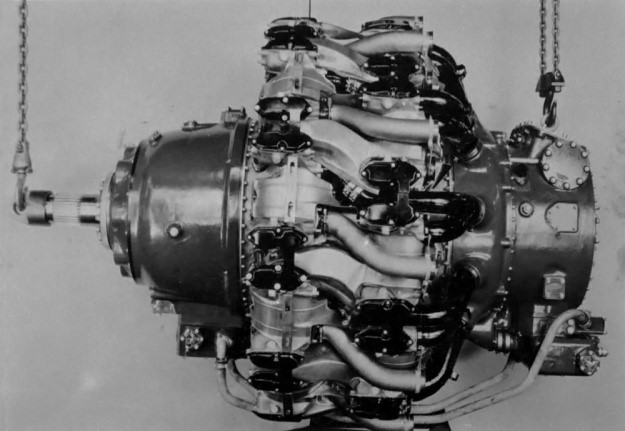
During the 1940s, Wright Aeronautical Corporation was constantly in competition with Pratt & Whitney for new engine designs required for civil and military aircraft. Utilising the Wright R-3350 as a basis, Wright developed a 22-cylinder engine (Wright model no. 792C22AA), using R-3350 cylinders arranged as a two-row radial engine with 11 cylinders per row.
The air-cooled R-4090 was rated to deliver 3,000 hp (2,200 kW) at 2,800 rpm for take-off, from a total displacement of 4,092 cu in (67.06 l), with a compression ratio of 6.85:1. Improved performance was expected from the R-4090 if it was proceeded with. A two-speed single-stage supercharger helped maintain rated power to higher altitudes.
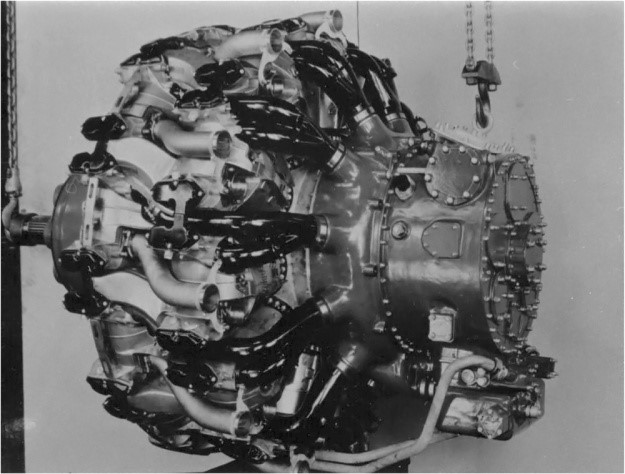
The core of the engine was a forged steel crankcase which enclosed the three piece two-throw crankshaft. The three-piece crankshaft was built up through the two one-piece master connecting rods. Ten articulating rods were attached to each master rod. The cylinders were arranged equally around the crankcase, with each row off-set by 16.3636° to ensure cooling airflow. The cylinders had 3,900 sq in (2.52 sq m) of cooling fin area. Each cylinder’s hemispherical combustion chamber had two valves; the exhaust valve was sodium-cooled. It appears that the .333 to 1 propeller gear reduction was provided by Wright’s standard, multi-pinion planetary gear system.
Accessories similar to other Cyclone engines were arranged around the rear face of the crankcase and a 0.333:1 planetary reduction gearbox at the front. The supercharger and accessory drive section was very similar to that used on the R-3350 engine. However, the supercharger had a 14 in (356 mm) impeller and gear ratios of 5 to 1 and 7 to 1.
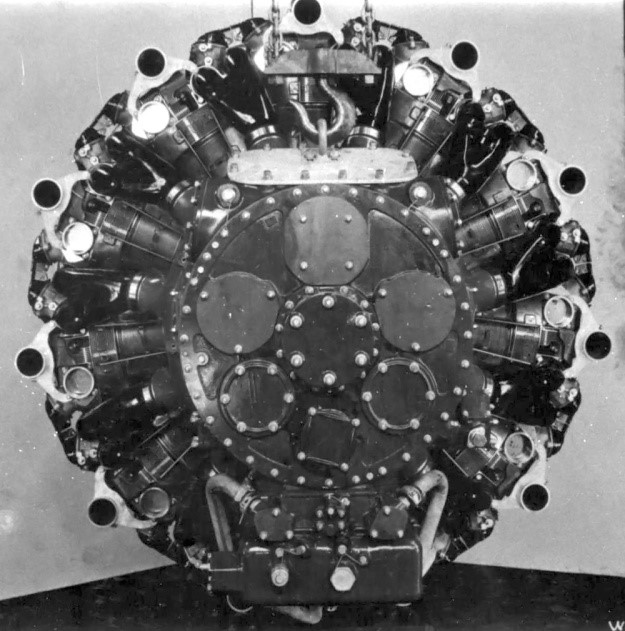
Rear view of the R-4090 showing the supercharger and accessory drive section which is very similar to that found on the R-3350.
Although there are no records of failings of the R-4090, the engine was abandoned to allow development of the R-3350 Cyclone 18 series. It is doubtful that the engine ever flew. Perhaps three R-4090 engines were completed: two XR-4090-1 engines with a single propeller shaft and one XR-4090-3 engine with a coaxial shaft for contra-rotating propellers. The XR-4090-3 weighed an additional 30 lb (13.6 kg) for a total of 3,260 lb (1,478 kg). In addition, the XR-4090-3 was to have a two-speed nose case to maximize propeller and engine speed efficiency for maximum power and cruise power.
Ultimately, the R-4090 Cyclone 22 was abandoned so that more resources could be used for the R-3350 Cyclone 18.
Variants:
XR-4090-1 (790C22AA1), drove a single propeller.
R-4090-3 (792C22AA), drove a contra-rotating propeller shaft and was intended to have a two-speed reduction gearbox to maximise efficiency in cruising flight.
XR-4090-1 Type: Air-cooled 22 cylinder two-row radial piston engine Bore: 6.125 in (155.6 mm) Stroke: 6.3125 in (160.3 mm) Displacement: 4,092 cu in (67.06 l) Length: 91 in (2,300 mm) Diameter: 58 in (1,500 mm) Dry weight: 3,230 lb (1,470 kg) Fuel type: Gasoline Power output: 3,000 hp (2,200 kW) at 2,800 rpm for take-off Compression ratio: 6.85:1 Supercharger: 14 in (360 mm) diameter impeller, single-stage two-speed supercharger; gear ratios: of 5 to 1 and 7 to 1. Reduction gear: 0.333:1 planetary reduction gearbox
Wright went on to develop two-row engines with 14 cylinders in two rows of 7, called the Cyclone 14, R-2600. This was installed in the Boeing 314, Grumman TBM/TBF Avenger, North American B-25 Mitchell, and some models of the Douglas A-20 Havoc (RAF Boston).
The Wright R-1300 Cyclone 7 is an American air-cooled seven-cylinder supercharged radial aircraft engine similar to a single row Wright R-2600. The engine was mass-produced but not widely used. Engineering began in 1942 but the first flight of an R1300 did not take place until 1949. The engine was produced under license by Kaiser-Frazer and later by AVCO Lycoming.
The R-1300 was developed for installation in the North American T-28. A production contract wither $7,000,000 was signed in 1948, 266 T-28 were on order.
The engine was used in combat, the R1300-1A, -1B in the A model North American Aviation T-28 Trojan and the R1300-3,-3A,-3C,-3D Sikorsky UH-19 Chickasaw. The R1300-1B was used in the Ayres Thrush. The R1300-4, -4A was used in the N class blimp, 50 of these designation were produced by AVCO. The engines early on had vibration problems, an improved lateral dampener in the crank brought about most of the model changes.
Variants: R1300-2 A direct drive version of the R1300-1. It had a 0.5625:1 reduction drive. Both used the PD9F1 carburetor. R1300-3 Derated to 690.3 hp (515 kW), uses forced-air cooling fan and uses a PD9G1 carburetor. R1300-4 Similar to the R1300-1, uses some different accessory components. R-1300-CB7A1 With reduction gear for use on fixed wing aircraft.
Applications: N class blimp North American T-28 Trojan Rockwell Thrush Commander Sikorsky H-19 Westland Whirlwind
Specifications: R-1300-1A Type: 7-cylinder supercharged air-cooled single row radial engine Bore: 6.125 in (155.6 mm) Stroke: 6.312 in (160.2 mm) Displacement: 1,301 cu in (21.3 L) Length: 48.22 in (1,225 mm) Diameter: 55 in (1,397 mm) Dry weight: 1,055 lb (478 kg) Valvetrain: Two pushrod-actuated valves per cylinder with sodium-cooled exhaust valve Supercharger: 1-stage Fuel system: Bendix-Stromberg PD9F1 downdraft carburetor with automatic mixture control Cooling system: Air-cooled Power output: 800 hp (596 kW) Specific power: 0.61 hp/cu.in (27.94 kW/L) Compression ratio: 6.20:1 Power-to-weight ratio: 0.76hp/lb (1.25 kW/kg)
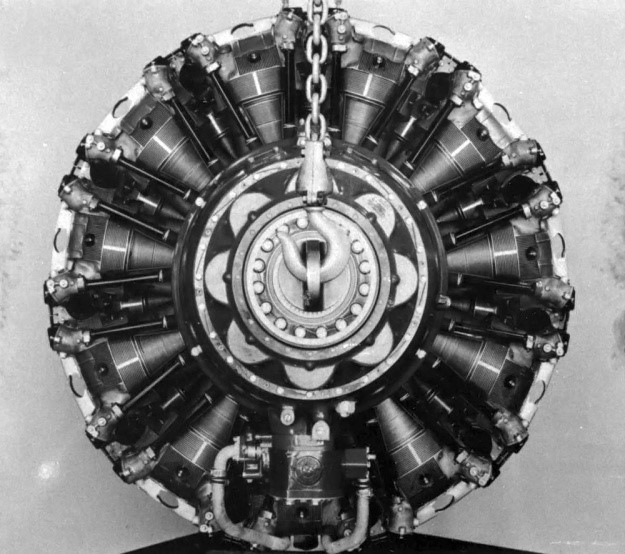
The Wright Whirlwind was a family of air-cooled radial aircraft engines built by Wright Aeronautical (originally an independent company, later a division of Curtiss-Wright). The family began with nine-cylinder engines, and later expanded to include five-cylinder and seven-cylinder varieties. Fourteen-cylinder twin-row versions were also developed, but these were not commercially produced. The Whirlwind was a direct descendant of the Lawrance J-1, a nine-cylinder air-cooled radial built by the Lawrance Aero Engine Company for the U.S. Navy. Because the Navy was very enthusiastic about air-cooled radials, but was concerned that Lawrance could not produce enough engines for its needs, it forced Wright to purchase the Lawrance company in 1923 and build the J-1 itself. Wright’s J-1 was the first engine in its nine-cylinder R-790 Whirlwind series. During the mid-1930s, Wright developed two fourteen-cylinder double-row versions of the Whirlwind, the R-1510 of 600 hp (450 kW), and the R-1670 (Introduced 1934, prototype only) of 800 hp (600 kW). These were used in a number of military aircraft prototypes, but neither engine reached the production stage.
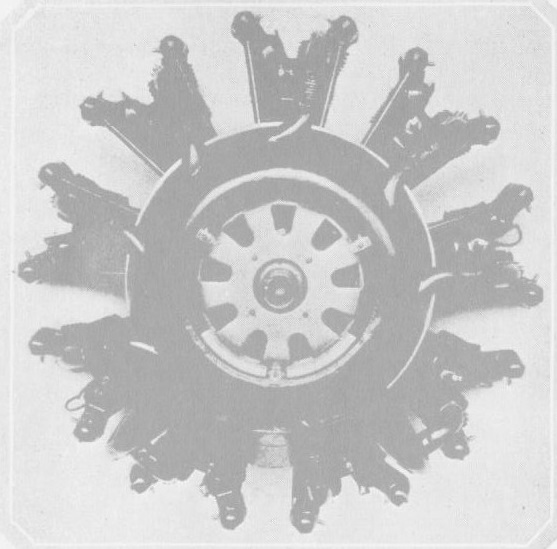
R-1670 14-cylinder twin-row radial, 800 hp (600 kW).
 All Aero