1928
230 W Washington Blvd
Los Angeles
California
USA
Airplane builder
Also were remodelers of the Fisk-Standard.
1928
230 W Washington Blvd
Los Angeles
California
USA
Airplane builder
Also were remodelers of the Fisk-Standard.
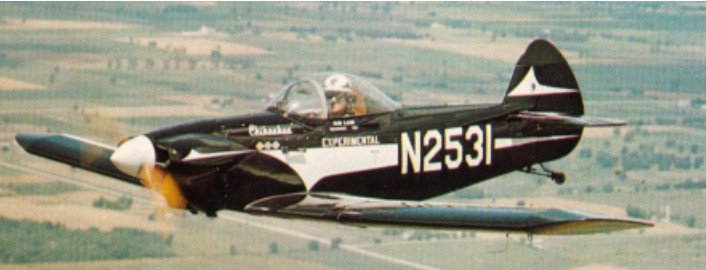
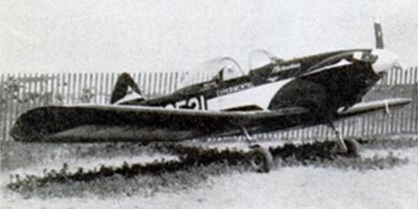
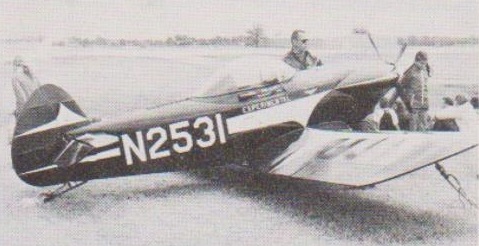
Built by Robert Ladd in 1967, the Taylor Chihuahua single place, enclosed low wing monoplane, was developed from the British John Taylor monoplane. One was built, N2531, was first flown in September 1967.
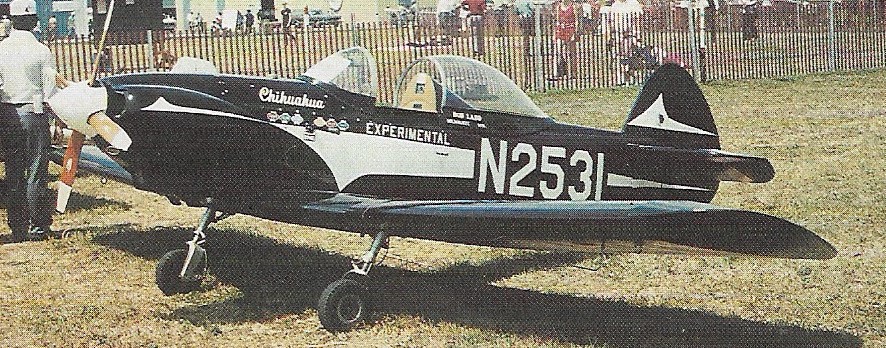
Engine: 53hp VW
Wingspan: 21’0″
Length: 15’6″
Cruise speed: 118 mph
Stall: 60 mph
Range: 250 mi
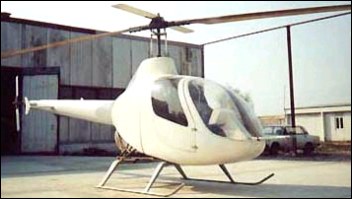
This light helicopter was built and flown in 2001 by the Lada Land company based in Tolyatti, Russia.
Lada Land VM-01
Engine: 1 x 170hp VAZ-416 piston
Main rotor diameter: 9.00m
Tail rotor diameter: 1.56m
Max take-off weight: 890kg
Payload: 300kg
Cruising speed: 140km/h
Rate of climb: 240m/min
Ceiling: 3000m
Range: 330km
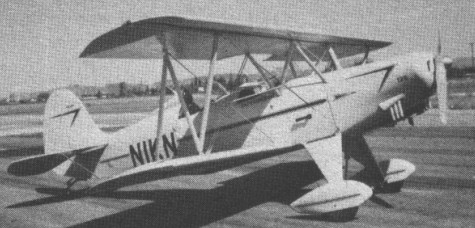
The LACO-125 is a sturdy two-seat biplane that is easy to fly yet very agile. To aid the builder, there are no castings, forgings or other difficult-to-build or obtain parts. The fuselage is a Warren truss type of chrome-moly tubing with wood formers and stringers. The wings are conventional two-spar construction with wood ribs and chrome-moly fittings for strength. This homebuilt derives its designation from the use of a 125-hp Continental in the prototype which is interchangeable with the 145-hp engine. The weight distribution of the LACO-125 is such that larger four-cylinder powerplants can be substituted.
The first, N1KN, was flown on 29 May 1977.
LACO-125
Engine Continental C-125, 125-hp
Wingspan: 22’9”
Length: 19’6”
Gross Wt: 1400 lb
Empty Wt: 860 lb
Fuel capacity: 24 USG
Top speed: 124 mph
Cruise: 113 mph
Stall: 56 mph
Climb rate: 900 fpm
Range: 325 miles
Seats: 2
Founder: Joe Laven
1980: LACO, Banning Municipal Airport, PO Box 415, Desert Hot Springs, CA 92240, USA.
Airplane builder
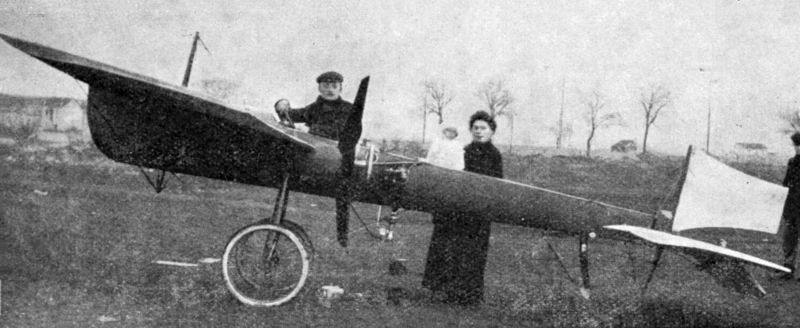
The first design of Adolphe-Étienne Lachassagne was this 1912-1913 tandem wing monoplane. The front and the tail wings could be adjusted. The two propellers were fitted at the trailing edge of the front wing, and were adjustable together with the wing. The engine was mounted in the fuselage and drove the two propellers via a rod. As Lachassagne had no funds to acquire a new and powerful engine he had to do with second hand engines. Lachassagne started to study a new aeroplane with tandem wings. The AL-2 airplane was never built in full size, only as a model. He was creative inventor and kept developing and building variable wing profile aircraft at least up to WW2. He also tried to develop a small affordable “peoples airplane”.
The first design of Adolphe-Étienne Lachassagne was a 1912-1913 tandem wing monoplane. As Lachassagne had no funds to acquire a new and powerful engine he had to do with second hand engines. Lachassagne started to study a new aeroplane with tandem wings. The AL-2 airplane was never built in full size, only as a model.
Lachassagne was creative inventor and kept developing and building variable wing profile aircraft at least up to WW2. He also tried to develop a small affordable “peoples airplane”.
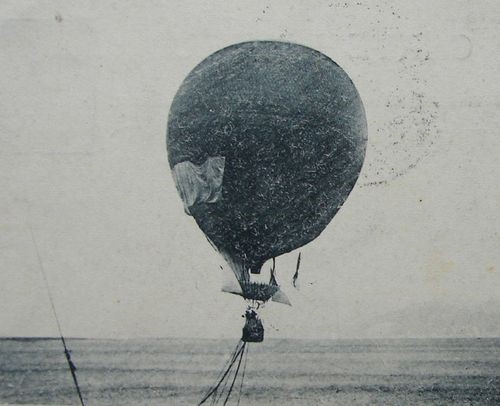
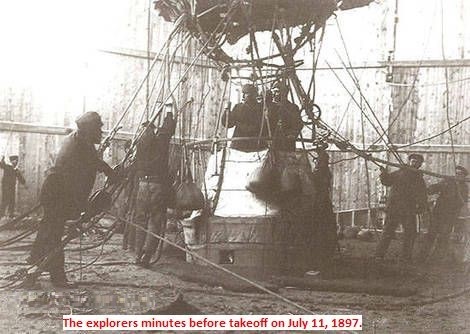
Swedish polar explorers Andrée, Fraenkel and Strindberg departing from Danes Island, Spitsbergen, in the Svalbard archipelago, on July 11, 1897, in an ill-fated attempt to reach the North Pole. The hydrogen gas balloon, 67 feet in diameter, with a capacity of 170,000 cubic feet, was built by Henri Lachambre in Paris. Three varnished layers of double Chinese silk formed the upper half of the envelope, with a single layer on the bottom half. A heavy casing of woven hempen netting shrouded the balloon, which was surmounted by a cap, or calotte, of varnished silk to keep arctic snows from lodging in the netting. Suspended from a bearing ring formed from American elm wood was a wicker car measuring 6.5 feet in diameter and 5 feet deep. The balloon was originally named “Le Pôle Nord”, but was later christened “Örnen” (Eagle). In 1930, the remains of Saloman Andrée and his two companions were discovered on White Island and repatriated to Sweden.
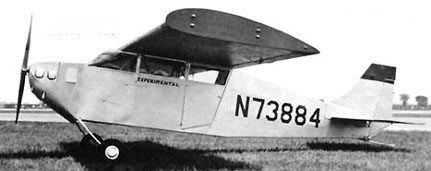
Built by Joseph L Lacey in 1962, the the two place Lacey M-10 had a pivoting unbraced wing stowed fore-and-aft for trailing or hangaring. One was built, N73884, first flying on 7/6/62.
The Lacey is one of the simplest designs for the homebuilder to construct. In the words of its designer, “There are no com¬pound curves and very few simple ones. The wing has no wash-in, no washout, no dihedral, and no incidence angle (the bottom is flat, and fits flat on top of the fuselage). It has no taper, no slots, no flaps, no spoilers, no wingtips, no struts, no wires, no braces, no spars.” The two-place, towable Lacey is propelled by a 90-hp Continental.
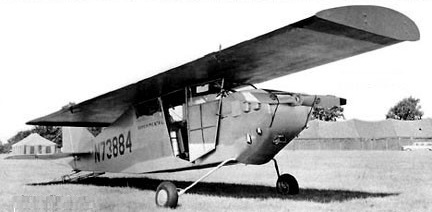
One M-10 VW Twin was built, N187LH, in 1968.
M-10
Engine: 95hp Continental C-90
Wingspan: 20’0″
Length: 19’6″
Gross Wt. 1118 lb
Empty Wt. 638 lb
Fuel capacity 20 USG
Useful load: 400 lb
Top speed: 140 mph
Cruise speed: 120 mph
Stall: 38 mph
Climb rate: 1000 fpm
Ceiling: 25,000′
Range: 440 miles
Takeoff run: 600 ft
Landing roll: 600 ft
Seats: 2
M-10 VW Twin
Engine: 2 x 40hp VW
Wing span: 20’0″
Length: 19’6″
Seats: 2
1962:
Joseph L Lacey
Tulsa
OK.
USA
1980: Joe Lacey, 1600 McArthur, Irving, TX 75060, USA.
Aircraft builder

