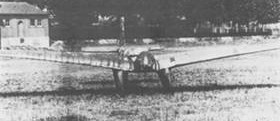
After the First World War the allied forces had destroyed all flight material, defined at that time as motorized aircraft. But a gray area was the building of a glider which seemed as no serious offence against the regulation.
Contrary to the gliders of the time the Düvel was a cantilever low-wing aircraft, which developed on the fundamentals of Professor Hugo Junkers. Professor Junkers taught at Aachen that the thick, cantilever wing with carefully disguised chassis was the future of the airplane.
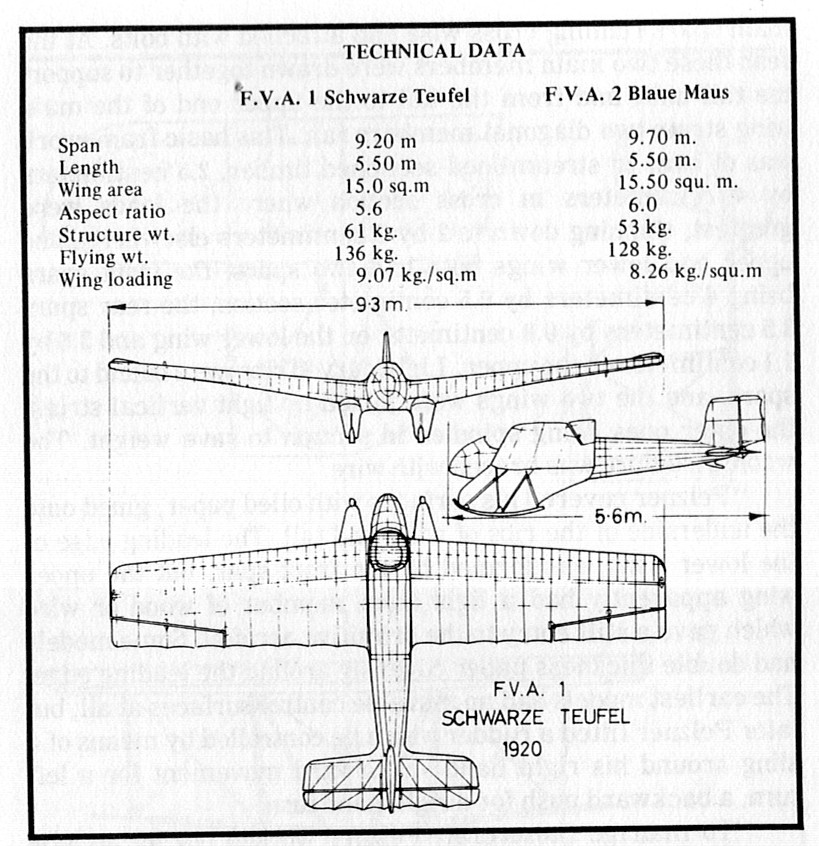
Built in day and nightshifts from wood, the first of the FVA built glider, the Schwatze Düvel was finished in 1920, built under the direction of Professor Theodore Kármán and Wolfgang Klemperer as well as a group of students.
The form is accomplished with plywood, with no flying wires. Sheet metal fittings were avoided. Only the clips, with which the tail can be separated from the fuselage and which are an attachment of the wing rear edge cord at the rib ends are aluminum plate. All remaining connections are with cold glue, where necessarily using Passleistchen and Passhölzchen glue.
In order to use the overall height of the thick wing profile, three cross-beams were utilised. The main spar had a 9.50 m span and weighed 7,5 kg. The ribs have a profile height tapering outward and are similar in the form to those of the Junkers airplanes. The internal rib had 0.42 m thickness. They are put in by the recesses of the cross-beams and are glued with the spar webs.
At a false spar 0.75 m large ailerons are linked. An aileron flap weighs 870 gm. It is rigid without pre-loading. The whole finished covered wing has a weight of only 24 kg with approximately 15 m area. For the covering served a particularly fine black Voilestoff, which with a special, here for the first time used kollodiumhaltigen means had impregnated and with 6 kg/cm ultimate tensile strength and weighed 90 g/sq.m. The impregnation worked in the wet weather on the Rhön excellently.
The seat is inserted between main and front spar and essentially rests on the latter. The control stick is duralumin pipe of 130 g with a hollow steel ball of 46 g in a hollow ball bowl ring of 32 g, from aluminum alloy. The joint is fastened to a pyramid-like plywood carrier to the front spar. The rudder pedals are hollow and weighs 150 g including the aluminum plate foot slots. The undercarriage is rubber-fitted with springs and skids.
The tail is supported by a low spur formed from tied together tubing sticks. The continuous elevator of 1400 g weight and 600 g heavy rudders are on duralumin pins in duralumin sockets stored and easily dismantlable. The steering ropes can be separated with snap hooks and be loosened with safety pin-like steel taps. The disassembly or assembly of the whole tail, which weighs only 11 kg complete, can be carried out in 2 minutes by three men.
The take-off uses rubber cord, which was bolted around hooks at the rear skid ends. The machine started with 62 kg unloaded weight and approximately 9 kg surface loading with 4 m/s wind. The excellent view, good sensitivity and agility, as well as the good characteristics of the thick profile during fast and slow flight make it suitable for soaring.
The FVA-1 Düvel, number 23, won the 1920 Rhönwettbewerb the first prize. The FVA 1 set a record en-route flight of 1830m on the first Röhnwettbeweb.
A world record flight was made by Wolfgang Klemperer on 30 August 1921 in the FVA1 of over 4.6km distance in 13 minutes.