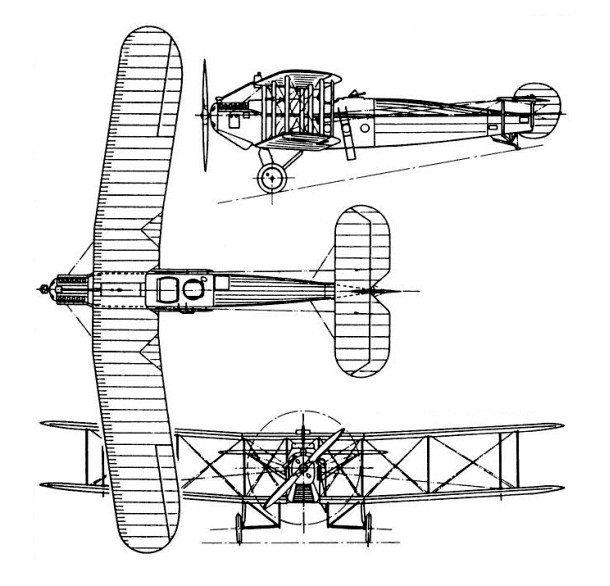
Avro 549 Aldershot

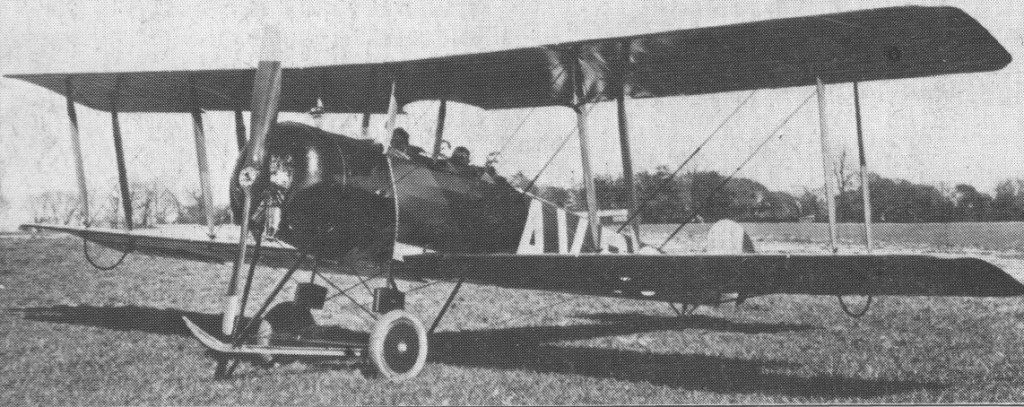
A three-seat heavy bomber of 1922 powered by a 485kW Rolls-Royce Condor III engine. Fifteen were built for No 99 Squadron, RAF, serving between 1924 and 1926.

Aldershot testbed for 1000 hp Napier Cub engine, with an Avro Baby.

Avro 549 Mark III
Engine: 1 x 650hp Rolls-Royce Condor III
Take-off weight: 4971 kg / 10959 lb
Empty weight: 2865 kg / 6316 lb
Wingspan: 20.73 m / 68 ft 0 in
Length: 13.72 m / 45 ft 0 in
Height: 4.65 m / 15 ft 3 in
Wing area: 98.85 sq.m / 1064.01 sq ft
Max. speed: 177 km/h / 110 mph
Ceiling: 4420 m / 14500 ft
Range: 1050 km / 567 nm
Armament: 3 x 7.7mm machine-guns, 4 x 240kg bombs or 8 x 110kg bombs
Crew: 3-4

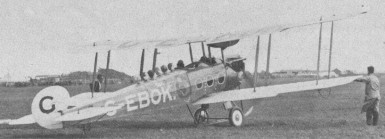
Avro 547

Avro 547A

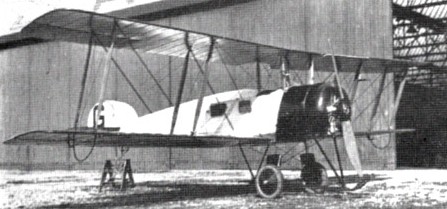
A four-passenger cabin transport which unsuccessfully competed in the Air Ministry Small Commercial Aeroplane Competition in 1920.

Avro 547
Engine: 1 x 160hp Beardmore
Take-off weight: 1362 kg / 3003 lb
Empty weight: 943 kg / 2079 lb
Wingspan: 11.35 m / 37 ft 3 in
Length: 9.09 m / 30 ft 10 in
Height: 4.39 m / 14 ft 5 in
Wing area: 46.27 sq.m / 498.05 sq ft
Max. speed: 155 km/h / 96 mph
Cruise speed: 134 km/h / 83 mph
Range: 370 km / 230 miles

Avro 547A

Avro 539

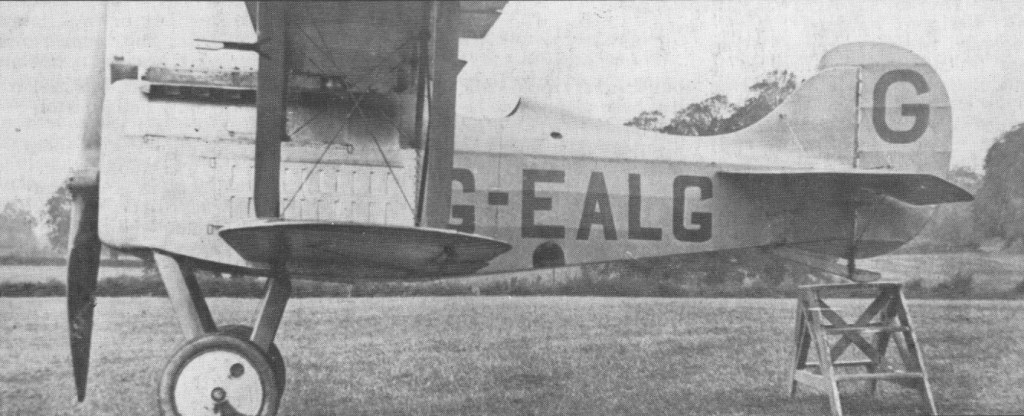
With the UK staging the first post-war Schneider Trophy contest in 1919, Avro decided to build and enter an aircraft, the Avro 539. In order to achieve the highest possible speed, it was the smallest practical single-engined aircraft that could be designed around the selected powerplant, a Siddeley Puma inline engine. An unequal-span biplane, with ailerons on both wings, it was of conventional construction with two single-step floats that were long enough to eliminate the need for a third float beneath the tail. First flown on 29 August 1919, only 12 days before the day of the race, the Avro 539 had performance that was considered to be generally satisfactory. However, when taking off from Cowes to take part in the seaworthiness trials, which were a compulsory preliminary to the speed contest, a float was seriously damaged by floating debris. Avro was given five days to repair, and used this time also to modify the tail unit. When the floatplane appeared again it carried the registration G-EALG, and because of the modifications was re-designated Avro 539A. When tested, its performance was not good enough to warrant selection for the speed contest, with the result it was delegated as the British reserve aircraft. The contest, held at Bournemouth on 10 September 1919 was a fiasco in foggy conditions and was abandoned.

The 539 was converted to a landplane and took part in the Aerial Derby of 1920, but force-landed with a fuel system leak. Then extensively modified, and with a 450 hp / 336 kW Napier Lion engine installed, it was re-designated Avro 539B. During tests before the 1921 Derby, the aircraft overshot on landing and was completely wrecked.

Avro 539A

Avro 539
Engine: 1 x 240hp Siddeley Puma
Wingspan: Upper 25 ft 6 in / 7.77 m / lower 24 ft 6 in / 7.47 m
Length: 6.50 m / 21 ft 4 in
Height: 2.97 m / 9 ft 9 in
Wing area: 18.12 sq.m / 195.04 sq ft
Take-off weight: 962 kg / 2121 lb
Empty weight: 758 kg / 1671 lb

Avro 536 / 546

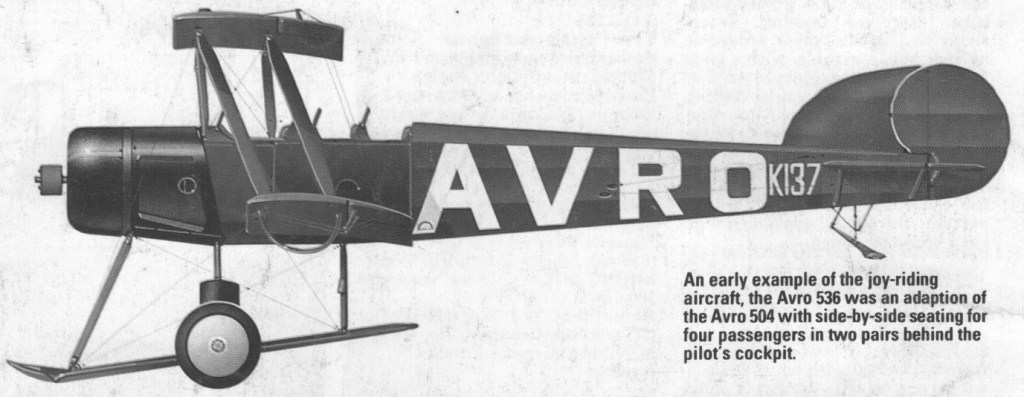
Early post-war pleasure flying was booming and a batch of Avro 504Ks were modified at the company’s Hamble factory. The fuselage was widened 9 in / 22.8 cm to accommodate four passengers in two pairs in the rear cockpit. The first conversion flew at Hamble in April 1919 and was later fitted with floats, the only such floatplane.

In all, 25 Avro 536s were built. 10 at Hamble, 12 at Manchester, and three at Croydon, where Surrey Flying Services undertook assembly.

A considerable amount of joy-riding was undertaken with these open-cockpit aircraft, and one was completed as a two-seater with a long range fuel tank. The last 536s were withdrawn from use at the end of 1930, these being the Surrey Flying Services machines, which had been fitted with 130 hp / 99 kW Clerget engines when Bentley rotaries became unavailable.

The Last Hamble-built Avro 536 was finished as the Avro 546 four-seat cabin biplane. The pilot was seated outside, I a cockpit above the three-seat cabin. Registered in December 1919, the 546 flew very little and its registration was cancelled 12 months later.

Avro 536
Engine: 1 x 130hp Clerget or 150hp Bentley B.R.1
Wingspan: 11.20 m / 37 ft 9 in
Length: 8.97 m / 29 ft 5 in
Height: 3.18 m / 10 ft 5 in
Wing area: 31.12 sq.m / 334.97 sq ft
Take-off weight: 1011 kg / 2229 lb
Empty weight: 650 kg / 1433 lb
Max. speed: 145 km/h / 90 mph
Cruise speed: 113 km/h / 70 mph
Ceiling: 3658 m / 12000 ft
Range: 306 km / 190 miles
Seats: 5

Avro 534 / 543 / 554 Baby

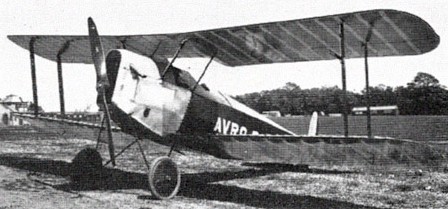
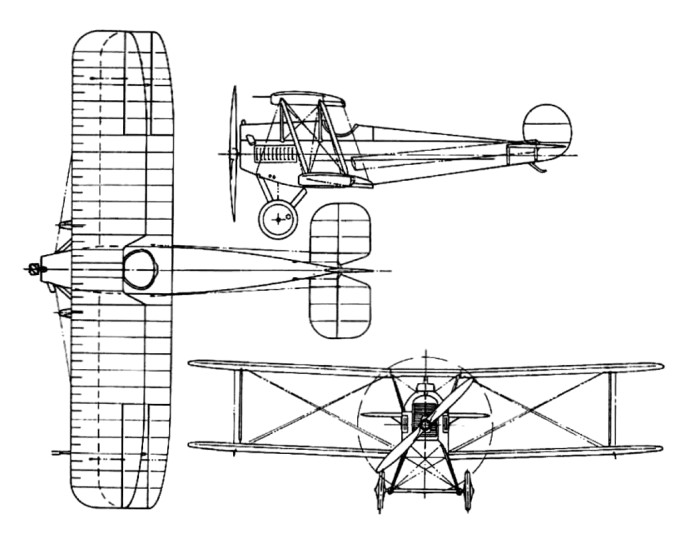
After WW1, A.V.Roe entered the light aircraft field with the Avro 534 Baby, a low-powered lightweight single-seat biplane. At the time, the only suitable engine was a 35 hp / 26 kW Green, which was modified by the makers. Designed around this machine, the Baby first flew on 39 April 1919, Just two minutes after take off it crashed at Hamble, the pilot having inadvertently switched off the ignition.

A second Baby flew on 10 May 1919, powered by the original engine, salvaged from the first aircraft, and this machine proved to have reasonable performance.

Records indicate that about nine Babies were built at Hamble, several achieving fame in notable flights.

Bert Hinkler was awarded the Britannia Trophy for 1 650 mile / 1046 km Croydon to Turin flight in 9 hr 30 min, while the third Baby won the 1920 Aerial Derby. One was sold to Russia, but the longest surviving example was probably the first production aircraft, which went to Australia and remained on that country’s civil register until 1936.

Avro 534B Baby

Variants

Avro 534A Water Baby
Twin-float seaplane flown in October 1919. Crashed in September 1921

Avro 534B
Version with plywood covered fuselage and shorter span lower wing.
Only one built. Crashed in August 1920.

Avro 534C
Version with reduced span wings for the 1921 Aerial Derby. Crashed in September 1922.

Avro 534D
Special version with modifications, to the order of Colonel E. Villiers, who used it for business trips around Calcutta until 1929.

Avro 543
Two-seat version with forward fuselage lengthened by 2 ft 6 in / 0.76m. later re-engined with 60 hp / 45 kW A.D.C. Cirrus engine and used until 1934.

Avro 554
Photo-survey version mounted on twin floats for the 1921 Shackleton-Rowett South Polr Expedition. Powered by an 80 hp / 60 kW Le Rhone rotary.

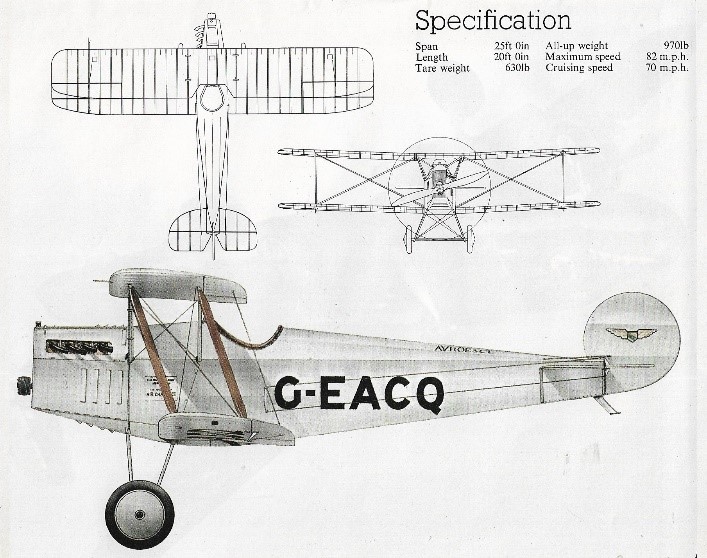
Avro 534
Engine: 1 x 35hp / 26 kW Green
Wingspan: 7.62 m / 25 ft 0 in
Length: 5.33 m / 17 ft 6 in
Height: 2.31 m / 7 ft 7 in
Wing area: 16.72 sq.m / 179.97 sq ft
Take-off weight: 395 kg / 871 lb
Empty weight: 280 kg / 617 lb
Max. speed: 129 km/h / 80 mph
Cruise speed: 113 km/h / 70 mph
Service ceiling: 12,000 ft / 3660 m
Range: 322 km / 200 miles

Hinkler’s Avro 534 Baby G-EACQ

Avro / A.V.Roe

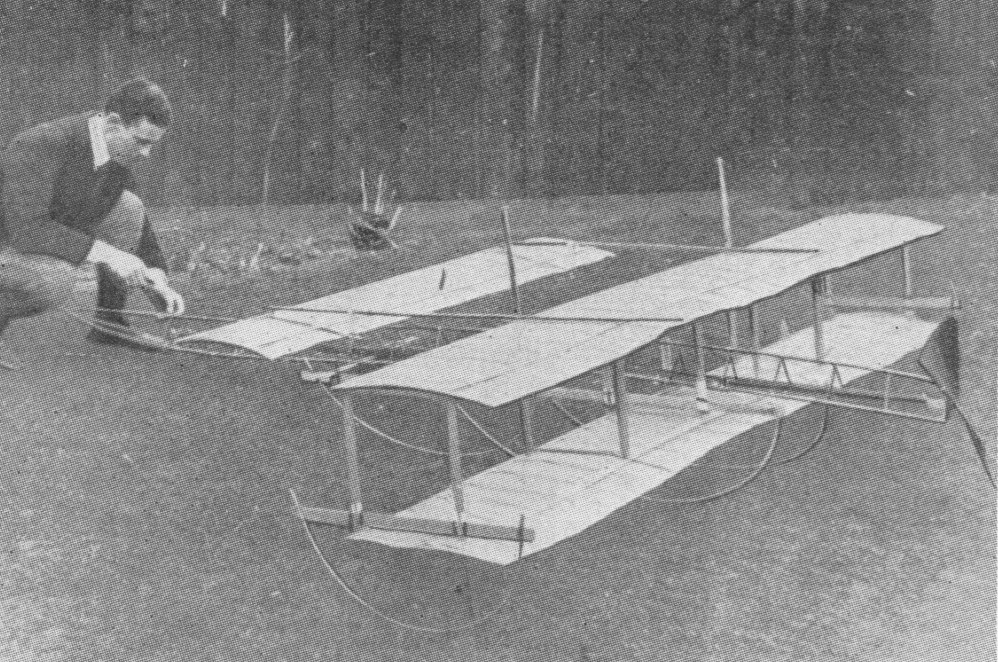
When the Daily Mail organised a model-flying contest at Alexander Palace, London, in March 1907, young A.V. Roe won first prize. His 8 ft tail first model flew more than 100 feet.

Avro Article

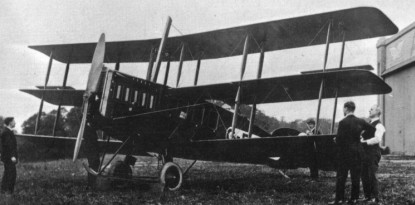
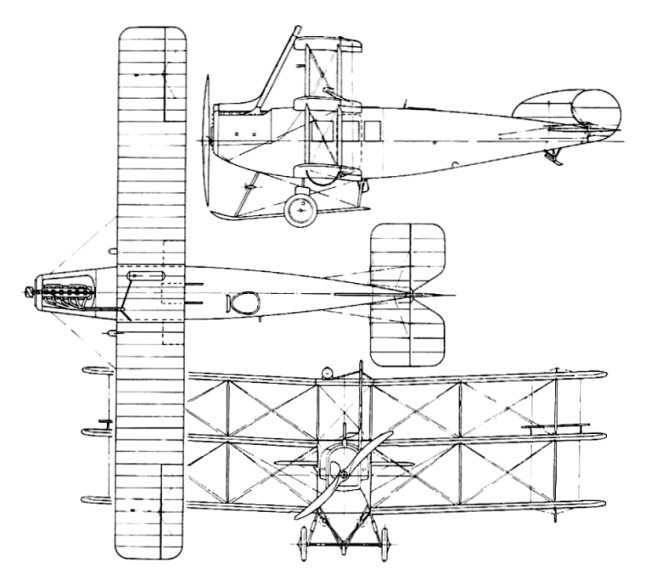
Alliott Verdon Roe, after a varied career in surveying, tree-planting, fishing, post-office management and marine engineering began aircraft design in 1906. Spurred by winning £75 in a model aircraft contest held in London in 1907. Roe built a full-size biplane, which made some tentative hops from the motor racing circuit at Brooklands in 1908.

Moving to an abandoned railway arch on Lea Marshes in Essex, he built the Roe I Triplane which weighed less than 91 kg (200 lb) and was covered in brown wrapping paper. He called it the Bull’s-Eye Avroplane after the brand-name of men’s trouser braces whose manufacturer had supported him. In July 1909 the Roe I Triplane made the first official powered flights in Britain by an all-British aircraft.
Alliott Roe subsequently developed three other triplane designs, one of which he flew (and crashed three times) at the great Boston-Harvard Aviation Meeting of 1910.

A.V. Roe and Company was established at Brownsfield Mill, Great Ancoats Street, Manchester, by Alliott Verdon Roe and his brother Humphrey Verdon Roe on 1 January 1910. Humphrey’s contribution was chiefly financial and organizational; funding it from the earnings of the family webbing business and acting as Managing Director until he joined the RFC in 1917.

In the summer of 1910 A. V. Roe and Company declared its willingness to build aeroplanes to other people’s designs and the first such aircraft was a Farman-type biplane for a Bolton business man. The Farman-type evidently did not meet with much success as 18 months later, at the end of 1912, the engine and airframe were advertised for sale in new condition for £45 and £60 respectively. Bolts, fittings and bracing wires were also supplied to Miss Lilian Bland who built and flew the Mayfly biplane of her own design at Carnamony, Belfast. Each of these aircraft was fitted with one of the few examples of the 20 h.p. two cylinder, horizontally opposed, air cooled Avro engines. These were never given an Avro designation.

A.V.Roe carried out numerous experiments with all kinds of plane sections with varying cambers, etc. These were sold off in November 1911 at peppercorn prices for gliders.

The first Avro aircraft to be produced in any quantity was the Avro E or Avro 500, first flown in March 1912, of which 18 were manufactured, most for the newly-formed RFC. The company also built the world’s first aircraft with enclosed crew accommodation in 1912, the monoplane Type F and the biplane Avro Type G in 1912, neither progressing beyond the prototype stage. The Type 500 was developed into the Avro 504, first flown in September 1913. A small number were bought by the War Office before the outbreak of the First World War and the type saw some front line service in the early months of the war, but is best known as a training aircraft, serving in this role until 1933. Production lasted 20 years and totalled 8,340 at several factories: Hamble, Failsworth, Miles Platting and Newton Heath.

By 1913 the company had become registered as A.V.Roe & Co. Ltd.

After the boom in orders during the First World War, the lack of new work in peacetime caused severe financial problems and in August 1920, 68.5% of the company’s shares were acquired by nearby Crossley Motors who had an urgent need for more factory space for automotive vehicle body building.

In 1924, the Company left Alexandra Park Aerodrome in south Manchester where test flying had taken place during the period since 1918 and the site was taken over by a mixture of recreation and housing development. A rural site to the south of the growing city was found at New Hall Farm, Woodford in Cheshire, which continued to serve aviation builders BAE Systems until March 2011.

Cierva Autogiro production started in Britain at A. V. Roe’s Hamble factory in 1926.

In 1928 Crossley Motors sold AVRO to Armstrong Siddeley Holdings Ltd. In 1928, A.V.Roe resigned from the company he had founded and formed the Saunders-Roe company that after World War II developed several radical designs for combat jets, and, eventually, a range of powerful hovercraft.

In 1928 Avro acquired a license to build the Fokker F.VIIB/3M as the Avro 618 Ten: it carried eight passengers and two crew, and orders included five for Australian National Airways. Rivaling the success of the 504 was the twin-engined Anson trainer and coastal patrol monoplane, flown as the Avro 652 civil transport for Imperial Airways in 1935.

In 1935, Avro became a subsidiary of Hawker Siddeley.

More than 10,000 Ansons were built in Britain and Canada between 1935 and 1952. The twin-engined Manchester bomber of 1939, with the unproven Rolls-Royce Vulture engines, was not a success, but led to the superb four-engined Lancaster, of which 7,374 were built during Second World War. The York transport derivative mated the same wings and tail, plus a central fin, with an entirely new fuselage seating 12 passengers. The Lincoln bomber was built as a replacement for the Lancaster, entering RAF service soon after VJ-day.

Over 7,000 Lancasters were built and of the total, nearly half were built at Avro’s Woodford and Chadderton (Manchester) sites, with some 700 Lancasters built at the Avro “shadow” factory next to Leeds Bradford Airport (formerly Yeadon Aerodrome), northwest Leeds. This factory employed 17,500 workers at a time when the population of Yeadon was just 10,000. The old taxiway from the factory to the runway is still evident.

Although only ⅓ of Lancasters hit their target, the Lancasters were at the time Britain’s best bombers.

The civilian Lancastrian and maritime reconnaissance Shackleton were derived from the Lancaster design. Avro’s postwar Tudor transport was not a success. With the same wings and engines as the Lincoln, it achieved only a short (34 completed) production run following a first flight in June 1945 and the cancellation of an order from BOAC.

The company’s last piston-engined aircraft was the Shackleton four-engined maritime reconnaissance aircraft. Following production of four Avro 707 delta research aircraft, the company produced the four-jet delta-wing Vulcan bomber, which began to enter RAF service in 1956. The Vulcan saw service as a conventional bomber during the British campaign to recapture the Falkland Islands in 1982. Vulcan XH558 flew again after several years of refurbishment, and several are prized as museum exhibits. Avro’s last design before being restyled the Avro Whitworth Division of Hawker Siddeley Aviation, in 1963, was the Avro 748 twin-turboprop transport (first flown in 1960). The Royal Flight bought a few and a variant with a rear-loading ramp and a “kneeling” main undercarriage was sold to the RAF and several members of the Commonwealth as the Andover.

When the company was absorbed into Hawker Siddeley Aviation with Folland, Gloster, Armstrong Whitworth, and de Havilland in July 1963, the Avro name ceased to be used. The brand still had a strong heritage appeal, and the marketing name “Avro RJ” (regional jet) was used by British Aerospace for production of the RJ-85 and RJ-100 models of the BAe 146 from 1994 to 2001. This aircraft type is sometimes also loosely called the “Avro 146”.
The BAe ATP (Advanced Turbo Prop) design evolved from the Avro 748. At 39 years, the Shackleton held the distinction of being the aircraft with the longest period of active RAF service, until overtaken by the English Electric Canberra in 1998.

AVIS III / AVIS IV           

Developed in parallel with the AVIS II and entering flight test shortly afterwards in 1935, the AVIS III was powered by a 550hp Manfred Weiss-built Gnome- Rhone 9Krsd Mistral nine-cylinder radial engine driving a three-bladed adjustable-pitch Hamilton Standard propeller. Unlike the preceding AVIS fighters which were of all-metal construction, the AVIS III had wooden wings with a combination of plywood and fabric skinning, and four prototypes were laid down. The AVIS III demonstrated improved characteristics, but lacking the agility of the Fiat CR.32, which was meanwhile evaluated by the Legilyi Hivatal and adopted for service, it was not ordered into production. The armament of the AVIS III was two 7.62mm Gebauer machine guns, and one of the four prototypes was completed with minor modifications as the AVIS IV.

AVIS III
Engine: 1 x 700hp Weiss/Gnome Rhone 9Krsd
Wingspan: 9.50 m / 31 ft 2 in
Length: 7.80 m / 26 ft 7 in
Height: 3.20 m / 11 ft 6 in
Wing area: 20.20 sq.m / 217.43 sq ft
Max take-off weight: 1380 kg / 3042 lb
Empty weight: 1210 kg / 2668 lb
Max. speed: 310 km/h / 193 mph
Cruise speed: 256 km/h / 159 mph
Ceiling: 6500 m / 21350 ft
Range: 400 km / 249 miles
Crew: 1
Armament: 2 x 7.62mm mm