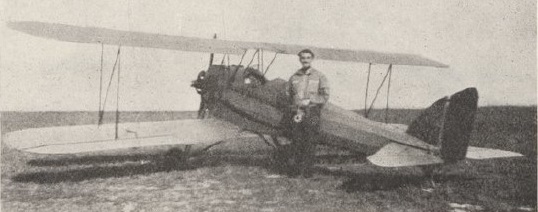
The Moineau biplane was designed and built by MM Bessard & Millevoye at Saint-Ouen in 1935. It featured a tube fuselage and 20-25 hp Poinsard engine.
The name ‘Le Moineau’ appeared on its fuselage.
The Moineau biplane was designed and built by MM Bessard & Millevoye at Saint-Ouen in 1935. It featured a tube fuselage and 20-25 hp Poinsard engine.
The name ‘Le Moineau’ appeared on its fuselage.

The Besler steam engine was a two-cylinder compound in V-configuration; one cylinder ran at high pressure and the other low. It was rated at 90 HP, fed with steam at 1130 psi and 430 degC. It weighed about 500 lbs.
A converted switch-locomotive powerplant, it was designed collaboratively by the Doble Steam Motors Company and the Besler brothers in 1933. A two-cylinder steam power 150hp reciprocating engine designed by William Besler; total 650 lb with its accessories, liquids, and fuel oil-heated boiler.
A Travel Air 2000 biplane made the world’s first piloted flight under steam power over Oakland, California, on 12 April 1933. The strangest feature of the flight was its relative silence; spectators on the ground could hear the pilot when he called to them from mid-air. The aircraft, piloted by William Besler, had been fitted with a two-cylinder, 150 hp reciprocating engine.

An important contribution to its design was made by Nathan C. Price, a former Doble Steam Motors engineer. Price was working on high pressure compact engines for rail and road transport; the purpose of the flight was to obtain publicity for this work. Following its unexpectedly favourable reception Price went to Boeing and worked on various aviation projects, but Boeing dropped the idea of a steam aero engine in 1936. Price later worked for Lockheed where his experience with developing compact burners for steam boilers helped to design Lockheed’s first jet engine.

Oakland/Emeryville, Ca. 1933

Besler Aero is known for flying a Travel Air 2000 powered by one of their steam engines.
John Berry (1849-1931) was an inventor, mechanic, car-dealer, and builder of balloons in St. Louis who in 1907 was slated to race his airship in the dirigible races held in conjunction with the Gordon Bennett balloon race.
Berry made his first balloon flight on a smoke balloon, in 1862 at the age of 13 from Rochester, N.Y., and his first gas balloon flight the following year. “The Dean of American Aeronauts”, Capt. Berry made more than 500 balloon flights during his aeronautical career which lasted sixty years; his last flight taking place in 1922.
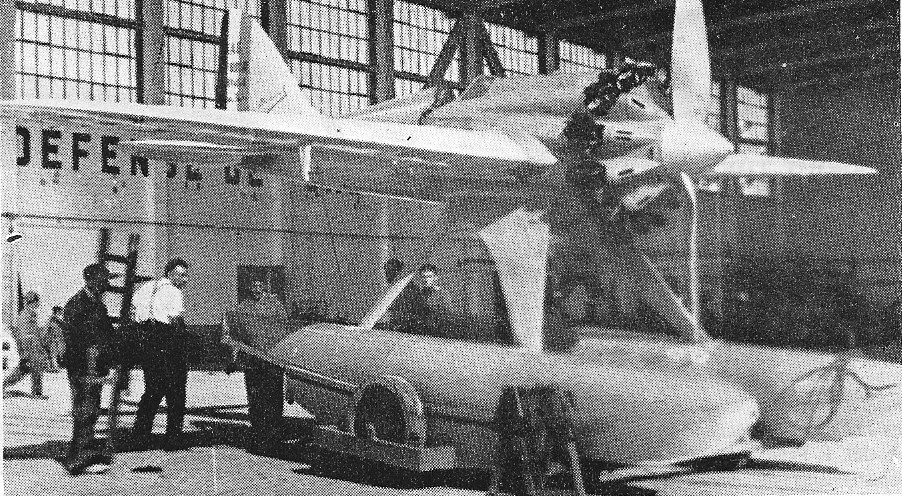
The Bernard HV.45 speed trainer was used for training pilots taking part in the Schneider Trophy Races during 1928.
It was based at Berre, France, until 1939.
Engine: Gnome Rhone 9 Kfr, 1200 hp
Span: 28 ft 6 in
Length: 24 ft 4 in
Height: 11 ft 9 in
Max speed: 280 mph
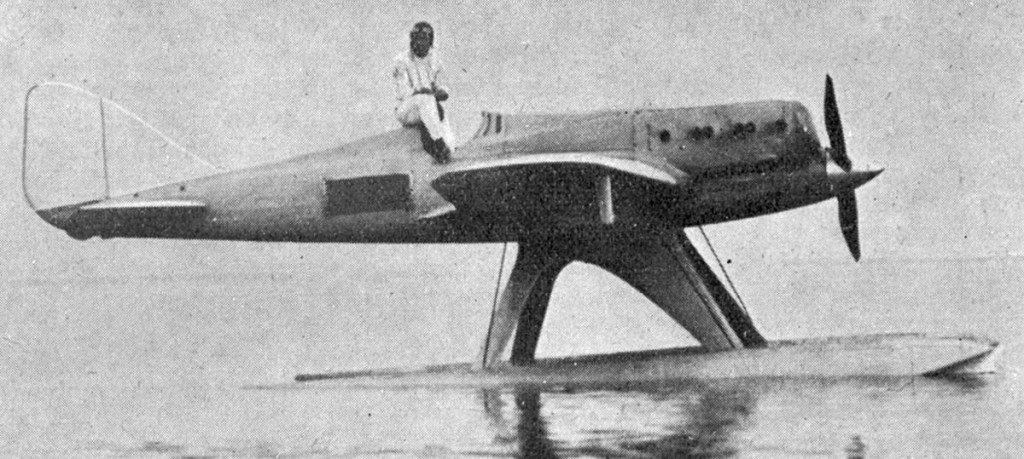
The Bernard H.V.42 was a racing seaplane designed by Société des Avions Bernard for the French government for use of the French Schneider Trophy team.
Three H.V.42s were ordered by the French government for use as trainers for the French Schneider Trophy team at Lake Berre. Similar to the earlier H.V.41 they were streamlined single-seat cantilever monoplanes with twin floats. The first H.V.42 flew in March 1931 and was soon joined by the other two. Marked as “1” “2” and “3” they were used during the summer of 1931 to train the French team for the 1931 race.
Powerplant: 1 × Hispano-Suiza 12Nsr Special, 746 kW (1,000 hp)
Wingspan: 9.20 m (30 ft 2.25 in)
Wing area: 12.00 sq.m (129.17 sq ft)
Length: 7.99 m (26 ft 2.5 in)
Height: 3.60 m (11 ft 9.75 in)
Maximum speed: 450 km/h (280 mph, 240 kn) (estimated)
Crew: 1
The Bernard-370 was single seat racer aircraft project intended for Coupe Deutsch contest of 1934, powered by one 450 hp Salmson V engine.
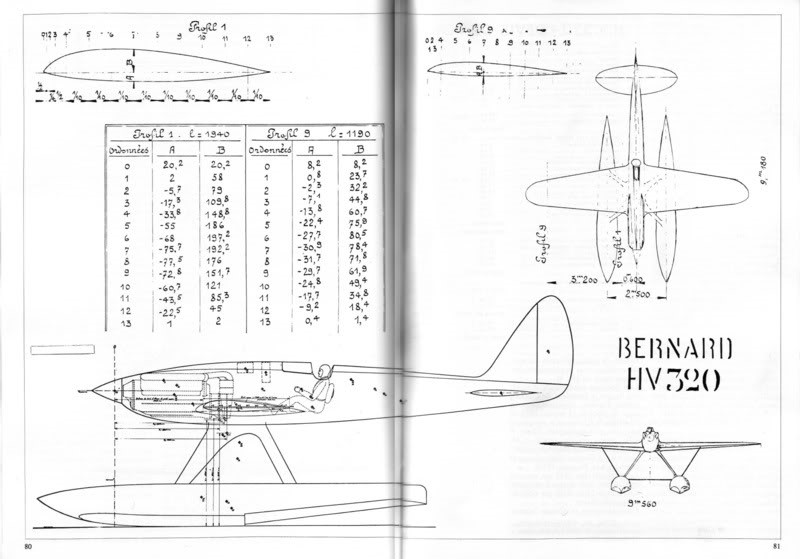
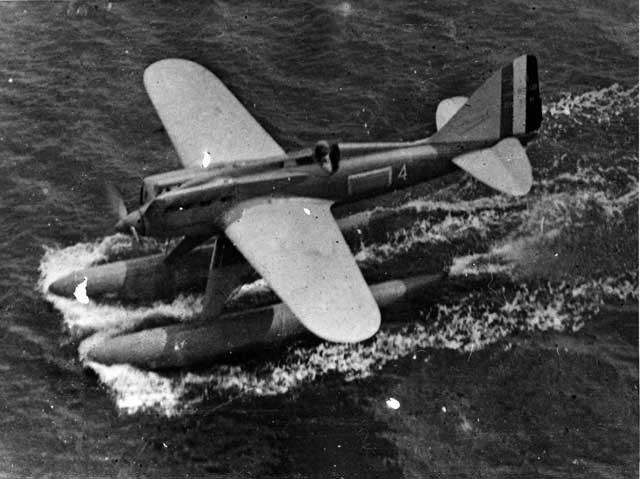
The H.V.120 was a wooden single-seat mid-wing cantilever monoplane seaplane designed and built by Bernard to compete in the Schneider Trophy race.
Powered by a 1,680 hp (1,253 kW) Hispano Suiza 18R W-18 piston engine, the first H.V.120 flew for the first time at Hourtin on 25 March 1930. Development was delayed due to engine problems, as well as technical issues. It was overweight and the engine mount and forward fuselage had to be re-designed. The first aircraft had a direct drive three-bladed propeller but the second had a reduction gear to drive a four-bladed Chauvière propeller. The second aircraft crashed into the water on its first flight in July 1931 killing pilot Georges Bougault.
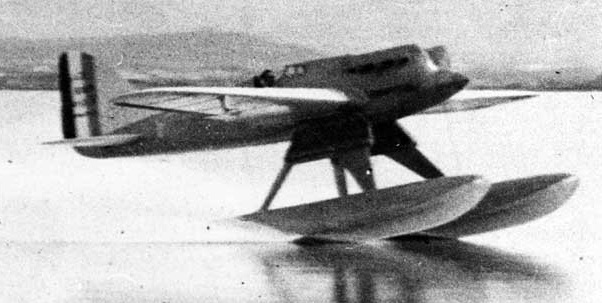
In 1933 the prototype was converted into a racing landplane as the Bernard V.4 with a 1,125 hp (839 kW) Hispano-Suiza 18Sb engine and shorter span wings. The V.4 had widely spaced main landing gear with streamlined wheel spats. It was moved to Istres in December 1933 to try and achieve a French Air Ministry prize for a French aircraft to beat the world speed record before January 1934. It was due to make an attempt to fly on 27 December 1933 but strong winds kept the aircraft grounded. Further attempts in February 1934 to fly were thwarted by engine problems and lack of government finance. The project was abandoned without the aircraft have flown.
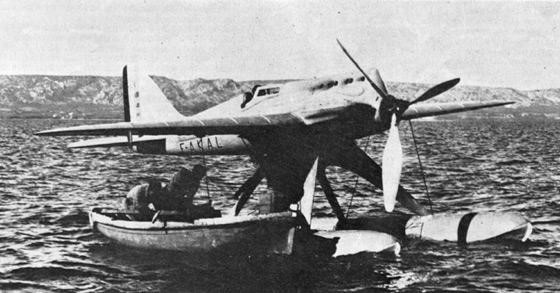
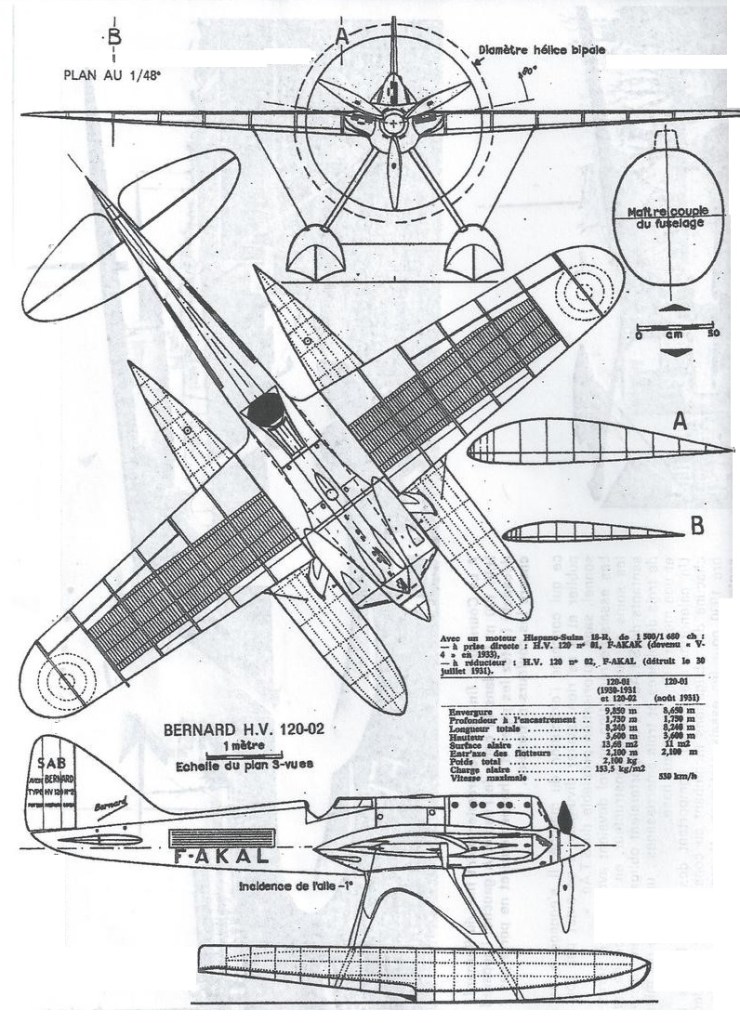
H.V.120-01
Engine: 1 × Hispano Suiza 18R W-18, 1,253 kW (1,680 hp)
Propeller: 3-bladed
Length: 8.24 m (27 ft 0 in)
Wingspan: 8.65 m (28 ft 5 in)
Height: 3.60 m (11 ft 10 in)
Wing area: 11.00 m2 (118.4 sq ft)
Max takeoff weight: 2,100 kg (4,630 lb)
Maximum speed: 530 km/h (329 mph; 286 kn)
Crew: 1
The Bernard SIMB AB 10 or Bernard SIMB AB 10 C 1 single-seat fighter (the AB in this name stood for Adolphe Bernard and C for chasseur – English: fighter – with 1 indicating single-seat), was an all-metal aircraft with straight-edged, slightly tapered wings which had straight wing tips tips rounded at the leading edge designed by Jean Hubert. Ailerons extended to the tips. The tail surfaces had straight swept leading edges but had rounded trailing edges on the control surfaces. The tailplane was mounted on top of the fuselage and the rudder extended to the bottom of the fuselage, moving between separate elevators.
Its fuselage, rounded in cross-section, tapered to the rear and curved down forwards over the engine to the low-mounted two-blade propeller. The open cockpit, with a brief, faired headrest, was placed over the middle of the wing. It had a conventional undercarriage with a pair of single mainwheels and a tailskid, but the mainwheel mounting was unusual, a wide-chord faired inverted T-shaped pylon. The engine was a 224 kW (300 hp) Hispano-Suiza V-8, cooled by a pair of Lamblin radiators placed horizontally side by side below the fuselage.
During its development the AB-C.1 was displayed at the Paris Aero Show in December 1922, though without its radiators. Over twenty months passed before the first flight of what became the SIMB AB 10. In this period the wing structure was revised and the span extended by 800 mm (2.6 ft) with more squared-off tips. The fin area was increased with a curved leading edge and the elevator trailing edge straightened. The SIMB AB 10 had its radiators close to each other, vertical and side by side, just ahead of the central undercarriage member. A late alteration braced the faired axle with vertical V-form struts on each side.
It flew in August 1924, piloted by Florentin Bonnet, but it was judged too radical and expensive and no production order was awarded. Only the one was built.
Engine: 1 × Hispano-Suiza 8Fb V-8, 220 kW (300 hp)
Propellers: 2-bladed
Wingspan: 11.00 m (36 ft 1 in)
Wing area: 19.20 m2 (206.7 sq ft)
Length: 7.00 m (23 ft 0 in)
Height: 2.75 m (9 ft 0 in)
Gross weight: 1,350 kg (2,976 lb)
Maximum speed: 245 km/h (152 mph; 132 kn)
Service ceiling: 6,000 m (19,685 ft)
Crew: 1

