Bloch MB.120

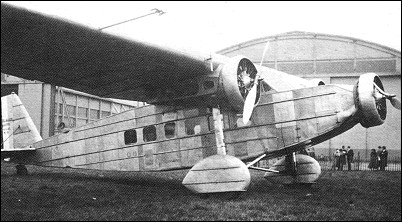
Selected by the French government from competing designs for a transport for colonial duties (passenger, mail and freight, transport and policing) in French overseas territories, the Bloch M.B.120 was a cantilever high-wing monoplane of all-metal construction. The M.B.120.01 prototype was the re-worked M.B.71 monoplane. It was put into service in 1934 on the routes of Air Afrique, a new airline established by the French government, on 11 May 1934, to link various French African territories. Ten series aircraft followed the prototype, six of them for civil use and four in Armee de I’Air service; all served in French Africa. The Air Afrique civil aircraft made scheduled flights between Algiers, Niamey, Fort Lamy, and the French Congo. Two of them connected Tananarive, Madagascar with Broken Hill, South Africa. The four military M.B.120s were joined subsequently by a fifth aircraft, formerly the civil F-APZV. One aircraft (F-ANTK, Ville de Paris) was reported to be in service as late as 1942.
Standard accommodation was for a crew of three and up to 10 passengers. More usually, however, the civil M.B.120s carried four passengers and a substantial load of mail. The general structure and layout of the three-engined M.B.120 was similar to that.of the M.B.200 twin-engined bomber.

M.B.120
Engine: 3 x Lorraine Algol 9Na radial piston engines, 224kW
Take-off weight: 6000 kg / 13228 lb
Loaded weight: 3700 kg / 8157 lb
Wingspan: 20.54 m / 67 ft 5 in
Length: 15.3 m / 50 ft 2 in
Wing area: 61 sq.m / 656.60 sq ft
Max. speed: 260 km/h / 162 mph
Cruise speed: 230 km/h / 143 mph
Ceiling: 6300 m / 20650 ft
Bloch MB.81      

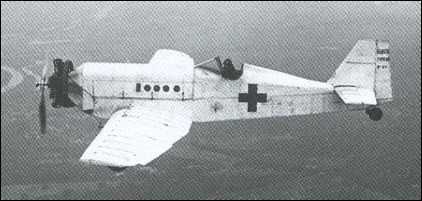
Developed in response to a government-sponsored competition in support of the new doctrine of “aerial first aid”, it was employed exclusively in the overseas colonies, specifically Morocco and Syria. The M.B.80 was followed by the M.B.81.01 coded F.301, which made its initial flight in October 1932, powered by a Salmson 9Nc engine of 101kW.

Unlike the MB.80 prototype, the MB.81 had a closed cockpit and a somewhat larger cargo space. This was the company’s first design which made it out of prototyping.

The aircraft was built without any assistance from the government, but an initial order of 20 was placed by the Ground French Forces (the French Armée de l’Air was founded in 1933), and it was one of the aircraft that relaunched Marcel Bloch in the aeronautical construction industry.

The production MB.81 was fitted with a French Salmson 9Nd of 128.68 kW (175 hp). It took part in military operations in Morocco and in Syria at the beginning of the 1930s.

A production order followed, the first of 20 M.B.81 production aircraft being delivered and entered service in 1935, and was used extensively throughout North Africa and the Middle East. A few were used in 1939-1940, before the French surrender, and in July, 1941 in the battle for Syria between the Vichy French and the British/Free French.

It rendered the greatest services, in particular for the military operations in Morocco and Syria at the beginning of the thirties. A few aircraft were used for the France campaign in 1939-1940 in Africa and the Middle East. One of them was used by the Free French Forces transport group commanded by Colonel Lionel de Marmier in Syria.

The fourth example flew with the RAF under serial AX677.

Bloch M.B.81
Engine: 1 x Salmson 9Nd radial piston engine, 130kW (172.56 hp)
Wingspan: 12.59 m (41 ft 4 in)
Wing Area: 17.8 sq.m / 191.60 sq ft
Length: 8.4 m (27 ft 7 in)
Height: 2.9 m (9 ft 6 in)
Empty weight: 580 kg (1,279 lb)
Max Take-Off Weight: 880 kg / 1940 lb
Maximum speed: 188 km/h (117 mph; 102 kn)
Cruise Speed: 161 km/h / 100 mph
Range: 654 km (406 mi; 353 nmi)
Ceiling: 6400 m / 21000 ft
Crew: 1
Service ceiling: 6,400 m (20,997 ft)
Capacity: 1 seated or stretchered

Bloch MB.80

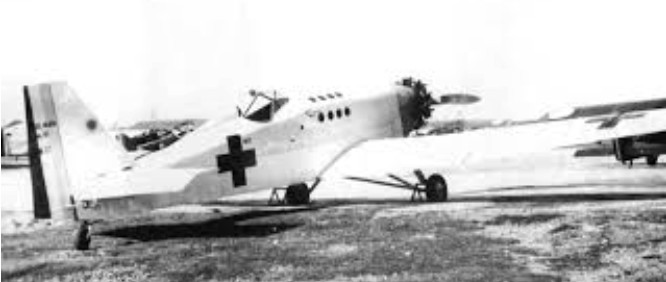
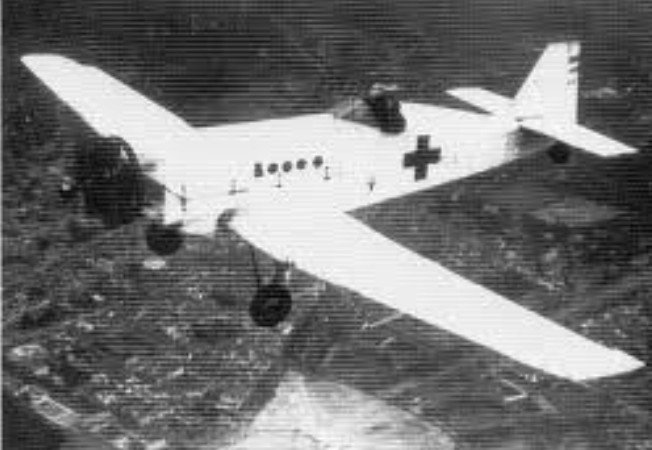
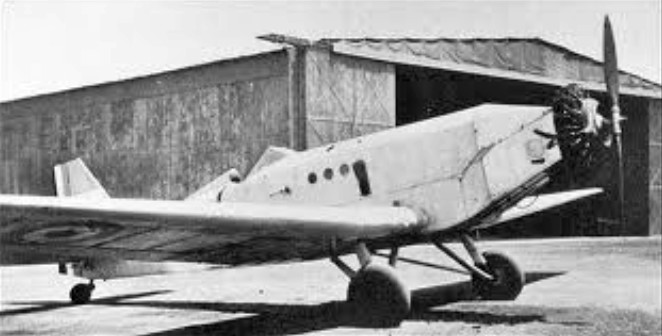
The aircraft was designed to be able to seek patients or casualties by scouting, even at high altitudes, during military operations in mountainous countries, like then-French Morocco over the Atlas Mountains.

The M.B.80 prototype was an angular cantilever low-wing monoplane, powered by a single 89kW Lorraine 5Pc engine, and with fixed wide-track divided landing gear to facilitate operations from unprepared strips. Its pilot was seated forward in an open cockpit and behind him in the rear fuselage, under easily accessible panels, was accommodation for a single stretcher.

The main design feature made it possible to transport a casualty lying prone, in a compartment placed between the pilot and the engine. The wings could also be adapted to hold casualties, remaining constantly under the sight of the pilot and connected to him by an Aviaphone communication system.

The MB.80 made its first flight at the beginning of summer 1932 in Villacoublay, piloted by Zacharie Heu. An all-metal monoplane with low wings, it was equipped with a French Lorraine 5 Pc of 88.24 kW (120 hp) which allowed him to reach a speed of 190 km/h (119 hp) at an altitude of 6,400 meters (21,000 ft). It was able to take off in 70 meters (230 ft) and to land in 95 meters (312 ft). In a 1932 test, the MB.80 carried out 209 landings in one and a half days without any problems.

The aircraft was built without any assistance from the government, but an initial order of 20 was placed by the Ground French Forces (the French Armée de l’Air was founded in 1933), and it was one of the aircraft that relaunched Marcel Bloch in the aeronautical construction industry.

The production model was called the MB.81.

Engine: Lorraine 5 PC, 120 hp
Maximum speed: 190 km/h
Ceiling: 6400 m
Take-off distance: 70 m
Landing distance: 95 m

Bloch

The son of a Jewish doctor, Adolph Bloch, in 1909 Marcel Bloch enrolled in the Paris College of Aeronautics.

During the First World War he set up his own company to make planes which began mass producing just after the war ended. In the 1930s he began building aircraft for the French post office, then the French air ministry.

In 1933 Marcel Bloch established a small factory at Courbevoie, Paris, to build light aircraft. In 1933-34 the company built its first fighter aircraft, the Bloch 130, the first flight of this prototype being made on 29 June 1934. Production Bloch 131s entered service in 1938. Subsequent production included the Bloch 151 /152/155 monoplane fighter, Bloch 175 light bomber, and Bloch MB 200 and MB 210 bomber aircraft. Nationalization of the French aircraft industry in 1937 combined the Bleriot and Bloch companies as Societe Nationale de Constructions Aeronautiques de Sud-Ouest, with Marcel Bloch as managing director.

By June 1940 production totaled about 600, involving five plants. MB.175 twin-engined bomber was in production and was revived after Second World War as torpedo aircraft.

After World War II, although four of the nationalized groups continued operating under state control, private companies were allowed to resume the design and manufacture of both civil and military aircraft. Some of the pioneering names of French aviation, such as Breguet and Morane Saulnier, returned to prominence, and by 1950 a new one had been added Avions Marcel Dassault.

It was not until after World War II that Marcel Bloch, born a Jew, converted to Catholicism and changed his name to Dassault.

The surviving private portion of Bloch became Dassault in 1948.

Bliss Titan

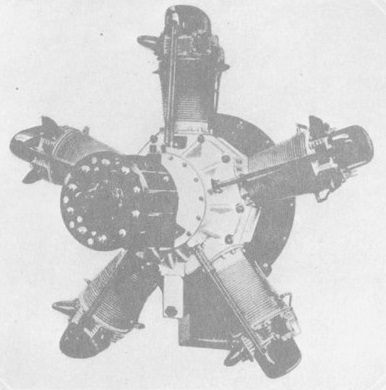
Circa 1920s the Titan major parts are interchangable with the 9 cylinder Jupiter engine. The accessories are grouped at the rear of the engine. An Eclipse starter was available at extra cost.

Type: 5 cyl air-cooled radial
Rating: 225hp at 1800rpm
Displacement: 842 cu.in
Compression ratio: 5-1
Bore: 6.75 in
Stroke: 6.5 in
Weight: 500 lb dry
Fuel consumption: not more than .065 lb/hp/hr
Oil consumption: not more than .0012 lb/hp/hr
Lubrication: Pressure pumps
Ignition: 2 H.T. Magnetos
Carburation: Bristol Triplex
Spark plugs: 1 per cyl K.L.G.

Bliss Jupiter

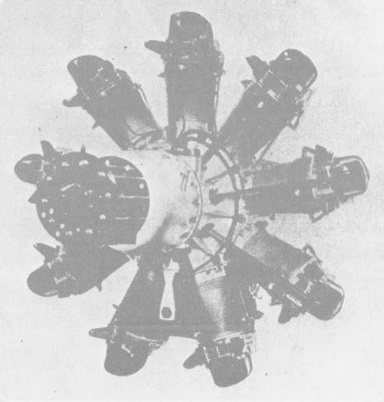
The 1920s Bliss Jupiter featured cylinder barrels of steel, and aluminium heads secured to the barrels by studs and set screws. Invar sleeves were fitted under the nuts to compensate for unequal expansion. The piztons were of cast Y-alloy (Nickel-Aluminium).

The Jupiter was supercharged and a 2-1 epcyclic reduction gear was optional. An Eclipse starter cost extra.

Type: 9 cyl radial, air-cooled (Approved Type Certificate)
Rating: 525hp at 1700rpm
Displacement: 1750 cu.in
Compression ratio: 5-1
Bore: 5.75 in
Stroke: 7.50 in
Diameter: 54.75 in
Weight: 720 lb
Fuel consumption: not more than .50 lb/hp/hr
Oil consumption: not more than .035 lb/hp/hr
Lubrication: Pressure pump, 40 lb/sq.in
Ignition: Dual GE Magneto
Carburation: Bristol Triplex
Spark plugs: 1 per cyl. K.L.G.

Bley M-Condor

The 1935 Bley Flugzeugbau GmbH M-Condor was an experimental monoplane designed by Heini Dittmar at the request of the pilot Peter Riedel.

The 18 hp Kröber engine was mounted on six uprights and was possibly removable.

Based on a Dittmar Condor, (powered by Bley-Flugzeugbau, Namburg a. S.) the first flight was in mid-May 1935.

Engine: Kröber, 18 hp
Wingspan: 17.24 m
Wing area: 13.2 m2
Length: 7.6 m
Height: 2.6 m
Empty weight: 260 kg
MTOW: 350 kg
Seats: 1